Ginger Market to See Strong Growth with CAGR of 5.70% & USD 6.93 Billion by 2034
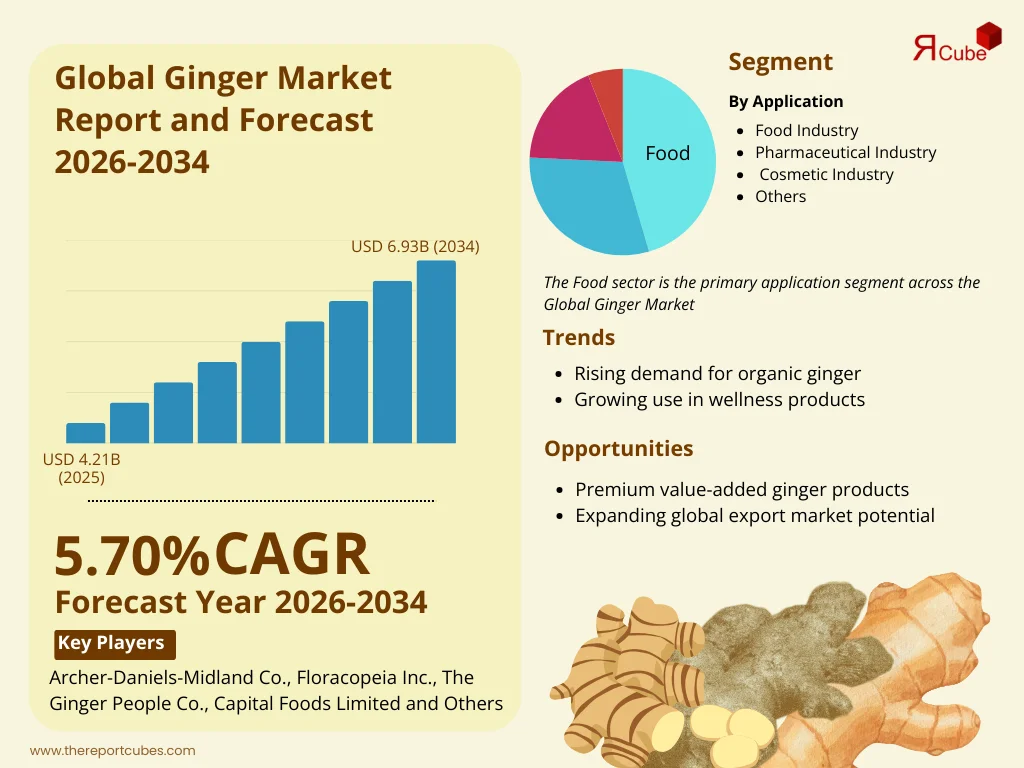
As per the recent research study by The Report Cube, the Ginger Market is predicted to expand gradually between 2026 & 2034, supported by booming global demand for fresh, dried, processed, and organic ginger across food, beverage, nutraceutical, and personal‑care applications. Also, the industry is presumed to register a CAGR of about 5.70% during 2026–2034, being valued at roughly USD 4.21 billion in 2025 & probable to reach nearly USD 6.93 billion by 2034, reflecting the strengthening fundamentals of the Global Ginger Market & increasing downstream worldwide.
Key Dynamics Affecting the Ginger Market
- Rapid global acceptance of ginger in functional foods, beverages, and nutraceuticals considerably boosting demand across retail & foodservice sector, strengthening the long‑term appeal of the ginger industry & boosting product innovation.
- Irregular quality standards, phytosanitary need, and fragmented residue guidelines in importing regions raise compliance complexity & cost, limiting participation for smaller manufacturers & frequently disrupting trade flows within the Global Ginger Market landscape.
- Growing health & wellness awareness, together with rising incidence of lifestyle‑related conditions, booming consumption of ginger‑based teas, shots, supplements, and herbal formulations, supporting market value growth beyond basic culinary use.
- Food & beverage (F&B) producers progressively assimilate ginger into ready meals, bakery, confectionery, plant‑based drinks, and premium condiments, deepening industrial demand & generating additional market opportunities for value‑added processed & organic ginger formats.
- In leading manufacturing countries, government programs & development initiatives that support farmer training, enhanced varieties, irrigation, and post‑harvest infrastructure support upstream resilience & stabilize supply, facilitating in managing volatility in price for ginger & overall ginger cost.
- Rising interest in sustainability, regenerative agriculture, and fair‑trade sourcing encourages exporters & brands to adopt noticeable, certified supply chains, which mend brand equity & support differentiated positioning in mature regional ginger markets like Europe & North America.
- Expanding usage of data‑driven tools & digital platforms in trading & logistics enables better market analysis, inventory optimization, and risk management, enhancing the transparency of ginger statistics & enabling more efficient contracting between growers, traders, and buyers.
- Climate changeability, disease pressure, and land‑use restraints remain major structural challenges, however ongoing investment in improved cultivation practices, disease‑resistant varieties, and regional diversification assists in mitigating supply risk & supporting the projected market size by 2034.
Which of the Segments, Under Type Classification, Influences the Market Share?
Across Type, the Ginger Industry is segmented as:
- Fresh Ginger
- Dried Ginger
- Ginger Powder
- Ginger Paste / Crushed Ginger
- Ginger Oil (Essential Oil)
- Ginger Oleoresin / Extracts
- Value-Added Products
Of the them, Fresh Ginger grabs the foremost share of the Ginger Market, as households, restaurants, and foodservice operators globally depend on the fresh rhizome for flavor, aroma, and perceived health advantages, making it the anchor of farm‑gate trade. Also, Processed Ginger, including dried slices, powder, paste, oils, and oleoresins, is also observed to be developing, supporting shelf‑stable applications, industrial formulations, and international shipments, specifically for organic ginger & tailored ingredient solutions across the Global Ginger Market.
Regional Analysis: Ginger Market
- North America
- Europe
- Asia-Pacific
- Latin America
- The Middle East & Africa
The Asia‑Pacific Ginger Market to flourish, with China & India, dominating the Global Ginger Market, influenced by robust agricultural capacity, diverse processing industries, and tremendous domestic consumption. Also, China stands out within this landscape owing to its large‑scale cultivation, integrated processing clusters, and efficient export infrastructure, enabling it to remain a central supplier to regional & international markets. Also, the global market is affected by its growing foothold across the North America (especially the US Ginger Market) & Europe.
Company Profile: Leading Ginger Market Players
The primary market companies support the progression of the Ginger Industry by offering a wide range of fresh & processed products, evolving branded value‑added lines, and investing in segregated sourcing programs that meet the expectations of retailers, foodservice chains, and industrial buyers. Also, these market players leverage various sales channels, traditional wholesale markets, modern retail, specialty health stores, e‑commerce platforms, and B2B export networks to reach end-users & sustain growth across global landscape.
Some of the major players are: Archer‑Daniels‑Midland Co., Floracopeia Inc., The Ginger People Co., Buderim Ginger Ltd., Capital Foods Limited, NANI Agro Foods Pvt. Ltd., Frontier Co‑op., Monterey Bay Herb Company, Guangxi Yongjiang Food Industry Co., Ltd., Sun Impex International Foods LLC, Indian Organic Farmers Producer Company Limited, The Canadian Ginger Co., Natural Ginger Corp., Spice World, Inc., and others.
Questions Answered in the Ginger Market Research Report
- What is the current market size & future growth forecast underlined in the Ginger Market research report?
- Which major factors are driving the rapid expansion of the Ginger Industry across major regions?
- What emerging trends are restructuring the competitive landscape according to the latest market insights?
- How is consumer / end-user demand evolving, and what impact does it have on the Ginger Market growth?
- Which leading companies are dominating the Ginger Industry, and what strategies are they adopting?
- What technological advancements are influencing product adoption & market penetration?
- How does the report evaluate regional performance & identify high-growth market opportunities?
- What challenges & risks could potentially affect market stability, according to the research findings by the analysts?