South Korea Ice Cream Market to Reach USD 2.8 Billion by 2034, Backed by K-Food Export Surge & Convenience Store Innovation
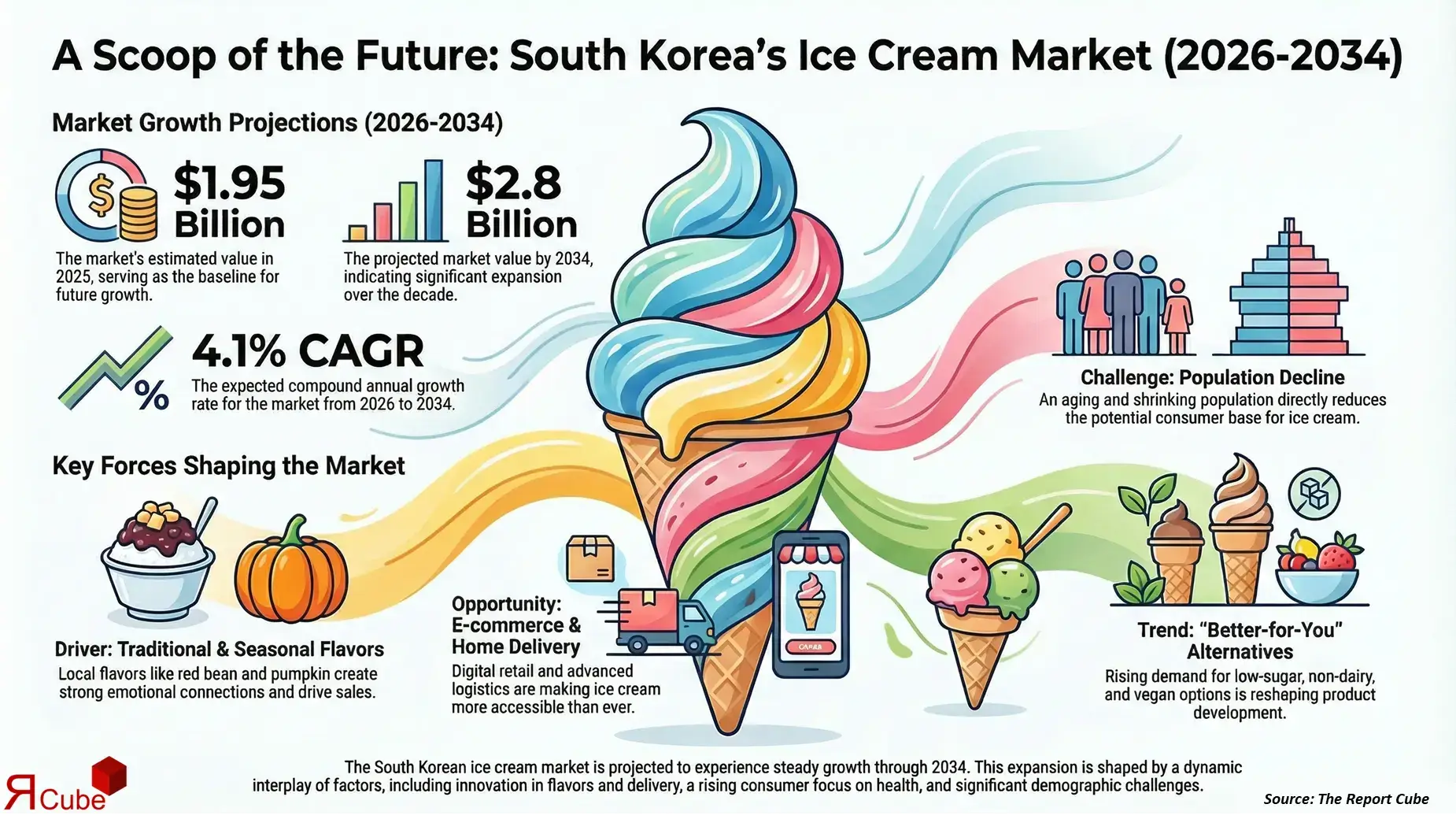
A new study by The Report Cube on the South Korea Ice Cream Market finds a sector caught between two realities: a domestic market that contracted for years and now shows cautious recovery, and an export business that crossed $100 million for the first time. The market was valued at USD 1.95 billion in 2025 and is projected to reach USD 2.8 billion by 2034, growing at a CAGR of 4.10%.
Key Dynamics Affecting the South Korea Ice Cream Market
South Korea crossed into super-aged society status in 2024 - adults aged 65 and over now exceed 20% of the total population. Statistics Korea projects that figure to reach 30.9% by 2036. For ice cream manufacturers, this is a structural constraint, not a temporary dip. The consumer base is not replenishing at the rate it once did, and older consumers buy less impulse ice cream than younger demographics. Any growth over the next decade will come from format innovation, export expansion, or both - not from population tailwinds.
Single-person households hit 36.1% of all South Korean households in 2024, with 8.05 million people living alone. Ice cream brands responded with smaller packs, portion-controlled formats, and individually wrapped novelties calibrated for a one-person fridge. Convenience stores are where this plays out: CU, GS25, and 7-Eleven account for roughly 40% of total ice cream retail value and have become the primary testbed for new formats. When GS25's ice cream sales jumped 31.3% in June 2026 during an early heat wave, it was convenience stores - not supermarkets - doing the heavy lifting.
Korean ice cream exports passed $100 million for the first time last year, with shipments rising a further 14.1% on-year to $49.8 million in the first four months of 2026, according to Korea Customs Service data. The US took more than 40% of exports, followed by China, Canada, the Philippines, and Vietnam. Binggrae's Melona bar now commands about 70% of Korean ice cream's US market share. Overseas sales rose to 21.9% of Binggrae's frozen dessert division revenue in Q1 2026, up from 9.3% in 2020. Lotte Wellfood's exports more than doubled to 29.1 billion won in 2025 from 13.7 billion won in 2021. Binggrae was selected among 145 companies for the government's Global Next K-Food programme in April 2026, giving it access to Ministry of Agriculture international marketing infrastructure across Asia, North America, and Europe.
Need Specific Data, Let’s Customize the Report for You
Request CustomizationWhich of the Segments, Under Category Classification, Influences the Market Share?
Across Category, the South Korea Ice Cream Industry is segmented as:
- Impulse Ice Cream
- Take-Home Ice Cream
- Artisanal Ice Cream
Impulse ice cream holds the largest share at approximately 48% of total market value in 2025. The category runs on convenience store infrastructure - 40% of all ice cream retail value moves through CU, GS25, and 7-Eleven. Novelty collaborations, seasonal releases, and small-format packs for single-person households are all concentrated in this segment. Take-home ice cream holds steady volume among family buyers and is where the health-reformulation story is most visible, with take-home tubs in low-fat and lactose-free variants finding shelf space in hypermarkets and online. Artisanal ice cream is the fastest-growing segment in urban centres, built around experiential consumption and premium ingredient positioning - local fruits, patbingsu-inspired flavours, and alcohol-infused novelties - that can justify higher price points in a market where mainstream pricing is under pressure.
Company Profile: Leading South Korea Ice Cream Market Players
The domestic landscape is concentrated. Three players - Lotte Confectionery, Binggrae, and Nongshim - account for most of domestic production volume, and their combined brand portfolios cover every channel from convenience stores to hypermarkets. Competition is not primarily on price at the top end; it runs on format innovation, brand collaboration velocity, and the ability to move products through convenience store networks fast enough to capture impulse decisions before novelty fades.
Binggrae is the company to watch on international expansion. Its Melona bar - introduced in 1992 - now holds around 70% of Korean ice cream's US market share and generated sales that pushed Binggrae's international revenue share from 9.3% of frozen dessert sales in 2020 to 21.9% in Q1 2026. Melona launched a dairy-free oat milk version in Canada. Samanco, the fish-shaped red bean ice cream sandwich, debuted in Europe at ANUGA 2025 in Cologne, with listings in Carrefour Poland, Netto Germany, and mainstream French retailers. The brand is expanding through both Asian grocery chains and mainstream European supermarkets - a dual-channel approach that competitors haven't replicated at the same scale.
Key players include: Binggrae Co. Ltd., Lotte Confectionery Co. Ltd. (Lotte Wellfood), Haitai Confectionery & Foods Co. Ltd., BR Korea (Baskin-Robbins), Unilever Plc, General Mills Inc., Nongshim, Coo & Coo, Hanwha Galleria (Benson), and Others.
Questions Answered in the South Korea Ice Cream Market Research Report
- What is the current market size & future growth forecast underlined in the South Korea Ice Cream Market research report?
- Which major factors are driving the rapid expansion of the South Korea Ice Cream Industry across major regions?
- What emerging trends are restructuring the competitive landscape according to the latest market insights?
- How is consumer demand evolving, and what impact does it have on the South Korea Ice Cream Market growth?
- Which leading companies are dominating the South Korea Ice Cream Industry, and what strategies are they adopting?
- What technological advancements are influencing product adoption & market penetration?
- How does the report evaluate regional performance & identify high-growth market opportunities?
- What challenges & risks could potentially affect market stability, according to the research findings by the analysts?