Thailand Healthcare Infrastructure Market to Witness Robust Expansion with CAGR of 6.25% & USD 21.57B by 2034
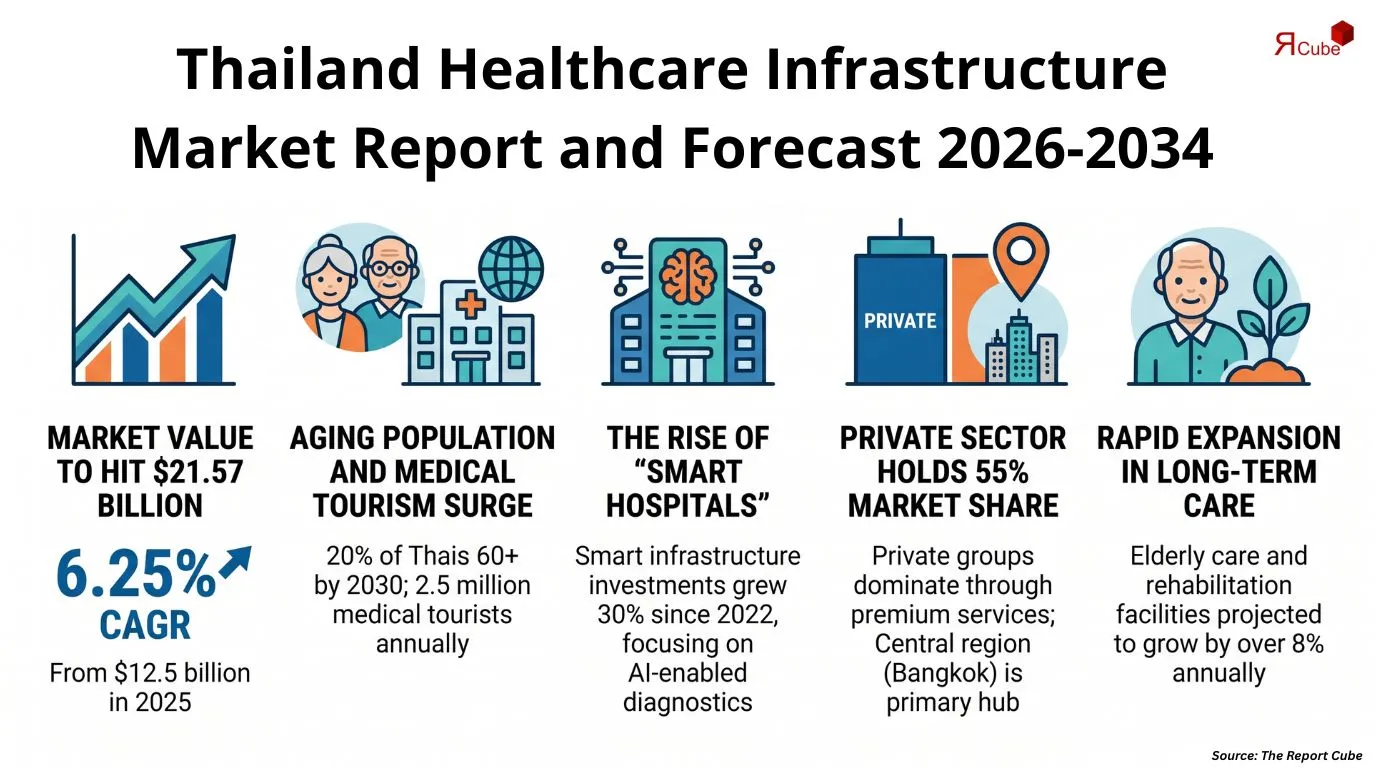
In line with the latest research studies by The Report Cube, the Thailand Healthcare Infrastructure Market Research Report underpins that the industry is set for considerable growth, during 2026–2034, supported by growing healthcare investments, augmented digital health adoption, and development of hospital infrastructure across the nation. Moreover, the industry is predicted to record a CAGR of around 6.25% during 2026–2034, valued at roughly USD 12.5 billion in 2025, and estimated to reach nearly USD 21.57 billion by 2034.
Thailand’s healthcare ecosystem is experiencing a structural revolution instigated by government-backed universal healthcare coverage, private hospital growth, increasing medical tourism inflows, and expanding demand for technologically advanced medical facilities. Also, constant investments in hospital digitization, smart medical equipment, and interoperable healthcare systems are further solidifying the nation’s healthcare infrastructure outlook
Key Dynamics Affecting the Thailand Healthcare Infrastructure Market
- Swift digitalization of hospitals & rising adoption of Electronic Health Records (EHRs) in Thailand substantially improve demand for interoperable healthcare systems & connected medical infrastructure.
- Growing healthcare expenditures, together with government initiatives to advance public hospitals & boost Public–Private Partnerships (PPPs), augment infrastructure progression nationwide.
- Increasing occurrence of chronic diseases, aging population trends, and intensifying home-based care models elevate the requirement for advanced hospitals, long-term care facilities, and remote patient monitoring infrastructure.
- Hospitals across Thailand progressively assimilate smart medical devices, cloud-based platforms, and interoperable data gateways to enhance patient safety, clinical efficiency, and operational workflows.
- The country’s robust medical tourism sector forces private healthcare providers to unceasingly modernize hospital facilities, accept digital technologies, and expand specialty care infrastructure.
- Progressions in AI-enabled diagnostics, automation, predictive analytics, and smart hospital solutions improve care delivery, optimize resource application, and support data-driven decision-making in healthcare facilities.
Which of the segments, under Market Structure Classification, influences the Market Share?
Across the Market Structure, the Thailand Healthcare Infrastructure Industry is segmented as:
- Public Sector
- Private Sector
- PPP Models
Among them all, the Private Sector captures the dominant market share of about 55% in 2025, supported by Thailand’s solid network of private hospitals, constant capacity growth, and big investments in advanced infrastructure & digital healthcare technologies. Moreover, private hospitals emphasize specialized care, smart hospital frameworks, and international patient services, making them a major contributor to infrastructure development. In addition, PPP models are also gaining traction as the government join forces with private players to modernize public healthcare facilities proficiently.
Regional Coverage: Thailand Healthcare Infrastructure Market
- Central
- Northern
- Northeastern
- Eastern
- Western
- Southern
Geographically, Central Thailand, commanded by Bangkok and its surrounding provinces, leads the Healthcare Infrastructure Market in Thailand. The region aids from a high concentration of tertiary care hospitals, advanced medical facilities, a strong private healthcare presence, and substantial medical tourism activity. Also, continuous investments in hospital development, specialty centers, and smart healthcare solutions strengthen Central Thailand’s leadership across the national healthcare infrastructure landscape, further enhancing the market size.
Company Profile: Leading Thailand Healthcare Infrastructure Market Players
Prominent market players play a crucial role in solidifying Thailand’s healthcare infrastructure via hospital growth, technology adoption, integrated care platforms, and high-quality clinical services. Also, key market companies operating across the market include Bangkok Dusit Medical Services (BDMS), Bumrungrad International Hospital, Samitivej Hospital Group, Thonburi Healthcare Group, MedPark Hospital, Phyathai Hospital Group, Paolo Hospital Group, Ramkhamhaeng Hospital, BNH Hospital, Yanhee Hospital, and others.
Bangkok Dusit Medical Services (BDMS) stands out as a noticeable innovator across the Thailand Healthcare Infrastructure Industry. Also, the firm continues to support hospital networks via advanced digital platforms, integrated healthcare systems, and investments in smart hospital technologies, strengthening Thailand’s position as a regional healthcare hub.
Questions Answered in the Thailand Healthcare Infrastructure Market Research Report
- What is the current market size & future growth forecast underlined in the Thailand Healthcare Infrastructure Market research report?
- Which major factors are driving the rapid expansion of the Thailand Healthcare Infrastructure Industry across major regions?
- What emerging trends are restructuring the competitive landscape according to the latest market insights?
- How is consumer / end-user demand evolving, and what impact does it have on the Thailand Healthcare Infrastructure Market growth?
- Which leading companies are dominating the Thailand Healthcare Infrastructure Industry, and what strategies are they adopting?
- What technological advancements are influencing product adoption & market penetration?
- How does the report evaluate regional performance & identify high-growth market opportunities?
- What challenges & risks could potentially affect market stability, according to the research findings by the analysts?