Vietnam Aquaculture Feed Market to Reach USD 5.56 Billion by 2034, Driven by RAS Expansion, Antibiotic-Free Compliance & Alternative Protein Investment
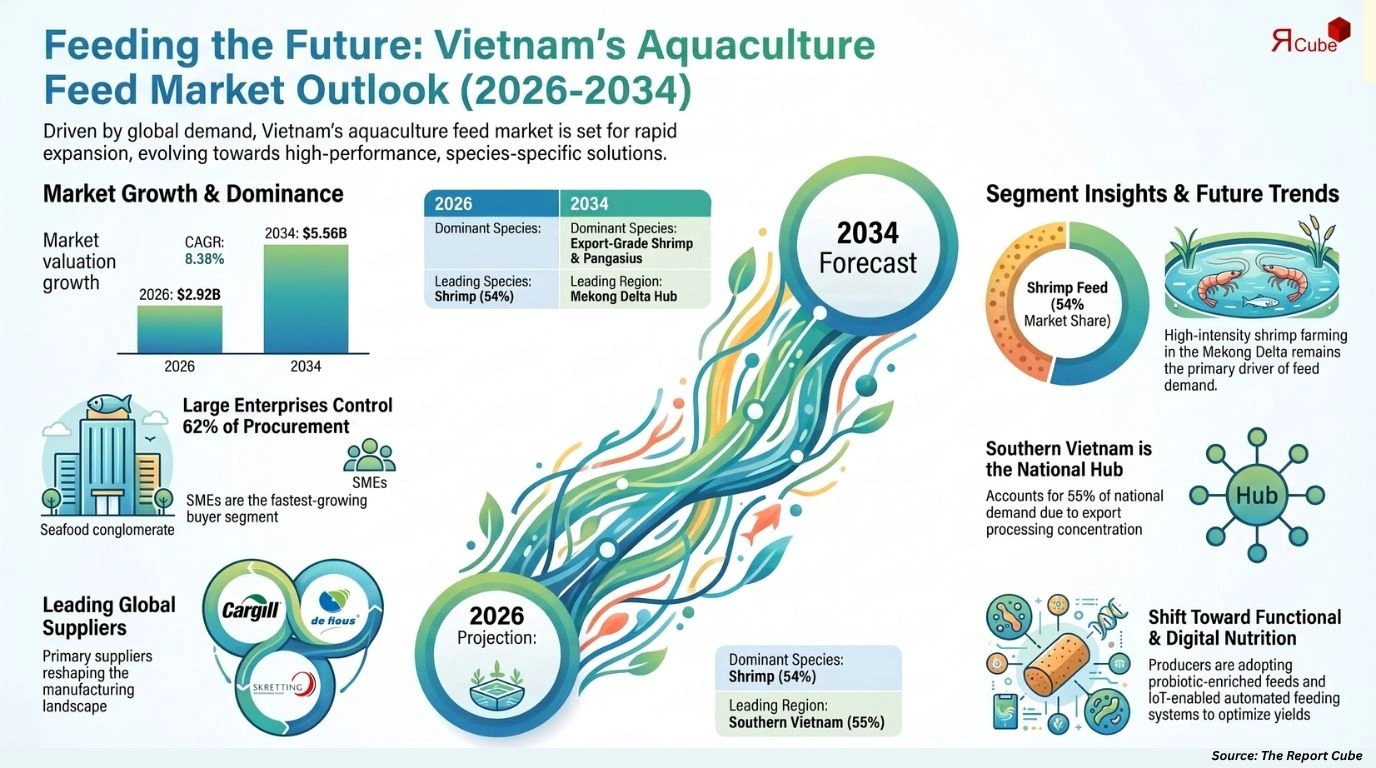
A new study by The Report Cube on the Vietnam Aquaculture Feed Market shows the sector consolidating around a clear structural shift: export revenue growth is pushing farms toward higher-specification feeds while tightening international residue standards make the old feed-and-antibiotic model commercially risky. The market was valued at USD 2.92 billion in 2026, is projected to grow at a CAGR of 8.38%, and is expected to reach USD 5.56 billion by 2034.
Key Dynamics Affecting the Vietnam Aquaculture Feed Market
Vietnam's seafood exports reached USD 11.34 billion in 2025 - up 13% year on year - with shrimp accounting for USD 4.65 billion and pangasius for USD 2.2 billion. These two species together pull the feed market. When export prices hold and volume targets rise, farmers go up the feed quality curve; when margins compress, they downgrade. The feed market's ceiling is set by how well Vietnam's aquaculture sector defends its position in the US, EU, China, and Japan simultaneously - and that is getting harder.
Feed represents 50–60% of total production costs for a shrimp or pangasius farm. That concentration means farmers scrutinize feed conversion ratios closely, which is why the shift from pelleted to extruded formulations - which hold together in water longer, reducing waste - is happening even though extruded feed costs more. Pelleted feed still leads at roughly 46% of the market in 2025, but the premium-formulation segment is where margin expansion lives for manufacturers.
Super-intensive shrimp farming using Recirculating Aquaculture Systems reached stocking densities of 800–1,200 post-larvae per square meter in 2024. Traditional extensive farms run at 10–15. RAS requires feed with higher protein content and enhanced digestibility - a different specification than the commodity pellets that dominate general trade. For manufacturers that can meet this spec, it is one of the cleaner pricing-power opportunities in the market. Tepbac's IoT monitoring platform now tracks over 1,500 shrimp farms, using precision-feeding algorithms to reduce feed waste and compress conversion ratios.
The EU's full ban on antimicrobials used in human medicine or as growth stimulants in aquatic products takes effect September 2026. The European Rapid Alert System for Food and Feed recorded 26 notifications for drug-residue detections in seafood in the first ten months of 2025 alone. US importers are separately requiring verified antibiotic-free supplier certifications following the Marine Mammal Protection Act tightening effective January 2026. For feed manufacturers, this means functional and probiotic-enhanced formulations - which support disease resistance without antibiotics - are no longer a niche; they are a procurement prerequisite for farms targeting these markets.
Need Specific Data, Let’s Customize the Report for You
Request CustomizationWhich of the Segments, Under Species Classification, Influences the Market Share?
Across Species, the Vietnam Aquaculture Feed Industry is segmented as:
- White-Leg Shrimp (Litopenaeus vannamei)
- Giant Tiger Prawn (Penaeus monodon)
- Pangasius
- Carp
- Catfish
- Tilapia
- Other Species
White-leg shrimp holds the largest feed share by species at approximately 46.5% in 2025. It is the dominant export species, the primary driver of intensive farming investment, and the species most exposed to antibiotic compliance pressure - which in practice means it is also the category where functional and premium feed formulation uptake is highest. The spec requirements differ by farming system: RAS farms need higher protein density and digestibility than pond systems, which is creating a two-tier market within white-leg shrimp feed alone.
Tilapia is the fastest-growing segment, projected at a 10.9% CAGR through 2031. It is a domestically consumed species and a growing export product - less exposed to the EU yellow card or MMPA complications than shrimp and pangasius, which makes it a lower-risk category for farm expansion. Feed demand for tilapia correlates directly with the trajectory of domestic aquaculture intensification in northern and central provinces.
Regional Analysis: Vietnam Aquaculture Feed Market
- Southern Vietnam
- Northern Vietnam
- Central Vietnam
Southern Vietnam holds approximately 55% of national feed demand. The Mekong Delta - covering provinces including Ca Mau, Bac Lieu, Soc Trang, and An Giang - is the production center for both shrimp and pangasius at scale. It is where RAS adoption is highest, where integrated processor-farmers with long-term supply contracts operate, and where the premium compound feed volumes move. Northern Vietnam at around 25% is growing steadily, carried by expanding freshwater fish cultivation in Quang Ninh, Hai Phong, and the Red River Delta, alongside growing government aquaculture zone investment. Central Vietnam's 20% share is growing faster than its current size suggests - intensive shrimp pond expansion and marine finfish cage culture along the coast from Nghe An through Khanh Hoa are drawing in specialized functional feed suppliers responding to higher disease pressure in that farming environment.
Company Profile: Leading Vietnam Aquaculture Feed Market Players
The competitive structure in Vietnam aquaculture feed has global multinationals occupying premium formulation and integrated supply positions, with regional players competing on price and distribution depth. Long-term supply agreements with export-oriented processors are the primary route to volume stability. Skretting Vietnam (Nutreco N.V.) has built its position around high-specification shrimp and pangasius formulations, supplying integrated conglomerates under contract. Cargill competes across both premium and mid-tier segments. De Heus Animal Nutrition B.V., after commissioning its Vinh Long marine R&D center in 2024, is signaling an intent to compete more aggressively on specification rather than cost alone. For any manufacturer without verifiable antibiotic-free certification and traceable supply chains, the addressable market is narrowing: farms targeting EU, US, and Japanese buyers are not in a position to source from suppliers that create compliance exposure.
Key players include: Cargill Inc., Skretting Vietnam (Nutreco N.V.), Charoen Pokphand Group, De Heus Animal Nutrition B.V., Grobest Industrial Co. Ltd. (Grobest Group), Tongwei Co. Ltd., Alltech Inc., Lallemand Inc., INVE Aquaculture Inc. (Benchmark Holdings Plc), GreenFeed Vietnam Corp., Uni-President Vietnam Co. Ltd., and Others.
Questions Answered in the Vietnam Aquaculture Feed Market Research Report
- What is the current market size & future growth forecast underlined in the Vietnam Aquaculture Feed Market research report?
- Which major factors are driving the rapid expansion of the Vietnam Aquaculture Feed Industry across major regions?
- What emerging trends are restructuring the competitive landscape according to the latest market insights?
- How is consumer demand evolving, and what impact does it have on the Vietnam Aquaculture Feed Market growth?
- Which leading companies are dominating the Vietnam Aquaculture Feed Industry, and what strategies are they adopting?
- What technological advancements are influencing product adoption & market penetration?
- How does the report evaluate regional performance & identify high-growth market opportunities?
- What challenges & risks could potentially affect market stability, according to the research findings by the analysts?