



Build Your Custom Market Intelligence Report
Customize Your ReportAustralia Aerospace Parts Manufacturing Market Insights & Analysis
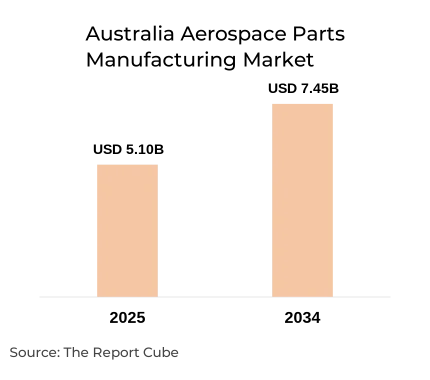
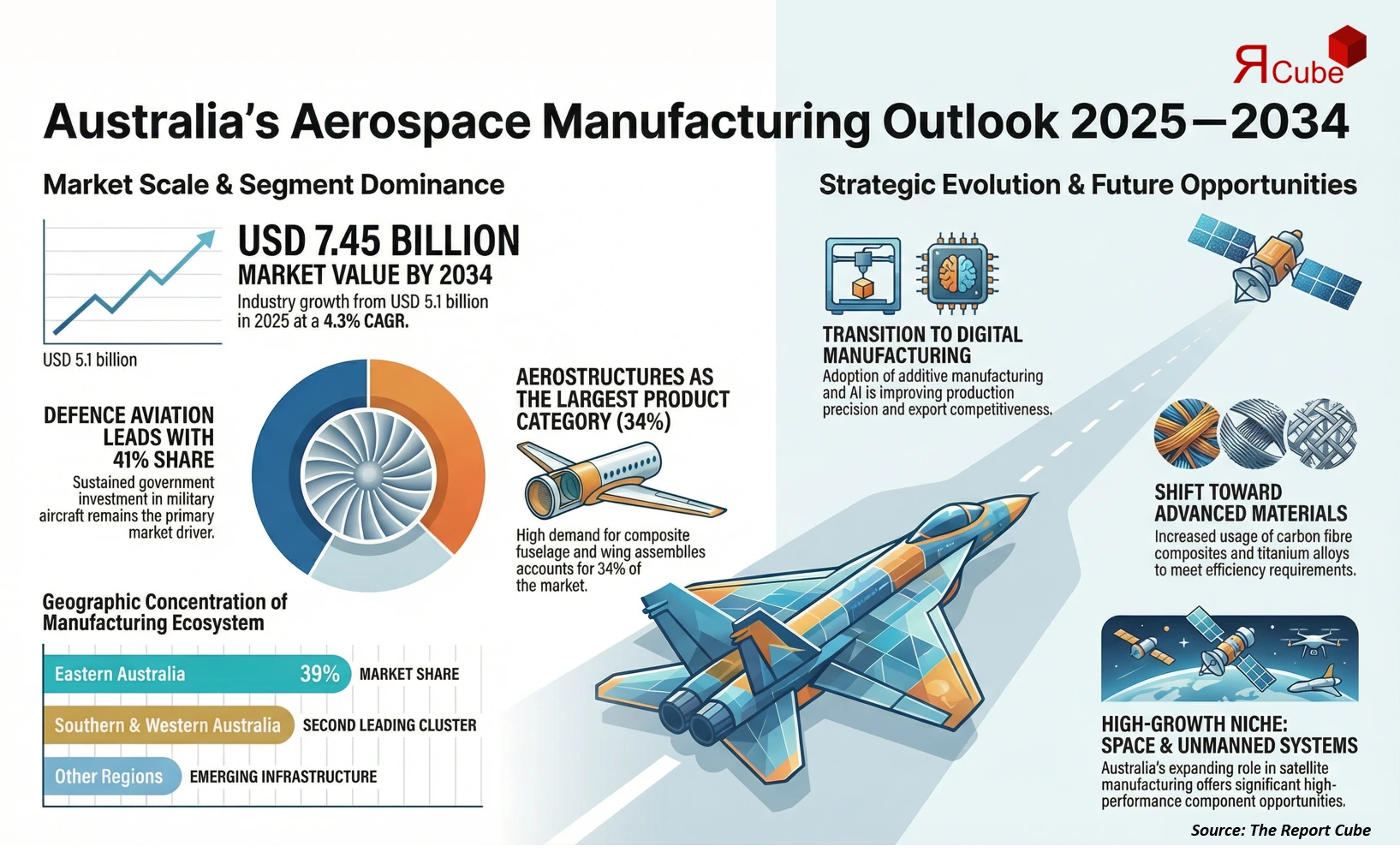
The Australia Aerospace Parts Manufacturing Market is anticipated to register a CAGR of 4.3% during the forecast period 2026-2034. The market size was valued at USD 5.1 billion in 2025 and is projected to reach USD 7.45 billion by 2034. This steady growth reflects Australia’s strengthening position within the global aerospace supply chain, supported by rising defense expenditure, increasing commercial aircraft maintenance demand, and expanding participation in advanced aerospace programs.
Australia has emerged as a strategic manufacturing hub for aerospace components due to its skilled workforce, strong regulatory framework, and close defense collaboration with allied nations. The country’s aerospace manufacturing ecosystem benefits from long-term contracts with global OEMs and tier-1 suppliers, ensuring consistent demand for high-precision components. As aircraft fleets operating in the Asia-Pacific region continue to expand, the need for locally manufactured and certified aerospace parts has grown steadily.
Furthermore, increased investment in sovereign defense capabilities and space-related programs is accelerating domestic manufacturing of critical aerospace components. The integration of advanced materials, digital manufacturing, and automation across production facilities is improving efficiency and export competitiveness. These interconnected factors collectively reinforce the long-term outlook for the Australia Aerospace Parts Manufacturing Market through 2034.
Australia Aerospace Parts Manufacturing Market Recent Developments
- 2025: Quickstep Holdings expanded composite aerostructure production capacity to support next-generation defense aircraft programs.
- 2025: BAE Systems Australia increased local sourcing of avionics and structural components under long-term defense contracts.
Government Initiatives & Policies
- Defence Industry Development Strategy: Supports domestic aerospace manufacturing and sovereign industrial capability.
- Australian Space Strategy: Encourages advanced manufacturing for aerospace and space systems.
Australia Aerospace Parts Manufacturing Market Dynamics
Key Driver: Rising Defence Aviation Spending and Local Manufacturing Focus
The primary driver of the Australia Aerospace Parts Manufacturing Market is the sustained rise in defense aviation spending coupled with a strong policy focus on local manufacturing. Australia’s defense budget allocation toward air combat, surveillance, and support aircraft has increased consistently, driving demand for domestically produced aerospace parts. Local manufacturing reduces supply chain risks, improves fleet readiness, and aligns with national security objectives. Defense aviation programs increasingly mandate local content requirements, benefiting manufacturers of engine components, aerostructures, and avionics. This demand is further reinforced by long-term maintenance, repair, and overhaul contracts that ensure recurring revenue streams. As defense platforms remain in service for decades, the need for reliable and certified parts continues to support market expansion.
Industry Trends: Adoption of Advanced Materials and Digital Manufacturing
A key trend shaping the market is the widespread adoption of advanced materials and digital manufacturing technologies. Australian manufacturers are increasingly utilizing carbon fiber composites, titanium alloys, and lightweight insulation materials to meet evolving aircraft performance and efficiency requirements. At the same time, digital tools such as additive manufacturing, automated machining, and predictive quality systems are improving production precision and reducing lead times. These technologies enable manufacturers to handle complex geometries and low-volume, high-value components efficiently. The integration of digital twins and data-driven production planning is also enhancing compliance with strict aerospace certification standards. This trend not only improves competitiveness but also positions Australia as a preferred supplier for global aerospace programs.
Major Challenge: High Certification and Compliance Requirements
Stringent certification and regulatory compliance requirements present a major challenge for aerospace parts manufacturers in Australia. Aerospace components must meet rigorous international safety and quality standards, requiring significant investment in testing, documentation, and skilled personnel. For smaller manufacturers, the cost and time associated with certification can limit scalability and delay market entry. Additionally, maintaining compliance across multiple export markets adds operational complexity. These challenges can constrain short-term growth, particularly for new entrants, even as long-term demand fundamentals remain favorable.
Opportunity: Growth in Space Systems and Unmanned Platforms
The rapid development of space systems and unmanned platforms offers a strong growth opportunity for the Australia Aerospace Parts Manufacturing Market. Australia’s expanding role in satellite manufacturing, launch support, and unmanned aerial systems is creating demand for specialized aerospace components. These platforms require lightweight structures, advanced avionics, and high-performance insulation materials, aligning well with domestic manufacturing capabilities. Government-backed space initiatives and private sector investments are accelerating this trend. As space and unmanned systems move from experimental to commercial scale, component manufacturing is expected to emerge as a high-growth niche within the broader aerospace ecosystem.
Australia Aerospace Parts Manufacturing Market Segment-wise Analysis
By Product:
- Engine Parts
- Aerostructures
- Cabin Interiors
- Avionics
- Insulation Parts
Aerostructures dominate the product segment, accounting for approximately 34% of the market share in 2025. This leadership is driven by strong demand for composite fuselage sections, wings, and structural assemblies used in both commercial and defense aircraft. Engine Parts follow, supported by ongoing fleet maintenance and upgrade programs. Avionics and cabin interiors are witnessing steady growth due to modernization and retrofitting activities. Insulation parts, while smaller in share, are gaining importance as aircraft manufacturers prioritize thermal efficiency and noise reduction, highlighting a balanced demand across product categories.
By End Use:
- Commercial Aviation
- Defence Aviation
- Business Aviation
- Unmanned Systems
- Space Systems
Defence Aviation leads the end-use segment with nearly 41% market share, reflecting sustained government investment in military aircraft and long-term sustainment programs. Commercial Aviation follows, driven by rising regional air traffic and increasing maintenance demand for in-service fleets. Business Aviation contributes a stable share, supported by corporate and charter aircraft operations. Unmanned Systems and Space Systems, though currently smaller, represent high-growth segments as Australia expands its presence in advanced aerospace applications. Together, these end-use segments create a diversified and resilient demand profile.
Regional Projection of Australia Aerospace Parts Manufacturing Industry
- Eastern
- Southern
- Northern
- Western
- Central
The Eastern region leads the Australia Aerospace Parts Manufacturing Market, holding approximately 39% market share. This dominance is attributed to the concentration of aerospace manufacturing facilities, skilled labor, and proximity to major defense and commercial aviation hubs. Southern and Western regions follow, supported by specialized manufacturing clusters and strong defense presence. The Eastern region’s leadership is further strengthened by research institutions and established supply chains, enabling efficient collaboration between OEMs and component manufacturers. As regional infrastructure continues to improve, other regions are expected to gradually increase their contribution to the national market.
Why Choose This Report?
- Provides a comprehensive overview of the overall market analysis, encompassing key trends, consumer behavior analysis, and risk assessment to support strategic decision-making.
- Provides accurate, up-to-date insights into market size, segmentation, and emerging opportunities, helping to minimize risk & capitalizing on growth.
- Gives deep understanding of target audience preferences, investment habits, and communication channels for enhanced product development & marketing effectiveness.
- Delivers competitive analysis & benchmarking, uncovering the strengths & weaknesses of market competitors to guide strategies.
- Consolidate comprehensive market intelligence, reducing reasoning & streamlining research efforts.
- Facilitates customized market segmentation & risk mitigation strategies, fine-tuned to the business objectives.
- Aids in identifying both market challenges & untapped opportunities within the industry to drive long-term business growth.
- Provides valuable information based on actual customer data & search trends.
Table of Contents
- Introduction
- Objective of the Study
- Product and Category Definition
- Market Segmentation
- Study Variables
- Research Methodology
- Secondary Data Points
- Breakdown of Secondary Sources
- Primary Data Points
- Breakdown of Primary Interviews
- Secondary Data Points
- Executive Summary
- Market Dynamics
- Drivers
- Challenges
- Opportunity Assessment
- Recent Trends and Developments
- Regulatory and Policy Landscape
- Australia Aerospace Parts Manufacturing Market Overview (2021-2034)
- Market Size, By Value (USD Million)
- Market Share, By Product
- Engine Parts
- Aerostructures
- Cabin Interiors
- Avionics
- Insulation Parts
- Market Share, By End Use
- Commercial Aviation
- Defence Aviation
- Business Aviation
- Unmanned Systems
- Space Systems
- Market Share, By Material
- Aluminium Alloys
- Composite Materials
- Titanium Alloys
- Steel Alloys
- Specialty Alloys
- Market Share, By Process
- CNC Machining
- Additive Manufacturing
- Casting Processes
- Forging Processes
- Sheet Fabrication
- Market Share, By Region
- Eastern
- Southern
- Northern
- Western
- Central
- Market Share, By Company
- Revenue Shares
- Competition Characteristics
- Revenue Shares & Analysis
- Eastern Australia Aerospace Parts Market
- Market Size, By Value (USD Million)
- Market Share, By Product
- Market Share, By End Use
- Market Share, By Material
- Market Share, By Process
- Market Share, By Key State
- New South Wales
- Queensland
- Australian Capital Territory
- Southern Australia Aerospace Parts Market
- Market Size, By Value (USD Million)
- Market Share, By Product
- Market Share, By End Use
- Market Share, By Material
- Market Share, By Process
- Market Share, By Key State
- Victoria
- South Australia
- Tasmania
- Northern & Western Australia Aerospace Parts Market
- Market Size, By Value (USD Million)
- Market Share, By Product
- Market Share, By End Use
- Market Share, By Material
- Market Share, By Process
- Market Share, By Key State
- Western Australia
- Northern Territory
- Competitive Outlook and Company Profiles
- Boeing Australia
- Company Overview
- Product Portfolio
- Strategic Alliances/Partnerships
- Recent Developments
- BAE Systems Australia
- Company Overview
- Product Portfolio
- Strategic Alliances/Partnerships
- Recent Developments
- Airbus Australia Pacific
- Company Overview
- Product Portfolio
- Strategic Alliances/Partnerships
- Recent Developments
- Lockheed Martin Australia
- Company Overview
- Product Portfolio
- Strategic Alliances/Partnerships
- Recent Developments
- Quickstep Holdings
- Company Overview
- Product Portfolio
- Strategic Alliances/Partnerships
- Recent Developments
- Rosebank Engineering
- Company Overview
- Product Portfolio
- Strategic Alliances/Partnerships
- Recent Developments
- TAE Aerospace
- Company Overview
- Product Portfolio
- Strategic Alliances/Partnerships
- Recent Developments
- ACS Australia
- Company Overview
- Product Portfolio
- Strategic Alliances/Partnerships
- Recent Developments
- Stärke AMG
- Company Overview
- Product Portfolio
- Strategic Alliances/Partnerships
- Recent Developments
- Avalon Technologies
- Company Overview
- Product Portfolio
- Strategic Alliances/Partnerships
- Recent Developments
- Others
- Boeing Australia
- Contact Us and Disclaimer
Top Key Players & Market Share Outlook
- Boeing Australia
- BAE Systems Australia
- Airbus Australia Pacific
- Lockheed Martin Australia
- Quickstep Holdings
- Rosebank Engineering
- TAE Aerospace
- ACS Australia
- Stärke AMG
- Avalon Technologies
- Others
Frequently Asked Questions






