


Build Your Custom Market Intelligence Report
Customize Your ReportKey Highlights
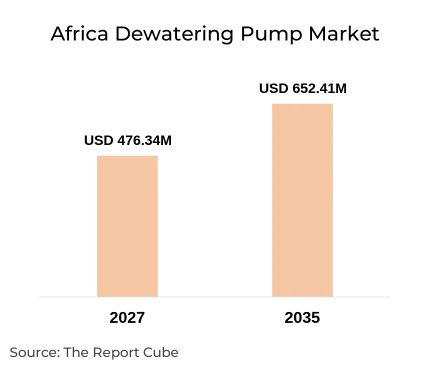
- Africa Dewatering Pump Market size is valued at USD 476.34 million in 2027 and is forecast to reach USD 652.41 million by 2035.
- The supplied forecast implies a CAGR of 4.01% during 2027–2035; this is retained as provided.
- The base year is 2026, with the supplied historical period 2022–2026 and forecast period 2027–2035.
- The input identifies 4 segmentation dimensions; all supplied subsegments are retained in the segment analysis.
- The supplied leading-segment shares are analyst estimates, not independently verified public market statistics.
- The market's demand profile is shaped by: Dewatering pumps remove groundwater, stormwater, process water and slurry from mines, construction sites, quarries and municipal works. Product selection depends on flow, head, solids handli
- Regional revenue shares, competitor rankings and company market shares are not assigned without comparable primary evidence.
Market Outlook
Dewatering pumps remove groundwater, stormwater, process water and slurry from mines, construction sites, quarries and municipal works. Product selection depends on flow, head, solids handling, corrosion, portability, energy source and maintenance access rather than a single continent-wide specification. The market.
The commercial structure of the Africa Dewatering Pump Market varies across national markets and end-user groups. Buyers assess availability, quality assurance, operating cost, delivery reliability and suitability for local conditions. Suppliers compete through product performance, service networks, technical support, regulatory.
Forecast interpretation should therefore separate three evidence layers: supplied market estimates, official sector indicators and qualitative market analysis. Official sources can validate the operating environment, but they do not independently validate the supplied market valuation. The report does not treat.
Government Regulations
Regulatory obligations arise from electrical and machinery safety, occupational health, mine safety, environmental discharge permits, water abstraction rules and site-specific standards. Mining operations may require equipment suitable for hazardous locations and documented maintenance controls. Pump suppliers must verify country-specific conformity.
Africa Dewatering Pump Market Dynamics
Market dynamics reflect the interaction of end-user demand, procurement cycles, infrastructure readiness, affordability and regulatory requirements. The strongest growth signals are not necessarily the same as the largest current revenue pools: a fast-growing application may start from a small base.
| Factor | Type | Specific Impact on Market | Magnitude |
|---|---|---|---|
| Structural demand | Driver | Recurring or project-linked need supports baseline demand, depending on the market's operating cycle. | High relevance |
| Technology and service improvement | Driver | Better performance, reliability, convenience or digital workflow integration can improve adoption. | Medium–High relevance |
| Local capability and distribution | Opportunity | Local service, assembly, partnerships and channel reach can reduce delivery friction. | Medium–High relevance |
| Regulatory alignment | Opportunity | Clearer standards and predictable approvals can improve procurement confidence. | Medium relevance |
| Affordability and financing | Challenge | Budget constraints, foreign exchange and payment delays can defer purchases or restrict coverage. | High relevance |
| Infrastructure and skills gaps | Challenge | Power, logistics, connectivity, trained staff and maintenance capacity can limit deployment. | High relevance |
The driver entries identify the demand foundations: Structural demand (Recurring or project-linked need supports baseline demand, depending on the market's operating cycle.); Technology and service improvement (Better performance, reliability, convenience or digital workflow integration can improve adoption.). The opportunity entries point to areas where suppliers may improve adoption or access: Local capability and distribution (Local service, assembly, partnerships and channel reach can reduce delivery friction.); Regulatory alignment (Clearer standards and predictable approvals can improve procurement confidence.). The challenge entries show constraints that may delay purchasing or deployment: Affordability and financing (Budget constraints, foreign exchange and payment delays can defer purchases or restrict coverage.); Infrastructure and skills gaps (Power, logistics, connectivity, trained staff and maintenance capacity can limit deployment.). The magnitude labels are qualitative assessments from this report framework, not measured market shares or independently quantified impact values.
Growth Drivers
Demand growth is supported by the underlying activity that creates the need for africa dewatering pump market. This may be corporate outsourcing demand, healthcare delivery, industrial and mining projects, transport electrification, trade flows or offshore development, depending on the market..
Need Specific Data, Let’s Customize the Report for You
Request CustomizationMarket Opportunities
Opportunities are associated with mine-water management, construction-site drainage, municipal water projects, flood response and industrial wastewater handling. Suppliers with rugged equipment, local service teams, spare-parts availability, rental options and energy-efficient pump systems may be better positioned to address varied operating conditions.
Opportunity Assessment
Commercial potential should be assessed by customer economics, procurement access, distribution reach, product performance and local service capability. The supplied market forecast indicates the expected direction and scale of the market under the provided assumptions; it does not by itself establish the addressable opportunity for every supplier. Companies should validate country-level demand, purchasing power, import requirements and channel economics before committing capacity.
Industry Challenges
Demand can be project-driven and sensitive to mining and construction investment cycles. Remote operating sites, difficult transport conditions, power availability, abrasive fluids, maintenance capability and upfront equipment costs can constrain deployment. Product selection also depends on flow, head, solids content and site conditions.
Market-wide data availability is another constraint. Public sources often describe policy, sector activity, disease burden, industrial output or infrastructure rather than the exact revenue pool defined by this market. Accordingly, segment and regional shares supplied in the input are treated as analyst estimates, not independently verified published statistics. They should not be interpreted as audited market measurements.
Market Trends
Buyers increasingly evaluate lifecycle cost, pumping efficiency, reliability, monitoring and service response rather than purchase price alone. Portable and rental fleets can support temporary projects, while remote monitoring and condition-based maintenance can reduce downtime where connectivity and technical capacity allow.
Across the forecast period, supplier performance is likely to depend on the ability to combine product or service quality with reliable delivery, technical support, compliance and transparent total-cost economics. The pace of adoption will differ by country and customer group; the forecast should therefore be read as a market-level projection rather than a guarantee of uniform growth.
Africa Dewatering Pump Market Segment Analysis
The segmentation below reproduces the two segmentation dimensions and all subsegments supplied for this market. Each category includes focused commentary on the leading segment and the second analyzed segment. Share figures are labelled as analyst estimates where supplied and are not represented as independently verified market statistics.
By Product Type
- Sludge Pump
- Slurry Pump
- Drainage Pump
- Hybrid Pump
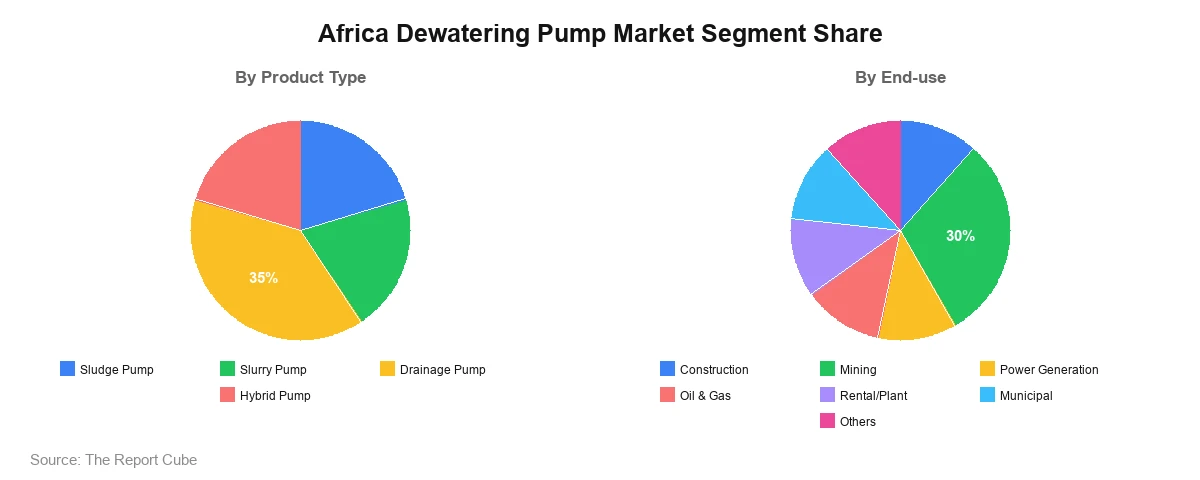
Drainage Pump leads this category with an approximate 35% share in 2026. Sludge Pump is the second analyzed segment. Its commercial role is linked to a distinct product, customer, technology or use-case requirement within the category. The remaining subsegments Slurry Pump, Hybrid Pump are retained in the scope, but their individual shares are not reliably quantifiable from the available sources.
By End-use
- Construction
- Mining
- Power Generation
- Oil & Gas
- Rental/Plant
- Municipal
- Others
Mining leads this category with an approximate 30% share in 2026. Construction is the second analyzed segment. Its commercial role is linked to a distinct product, customer, technology or use-case requirement within the category. The remaining subsegments Power Generation, Oil & Gas, Rental/Plant, Municipal, Others are retained in the scope, but their individual shares are not reliably quantifiable from the available sources.
Africa Dewatering Pump Market Regional Analysis
Regional performance varies by market, geography and the supplied country or regional scope. The table summarizes the available regional assessment. Region-specific industry trends are shown only where supported; otherwise, they are identified as not reliably established from available sources.
| Region | Key Growth Factors | Industry Trends |
|---|---|---|
| South Africa | Established mining activity and demanding mine-water management requirements support dewatering equipment needs. | Operators focus on reliable, energy-efficient pumping, reduced downtime and rental/service availability. |
| DR Congo | Copper and cobalt mining activity creates requirements for pit drainage, underground water handling and process-water movement. | Mine operators require robust pumps suited to abrasive water, variable flow and continuous operation. |
| Zambia | Copper mining and associated mineral-processing operations create demand for mine dewatering and water-transfer systems. | Water efficiency, maintenance access and dependable pumping systems are key operational considerations. |
| Nigeria | Mining, construction and municipal drainage applications create potential demand, although market-specific pump deployment data was not identified. | Portable and submersible systems are relevant to temporary drainage and construction-site water management. |
The table covers South Africa, Nigeria, Zambia, Malawi, Congo DRC. South Africa is identified as the leading region or country group in the supplied input; the stated share remains an analyst estimate where shown and is not independently verified. Other growth-factor details are limited to the supplied assessment, while comparable industry-trend evidence was not available for reliable region-by-region comparison.
These groupings are not necessarily exhaustive or mutually exclusive at the level of all possible market activity. The input estimate for the leading group is retained as an estimate and is not used to calculate the shares of other regions. A comparable regional revenue-share series was not established from the reviewed source set.
Africa Dewatering Pump Market Competitive Landscape
The competitive landscape includes the companies listed in the supplied market input. Competitive strength summarizes the available company-positioning notes and does not imply market ranking or share. A market-specific primary segment served is not stated where product-level evidence is unavailable.
| Company | Competitive Strength | Primary Segment Served |
|---|---|---|
| Xylem Inc. | Offers mine dewatering systems spanning submersible and dry-mounted pumps, including Flygt and Godwin ranges, plus selected rental options. | Centrifugal/submersible dewatering pumps; mining and drainage applications. |
| Grundfos | Provides submersible pumps and mining-water solutions for dewatering, drainage, raw-water intake and wastewater handling. | Submersible and centrifugal pumps; mine dewatering and water management. |
Competitive entries are selected, source-verified examples from the supplied player list; they are not a market-share ranking. Company strengths and served segments reflect the reviewed company portfolio information. Where a listed company's current product fit could not be verified, it is not presented as a confirmed competitor in this table.
The table lists 10 companies included in the supplied competitive set for this market. The competitive-strength column preserves the available company-positioning notes; these notes do not establish market share or ranking. Primary segments served are stated as not reliably established where product-level evidence was not available in the supplied research.
Company Profiles
- Atlas Copco: Atlas Copco is included among the companies identified for this market in the supplied input. The available project source set does not establish a verified market-specific revenue figure, share, ranking, contract award or country-level footprint for this company. Its position should therefore be evaluated through official product information, regulatory or certification records, disclosed regional operations and customer announcements before assigning a competitive rank.
- Doosan: Doosan is included among the companies identified for this market in the supplied input. The available project source set does not establish a verified market-specific revenue figure, share, ranking, contract award or country-level footprint for this company. Its position should therefore be evaluated through official product information, regulatory or certification records, disclosed regional operations and customer announcements before assigning a competitive rank.
Africa Dewatering Pump Market Future Outlook
The supplied forecast places the Africa Dewatering Pump Market at USD 476.34 million in 2027 and USD 652.41 million by 2035, at the supplied CAGR of 4.01% over 2027–2035. These are input values retained for CMS publication and are not independently re-estimated in this narrative. The forecast trajectory will depend on market-specific adoption, capital availability, policy execution, customer affordability, supply-chain resilience and the ability of providers to deliver consistent quality.
In the near term, suppliers are likely to prioritise operational reliability, channel access and compliance. Over the medium term, investment in technology, local capability, partnerships and service infrastructure may influence competitive outcomes. Forecast uncertainty remains material where public datasets do not directly measure the defined market; readers should interpret the projection alongside the disclosed evidence limitations.
Africa Dewatering Pump Market Report Coverage
The Africa Dewatering Pump Market report coverage table summarizes the supplied market values, forecast assumptions, geographic scope, segmentation and named companies. No base-year market value was supplied, so it is identified as unavailable; the 2027 and forecast-year values are reproduced from the input.
| Parameter | Details |
|---|---|
| Market Name | Africa Dewatering Pump Market |
| Market Size (2027) | 476.34 million |
| Market Size (Forecast Year) | 652.41 million |
| CAGR | 4.01% |
| Base Year | 2026 |
| Historical Period | 2022-2026 |
| Forecast Period | 2027-2035 |
| Segmentation | By Technology, By Product Type, By End, By Country |
| Regions Covered | South Africa, Nigeria, Zambia, Malawi, Congo DRC |
| Key Companies | Atlas Copco, Doosan, Elgi, Kirloskar, Sullair, Ingersoll Rand, Xylem Inc., Grundfos, The Weir Group, Sulzer |
| Customization | Yes |
The table consolidates the report scope and supplied assumptions for the Africa Dewatering Pump Market. The supplied market value moves from 476.34 million in 2027 to 652.41 million in 2035. The supplied CAGR is 4.01% it is reproduced as provided and should be read alongside the stated forecast period. The historical reference period is 2021–2025. The forecast reference period is 2027–2035. These are the report inputs and scope descriptors; the table does not independently validate the underlying market estimates.
Why Choose This Africa Dewatering Pump Market Report
- Presents the supplied 2027 market value, 2035 forecast value and CAGR without altering the input assumptions.
- Organises all supplied segmentation categories and retains every listed subsegment.
- Explains the leading and second analyzed segment within each category while distinguishing estimates from verified statistics.
- Provides a regional or country-group assessment without inventing unsupported revenue shares.
- Identifies the companies supplied for the competitive landscape without assigning unsupported rankings or market shares.
- Uses institutional and official sources for relevant policy, regulatory and sector context, with source limitations disclosed.
- Highlights market opportunities, operating constraints, trends and forecast uncertainties to support further commercial assessment.
Table of Contents
- Introduction
- Objective of the Study
- Product Definition
- Market Segmentation
- Study Variables
- Research Methodology
- Secondary Data Points
- Companies Interviewed
- Primary Data Points
- Breakdown of Primary Interviews
- Secondary Data Points
- Executive Summary
- Market Dynamics
- Drivers
- Challenges
- Opportunity Assessment
- Recent Trends and Developments
- Policy and Regulatory Landscape
- Africa Dewatering Pump Market Overview and Forecast Analysis (2022-2035)
- Market Size, By Value, By Growth Rate (CAGR/USD Millions)
- Demand – Supply Trends
- Market Share, By Technology
- Positive Displacement
- Centrifugal
- Market Share, By Product Type
- Sludge Pump
- Slurry Pump
- Drainage Pump
- Hybrid Pump
- Market Share, By End-use
- Construction
- Mining
- Power Generation
- Oil & Gas
- Rental/Plant
- Municipal
- Others
- Market Share, By Country
- South Africa
- Nigeria
- Zambia
- Malawi
- Congo DRC
- Market Share, By Competitors
- Competition Characteristics
- Revenue Shares
- Positive Displacement Africa Dewatering Pump Market Overview, 2022-2035F
- By Value (USD Million)
- By Product Type – Market Size & Forecast 2022-2035, USD Million
- Sludge Pump
- Slurry Pump
- Drainage Pump
- Hybrid Pump
- Centrifugal Africa Dewatering Pump Market Overview, 2022-2035F
- By Value (USD Million)
- By Product Type – Market Size & Forecast 2022-2035, USD Million
- Sludge Pump
- Slurry Pump
- Drainage Pump
- Hybrid Pump
- Competitive Outlook (Company Profile – Partial List)
- Atlas Copco
- Company Overview
- Business Segments
- Strategic Alliances/Partnerships
- Recent Developments
- Doosan
- Company Overview
- Business Segments
- Strategic Alliances/Partnerships
- Recent Developments
- Elgi
- Company Overview
- Business Segments
- Strategic Alliances/Partnerships
- Recent Developments
- Kirloskar
- Company Overview
- Business Segments
- Strategic Alliances/Partnerships
- Recent Developments
- Sullair
- Company Overview
- Business Segments
- Strategic Alliances/Partnerships
- Recent Developments
- Ingersoll Rand
- Company Overview
- Business Segments
- Strategic Alliances/Partnerships
- Recent Developments
- Xylem Inc.
- Company Overview
- Business Segments
- Strategic Alliances/Partnerships
- Recent Developments
- Grundfos
- Company Overview
- Business Segments
- Strategic Alliances/Partnerships
- Recent Developments
- The Weir Group
- Company Overview
- Business Segments
- Strategic Alliances/Partnerships
- Recent Developments
- Sulzer
- Company Overview
- Business Segments
- Strategic Alliances/Partnerships
- Recent Developments
- Atlas Copco
- Contact Us & Disclaimer
Top Key Players & Market Share Outlook
- Atlas Copco
- Doosan
- Elgi
- Kirloskar
- Sullair
- Ingersoll Rand
- Xylem Inc.
- Grundfos
- The Weir Group
- Sulzer
Frequently Asked Questions