




Build Your Custom Market Intelligence Report
Customize Your ReportGermany Air Conditioners Market Key Highlights
By Product Type:
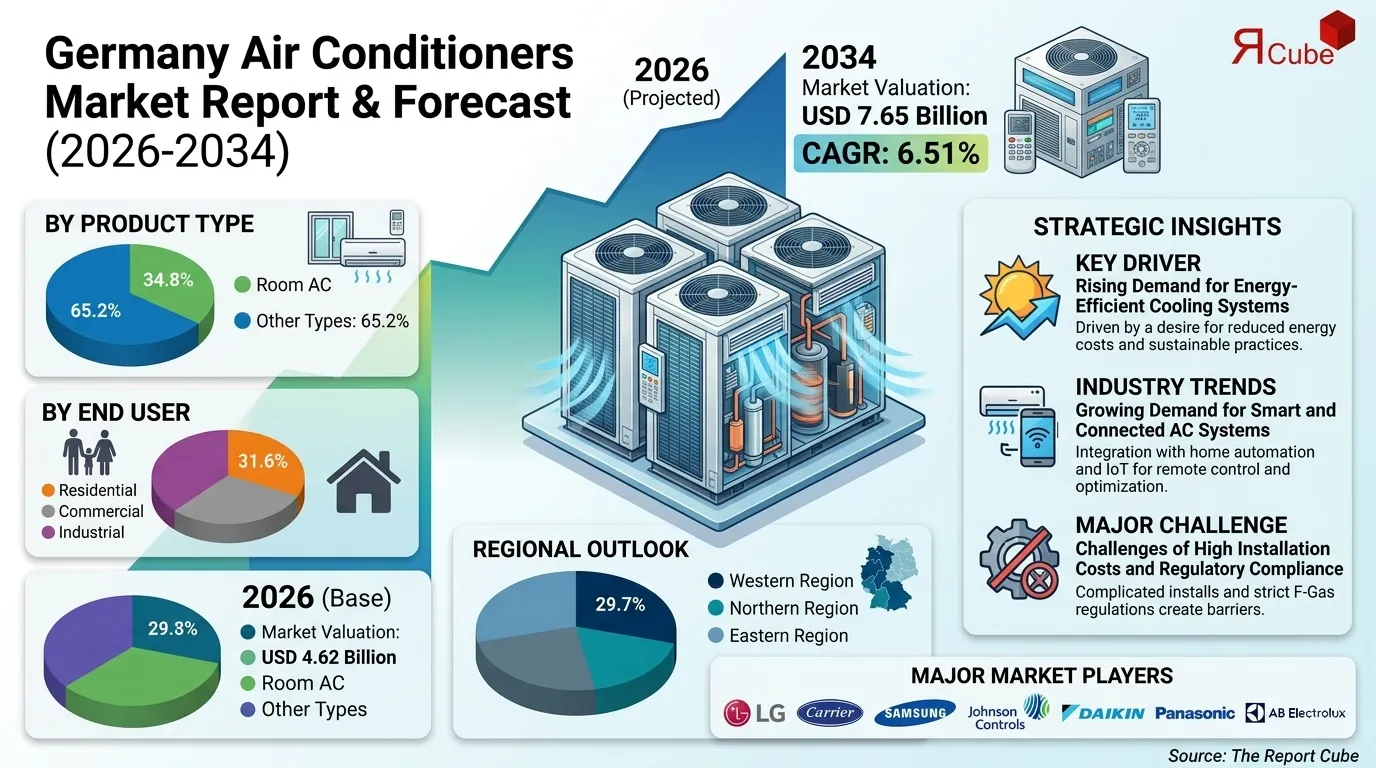
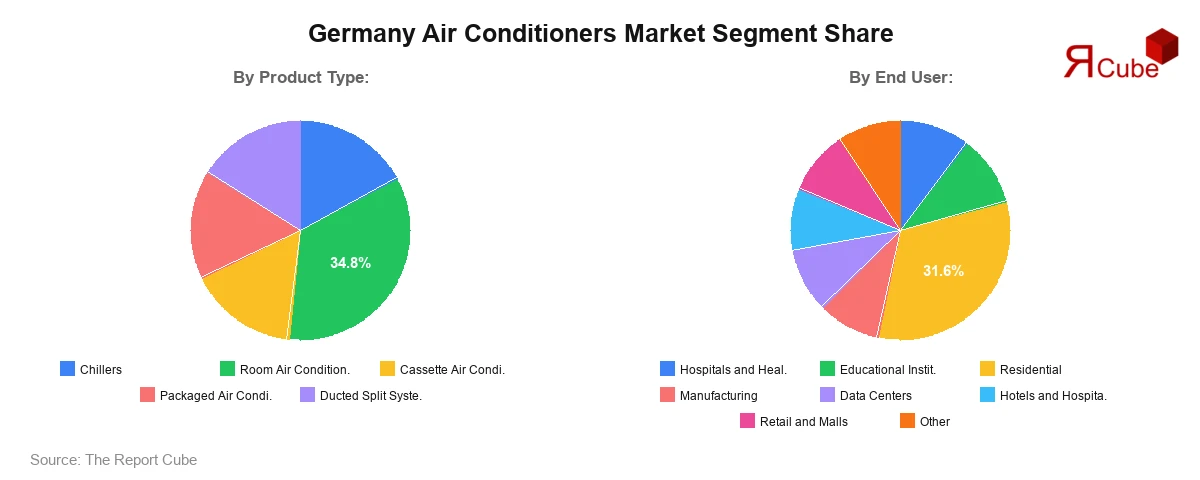
Room Air Conditioners segment leads the market with 34.8%.
By End User:
Residential segment dominates the market with 31.6% of revenue.
Regional Outlook:
Western region dominates the Germany Air Conditioners market with 29.7% share.
Germany Air Conditioners Market Insights & Analysis
The Germany Air Conditioners Market is anticipated to register a CAGR of around 6.51% during the forecast period 2026-2034. The market size is valued at USD 4.62 billion and is projected to reach USD 7.65 billion by 2034. Germany air conditioners market size, share, demand, and trends are increasingly influenced by climate adaptation strategies and building modernization programs. Rising summer temperature peaks across urban centers such as Frankfurt and Berlin are driving demand for energy-efficient cooling systems. In 2025, over 41% of new residential permits included provisions for integrated cooling, reflecting a shift in building codes and consumer expectations. Manufacturers are focusing on inverter-based and low-GWP refrigerant systems to align with EU sustainability goals.
Investment activity remains strong, supported by Germany’s electrification push and stricter energy efficiency norms under updated building regulations. Companies are expanding R&D in smart HVAC technologies, including IoT-enabled air conditioning systems that improve energy monitoring and predictive maintenance. Commercial sectors such as data centers and pharmaceuticals are scaling cooling infrastructure, as server density and temperature-sensitive operations grow. Germany air conditioners market growth is further supported by retrofitting projects, where older buildings are upgrading ventilation and cooling systems to meet new efficiency benchmarks and indoor air quality standards.
Germany Air Conditioners Market Impact Analysis
| Factor | Type | Specific Impact on Market | Magnitude | Business Implication |
|---|---|---|---|---|
| Rising Summer Temperatures & Heatwaves | Demand Driver | Increasing AC adoption in residential households across Germany | High | Growth in split and portable AC demand |
| Low AC Penetration vs Southern Europe | Growth Opportunity | Large untapped residential market potential | High | Long-term volume growth opportunity |
| Strict EU Energy Efficiency Regulations | Regulatory Driver | Shift toward inverter and energy-efficient AC systems | High | Premiumization of product offerings |
| High Electricity Prices | Market Constraint | Consumers prefer energy-efficient and low-consumption units | Medium | Boost in inverter AC adoption |
| Growth of Smart Homes & Automation | Technology Driver | Demand for connected and IoT-enabled AC systems | Medium | Competitive differentiation via smart features |
| Rise of Heat Pumps as Alternative | Substitution Threat | Heat pumps reduce standalone AC demand | Medium | Hybrid cooling-heating solutions gain traction |
| Commercial Infrastructure Expansion | Demand Driver | Growth in offices, retail, and industrial cooling needs | Medium | Central & VRF systems demand rises |
| Sustainability & Decarbonization Goals | Policy Driver | Adoption of eco-friendly refrigerants and systems | High | R&D investments increase across manufacturers |
Germany Air Conditioners Market Dynamics
Key Driver: Rising Demand for Energy-Efficient Cooling Systems in Germany
As electricity costs continue to rise and people become more conscious of their energy consumption, Germany's demand for energy-efficient cooling systems is growing rapidly across both residential and commercial sectors. Consumers are increasingly opting for inverter ACs and smart cooling systems, which can cut energy use by as much as 27%. In fact, by 2026, nearly half of all newly installed air conditioning units are expected to be high-efficiency models. This shift is getting a big push from government incentives that promote the use of sustainable appliances, especially in urban housing and green-certified buildings.
On the commercial side, the demand for cooling systems is also on the rise. As Germany's infrastructure continues to grow, with new data centers, retail complexes, and healthcare facilities, the need for reliable cooling solutions is becoming even more critical. For instance, data centers alone are projected to account for 19% of all commercial HVAC demand by 2025, driven by the increasing need for cloud computing services.
Trends in the air conditioning market show that precision cooling and temperature control are becoming essential in mission-critical environments. This is pushing businesses to adopt more advanced systems, like ducted and Variable Refrigerant Flow (VRF) systems, which provide superior efficiency and reliability for demanding spaces.
Book your FREE 30-minute expert consultation today
Contact UsIndustry Trends: Growing Demand for Energy-Efficient Cooling Systems in Germany
As electricity costs rise and environmental concerns grow, Germany’s demand for energy-efficient air conditioning systems is on the up. Consumers are increasingly choosing inverter ACs and smart cooling systems, which can reduce energy use by up to 27%. By 2026, nearly half of all new AC installations are expected to be high-efficiency models. This shift is supported by government incentives promoting sustainable appliances, especially in urban housing and green-certified buildings.
The expansion of commercial infrastructure, including data centers, retail spaces, and healthcare facilities, is also driving the demand for advanced cooling solutions. Data centers alone are projected to account for 19% of commercial HVAC demand by 2025 due to the growing need for cloud computing. As precision cooling becomes essential for mission-critical environments, businesses are increasingly adopting systems like ducted and VRF units, which offer better efficiency and control.
Major Challenge: Challenges of High Installation Costs and Regulatory Compliance in Germany
The high upfront cost of installing advanced air conditioning systems is a significant barrier, especially for small businesses and older homes. Many energy-efficient systems require structural changes, which can push installation costs up by nearly 22%. This makes it harder for price-sensitive consumers to adopt these systems, slowing overall growth in Germany’s air conditioning market.
On top of this, stringent environmental regulations on refrigerants and emissions add extra complexity for manufacturers and installers. For example, compliance with EU F-gas regulations means that products must undergo constant redesigns and certification processes. This not only delays product launches but also increases operational costs, making it harder for smaller companies to compete and scale. These challenges are slowing the market’s progress and making it harder for both businesses and consumers to embrace the latest cooling technologies.
Opportunity: Growth in Retrofitting and Sustainable Building Upgrades in Germany
Germany’s aging building stock is creating significant opportunities for air conditioning system upgrades. About 52% of residential buildings were built before modern energy standards, which is driving demand for efficient retrofitting solutions. The country’s air conditioning market is benefiting from renovation programs that focus on better insulation and improved climate control, making older buildings more energy-efficient.
On the corporate side, sustainability goals are encouraging businesses to embrace greener cooling technologies. Many companies are investing in low-emission HVAC systems to meet environmental, social, and governance (ESG) targets and reduce their carbon footprints. This shift is creating new opportunities for manufacturers that offer eco-friendly refrigerants and energy-efficient systems, especially in commercial and industrial sectors. These trends highlight the growing importance of energy-efficient cooling in both residential and commercial spaces as Germany moves towards a more sustainable future.
Germany Air Conditioners Market Segment-wise Analysis
By Product Type:
- Chillers
- Room Air Conditioners
- Cassette Air Conditioners
- Packaged Air Conditioners
- Ducted Split Systems
Room Air Conditioners lead the Germany air conditioners market with a share of 34.8%, driven by increasing residential adoption and compact system preferences. Split AC units dominate this category due to their energy efficiency and flexible installation options. In 2025, over 62% of residential buyers preferred split systems for apartments and small homes.
Demand is further supported by rising urbanization and apartment construction, especially in metropolitan regions. Consumer inclination toward silent operation, aesthetic design, and smart features is reinforcing the segment’s growth. Window AC units hold a smaller share due to noise and installation limitations, making split systems the preferred choice.
By End User:
- Retail and Malls
- Pharmaceuticals
- Food and Beverage
- Hotels and Hospitality
- Data Centers
- Offices
- Manufacturing
- Residential
- Educational Institutions
- Hospitals and Healthcare
- Other
The residential segment dominates with 31.6% revenue share, supported by rising consumer awareness and changing climate conditions. Increasing disposable income and preference for indoor comfort are key contributors to demand. In 2026, nearly 44% of new households are expected to install at least one air conditioning unit.
The shift toward energy-efficient appliances and government-backed incentives is accelerating adoption. Commercial sectors such as data centers and healthcare are growing steadily, though residential demand remains higher due to broader customer base and faster replacement cycles.
Regional Projection of Germany Air Conditioners Industry
- Northern
- Western
- Eastern
- Southern
- Others
Western Germany leads the market with 29.7% share, supported by strong industrial presence and higher urban density. Cities such as Cologne and Düsseldorf have significant commercial infrastructure, driving demand for advanced HVAC systems. The region recorded a 33% increase in commercial AC installations in 2025, particularly in office spaces and retail developments.
High disposable income and early adoption of smart technologies further strengthen regional demand. Additionally, infrastructure modernization projects and retrofitting initiatives are actively upgrading older buildings, contributing to sustained market expansion across Western Germany.
Germany Air Conditioners Market Regional Analysis
The regional demand for air conditioners in Germany varies significantly based on climate conditions, urbanization levels, and industrial concentration across different regions.
| Region | Demand Level | Key Cities | Climate Profile | Primary Demand Driver | Preferred AC Type | Growth Outlook |
|---|---|---|---|---|---|---|
| Southern Germany | High | Munich, Stuttgart | Warmer summers, rising heatwaves | Residential demand & industrial activity | Split AC | Strong growth |
| Western Germany | High | Cologne, Düsseldorf | Moderate to warm summers | High urban density & commercial infrastructure | Split & Central AC | Strong growth |
| Eastern Germany | Medium | Berlin, Leipzig | Seasonal heat variations | Urban expansion & residential upgrades | Split & Portable AC | Moderate growth |
| Northern Germany | Low-Medium | Hamburg, Bremen | Cooler climate, mild summers | Limited residential cooling demand | Portable AC | Gradual growth |
Need insights for a specific region within this market?
Request Regional DataGovernment Initiatives & Policies
- Germany Building Energy Act Update 2025: Strengthens efficiency standards for HVAC systems, mandating lower emissions and higher energy performance.
- EU Ecodesign Directive 2026 Expansion: Introduces stricter energy labeling and efficiency requirements for cooling appliances across Germany.
Germany Air Conditioners Industry Recent Developments
- 2025: Bosch Home Comfort Group announced expansion from 17 to 33 global plants after integrating new units. In Germany, 2025 marked a shift as heat pump sales surpassed gas systems. The company is introducing new air conditioning platforms aligned with electrification and efficiency regulations.
Why Choose This Report?
- Provides a comprehensive overview of the overall market analysis, encompassing key trends, consumer behavior analysis, and risk assessment to support strategic decision-making.
- Provides accurate, up-to-date insights into market size, segmentation, and emerging opportunities, helping to minimize risk & capitalizing on growth.
- Gives deep understanding of target audience preferences, investment habits, and communication channels for enhanced product development & marketing effectiveness.
- Delivers competitive analysis & benchmarking, uncovering the strengths & weaknesses of market competitors to guide strategies.
- Consolidate comprehensive market intelligence, reducing reasoning & streamlining research efforts.
- Facilitates customized market segmentation & risk mitigation strategies, fine-tuned to the business objectives.
- Aids in identifying both market challenges & untapped opportunities within the industry to drive long-term business growth.
- Provides valuable information based on actual customer data & search trends.
Table of Contents
- Introduction
- Objective of the Study
- Product and Category Definition
- Market Segmentation
- Study Variables
- Research Methodology
- Secondary Data Points
- Breakdown of Secondary Sources
- Primary Data Points
- Breakdown of Primary Interviews
- Secondary Data Points
- Executive Summary
- Market Dynamics
- Emerging Opportunities
- Adoption Trends
- Demand Drivers
- Disruption Analysis (Challenges)
- Industry Analysis & Strategic Insights
- Supply/Value Chain Analysis
- Pricing Analysis
- Go-To-Market (GTM) Strategy
- BCG Matrix
- Recent Trends and Developments
- Import and Export Analysis
- Regulatory and Policy Landscape
- Region-wise Policies
- Government Initiatives
- Germany Air Conditioners Market Overview and Forecast Analysis (2021-2034)
- Market Size, By Value, By Growth Rate (CAGR/USD Billion)
- Market Share, By Product Type
- Chillers
- Water-cooled Chillers
- Air-cooled Chillers
- Other Chillers
- Room Air Conditioners
- Split AC
- Up to 1 Ton
- 1 Ton to 1.5 Ton
- Above 1.6 to 2 Ton
- Above 2 Ton
- Window AC
- Up to 1 Ton
- 1 Ton to 2 Ton
- Above 2 Ton
- Split AC
- Cassette Air Conditioners
- Up to 2 Tons
- 2.1 to 4 Tons
- 4.1 to 5 Tons
- Above 5 Tons
- Packaged Air Conditioners
- Up to 5 Tons
- 6 to 10 Tons
- 11 to 20 Tons
- Above 20 Tons
- Ducted Split Systems
- VRF Systems
- Up to 5 Tons
- 6 to 10 Tons
- 11 to 20 Tons
- Above 20 Tons
- Others (Air Handling Units / Fan Coil Units, etc.)
- Chillers
- Market Share, By Refrigerant Type
- R290
- R410A
- R32
- R1234ze / R1234yf
- R134a
- Other Refrigerants
- Market Share, By Distribution Channel
- Multi-brand Stores
- Online
- Direct Sales
- Authorized Dealers and Distributors
- Market Share, By End User
- Retail and Malls
- Pharmaceuticals
- Food and Beverage
- Hotels and Hospitality
- Data Centers
- Offices
- Manufacturing
- Residential
- Educational Institutions
- Hospitals and Healthcare
- Other End Users
- Market Share, By Region
- Northern
- Western
- Eastern
- Southern
- Others
- Market Share, By Company
- Revenue Shares and Analysis
- Competitive Landscape
- Northern Germany Air Conditioners Market Overview and Forecast Analysis (2021-2034)
- Market Size, By Value, By Growth Rate (CAGR/USD Billion/Million)
- Market Share, By Product Type
- Market Share, By Refrigerant Type
- Market Share, By Distribution Channel
- Market Share, By End User
- Western Germany Air Conditioners Market Overview and Forecast Analysis (2021-2034)
- Market Size, By Value, By Growth Rate (CAGR/USD Billion/Million)
- Market Share, By Product Type
- Market Share, By Refrigerant Type
- Market Share, By Distribution Channel
- Market Share, By End User
- Eastern Germany Air Conditioners Market Overview and Forecast Analysis (2021-2034)
- Market Size, By Value, By Growth Rate (CAGR/USD Billion/Million)
- Market Share, By Product Type
- Market Share, By Refrigerant Type
- Market Share, By Distribution Channel
- Market Share, By End User
- Southern Germany Air Conditioners Market Overview and Forecast Analysis (2021-2034)
- Market Size, By Value, By Growth Rate (CAGR/USD Billion/Million)
- Market Share, By Product Type
- Market Share, By Refrigerant Type
- Market Share, By Distribution Channel
- Market Share, By End User
- Competitive Analysis, 2026
- Market Share of Key Players
- Competitive Mapping for Each Product Type and Companies Operating Regionally
- Northern Germany Air Conditioners Companies Share and Competitive Analysis, 2026
- Western Germany Air Conditioners Companies Share and Competitive Analysis, 2026
- Eastern Germany Air Conditioners Companies Share and Competitive Analysis, 2026
- Southern Germany Air Conditioners Companies Share and Competitive Analysis, 2026
- Company Profile (Partial List)
- LG Corporation
- Company Overview
- Product Portfolio
- Strategic Alliances/Partnerships
- Recent Developments
- Carrier Global Corporation
- Company Overview
- Product Portfolio
- Strategic Alliances/Partnerships
- Recent Developments
- Samsung Electronics Co. Ltd.
- Company Overview
- Product Portfolio
- Strategic Alliances/Partnerships
- Recent Developments
- Johnson Controls International Plc
- Company Overview
- Product Portfolio
- Strategic Alliances/Partnerships
- Recent Developments
- Daikin Industries, Ltd.
- Company Overview
- Product Portfolio
- Strategic Alliances/Partnerships
- Recent Developments
- Panasonic Holdings Corporation
- Company Overview
- Product Portfolio
- Strategic Alliances/Partnerships
- Recent Developments
- AB Electrolux
- Company Overview
- Product Portfolio
- Strategic Alliances/Partnerships
- Recent Developments
- Mitsubishi Electric Corp.
- Company Overview
- Product Portfolio
- Strategic Alliances/Partnerships
- Recent Developments
- Haier Group Corp.
- Company Overview
- Product Portfolio
- Strategic Alliances/Partnerships
- Recent Developments
- Hughes Group
- Company Overview
- Product Portfolio
- Strategic Alliances/Partnerships
- Recent Developments
- Others (Partial List)
- LG Corporation
- Contact Us and Disclaimer
Top Key Players & Market Share Outlook
- LG Corporation
- Carrier Global Corporation
- Samsung Electronics Co. Ltd.
- Johnson Controls International Plc
- Daikin Industries, Ltd.
- Panasonic Holdings Corporation
- AB Electrolux
- Mitsubishi Electric Corp.
- Haier Group Corp.
- Hughes Group
Frequently Asked Questions






