



Build Your Custom Market Intelligence Report
Customize Your ReportIsrael Air Conditioners Market Key Highlights
By Product Type:
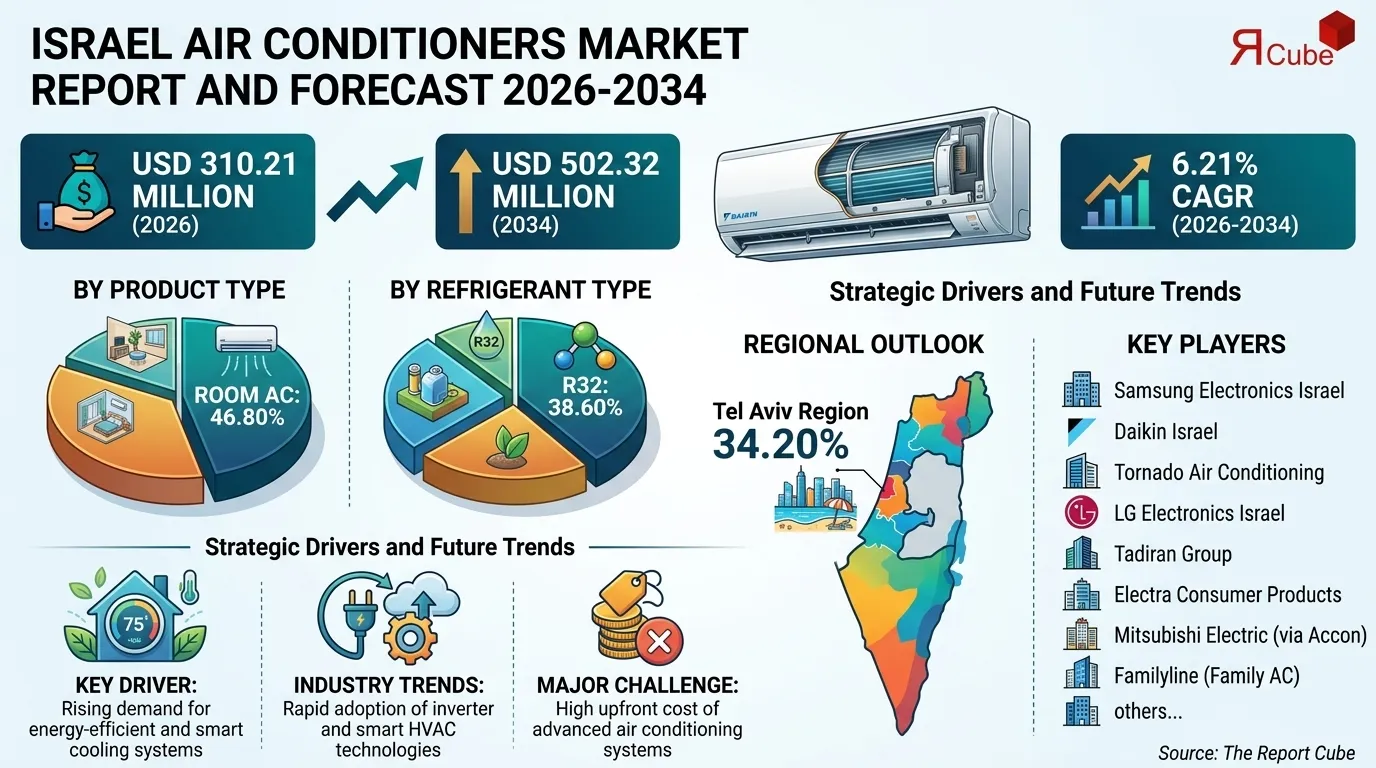
Room Air Conditioners segment leads the market with 46.80%.
By Refrigerant Type:
R32 segment dominates the market with 38.60% of revenue.
Regional Outlook:
Tel Aviv region dominates the Israel Air Conditioners market with 34.20% share.
Israel Air Conditioners Market Insights & Analysis
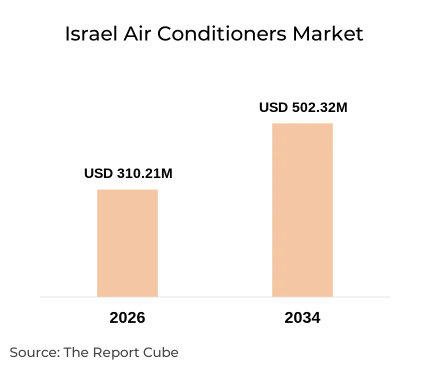
The Israel Air Conditioners Market is anticipated to register a CAGR of around 6.21% during the forecast period 2026-2034. The market size is valued at USD 310.21 million in 2026 and is projected to reach USD 502.32 million by 2034. Israel’s air conditioners market size and share are expanding due to rising urban density, climate variability, and increased residential construction across Tel Aviv and Central regions. Data from 2025 indicates that room air conditioners alone crossed USD 640.66 million, highlighting strong replacement demand and consistent consumer upgrades toward inverter-based cooling systems. Demand trends show higher adoption of split AC systems driven by energy savings and improved cooling efficiency. Government-backed building efficiency norms are encouraging energy-rated appliances, pushing manufacturers to innovate in low-energy consumption technologies.
Industry activity is accelerating with key players expanding distribution networks and investing in smart cooling solutions. Companies such as Samsung Electronics Israel and Daikin Israel are introducing AI-enabled air conditioners that optimize cooling cycles based on occupancy patterns. Import trends and regional supply chain integration within the Middle East are improving product availability and pricing competitiveness. Supporting keywords like energy-efficient cooling systems, inverter AC demand, and smart HVAC adoption reflect the structural evolution shaping Israel’s air conditioning market growth through 2034.
Israel Air Conditioners Market Impact Analysis
| Factor | Type | Specific Impact on Market | Magnitude | Business Implication |
|---|---|---|---|---|
| Structurally Mature, High-Penetration AC Market | Market | Growth led by replacement not first-time installs | Medium | Prioritise upgrade offers and premium replacement SKUs |
| Steady Room AC Market CAGR Around 2% | Market | Moderate expansion with stable long-term demand | Medium | Focus on margin optimisation rather than pure volume |
| Intensifying Heatwaves and Thermal Extremes | Environmental | Heat events embed cooling as household necessity | High | Align promotions and stock with extreme weather spikes |
| Dense Urban, Apartment-Heavy Housing Structure | Market | Drives strong demand for compact split AC formats | High | Prioritise quiet, space-efficient split room models |
| Shift to European Import and Efficiency Rules | Regulatory | Non-compliant legacy models forced from market | High | Update portfolio early and use compliance as lever |
| Energy Efficiency as Primary Purchase Criterion | Consumer | Labels and ratings heavily influence model choice | High | Highlight rating, bills and payback in all messaging |
| Rising Electricity Cost Awareness Among Households | Consumer | Buyers compare lifetime running cost more closely | Medium | Offer calculators, clear usage data and bill saves |
| Population Growth and New Household Formation | Market | Creates steady stream of fresh installation demand | Medium | Target new builds and movers with bundled offers |
| Regulatory-Driven Split AC Portfolio Renewal Wave | Technological | Compliance shift accelerates upgrade to new splits | High | Launch trade-in schemes for older non-compliant sets |
| HVAC Market-Wide Move to Sustainable Solutions | Technological | Supports demand for greener, low-GWP AC systems | Medium | Invest in eco refrigerants and market green ranges |
Israel Air Conditioners Market Dynamics
Key Driver: Rising demand for energy-efficient and smart cooling systems
Increasing electricity costs and awareness of sustainable consumption are encouraging households and businesses to adopt energy-efficient air conditioners. Consumers are shifting toward inverter technology and smart-enabled systems that reduce power usage while maintaining performance. This shift is visible across urban housing developments and commercial establishments, where cooling systems account for a major portion of energy consumption.
Policy support and appliance labeling standards are influencing buying decisions. Energy rating regulations and incentives for efficient appliances are accelerating the transition toward eco-friendly refrigerants and optimized cooling systems. This driver is closely tied to Israel air conditioner market growth, as manufacturers respond with advanced features such as adaptive cooling and IoT integration.
Book your FREE 30-minute expert consultation today
Contact UsIndustry Trends: Rapid adoption of inverter and smart HVAC technologies
The Israel air conditioners market trends show increasing penetration of inverter AC systems due to their efficiency and quieter operation. Consumers prefer split AC units with smart connectivity, allowing remote control through mobile applications. This trend is gaining momentum in both residential and light commercial sectors.
Manufacturers are focusing on integrating sensors, automation, and predictive maintenance capabilities. Smart HVAC solutions are enabling real-time monitoring and energy optimization, which aligns with rising demand for connected homes. Trends such as AI-driven cooling, eco refrigerants, and modular HVAC systems are reshaping product offerings and strengthening market share competition.
Major Challenge: High upfront cost of advanced air conditioning systems
Although demand for efficient systems is growing, the initial cost of advanced inverters and smart air conditioners remains a barrier for price-sensitive consumers. Premium models with IoT features and environmentally friendly refrigerants often carry higher price points compared to conventional units.
Import dependency and currency fluctuations further influence pricing dynamics. This creates hesitation among mid-income households, slowing adoption in certain segments. The challenge impacts Israel air conditioners market demand, particularly in regions where affordability remains a key purchase factor.
Opportunity: Expansion of green building infrastructure and retrofitting projects
Israel’s focus on sustainable infrastructure is opening opportunities for energy-efficient HVAC systems. Green building certifications and retrofitting of older buildings are increasing demand for modern air conditioning solutions. Commercial buildings and public infrastructure projects are key contributors to this opportunity.
Replacement demand is rising as older systems are phased out in favor of energy-saving alternatives. Companies are introducing compact and efficient solutions tailored for retrofitting needs. This opportunity supports Israel air conditioners market size expansion by encouraging long-term investments in efficient cooling technologies.
Israel Air Conditioners Market Segment-wise Analysis
By Product Type:
- Chillers
- Room Air Conditioners
- Cassette Air Conditioners
- Packaged Air Conditioners
- Ducted Split Systems
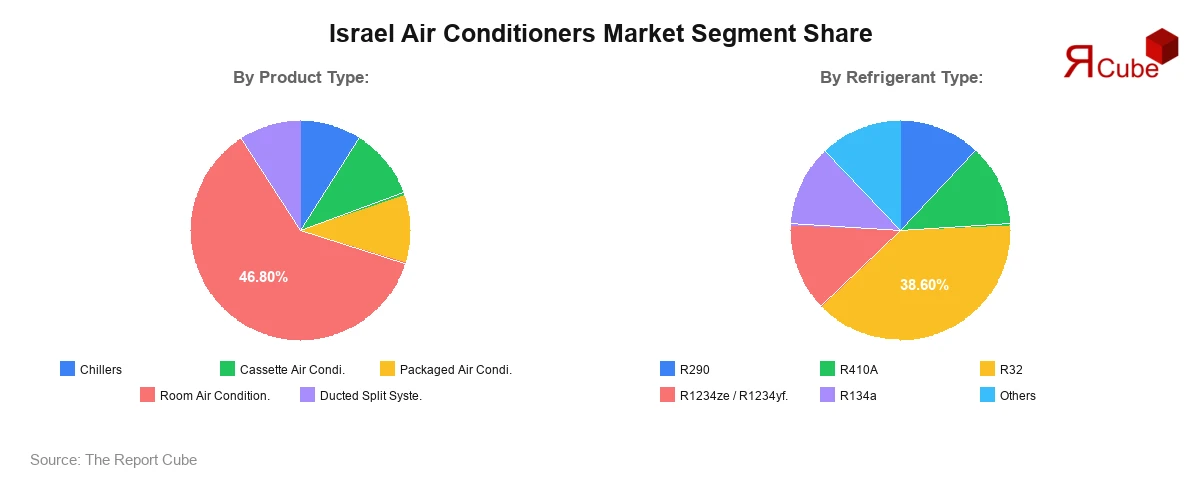
Room Air Conditioners dominate the Israel air conditioners market share at 46.80% due to strong residential demand and frequent replacement cycles. Split AC systems contribute the largest portion within this segment as they offer higher efficiency and flexible installation. Urban apartments and small offices prefer split units because of compact design and lower operational cost.
Demand for window AC units is declining gradually as consumers shift toward advanced systems. Rising housing construction and increasing summer temperatures are further supporting segment growth, making it the primary contributor to overall market size and revenue generation.
By Refrigerant Type:
- R290
- R410A
- R32
- R1234ze / R1234yf
- R134a
- Other Refrigerants
R32 leads the refrigerant segment with 38.60% share due to its lower environmental impact and higher efficiency compared to traditional refrigerants. Manufacturers are actively transitioning toward R32-based systems as part of global sustainability initiatives. This refrigerant supports better cooling performance while reducing greenhouse gas emissions.
Regulatory alignment with environmental standards is accelerating its adoption across residential and commercial applications. Demand for eco-friendly refrigerants such as R290 and R1234yf is increasing, yet R32 remains dominant due to cost-effectiveness and widespread availability in Israel’s HVAC market.
Regional Projection of Israel Air Conditioners Industry
- Tel Aviv
- Central
- Southern
- Jerusalem
- Northern
Tel Aviv holds the leading position with 34.20% market share driven by dense urban population, high residential demand, and strong commercial infrastructure. The region experiences consistent demand for air conditioning due to higher temperatures and modern housing developments. Commercial spaces such as offices, retail centers, and hospitality establishments significantly contribute to cooling system adoption.
Infrastructure development and higher income levels support the adoption of advanced and smart air conditioning systems. Central region follows closely due to expanding suburban housing and rising construction activities, further supporting overall Israel air conditioners market growth trends.
Israel Air Conditioners Market Cities Analysis
The Israel air conditioners market varies significantly across regions due to diverse climatic conditions, urban concentration, and economic activity.
| Cluster | Demand Level | Key Areas | System Dominance | Core Demand Logic | Growth Nature |
|---|---|---|---|---|---|
| Tel Aviv | Extremely High | City core, Gush Dan belt | Split, multi‑split and VRF systems | High urban density and year‑round usage | Upgrade and tech-driven replacement |
| Central District | Very High | Petah Tikva, Sharon, Modi'in | Split AC and smart-ready systems | High ownership, family housing focus | Stable, replacement-led expansion |
| Southern District | High | Beersheba, Negev towns | Split AC, robust systems for heat | Hot desert climate, long cooling season | Structurally rising penetration |
| Jerusalem District | Medium | Jerusalem city and suburbs | Split units in flats, small VRF | Milder summers, mixed religious areas | Gradual, renovation-linked growth |
| Northern District | Medium to High | Haifa, Galilee, coastal towns | Split AC, some central in complexes | Humid summers and rising comfort needs | Steady, climate-driven adoption |
Need insights for a specific region within this market?
Request Regional DataGovernment Initiatives & Policies
- Energy Efficiency Standards 2025: Israel updated appliance efficiency regulations mandating higher energy ratings for cooling systems to reduce electricity consumption.
- Green Building Code Expansion 2026: New building policies promote energy-efficient HVAC systems in residential and commercial construction projects, supporting sustainable cooling adoption.
Israel Air Conditioners Industry Recent Developments
- 2025: Tadiran Group introduced a new series of energy-efficient inverter air conditioners integrated with smart climate control features. The development focuses on reducing electricity usage while enhancing user comfort, strengthening its competitive position in Israel’s residential cooling segment.
Why Choose This Report?
- Provides a comprehensive overview of the overall market analysis, encompassing key trends, consumer behavior analysis, and risk assessment to support strategic decision-making.
- Provides accurate, up-to-date insights into market size, segmentation, and emerging opportunities, helping to minimize risk & capitalizing on growth.
- Gives deep understanding of target audience preferences, investment habits, and communication channels for enhanced product development & marketing effectiveness.
- Delivers competitive analysis & benchmarking, uncovering the strengths & weaknesses of market competitors to guide strategies.
- Consolidate comprehensive market intelligence, reducing reasoning & streamlining research efforts.
- Facilitates customized market segmentation & risk mitigation strategies, fine-tuned to the business objectives.
- Aids in identifying both market challenges & untapped opportunities within the industry to drive long-term business growth.
- Provides valuable information based on actual customer data & search trends.
Table of Contents
- Introduction
- Objective of the Study
- Product and Category Definition
- Market Segmentation
- Study Variables
- Research Methodology
- Secondary Data Points
- Breakdown of Secondary Sources
- Primary Data Points
- Breakdown of Primary Interviews
- Secondary Data Points
- Executive Summary
- Market Dynamics
- Emerging Opportunities
- Adoption Trends
- Demand Drivers
- Disruption Analysis (Challenges)
- Industry Analysis & Strategic Insights
- Supply/Value Chain Analysis
- Pricing Analysis
- Go-To-Market (GTM) Strategy
- BCG Matrix
- Recent Trends and Developments
- Import and Export Analysis
- Regulatory and Policy Landscape
- Region-wise Policies
- Government Initiatives
- Israel Air Conditioners Market Overview and Forecast Analysis (2021-2034)
- Market Size, By Value, By Growth Rate (CAGR/USD Million)
- Market Share, By Product Type
- Chillers
- Water-cooled Chillers
- Air-cooled Chillers
- Other Chillers
- Room Air Conditioners
- Split AC
- Up to 1 Ton
- 1 Ton to 1.5 Ton
- Above 1.6 to 2 Ton
- Above 2 Ton
- Window AC
- Up to 1 Ton
- 1 Ton to 2 Ton
- Above 2 Ton
- Split AC
- Cassette Air Conditioners
- Up to 2 Tons
- 2.1 to 4 Tons
- 4.1 to 5 Tons
- Above 5 Tons
- Packaged Air Conditioners
- Up to 5 Tons
- 6 to 10 Tons
- 11 to 20 Tons
- Above 20 Tons
- Ducted Split Systems
- VRF Systems
- Up to 5 Tons
- 6 to 10 Tons
- 11 to 20 Tons
- Above 20 Tons
- Others (Air Handling Units / Fan Coil Units, etc.)
- Chillers
- Market Share, By Refrigerant Type
- R290
- R410A
- R32
- R1234ze / R1234yf
- R134a
- Other Refrigerants
- Market Share, By Distribution Channel
- Multi-brand Stores
- Online
- Direct Sales
- Authorized Dealers and Distributors
- Market Share, By End User
- Retail and Malls
- Pharmaceuticals
- Food and Beverage
- Hotels and Hospitality
- Data Centers
- Offices
- Manufacturing
- Residential
- Educational Institutions
- Hospitals and Healthcare
- Other End Users
- Market Share, By Region
- Tel Aviv
- Central
- Southern
- Jerusalem
- Northern
- Market Share, By Company
- Revenue Shares and Analysis
- Competitive Landscape
- Tel Aviv Air Conditioners Market Overview and Forecast Analysis (2021-2034)
- Market Size, By Value, By Growth Rate (CAGR/USD Million)
- Market Share, By Product Type
- Market Share, By Refrigerant Type
- Market Share, By Distribution Channel
- Market Share, By End User
- Central Air Conditioners Market Overview and Forecast Analysis (2021-2034)
- Market Size, By Value, By Growth Rate (CAGR/USD Million)
- Market Share, By Product Type
- Market Share, By Refrigerant Type
- Market Share, By Distribution Channel
- Market Share, By End User
- Southern Air Conditioners Market Overview and Forecast Analysis (2021-2034)
- Market Size, By Value, By Growth Rate (CAGR/USD Million)
- Market Share, By Product Type
- Market Share, By Refrigerant Type
- Market Share, By Distribution Channel
- Market Share, By End User
- Jerusalem Air Conditioners Market Overview and Forecast Analysis (2021-2034)
- Market Size, By Value, By Growth Rate (CAGR/USD Million)
- Market Share, By Product Type
- Market Share, By Refrigerant Type
- Market Share, By Distribution Channel
- Market Share, By End User
- Northern Air Conditioners Market Overview and Forecast Analysis (2021-2034)
- Market Size, By Value, By Growth Rate (CAGR/USD Million)
- Market Share, By Product Type
- Market Share, By Refrigerant Type
- Market Share, By Distribution Channel
- Market Share, By End User
- Competitive Analysis, 2026
- Market Share of Key Players
- Competitive Mapping for Each Segment and Companies Operating by Region
- Tel Aviv Air Conditioners Companies Share and Competitive Analysis, 2026
- Central Air Conditioners Companies Share and Competitive Analysis, 2026
- Southern Air Conditioners Companies Share and Competitive Analysis, 2026
- Jerusalem Air Conditioners Companies Share and Competitive Analysis, 2026
- Northern Air Conditioners Companies Share and Competitive Analysis, 2026
- Company Profile (Partial List)
- Samsung Electronics Israel
- Company Overview
- Product Portfolio
- Strategic Alliances/Partnerships
- Recent Developments
- Daikin Israel
- Company Overview
- Product Portfolio
- Strategic Alliances/Partnerships
- Recent Developments
- Tornado Air Conditioning
- Company Overview
- Product Portfolio
- Strategic Alliances/Partnerships
- Recent Developments
- LG Electronics Israel
- Company Overview
- Product Portfolio
- Strategic Alliances/Partnerships
- Recent Developments
- Tadiran Group
- Company Overview
- Product Portfolio
- Strategic Alliances/Partnerships
- Recent Developments
- Electra Consumer Products
- Company Overview
- Product Portfolio
- Strategic Alliances/Partnerships
- Recent Developments
- Mitsubishi Electric (via Accon)
- Company Overview
- Product Portfolio
- Strategic Alliances/Partnerships
- Recent Developments
- Familyline (Family AC)
- Company Overview
- Product Portfolio
- Strategic Alliances/Partnerships
- Recent Developments
- Others (Partial List)
- Samsung Electronics Israel
- Contact Us and Disclaimer
Top Key Players & Market Share Outlook
- Samsung Electronics Israel
- Daikin Israel
- Tornado Air Conditioning
- LG Electronics Israel
- Tadiran Group
- Electra Consumer Products
- Mitsubishi Electric (via Accon)
- Familyline (Family AC)
Frequently Asked Questions






