



Build Your Custom Market Intelligence Report
Customize Your ReportMiddle East Air Conditioners Market Key Highlights
By Product Type:
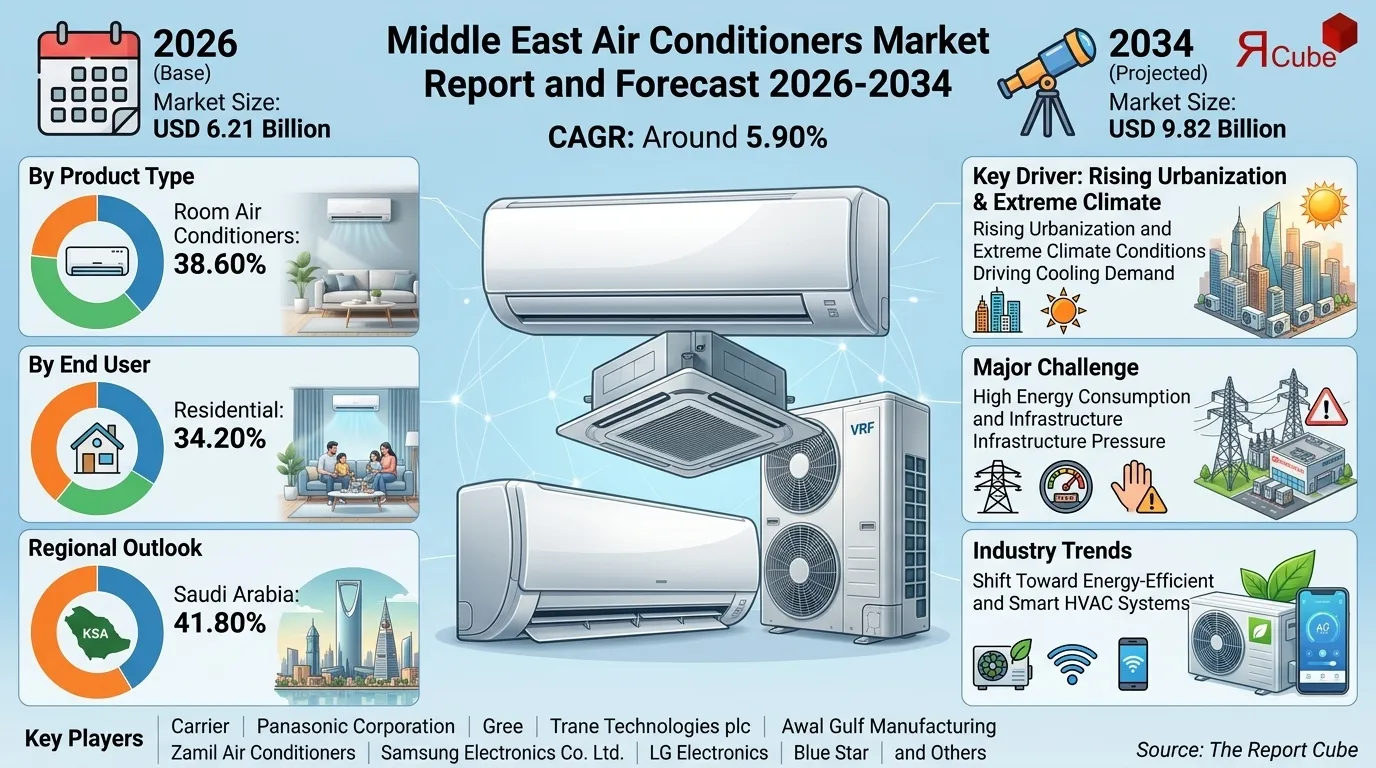
Room Air Conditioners segment leads the market with 38.60%.
By End User:
Residential segment dominates the market with 34.20% of revenue.
Regional Outlook:
Saudi Arabia region dominates the Middle East Air Conditioners Market with 41.80% share.
Middle East Air Conditioners Market Insights & Analysis
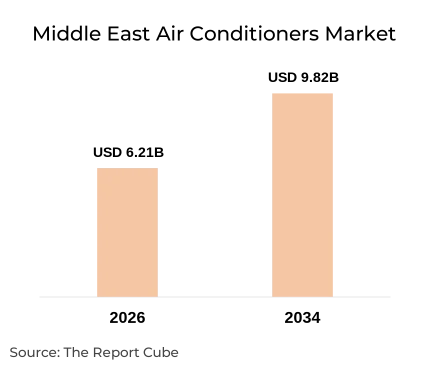
The Middle East Air Conditioners Market is anticipated to register a CAGR of around 5.90% during the forecast period 2026-2034. The market size is valued at USD 6.21 billion and is projected to reach USD 9.82 billion by 2034. Rapid urban expansion across Gulf countries continues to shape air conditioners market size and demand. Governments are investing heavily in smart cities such as NEOM in Saudi Arabia and sustainable housing in the UAE. These developments require advanced cooling systems, especially energy-efficient HVAC solutions. Increasing construction of commercial complexes, data centers, and hospitality infrastructure supports consistent demand for large-scale cooling systems.
Innovation in inverter technology and smart climate control systems is strengthening the Middle East air conditioners market share. Companies are introducing IoT-enabled cooling units that allow remote monitoring and predictive maintenance. Regional policies promoting energy efficiency, such as minimum energy performance standards, are pushing manufacturers to upgrade product portfolios. Investments from global players and partnerships with local distributors are further enhancing product accessibility and strengthening overall market growth trends.
Middle East Air Conditioners Market Impact Analysis
| Factor | Type | Specific Impact on Market | Magnitude | Business Implication |
|---|---|---|---|---|
| Steady Growth in Regional AC Market Size | Market | Supports sustained volume growth across key GCC hubs | High | Scale presence in Saudi Arabia, UAE and core cities |
| Extreme Heat and Arid Climate Conditions | Environmental | Drives essential year-round cooling need in buildings | High | Position ACs as critical comfort and reliability solution |
| Urbanisation and Large-Scale Construction Projects | Market | Boosts demand from housing, malls and office towers | High | Target large developers and EPCs with project bundles |
| Growth in Commercial and Industrial Installations | Market | Increases uptake of VRF, chillers and packaged units | High | Develop strong B2B sales and key account management |
| Rising Focus on Energy-Efficient Cooling Systems | Regulatory | Shifts mix toward inverter and high-efficiency models | High | Invest in premium efficient lines and rating upgrades |
| Smart Cities and Sustainable Infrastructure Projects | Technological | Creates demand for smart, low-GWP and green solutions | Medium | Bundle IoT-enabled systems for flagship urban projects |
| Stringent MEPS and Refrigerant Transition Policies | Regulatory | Raises compliance requirements on energy and gases | Medium | Align designs early and use compliance to win bids |
| Strong Competition from Global and Regional Brands | Competitive | Heightens price pressure and limits easy share gains | High | Differentiate via reliability, service and localisation |
| Adoption of Smart, Connected and IoT-Ready Systems | Technological | Raises expectations for controls, monitoring and data | Medium | Partner on platforms and embed smart features at scale |
| High Operating Costs and Energy Price Sensitivity | Consumer | Makes lifecycle cost a key purchase decision factor | Medium | Emphasise TCO, payback and efficiency in all pitches |
| Harsh Desert Environment and Maintenance Needs | Environmental | Increases wear, servicing frequency and filter issues | Medium | Design for durability and sell robust service contracts |
| Government Vision Plans and Infrastructure Spending | Market | Supports long-term pipeline of HVAC-intensive assets | High | Align bids with Vision programmes and mega city plans |
Middle East Air Conditioners Market Dynamics
Key Driver: Rising Urbanization and Extreme Climate Conditions Driving Cooling Demand
High temperatures across the Middle East, often exceeding 45°C, are a primary factor accelerating air conditioners market demand. Residential and commercial sectors rely heavily on cooling systems for comfort and operational stability. Increasing population density in urban areas has led to higher housing demand, directly influencing the need for room air conditioners and ducted systems.
Construction activity remains strong across Saudi Arabia, UAE, and Qatar, supported by government-backed infrastructure projects. Large-scale developments such as airports, shopping malls, and mixed-use buildings require centralized HVAC systems. This consistent demand strengthens market growth and encourages manufacturers to expand regional production and supply chains.
Book your FREE 30-minute expert consultation today
Contact UsIndustry Trends: Shift Toward Energy-Efficient and Smart HVAC Systems
A clear trend shaping the Middle East air conditioners market growth is the shift toward energy-efficient systems. Governments are enforcing strict energy regulations, encouraging adoption of inverter ACs and VRF systems. Consumers and businesses are prioritizing lower electricity consumption due to rising utility costs.
Smart technologies are becoming more common across residential and commercial applications. Integration with mobile apps and building management systems enhances operational efficiency. Companies are focusing on sustainable refrigerants and eco-friendly solutions, aligning with regional net-zero goals and environmental commitments.
Major Challenge: High Energy Consumption and Infrastructure Pressure
Air conditioning systems account for a significant portion of electricity usage in the Middle East. This creates pressure on national power grids, particularly during peak summer months. High energy consumption increases operational costs for businesses and households, impacting purchasing decisions.
Another challenge is the maintenance and lifecycle cost of HVAC systems in harsh desert environments. Dust accumulation and extreme heat can reduce efficiency and increase servicing needs. These factors can limit adoption of advanced systems in price-sensitive segments, affecting overall market penetration.
Opportunity: Expansion of Smart Cities and Sustainable Infrastructure
Ongoing investments in smart cities and green building projects present strong opportunities for the Middle East air conditioners market. Developments such as NEOM and Masdar City are adopting energy-efficient cooling technologies, boosting demand for advanced HVAC systems.
Growing focus on indoor air quality in hospitals, offices, and educational institutions is creating demand for specialized air conditioning systems. Integration of AI-based climate control and predictive maintenance solutions offers new revenue streams for manufacturers and service providers, supporting long-term market expansion.
Middle East Air Conditioners Market Segment-wise Analysis
By Product Type:
- Chillers
- Room Air Conditioners
- Cassette Air Conditioners
- Packaged Air Conditioners
- Ducted Split Systems
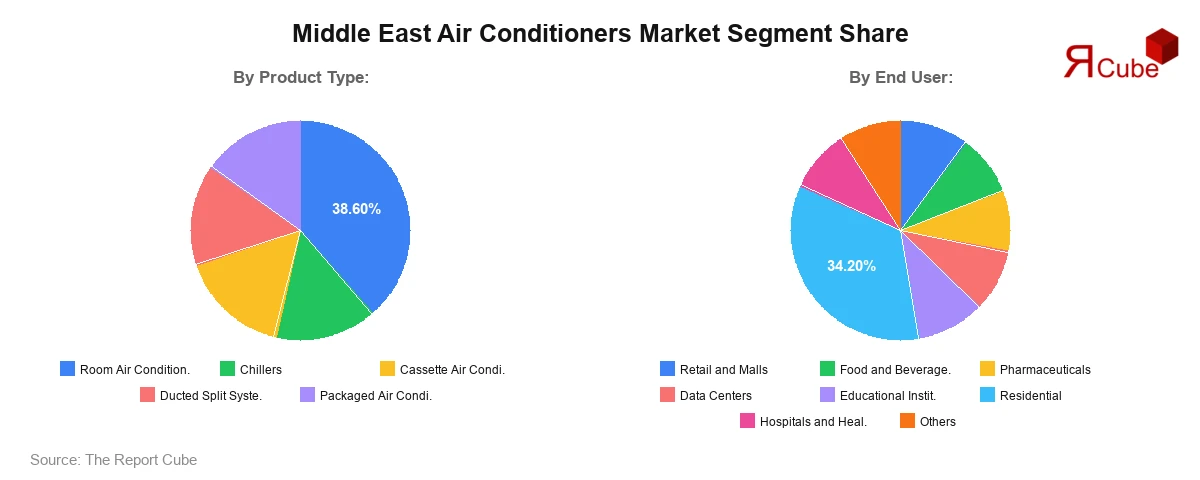
Room air conditioners lead the Middle East air conditioners market share, accounting for 38.60%. This dominance is linked to rising residential construction and increasing consumer preference for split AC systems. Split units offer better energy efficiency, quieter operation, and flexibility in installation compared to window units.
Countries such as Saudi Arabia and UAE are witnessing strong demand for inverter-based split ACs, especially in urban housing projects. The segment benefits from frequent product upgrades, including smart connectivity and improved cooling performance. Increasing disposable income and demand for comfort-driven appliances continue to support this segment’s expansion.
By End User:
- Retail and Malls
- Pharmaceuticals
- Food and Beverage
- Hotels and Hospitality
- Data Centers
- Offices
- Manufacturing
- Residential
- Educational Institutions
- Hospitals and Healthcare
The residential segment dominates the market with a 34.20% share, driven by increasing urban population and housing demand. Rising temperatures and changing lifestyle preferences are encouraging households to invest in advanced air conditioning systems. Governments are supporting residential development projects, particularly in Saudi Arabia and UAE, boosting product adoption.
Affordable financing options and availability of energy-efficient models are making AC units more accessible. Smart home integration is another factor influencing consumer choices, as buyers increasingly prefer connected devices for convenience and energy savings.
Regional Projection of Middle East Air Conditioners Industry
Saudi Arabia leads the Middle East air conditioners market with a 41.80% share, supported by extensive infrastructure investments and large-scale construction projects. Government initiatives such as Vision 2030 are driving development of residential, commercial, and industrial sectors. High population growth and extreme climatic conditions create continuous demand for cooling systems.
The country’s focus on smart cities and energy-efficient buildings is encouraging adoption of advanced HVAC technologies. Strong presence of local manufacturers and partnerships with global brands further strengthens supply capabilities and market expansion.
Middle East Air Conditioners Market Countries Analysis
The Middle East air conditioners market varies significantly across regions due to diverse climatic conditions, urban concentration, and economic activity.
| Country | Demand Level | Key Demand Hubs | System Dominance | Core Demand Logic | Growth Nature |
|---|---|---|---|---|---|
| Saudi Arabia | Extremely High | Riyadh, Jeddah, Dammam belts | Room splits, ducted, central AC | Year‑round cooling and mega projects | New build plus heavy replacement |
| UAE | Extremely High | Dubai, Abu Dhabi, Sharjah | VRF, district cooling, high‑end splits | High urban density and premium comfort | Value‑upgrade and tech‑driven growth |
| Qatar | Very High | Doha, Lusail, industrial corridors | Central plants, VRF, packaged units | Infrastructure, tourism and expat housing | Project‑led and hospitality driven |
| Oman | High | Muscat, Sohar, Salalah zones | Splits, window AC, ducted systems | Harsh summers and steady housing | Moderate, tied to real estate cycle |
| Kuwait | Very High | Kuwait City, Ahmadi suburbs | Central AC, ducted splits, VRF | Villa dominated stock and extreme heat | Retrofit plus efficiency‑led upgrades |
| Bahrain | High | Manama, Seef, industrial areas | Splits, central AC in towers | Mixed residential and service demand | Steady, service‑sector linked growth |
| Lebanon | Medium | Beirut, coastal urban stretches | Wall splits, portable and window units | Summer comfort amid grid constraints | Patchy, constrained by macro risks |
Need insights for a specific region within this market?
Request Regional DataGovernment Initiatives & Policies
- Saudi Energy Efficiency Program (SEEP): Promotes high-efficiency air conditioning systems through labeling and standards.
- UAE Energy Strategy 2050 Update 2025: Focuses on reducing energy consumption and improving HVAC efficiency across buildings.
Middle East Air Conditioners Industry Recent Developments
- 2025: Panasonic Corporation established Panasonic HVAC & CC Co., Ltd., consolidating HVAC and cold chain operations. This initiative enhances integrated climate solutions and supports demand for energy-efficient systems aligned with regional sustainability and net-zero building requirements.
Why Choose This Report?
- Provides a comprehensive overview of the overall market analysis, encompassing key trends, consumer behavior analysis, and risk assessment to support strategic decision-making.
- Provides accurate, up-to-date insights into market size, segmentation, and emerging opportunities, helping to minimize risk & capitalizing on growth.
- Gives deep understanding of target audience preferences, investment habits, and communication channels for enhanced product development & marketing effectiveness.
- Delivers competitive analysis & benchmarking, uncovering the strengths & weaknesses of market competitors to guide strategies.
- Consolidate comprehensive market intelligence, reducing reasoning & streamlining research efforts.
- Facilitates customized market segmentation & risk mitigation strategies, fine-tuned to the business objectives.
- Aids in identifying both market challenges & untapped opportunities within the industry to drive long-term business growth.
Provides valuable information based on actual customer data & search trends.
Table of Contents
- Introduction
- Objective of the Study
- Product and Category Definition
- Market Segmentation
- Study Variables
- Research Methodology
- Secondary Data Points
- Breakdown of Secondary Sources
- Primary Data Points
- Breakdown of Primary Interviews
- Secondary Data Points
- Executive Summary
- Market Dynamics
- Emerging Opportunities
- Adoption Trends
- Demand Drivers
- Disruption Analysis (Challenges)
- Industry Analysis & Strategic Insights
- Supply/Value Chain Analysis
- Pricing Analysis
- Go-To-Market (GTM) Strategy
- BCG Matrix
- Recent Trends and Developments
- Import and Export Analysis
- Regulatory and Policy Landscape
- Region-wise Policies
- Government Initiatives
- Middle East Air Conditioners Market Overview and Forecast Analysis (2021-2034)
- Market Size, By Value, By Growth Rate (CAGR/USD Billion)
- Market Share, By Product Type
- Chillers
- Water-cooled Chillers
- Air-cooled Chillers
- Other Chillers
- Room Air Conditioners
- Split AC
- Up to 1 Ton
- 1 Ton to 1.5 Ton
- Above 1.6 to 2 Ton
- Above 2 Ton
- Window AC
- Up to 1 Ton
- 1 Ton to 2 Ton
- Above 2 Ton
- Split AC
- Cassette Air Conditioners
- Up to 2 Tons
- 2.1 to 4 Tons
- 4.1 to 5 Tons
- Above 5 Tons
- Packaged Air Conditioners
- Up to 5 Tons
- 6 to 10 Tons
- 11 to 20 Tons
- Above 20 Tons
- Ducted Split Systems
- VRF Systems
- Up to 5 Tons
- 6 to 10 Tons
- 11 to 20 Tons
- Above 20 Tons
- Others (Air Handling Units / Fan Coil Units, etc.)
- Chillers
- Market Share, By Refrigerant Type
- R290
- R410A
- R32
- R1234ze / R1234yf
- R134a
- Other Refrigerants
- Market Share, By Distribution Channel
- Multi-Brand Stores
- Online
- Direct Sales
- Authorized Dealers and Distributors
- Market Share, By End User
- Retail and Malls
- Pharmaceuticals
- Food and Beverage
- Hotels and Hospitality
- Data Centers
- Offices
- Manufacturing
- Residential
- Educational Institutions
- Hospitals and Healthcare
- Other
- Market Share, By Country
- Saudi Arabia
- UAE
- Qatar
- Oman
- Kuwait
- Bahrain
- Lebanon
- Others
- Market Share, By Company
- Revenue Shares and Analysis
- Competitive Landscape
- Saudi Arabia Air Conditioners Market Overview and Forecast Analysis (2021-2034)
- Market Size, By Value, By Growth Rate (CAGR/USD Billion/Million)
- Market Share, By Product Type
- Market Share, By Refrigerant Type
- Market Share, By Distribution Channel
- Market Share, By End User
- UAE Air Conditioners Market Overview and Forecast Analysis (2021-2034)
- Market Size, By Value, By Growth Rate (CAGR/USD Billion/Million)
- Market Share, By Product Type
- Market Share, By Refrigerant Type
- Market Share, By Distribution Channel
- Market Share, By End User
- Qatar Air Conditioners Market Overview and Forecast Analysis (2021-2034)
- Market Size, By Value, By Growth Rate (CAGR/USD Billion/Million)
- Market Share, By Product Type
- Market Share, By Refrigerant Type
- Market Share, By Distribution Channel
- Market Share, By End User
- Oman Air Conditioners Market Overview and Forecast Analysis (2021-2034)
- Market Size, By Value, By Growth Rate (CAGR/USD Billion/Million)
- Market Share, By Product Type
- Market Share, By Refrigerant Type
- Market Share, By Distribution Channel
- Market Share, By End User
- Kuwait Air Conditioners Market Overview and Forecast Analysis (2021-2034)
- Market Size, By Value, By Growth Rate (CAGR/USD Billion/Million)
- Market Share, By Product Type
- Market Share, By Refrigerant Type
- Market Share, By Distribution Channel
- Market Share, By End User
- Bahrain Air Conditioners Market Overview and Forecast Analysis (2021-2034)
- Market Size, By Value, By Growth Rate (CAGR/USD Billion/Million)
- Market Share, By Product Type
- Market Share, By Refrigerant Type
- Market Share, By Distribution Channel
- Market Share, By End User
- Lebanon Air Conditioners Market Overview and Forecast Analysis (2021-2034)
- Market Size, By Value, By Growth Rate (CAGR/USD Billion/Million)
- Market Share, By Product Type
- Market Share, By Refrigerant Type
- Market Share, By Distribution Channel
- Market Share, By End User
- Others Middle East Air Conditioners Market Overview and Forecast Analysis (2021-2034)
- Market Size, By Value, By Growth Rate (CAGR/USD Billion/Million)
- Market Share, By Product Type
- Market Share, By Refrigerant Type
- Market Share, By Distribution Channel
- Market Share, By End User
- Competitive Analysis, 2026
- Market Share of Key Players
- Competitive Mapping for Each Segment and Companies Operating Regionally
- Saudi Arabia Air Conditioners Companies/Brands Share and Competitive Analysis, 2026
- UAE Air Conditioners Companies/Brands Share and Competitive Analysis, 2026
- Qatar Air Conditioners Companies/Brands Share and Competitive Analysis, 2026
- Oman Air Conditioners Companies/Brands Share and Competitive Analysis, 2026
- Kuwait Air Conditioners Companies/Brands Share and Competitive Analysis, 2026
- Bahrain Air Conditioners Companies/Brands Share and Competitive Analysis, 2026
- Lebanon Air Conditioners Companies/Brands Share and Competitive Analysis, 2026
- Company Profile (Partial List)
- Carrier
- Company Overview
- Product Portfolio
- Strategic Alliances/Partnerships
- Recent Developments
- Panasonic Corporation
- Company Overview
- Product Portfolio
- Strategic Alliances/Partnerships
- Recent Developments
- Gree
- Company Overview
- Product Portfolio
- Strategic Alliances/Partnerships
- Recent Developments
- Trane Technologies plc
- Company Overview
- Product Portfolio
- Strategic Alliances/Partnerships
- Recent Developments
- Awal Gulf Manufacturing
- Company Overview
- Product Portfolio
- Strategic Alliances/Partnerships
- Recent Developments
- Zamil Air Conditioners
- Company Overview
- Product Portfolio
- Strategic Alliances/Partnerships
- Recent Developments
- Samsung Electronics Co. Ltd.
- Company Overview
- Product Portfolio
- Strategic Alliances/Partnerships
- Recent Developments
- LG Electronics
- Company Overview
- Product Portfolio
- Strategic Alliances/Partnerships
- Recent Developments
- Blue Star
- Company Overview
- Product Portfolio
- Strategic Alliances/Partnerships
- Recent Developments
- Others (Partial List)
- Carrier
- Contact Us and Disclaimer
Top Key Players & Market Share Outlook
- Carrier
- Panasonic Corporation
- Gree
- Trane Technologies plc
- Awal Gulf Manufacturing
- Zamil Air Conditioners
- Samsung Electronics Co. Ltd.
- LG Electronics
- Blue Star
Frequently Asked Questions






