



Build Your Custom Market Intelligence Report
Customize Your ReportGlobal Animal Feed Insect Proteins Market Key Takeaways
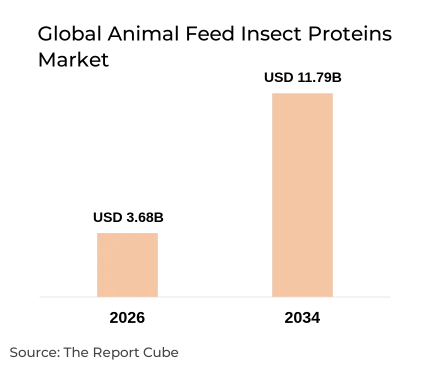
- Market valued at USD 3.68 billion in 2026, reflecting accelerating sustainable protein adoption globally.
- Industry projected to reach USD 11.79 billion by 2034, expanding at a 15.67% CAGR.
- Black Soldier Fly remains the dominant protein source segment owing to superior bioconversion efficiency.
- Growth optimization leads application segments driven by rising livestock productivity enhancement demands worldwide.
- Europe maintains regional leadership through pioneering regulatory frameworks and established insect farming infrastructure.
- Asia-Pacific emerges as the fastest-growing region fueled by aquaculture expansion and government investments.
- Leading companies include AgriProtein, Ynsect, Protix, InnovaFeed, Enterra Feed Corporation, and Aspire Food Group.
- Escalating fishmeal replacement demand and circular economy mandates continue accelerating insect protein adoption globally.
Global Animal Feed Insect Proteins Market Insights & Analysis
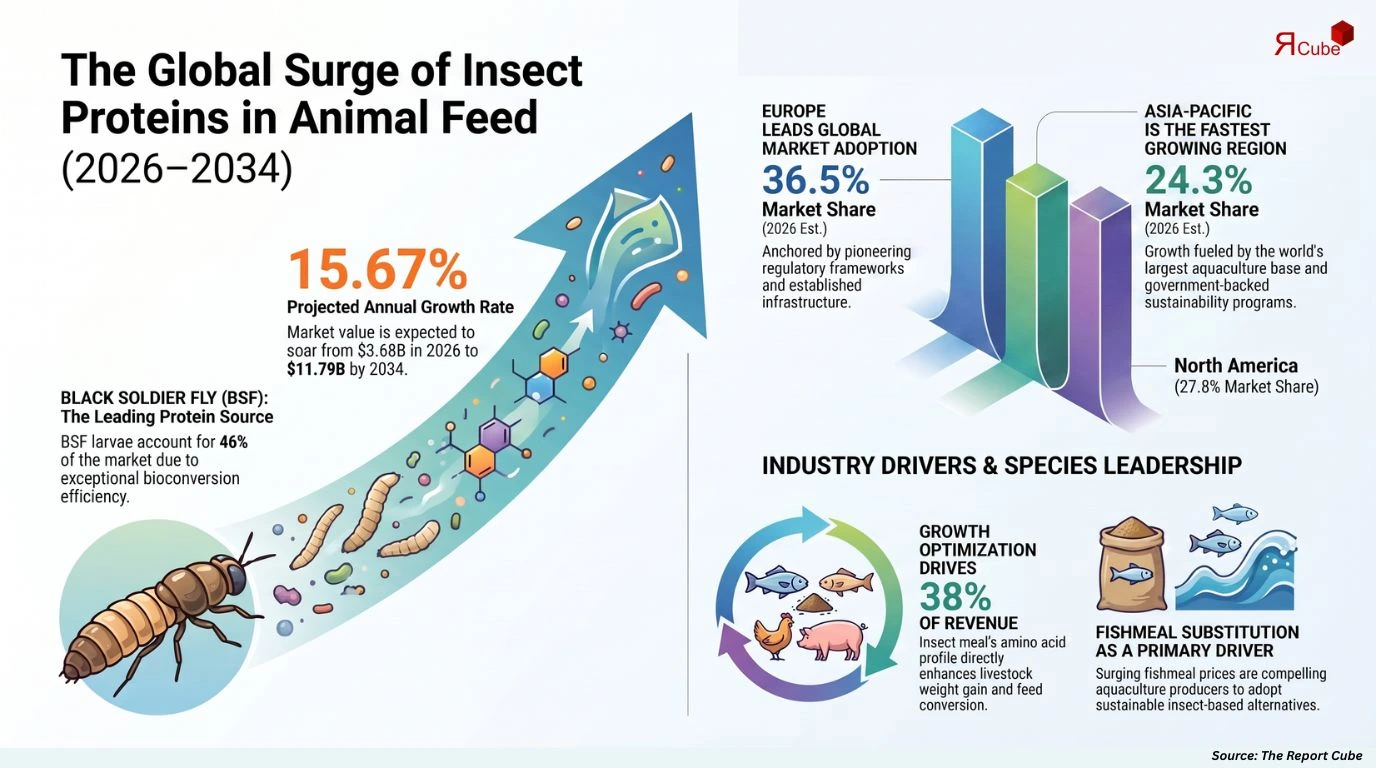
The Global Animal Feed Insect Proteins Market is anticipated to register a 15.67% CAGR during 2026–2034. The market size was valued at USD 3.68 billion in 2026 and is projected to reach USD 11.79 billion by 2034. The industry is benefiting from intensifying pressure on conventional feed supply chains, rising costs of fishmeal and soybean meal, and expanding regulatory approvals that formally authorize insect-derived processed animal proteins for use in poultry, swine, and aquaculture feed. Governments across the European Union, United States, and major Asia-Pacific economies are actively funding insect protein infrastructure through circular economy policy mandates and agricultural sustainability programs.
Institutional investment activity further reinforces long-term market confidence. InnovaFeed secured €51 million in new funding in 2026 to scale commercial deployment of its black soldier fly ingredients at its fully industrialized Nesle production facility. Ynsect, backed by over USD 420 million in cumulative capital, continues scaling mealworm protein capacity through automated vertical farming systems. The FAO and World Bank have jointly established sustainability frameworks positioning insect protein as a critical contributor to global feed security targets by 2050, stimulating additional public and private capital allocation across production and distribution infrastructure worldwide.
Global Animal Feed Insect Proteins Market Dynamics
Demand for animal feed insect proteins continues expanding as aquaculture producers, poultry integrators, swine feed manufacturers, and pet food companies accelerate the substitution of conventional protein ingredients. Rising environmental accountability mandates, increasing volatility in fishmeal pricing, and growing consumer preference for sustainably sourced animal products are collectively elevating insect protein from a niche alternative to a strategic ingredient category across global feed value chains.
|
Factor |
Type |
Specific Impact on Market |
Magnitude |
|---|---|---|---|
|
Fishmeal price volatility |
Driver |
Accelerates insect meal adoption in aquaculture and poultry feed |
Very High |
|
EU regulatory approvals for insect PAPs |
Driver |
Expands commercial deployment across livestock feed categories |
High |
|
Circular economy waste valorization |
Opportunity |
Enables low-cost insect substrate sourcing from agri-food by-products |
High |
|
Aquaculture production expansion |
Driver |
Increases demand for high-protein sustainable fishmeal substitutes |
Very High |
|
Automated insect rearing technology |
Trend |
Reduces per-kilogram production costs and improves feed grade consistency |
High |
Key Market Driver: Fishmeal Substitution in Aquaculture Feed
Global aquaculture production is projected to expand from 130 million metric tons in 2025 to approximately 185 million metric tons by 2034, intensifying demand for high-quality, sustainably sourced protein ingredients. Black Soldier Fly larvae meal delivers 42–48% crude protein with an amino acid profile closely comparable to conventional fishmeal, enabling direct substitution rates of 25–50% in commercial aquafeed formulations. Simultaneously, fishmeal spot prices surged over 30% between 2022 and 2025 due to Peruvian anchovy quota reductions, compelling feed formulators to accelerate structured procurement partnerships with industrial-scale insect protein manufacturers across Europe, North America, and Southeast Asia.
Major Industry Challenge: Regulatory Fragmentation Across Key Markets
Despite meaningful progress in the European Union, where Commission Regulation 2017/893 authorized insect processed animal proteins for aquaculture and subsequent amendments extended approvals to poultry and swine, regulatory frameworks remain inconsistent across major markets. In the United States, the FDA continues developing formal guidance on insect-derived feed ingredients while AAFCO's ingredient definition process for dried black soldier fly larvae progresses incrementally. In China, insect protein import tariff structures and quality certification requirements create additional compliance complexity. This regulatory fragmentation forces manufacturers to maintain separate product certifications and documentation systems, increasing operational overhead and limiting the pace of global commercial scaling for insect protein producers.
Emerging Trend Shaping Outlook: Automated Vertical Insect Farming
Industrial-scale insect protein producers are rapidly deploying automated rearing systems, computer vision-guided larvae monitoring, IoT-enabled climate control, and AI-powered feed optimization technologies to improve production consistency and reduce unit costs. Ynsect's facilities incorporate robotic harvesting and vertical farming stacks achieving over 95% climate-controlled environment optimization, while Protix operates fully vertically integrated production targeting 150,000 metric tons of annual capacity by 2028. These automated systems improve feed conversion ratios, reduce labor intensity, lower energy consumption per kilogram of protein produced, and enable continuous quality monitoring that meets the stringent nutritional specifications demanded by commercial aquafeed and compound feed manufacturers.
Need Specific Data, Let’s Customize the Report for You
Request CustomizationThe global animal feed insect proteins market demonstrates broad segmentation across application functions and protein source species, with distinct revenue contributions reflecting the diverse nutritional, sustainability, and economic rationale driving adoption across commercial livestock, aquaculture, and pet food value chains.
By Application
- Growth Optimization
- Disease Prevention
- Nutrient Fortification
- Environmental Sustainability
- Cost Optimization
Growth optimization represents the dominant application segment, accounting for approximately 38% of total market revenue in 2026. This dominance reflects the foundational role of insect protein as a high-density amino acid source that directly supports weight gain, feed conversion improvement, and muscle development in aquaculture, broiler poultry, and swine production systems. Black soldier fly meal and mealworm protein demonstrate lysine, methionine, and threonine profiles that match or exceed soybean meal specifications, making them directly substitutable in growth-phase feed formulations. Commercial broiler producers in Europe and North America have integrated insect meal at 5–15% inclusion rates, reporting measurable improvements in average daily weight gain and feed conversion ratios compared to conventional formulations.
Disease prevention and nutrient fortification are the fastest-growing application sub-segments, collectively accounting for approximately 28% of market revenue in 2026. Insect-derived chitin present in black soldier fly and mealworm fractions has demonstrated immunostimulatory properties in Atlantic salmon and broiler chicken trials, reducing incidence of bacterial and fungal infections without antibiotic supplementation. Nutrient fortification applications leverage the high levels of lauric acid, zinc, iron, and B-vitamins naturally present in insect protein fractions, enabling functional feed formulations targeting reproductive performance, bone density, and egg quality enhancement across layer poultry and aquaculture breeding stock. Environmental sustainability and cost optimization applications are gaining structured commercial traction as circular economy policies mandate organic waste valorization in feed production systems.

By Protein Source
- Black Soldier Fly
- Housefly
- Mealworm
- Cricket
- Buffalo Worm
Black Soldier Fly (BSF) dominates the protein source segment with an estimated 46% market share in 2026, driven by its exceptional bioconversion efficiency, broad substrate flexibility, and regulatory acceptance across major global feed markets. BSF larvae convert organic agricultural by-products into high-protein biomass at conversion efficiencies exceeding 50%, while producing 80% fewer greenhouse gas emissions and consuming 75% less water than conventional livestock protein production. The species has received regulatory authorization for processed animal protein use in aquaculture feed under EU frameworks and continues receiving expanded approvals globally, making it the preferred commercial insect species for large-scale production operations including those of InnovaFeed, Protix, and AgriProtein.
Mealworm ranks as the second-largest protein source segment with an estimated 22% share in 2026, supported by Ynsect's large-scale automated vertical farming facilities and strong nutritional performance in poultry and pet food applications. Mealworm protein delivers 45–52% crude protein with a lower lipid content of 18–22% compared to BSF, making it particularly suited for applications requiring leaner protein profiles. Cricket-based protein is the fastest-growing alternative source, expanding at above-market rates due to strong consumer acceptance in pet food and specialty aquaculture applications across North America and Europe. Housefly and buffalo worm segments serve niche applications in research-stage formulations and regional specialty feeds, with commercialization expected to broaden significantly through 2034 as automation reduces production costs and expands viable substrate access across emerging market geographies.
Regional Projection of Global Animal Feed Insect Proteins Market
The global animal feed insect proteins market exhibits pronounced regional differentiation based on regulatory maturity, existing insect farming infrastructure, aquaculture and livestock sector scale, and government commitment to sustainable feed transition programs.
|
Region |
Estimated Market Share |
Key Growth Factors |
Consumer Trends |
|---|---|---|---|
|
Europe |
36.5% |
EU regulatory approvals, circular economy policy, established producers |
Rising aquafeed and pet food insect protein adoption |
|
North America |
27.8% |
R&D investment, aquaculture expansion, venture capital funding |
Growing poultry and companion animal feed insect meal use |
|
Asia-Pacific |
24.3% |
Aquaculture scale, government incentives, traditional insect use |
Rapid adoption in shrimp and fish feed formulations |
|
Latin America |
7.2% |
Expanding poultry integration, sustainability certification pressure |
Increasing commercial interest in insect meal substitution |
|
Middle East and Africa |
4.2% |
Circular waste management programs, livestock modernization |
Pilot-stage insect farming facility investments |
- Europe: Europe dominates with an estimated 36.5% market share, anchored by pioneering EU regulatory frameworks that authorized insect processed animal proteins for aquaculture and subsequently for poultry and swine feed, combined with established commercial producers including Protix in the Netherlands, InnovaFeed in France, and Ynsect operating large-scale mealworm facilities. Government circular economy mandates requiring organic waste valorization and carbon footprint reduction in feed supply chains continue reinforcing producer investment and buyer adoption across the region.
- North America: North America holds approximately 27.8% of the global market, supported by expanding aquaculture production along the Pacific and Atlantic coasts, growing venture capital activity in alternative protein, and R&D investments from Enterra Feed Corporation and Aspire Food Group. The USDA's sustainable agriculture investment programs and AAFCO's ongoing formalization of insect ingredient definitions are expected to accelerate regulatory clarity and commercial adoption through 2034.
- Asia-Pacific: Asia-Pacific represents the fastest-growing regional market, driven by the world's largest aquaculture production base, abundant organic substrate availability for insect rearing, and strong government-backed sustainable agriculture modernization programs across China, Vietnam, Indonesia, and India. China alone accounts for over 260 million metric tons of annual feed production, creating a substantial structural demand pool for commercially competitive insect protein ingredients as production scale and regulatory frameworks mature.
- Latin America: Latin America contributes approximately 7.2% of global market revenue, with Brazil emerging as the primary growth engine owing to its 500-million-bird poultry population and export-oriented feed certification requirements aligned with European sustainability standards, which are creating structured demand for insect protein inclusion in commercial poultry feed formulations.
- Middle East and Africa: The Middle East and Africa region accounts for approximately 4.2% of global market revenue, with South Africa serving as a production hub through AgriProtein's commercial black soldier fly operations. Expanding livestock modernization programs, increasing organic waste management mandates, and growing investments in sustainable aquaculture infrastructure across the Gulf Cooperation Council countries are expected to gradually accelerate regional market development through 2034.
Global Animal Feed Insect Proteins Market: Recent Development (2025)
- InnovaFeed secured €51 million in funding to expand commercial insect protein production at Nesle facility.
- Ynsect unveiled plans to double French production output by investing in a new advanced facility.
- Protix extended global distribution networks through strengthened aquaculture and pet food manufacturer partnerships.
- AgriProtein won a new contract to supply insect protein across expanded Asian aquaculture distribution channels.
Global Animal Feed Insect Proteins Market Future Outlook (2034)
The Global Animal Feed Insect Proteins Market is projected to expand at a 15.67% CAGR, reaching approximately USD 11.79 billion by 2034. Sustained growth will be driven by deepening fishmeal substitution across commercial aquaculture, accelerating regulatory harmonization across North American and Asia-Pacific markets, and the continued cost-competitiveness improvements delivered by automated industrial-scale insect farming. End-of-life battery-free circular production models leveraging agricultural by-products as low-cost substrates will enable producers to deliver insect meal at price parity with fishmeal in an increasing number of feed categories and regional markets by the early 2030s.
AI-driven feed formulation optimization, predictive larvae health monitoring, and machine learning-enabled bioconversion efficiency tools will become core operational components for leading insect protein manufacturers. Automated vertical farming adoption will reduce per-kilogram production costs by an estimated 35–45% between 2026 and 2034, unlocking new downstream markets in swine, ruminant, and commercial layer poultry feed segments that currently remain cost-constrained. Long-term expansion will also be supported by the integration of insect frass as a biofertilizer by-product, enabling producers to generate additional revenue streams that improve unit economics and strengthen the commercial viability of large-scale insect protein operations across all major regions.
Global Animal Feed Insect Proteins Market Report Coverage
|
Report Attribute |
Details |
|---|---|
|
Market Name |
Global Animal Feed Insect Proteins Market |
|
Market Size (2026) |
USD 3.68 Billion |
|
Market Size (2034) |
USD 11.79 Billion |
|
Forecast Period |
2026–2034 |
|
CAGR |
15.67% |
|
Base Year |
2026 |
|
Historical Years |
2021–2025 |
|
Forecast Years |
2026–2034 |
|
Segments Covered |
By Application, By Protein Source, By Feed Type, By Form |
|
Regions Covered |
North America, Europe, Asia-Pacific, Latin America, Middle East and Africa |
|
Key Companies |
AgriProtein, Ynsect, Protix, Enterra Feed Corporation, InnovaFeed, Aspire Food Group, Hexafly, Bugsolutely |
|
Report Format |
PDF, Excel, PPT |
|
Customization |
Available as per client requirements |
Why Choose This Report?
- Comprehensive analysis covering insect protein adoption across all major animal feed segments globally.
- Accurate market sizing with a reliable 15.67% CAGR forecast extending through 2034.
- Detailed segmentation analysis highlighting growth optimization and black soldier fly revenue leadership.
- Regional insights supported by evolving EU, US, and Asia-Pacific regulatory developments.
- Competitive profiling of AgriProtein, Ynsect, Protix, InnovaFeed, and emerging insect producers.
- Forward-looking analysis of automated vertical farming and AI-driven production cost reduction.
- Strategic investment insights across aquaculture, poultry, swine, and pet food application categories.
- Data-driven research following EEAT best practices and current 2025–2026 market intelligence.
Table of Contents
- Introduction
- Objective of the Study
- Product Definition
- Market Segmentation
- Study Variables
- Research Methodology
- Secondary Data Points
- Companies Interviewed
- Primary Data Points
- Breakdown of Primary Interviews
- Secondary Data Points
- Executive Summary
- Market Dynamics
- Drivers
- Challenges
- Opportunity Assessment
- Recent Trends and Developments
- Policy and Regulatory Landscape
- Global Animal Feed Insect Proteins Market Overview and Forecast Analysis (2021-2034)
- Market Size, By Value, By Growth Rate (CAGR/USD Billions)
- Demand – Supply Trends
- Market Share, By Form
- Whole Insect Meal
- Insect Frass
- Insect Oil
- Hydrolyzed Insect Protein
- Market Share, By Feed Type
- Fish Feed
- Pet Food
- Poultry Feed
- Swine Feed
- Aquaculture Feed
- Market Share, By Application
- Growth Optimization
- Disease Prevention
- Nutrient Fortification
- Environmental Sustainability
- Cost Optimization
- Market Share, By Protein Source
- Black Soldier Fly
- Housefly
- Mealworm
- Cricket
- Buffalo Worm
- Market Share, By Region
- Europe
- North America
- Asia-Pacific
- Latin America
- Middle East and Africa
- Market Share, By Competitors
- Competition Characteristics
- Revenue Shares
- Whole Insect Meal Global Animal Feed Insect Proteins Market Overview, 2021-2034F
- By Value (USD Million)
- By Feed Type – Market Size & Forecast 2021-2034, USD Million
- Fish Feed
- Pet Food
- Poultry Feed
- Swine Feed
- Aquaculture Feed
- Insect Frass Global Animal Feed Insect Proteins Market Overview, 2021-2034F
- By Value (USD Million)
- By Feed Type – Market Size & Forecast 2021-2034, USD Million
- Fish Feed
- Pet Food
- Poultry Feed
- Swine Feed
- Aquaculture Feed
- Insect Oil Global Animal Feed Insect Proteins Market Overview, 2021-2034F
- By Value (USD Million)
- By Feed Type – Market Size & Forecast 2021-2034, USD Million
- Fish Feed
- Pet Food
- Poultry Feed
- Swine Feed
- Aquaculture Feed
- Hydrolyzed Insect Protein Global Animal Feed Insect Proteins Market Overview, 2021-2034F
- By Value (USD Million)
- By Feed Type – Market Size & Forecast 2021-2034, USD Million
- Fish Feed
- Pet Food
- Poultry Feed
- Swine Feed
- Aquaculture Feed
- Competitive Outlook (Company Profile – Partial List)
- AgriProtein
- Company Overview
- Business Segments
- Strategic Alliances/Partnerships
- Recent Developments
- Ynsect
- Company Overview
- Business Segments
- Strategic Alliances/Partnerships
- Recent Developments
- Protix
- Company Overview
- Business Segments
- Strategic Alliances/Partnerships
- Recent Developments
- Enterra Feed Corporation
- Company Overview
- Business Segments
- Strategic Alliances/Partnerships
- Recent Developments
- InnovaFeed
- Company Overview
- Business Segments
- Strategic Alliances/Partnerships
- Recent Developments
- Aspire Food Group
- Company Overview
- Business Segments
- Strategic Alliances/Partnerships
- Recent Developments
- Hexafly
- Company Overview
- Business Segments
- Strategic Alliances/Partnerships
- Recent Developments
- Bugsolutely
- Company Overview
- Business Segments
- Strategic Alliances/Partnerships
- Recent Developments
- Others
- AgriProtein
- Contact Us & Disclaimer
Top Key Players & Market Share Outlook
- AgriProtein
- Ynsect
- Protix
- Enterra Feed Corporation
- InnovaFeed
- Aspire Food Group
- Hexafly
- Bugsolutely
- Others
Frequently Asked Questions






