



Build Your Custom Market Intelligence Report
Customize Your ReportAsia Automotive Engines Market Key Highlights
By Engine Type:
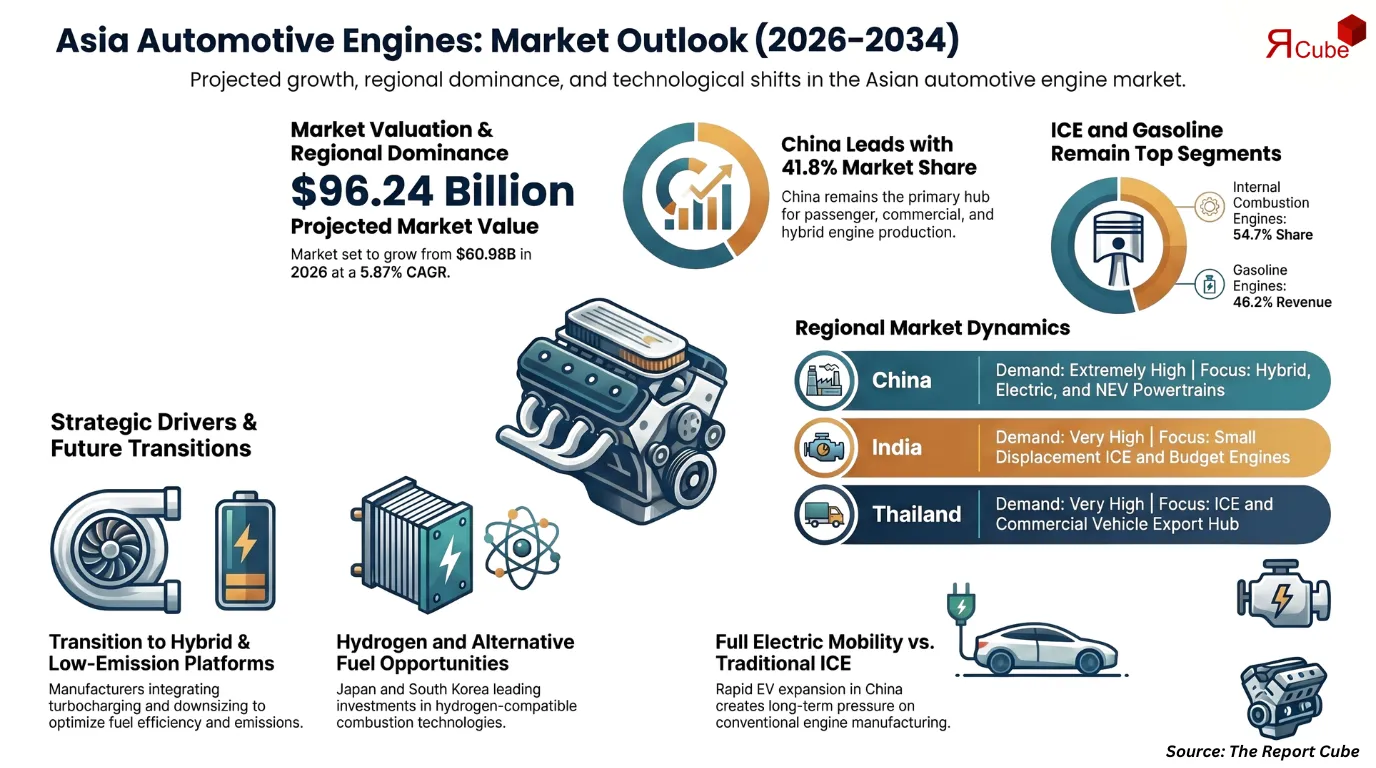
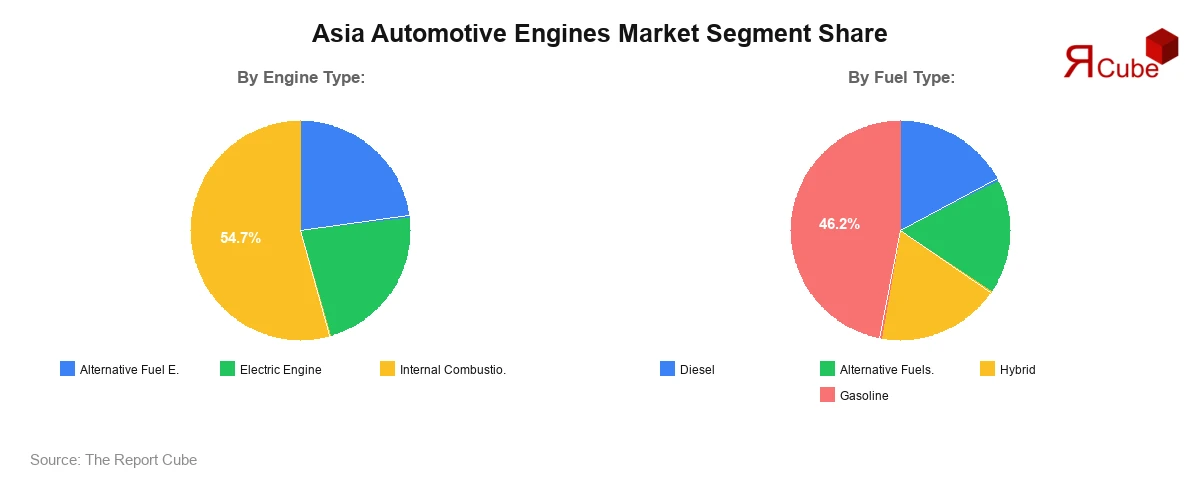
Internal Combustion Engine (ICE) segment leads the market with nearly 54.7% share.
By Fuel Type:
Gasoline engine segment dominates the market with around 46.2% of total revenue.
Regional Outlook:
China dominates the Asia Automotive Engines market with approximately 41.8% share.
Asia Automotive Engines Market Insights & Analysis
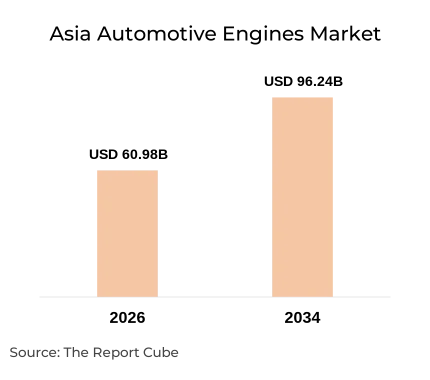
The Asia Automotive Engines Market is anticipated to register a CAGR of around 5.87% during the forecast period 2026-2034. The market size is valued at USD 60.98 billion in 2026 and is projected to reach USD 96.24 billion by 2034. Strong automotive manufacturing activity across China, India, Japan, South Korea, and Southeast Asian economies continues to create stable demand for gasoline engines, hybrid propulsion systems, and commercial vehicle powertrains. Vehicle production capacity expansion by regional and international automakers is strengthening localized engine manufacturing operations across Asia. Passenger vehicle ownership is increasing steadily due to urban population growth, industrial expansion, and improving household income levels, particularly in India, Indonesia, Thailand, and Vietnam.
Growing adoption of hybrid engines, hydrogen-compatible combustion technologies, and low-emission fuel systems is reshaping the Asia automotive engines market growth outlook. Automotive manufacturers are actively focusing on engine downsizing, turbocharging technologies, and lightweight engine materials to improve fuel efficiency and reduce carbon emissions. Countries such as Japan and South Korea are expanding investments in hydrogen-powered mobility infrastructure, while China continues large-scale electric vehicle manufacturing expansion. In addition, government-backed clean mobility programs, emission standards, and industrial incentives are encouraging automotive OEMs to modernize engine platforms and increase production capacity for sustainable automotive engine technologies across the regional automotive sector.
Asia Automotive Engines Market Impact Analysis
| Factor | Type | Specific Impact on Market | Magnitude | Business Implication |
|---|---|---|---|---|
| Rising Vehicle Production in Asia | Market | Higher car and truck output lifts demand for new engines | High | Supports capacity expansion and long term supply contracts |
| Shift Toward Fuel Efficient Powertrains | Technological | OEMs adopt advanced engines to meet efficiency targets | High | Requires rapid upgrade of designs and engineering capability |
| Stringent Emission Regulations in Region | Regulatory | Tough norms push cleaner combustion and hybrid engines | High | Drives investment in compliant low emission engine platforms |
| Growing Adoption of Hybrid and EV Drivetrains | Environmental | Electric powertrains gradually reduce ICE engine share | Medium | Engine makers must diversify into hybrid and EV solutions |
| Volatile Raw Material and Component Prices | Market | Cost swings affect profitability of engine manufacturing | Medium | Needs flexible sourcing and strong cost control programs |
| Regional Supply Chain and Localization Push | Competitive | Local sourcing gains favor to reduce import dependence | Medium | Encourages regional plants and partnerships with suppliers |
| Rising Demand for Commercial and Fleet Vehicles | Consumer | Logistics and fleet growth sustains heavy duty engine need | High | Opens opportunity in durable and high torque engine lines |
Asia Automotive Engines Market Dynamics
Key Driver: Rising Vehicle Production and Industrial Transportation Demand
Asia continues to dominate global vehicle manufacturing output, creating sustained demand for advanced automotive engine systems across passenger and commercial transportation segments. China, India, Thailand, and Indonesia are witnessing continuous expansion in automotive assembly operations supported by infrastructure growth, industrial investments, and rising regional trade activity. Passenger cars remain the largest contributor to engine demand due to increasing personal mobility requirements and broader financing accessibility across developing economies.
Commercial transportation growth is also supporting demand for durable diesel engines and hybrid commercial vehicle powertrains. Logistics operators and fleet owners are investing in fuel-efficient engine technologies to improve operational performance and reduce long-term maintenance costs. Automotive manufacturers are responding through localized production strategies, upgraded combustion technologies, and advanced engine management systems designed to meet evolving emission standards while maintaining engine durability and fuel efficiency.
Industry Trends: Transition Toward Hybrid and Low-Emission Engine Platforms
Automotive engine manufacturers across Asia are actively modernizing engine portfolios to align with stricter emission standards and sustainable mobility targets. Hybrid propulsion systems are gaining strong momentum across passenger vehicle categories as consumers seek improved fuel economy without sacrificing driving range or vehicle performance. Manufacturers are integrating turbocharged gasoline engines, advanced thermal efficiency systems, and intelligent engine control technologies to optimize fuel consumption and reduce carbon emissions.
Hydrogen-compatible combustion engines are emerging as a strategic innovation area, particularly in Japan and South Korea where governments and automotive companies are accelerating investments in next-generation clean mobility technologies. Southeast Asian markets are also witnessing increased demand for cleaner diesel engine platforms within SUVs and utility vehicles. This trend is encouraging regional manufacturers to strengthen research capabilities and diversify product portfolios toward low-emission engine technologies suitable for future transportation requirements.
Book your FREE 30-minute expert consultation today
Contact UsMajor Challenge: Accelerating Shift Toward Full Electric Mobility
The rapid expansion of battery electric vehicle adoption across Asia is creating long-term pressure on conventional automotive engine manufacturers. China, Japan, and South Korea continue introducing stricter emission regulations and electric mobility incentives aimed at reducing dependency on traditional internal combustion engines. As electric vehicle infrastructure expands, automotive companies are gradually reallocating investments toward battery systems and electric drivetrains.
Engine manufacturers also face rising operational costs linked to advanced emission compliance, fuel efficiency upgrades, and evolving environmental regulations. Developing cleaner combustion systems requires significant capital investment in engineering, testing, and manufacturing modernization. Small and medium-sized engine component suppliers may encounter additional challenges adapting to fast-changing regulatory standards and fluctuating raw material pricing conditions across the apac automotive supply chain.
Opportunity: Expansion of Hydrogen and Alternative Fuel Engine Technologies
Long-term opportunities within the Asia automotive engines market are increasingly tied to hydrogen-compatible engines, hybrid propulsion technologies, and alternative fuel systems. Governments across Asia are supporting cleaner transportation initiatives through industrial incentives, low-emission mobility programs, and investments in hydrogen infrastructure development. Automotive OEMs are accelerating research programs focused on hydrogen combustion systems and synthetic fuel compatibility to diversify future engine solutions.
Heavy commercial vehicle operators and industrial transportation companies are also exploring fuel-flexible engine technologies capable of lowering emissions while maintaining high operational performance. This shift is creating opportunities for advanced diesel engines, compressed natural gas systems, and hybrid commercial vehicle platforms. Expanding automotive manufacturing hubs across Southeast Asia are expected to further support localized engine production, aftermarket services, and component supply chain development during the forecast period.
Asia Automotive Engines Market Segment-wise Analysis
By Engine Type:
- Alternative Fuel Engine
- Electric Engine
- Internal Combustion Engine (ICE)
The internal combustion engine (ICE) technology segment led the market, accounting for nearly 54.7% total share of the Asia automotive engines market due to its extensive application across passenger cars, light commercial vehicles, and heavy-duty transportation fleets. Established fueling infrastructure, lower upfront vehicle costs, and broad servicing networks continue supporting strong adoption of gasoline and diesel engine platforms across developing Asian economies. Automotive manufacturers are enhancing ICE efficiency through direct injection systems, variable valve timing technologies, and lightweight engine architecture.
Demand for hybrid-compatible combustion engines is also increasing steadily as automakers balance fuel efficiency goals with consumer preference for extended driving range. Commercial transportation industries across India, China, and Southeast Asia continue depending heavily on advanced diesel engine systems for freight movement and industrial logistics. This sustained demand is supporting ongoing investments in cleaner combustion technologies and improved engine durability solutions.
By Fuel Type:
- Diesel
- Alternative Fuels
- Hybrid
- Gasoline
Gasoline-powered engines maintain a dominant position within the Asia automotive engines market with approximately 46.2% revenue share owing to strong demand for compact passenger vehicles and urban mobility solutions. Countries including India, Indonesia, Thailand, and Vietnam continue experiencing consistent growth in gasoline vehicle registrations supported by affordability, lower maintenance requirements, and expanding middle-income populations. Automotive companies are improving gasoline engine performance through hybrid integration, turbocharging systems, and intelligent fuel management technologies.
Hybrid fuel systems are recording notable growth across Japan, China, and South Korea where consumers increasingly prioritize fuel savings and reduced environmental impact. At the same time, alternative fuel technologies such as hydrogen combustion engines and compressed natural gas systems are gaining attention within public transportation and commercial fleet applications. This diversification of fuel technologies is reshaping long-term engine development strategies across the regional automotive industry.
Countries Projection of Asia Automotive Engines Industry
- China
- Japan
- South Korea
- India
- Bangladesh
- Indonesia
- Thailand
- Vietnam
- Malaysia
- Others
China dominates the Asia automotive engines market with around 41.8% regional share due to its large-scale automotive manufacturing ecosystem, advanced supply chain infrastructure, and strong domestic vehicle demand. The country remains a major production hub for passenger cars, commercial vehicles, hybrid powertrains, and electric mobility platforms. Chinese automotive companies are investing heavily in advanced engine technologies, automated manufacturing systems, and localized component production to strengthen competitiveness within both regional and international markets.
Japan and South Korea maintain strong market positions through technological leadership in hybrid engines, hydrogen-powered mobility systems, and premium automotive engineering capabilities. Meanwhile, Southeast Asian countries including Thailand, Indonesia, and Vietnam are emerging as important automotive production centers driven by lower manufacturing costs, favorable industrial policies, and expanding domestic vehicle demand. These regional developments are collectively supporting long-term growth across the Asia automotive engines market.
Need insights for a specific region within this market?
Request Regional DataAsia Automotive Engines Market Countries Analysis
The Asia automotive engines market demonstrates diverse growth patterns across countries, driven by production capacity, electrification trends, and economic development.
| Country | Demand Level | Key Engine Types | Production Focus | Core Demand Logic | Growth Nature |
|---|---|---|---|---|---|
| China | Extremely High | Hybrid & Electric powertrains | NEVs & domestic brands | World's largest producer for 17 years | Zero to slight growth |
| Japan | Medium | ICE & Hybrid engines | Fuel-efficient powertrains | Export-oriented manufacturing hub | Stagnant market decline |
| South Korea | High | ICE & Hybrid systems | Advanced engine technology | Strong domestic & export market | Recovery-driven growth |
| India | Very High | Small displacement ICE | Budget engines & 2-wheelers | 7% of GDP; 32M employment; volume leader | Rapid expansion phase |
| Indonesia | High | ICE for passenger cars | Assembly & local production | Largest ASEAN market; 803K units sold | Manufacturing expansion |
| Thailand | Very High | ICE & commercial vehicle | ASEAN production leader | Half of ASEAN car production capacity | Export-led growth |
| Vietnam | Medium | Imported ICE assemblies | Assembly from imported parts | 20.3% market growth in 2025; 2nd fastest | Emerging market phase |
| Malaysia | High | ICE & EV powertrains | Domestic brands & EVs | Led ASEAN sales 2025; 820K units | EV-driven transformation |
| Bangladesh | Low to Medium | Small ICE & 2-wheelers | Aftermarket & imports | 3rd largest South Asia; early development | Aftermarket-led growth |
| Others (ASEAN, South Asia) | Low | ICE imports | Import-dependent markets | Limited local production infrastructure | Import-driven demand |
Government Initiatives & Policies
- China New Energy Vehicle Industry Development Plan 2025: China continues supporting electric and hybrid vehicle manufacturing through industrial subsidies, localized battery production incentives, and charging infrastructure investments to strengthen sustainable automotive engine technologies.
- Japan Green Growth Strategy 2026: Japan is accelerating hydrogen engine development, carbon-neutral mobility programs, and low-emission automotive manufacturing investments to support next-generation engine technologies and sustainable transportation systems.
Asia Automotive Engines Industry Recent Developments
- March 2025: Great Wall Motor introduced the diesel-powered Tank 300 SUV in Thailand to strengthen its position within the Southeast Asian utility vehicle segment. The launch supports growing regional demand for fuel-efficient diesel engine platforms designed for urban mobility and off-road transportation applications.
- April 2025: Kawasaki Heavy Industries commercialized a hydrogen-compatible gas engine in Japan capable of operating with fuel blends containing up to 30% hydrogen. The innovation reflects increasing industry investment in low-emission combustion systems and sustainable automotive propulsion technologies.
Why Choose This Report?
- Provides a comprehensive overview of the overall market analysis, encompassing key trends, consumer behavior analysis, and risk assessment to support strategic decision-making.
- Provides accurate, up-to-date insights into market size, segmentation, and emerging opportunities, helping to minimize risk & capitalizing on growth.
- Gives deep understanding of target audience preferences, investment habits, and communication channels for enhanced product development & marketing effectiveness.
- Delivers competitive analysis & benchmarking, uncovering the strengths & weaknesses of market competitors to guide strategies.
- Consolidate comprehensive market intelligence, reducing reasoning & streamlining research efforts.
- Facilitates customized market segmentation & risk mitigation strategies, fine-tuned to the business objectives.
- Aids in identifying both market challenges & untapped opportunities within the industry to drive long-term business growth.
- Provides valuable information based on actual customer data & search trends.
Table of Contents
- Introduction
- Objective of the Study
- Product and Category Definition
- Market Segmentation
- Study Variables
- Research Methodology
- Secondary Data Points
- Breakdown of Secondary Sources
- Primary Data Points
- Breakdown of Primary Interviews
- Secondary Data Points
- Executive Summary
- Market Dynamics
- Emerging Opportunities
- Adoption Trends
- Demand Drivers
- Disruption Analysis (Challenges)
- Industry Analysis and Strategic Insights
- Supply and Value Chain Analysis
- Pricing Analysis
- Go-To-Market (GTM) Strategy
- BCG Matrix
- Recent Trends and Developments
- Import and Export Analysis
- Regulatory and Policy Landscape
- Region-wise Policies
- Government Initiatives
- Asia Automotive Engines Market Overview and Forecast Analysis (2021-2034)
- Market Size, By Value and Growth Rate (CAGR/USD Billion)
- Market Share, By Engine Type
- Alternative Fuel Engine
- Electric Engine
- Internal Combustion Engine (ICE)
- Market Share, By Fuel Type
- Diesel
- Alternative Fuels
- Hybrid
- Gasoline
- Market Share, By Vehicle Type
- Heavy Commercial Vehicles (HCVs)
- Passenger Cars
- Light Commercial Vehicles (LCVs)
- Market Share, By Engine Capacity
- Below 1.0L
- 1.0L-2.0L
- 2.0L-3.0L
- Above 3.0L
- Market Share, By Engine Configuration
- Opposed Engine
- In-line Engine
- V-type Engine
- Market Share, By Sales Channel
- Aftermarket
- OEM
- Market Share, By Country
- China
- Japan
- South Korea
- India
- Bangladesh
- Indonesia
- Thailand
- Vietnam
- Malaysia
- China Automotive Engines Market Overview and Forecast Analysis (2021-2034)
- Market Size, By Value and Growth Rate (CAGR/USD Billion/Million)
- Market Share, By Engine Type
- Market Share, By Fuel Type
- Market Share, By Vehicle Type
- Market Share, By Engine Capacity
- Market Share, By Engine Configuration
- Market Share, By Sales Channel
- Japan Automotive Engines Market Overview and Forecast Analysis (2021-2034)
- Market Size, By Value and Growth Rate (CAGR/USD Billion/Million)
- Market Share, By Engine Type
- Market Share, By Fuel Type
- Market Share, By Vehicle Type
- Market Share, By Engine Capacity
- Market Share, By Engine Configuration
- Market Share, By Sales Channel
- South Korea Automotive Engines Market Overview and Forecast Analysis (2021-2034)
- Market Size, By Value and Growth Rate (CAGR/USD Billion/Million)
- Market Share, By Engine Type
- Market Share, By Fuel Type
- Market Share, By Vehicle Type
- Market Share, By Engine Capacity
- Market Share, By Engine Configuration
- Market Share, By Sales Channel
- India Automotive Engines Market Overview and Forecast Analysis (2021-2034)
- Market Size, By Value and Growth Rate (CAGR/USD Billion/Million)
- Market Share, By Engine Type
- Market Share, By Fuel Type
- Market Share, By Vehicle Type
- Market Share, By Engine Capacity
- Market Share, By Engine Configuration
- Market Share, By Sales Channel
- Bangladesh Automotive Engines Market Overview and Forecast Analysis (2021-2034)
- Market Size, By Value and Growth Rate (CAGR/USD Billion/Million)
- Market Share, By Engine Type
- Market Share, By Fuel Type
- Market Share, By Vehicle Type
- Market Share, By Engine Capacity
- Market Share, By Engine Configuration
- Market Share, By Sales Channel
- Indonesia Automotive Engines Market Overview and Forecast Analysis (2021-2034)
- Market Size, By Value and Growth Rate (CAGR/USD Billion/Million)
- Market Share, By Engine Type
- Market Share, By Fuel Type
- Market Share, By Vehicle Type
- Market Share, By Engine Capacity
- Market Share, By Engine Configuration
- Market Share, By Sales Channel
- Thailand Automotive Engines Market Overview and Forecast Analysis (2021-2034)
- Market Size, By Value and Growth Rate (CAGR/USD Billion/Million)
- Market Share, By Engine Type
- Market Share, By Fuel Type
- Market Share, By Vehicle Type
- Market Share, By Engine Capacity
- Market Share, By Engine Configuration
- Market Share, By Sales Channel
- Vietnam Automotive Engines Market Overview and Forecast Analysis (2021-2034)
- Market Size, By Value and Growth Rate (CAGR/USD Billion/Million)
- Market Share, By Engine Type
- Market Share, By Fuel Type
- Market Share, By Vehicle Type
- Market Share, By Engine Capacity
- Market Share, By Engine Configuration
- Market Share, By Sales Channel
- Malaysia Automotive Engines Market Overview and Forecast Analysis (2021-2034)
- Market Size, By Value and Growth Rate (CAGR/USD Billion/Million)
- Market Share, By Engine Type
- Market Share, By Fuel Type
- Market Share, By Vehicle Type
- Market Share, By Engine Capacity
- Market Share, By Engine Configuration
- Market Share, By Sales Channel
- Competitive Analysis, 2026
- Market Share of Key Players
- Competitive Mapping for Each Segment and Companies Operating Regionally
- China Automotive Engines Companies Share and Competitive Analysis, 2026
- Japan Automotive Engines Companies Share and Competitive Analysis, 2026
- South Korea Automotive Engines Companies Share and Competitive Analysis, 2026
- India Automotive Engines Companies Share and Competitive Analysis, 2026
- Bangladesh Automotive Engines Companies Share and Competitive Analysis, 2026
- Indonesia Automotive Engines Companies Share and Competitive Analysis, 2026
- Thailand Automotive Engines Companies Share and Competitive Analysis, 2026
- Vietnam Automotive Engines Companies Share and Competitive Analysis, 2026
- Malaysia Automotive Engines Companies Share and Competitive Analysis, 2026
- Company Profile (Partial List)
- General Motors Company
- Company Overview
- Product Portfolio
- Strategic Alliances and Partnerships
- Recent Developments
- Ford Motor Company
- Company Overview
- Product Portfolio
- Strategic Alliances and Partnerships
- Recent Developments
- Honda Motor Company, Ltd.
- Company Overview
- Product Portfolio
- Strategic Alliances and Partnerships
- Recent Developments
- Greaves Cotton
- Company Overview
- Product Portfolio
- Strategic Alliances and Partnerships
- Recent Developments
- Toyota Motor Corporation
- Company Overview
- Product Portfolio
- Strategic Alliances and Partnerships
- Recent Developments
- Cummins Inc.
- Company Overview
- Product Portfolio
- Strategic Alliances and Partnerships
- Recent Developments
- Volkswagen AG
- Company Overview
- Product Portfolio
- Strategic Alliances and Partnerships
- Recent Developments
- Yuchai International
- Company Overview
- Product Portfolio
- Strategic Alliances and Partnerships
- Recent Developments
- Hyundai Motor Company
- Company Overview
- Product Portfolio
- Strategic Alliances and Partnerships
- Recent Developments
- Nissan Motor Co., Ltd.
- Company Overview
- Product Portfolio
- Strategic Alliances and Partnerships
- Recent Developments
- Force Motors
- Company Overview
- Product Portfolio
- Strategic Alliances and Partnerships
- Recent Developments
- Mazda Motor Corporation
- Company Overview
- Product Portfolio
- Strategic Alliances and Partnerships
- Recent Developments
- Stellantis N.V.
- Company Overview
- Product Portfolio
- Strategic Alliances and Partnerships
- Recent Developments
- Bayerische Motoren Werke AG
- Company Overview
- Product Portfolio
- Strategic Alliances and Partnerships
- Recent Developments
- Groupe Renault
- Company Overview
- Product Portfolio
- Strategic Alliances and Partnerships
- Recent Developments
- Anhui Quanchai Engine
- Company Overview
- Product Portfolio
- Strategic Alliances and Partnerships
- Recent Developments
- Weichai Power
- Company Overview
- Product Portfolio
- Strategic Alliances and Partnerships
- Recent Developments
- General Motors Company
- Contact Us and Disclaimer
Top Key Players & Market Share Outlook
- General Motors Company
- Ford Motor Company
- Honda Motor Company, Ltd.
- Greaves Cotton
- Toyota Motor Corporation
- Cummins Inc.
- Volkswagen AG
- Yuchai International
- Hyundai Motor Company
- Nissan Motor Co., Ltd.
- Force Motors
- Mazda Motor Corporation
- Stellantis N.V.
- Bayerische Motoren Werke AG
- Groupe Renault
- Anhui Quanchai Engine
- Weichai Power
- Others
Frequently Asked Questions






