



Build Your Custom Market Intelligence Report
Customize Your ReportChina Automotive Service Market Insights & Analysis
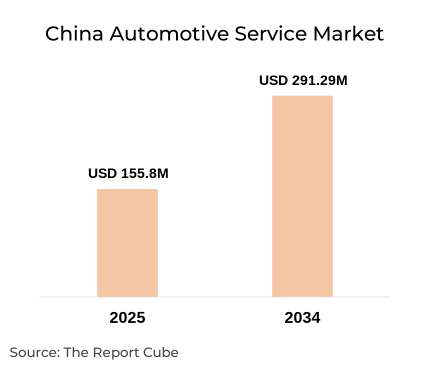
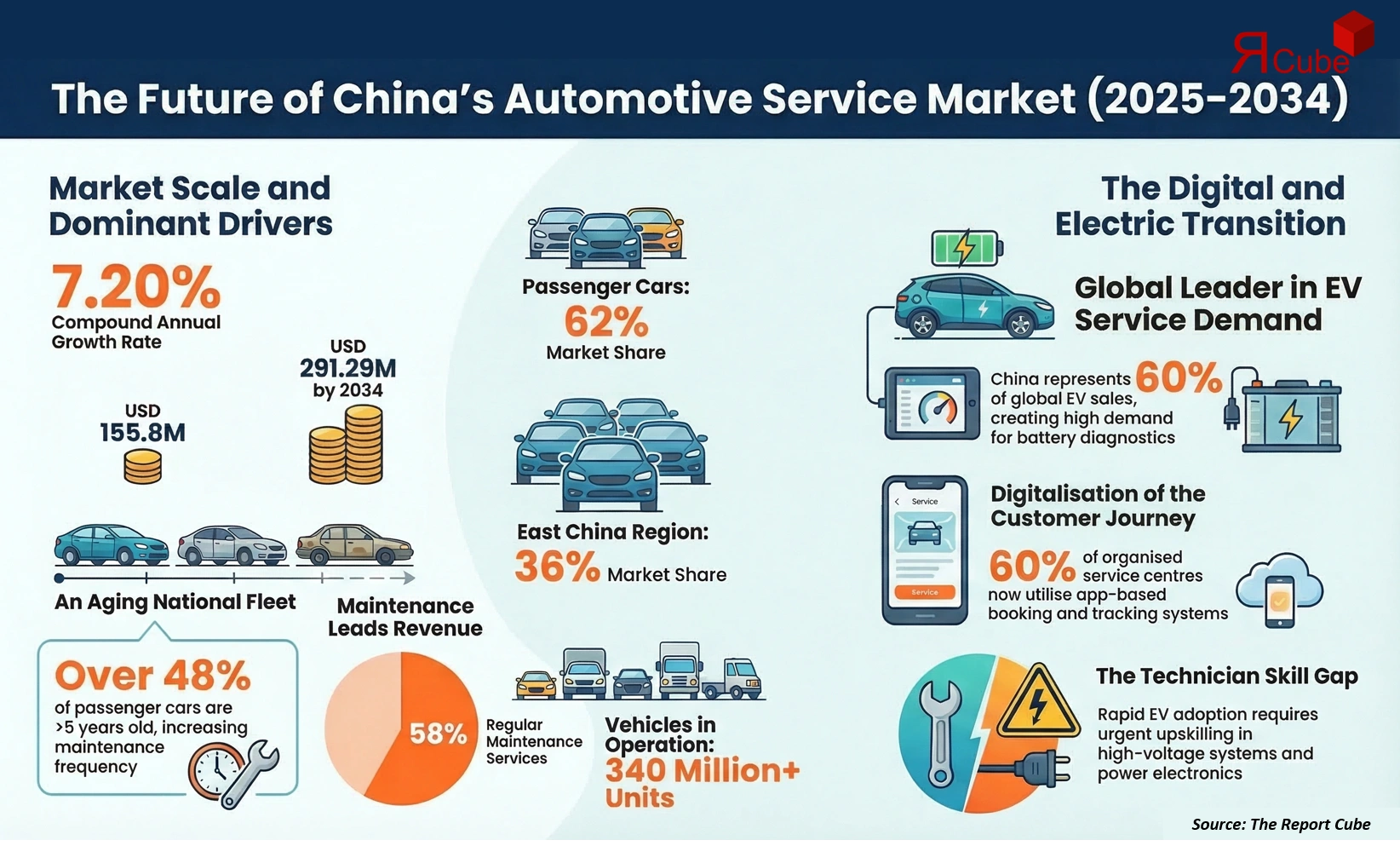
The China Automotive Service Market is anticipated to register a CAGR of 7.20% during the forecast period 2026-2034. The market size was valued at USD 155.8 million in 2025 and is projected to reach USD 291.29 million by 2034. This steady expansion reflects the rapid growth of China’s vehicle parc, rising average vehicle age, and increasing consumer focus on safety, reliability, and long-term vehicle performance.
China’s automotive ecosystem has shifted from being sales-driven to service-oriented, as vehicle ownership penetration stabilizes in urban regions. With over 340 million vehicles currently in operation, demand for regular maintenance, diagnostics, and repair services has intensified across both metropolitan and tier-2 cities. Consumers are increasingly opting for organized service networks that provide standardized pricing, genuine parts, and digital service tracking, improving trust and service transparency.
Additionally, the expansion of electric and hybrid vehicles is reshaping service requirements, encouraging workshops to upgrade technical capabilities and invest in skilled labor. Government emphasis on vehicle safety inspections and emission compliance further supports recurring service demand. Together, these factors position the China Automotive Service Market as a resilient and recurring-revenue industry, supported by structural shifts in vehicle ownership and consumer behavior.
China Automotive Service Market Recent Developments
- 2025: Zhongsheng Group expanded digital aftersales platforms to improve service efficiency and customer retention.
- 2025: BYD Auto Service enhanced EV maintenance training programs across its nationwide dealer network.
Government Initiatives & Policies
- Automobile Aftermarket Development Plan: Supports standardization and digitalization of vehicle service networks.
- Green Vehicle Maintenance Policy: Promotes environmentally compliant repair and recycling practices.
China Automotive Service Market Dynamics
Key Driver: Expanding Vehicle Parc and Aging Fleet
The most influential driver of the China Automotive Service Market is the continuous expansion and aging of the national vehicle fleet. While new vehicle sales growth has moderated, the number of vehicles in operation continues to rise, increasing demand for periodic servicing. Vehicles older than five years now account for more than 48% of total passenger cars, significantly raising the frequency of maintenance and repair visits. Older vehicles typically require brake replacements, engine diagnostics, suspension servicing, and emission checks, all of which generate recurring service revenue. Furthermore, rising disposable income encourages owners to invest in preventive maintenance rather than reactive repairs, improving vehicle longevity. This combination of volume growth and aging vehicles creates a stable demand base, making automotive services less cyclical compared to vehicle sales.
Book your FREE 30-minute expert consultation today
Contact UsIndustry Trends: Digitalization of Automotive Service Operations
Digital transformation is emerging as a defining trend in China’s automotive service industry. Service providers are adopting online appointment systems, digital vehicle health reports, and mobile payment integration to enhance customer convenience. Over 60% of organized service centers now offer app-based booking and service tracking, improving operational efficiency and customer engagement. Data-driven diagnostics tools are also gaining traction, enabling faster fault detection and more accurate repair recommendations. Additionally, partnerships between OEMs and third-party platforms are expanding service reach into lower-tier cities. This trend not only improves service transparency but also strengthens customer loyalty, allowing service providers to differentiate themselves in an increasingly competitive market.
Major Challenge: Fragmentation and Skill Gaps
Market fragmentation remains a key challenge for the China Automotive Service Market. Despite the growth of organized service chains, a significant portion of services is still delivered by small, independent workshops with inconsistent quality standards. This fragmentation creates pricing pressure and limits large-scale standardization. Moreover, the rapid adoption of electric vehicles has exposed skill gaps among technicians, as EVs require specialized knowledge in battery systems and power electronics. Training costs and talent shortages increase operational expenses for service providers. Without continuous workforce upskilling and consolidation, these challenges could restrict efficiency gains and service quality improvements across the market.
Opportunity: Rising Electric Vehicle Service Demand
The accelerating adoption of electric vehicles presents a substantial opportunity for automotive service providers. China accounts for over 60% of global EV sales, creating new demand for battery diagnostics, software updates, and thermal management services. Although EVs require fewer mechanical repairs, their high-voltage systems and software-driven components create specialized service needs. Service providers that invest early in EV-certified infrastructure and technician training can capture premium margins and long-term customer relationships. Additionally, OEM-backed service networks are expanding EV-specific maintenance packages, supporting predictable revenue streams. This transition positions EV servicing as a high-growth subsegment within the broader automotive service market.
China Automotive Service Market Segment-wise Analysis
By Service Type:
- Repair Services
- Maintenance Services
Maintenance Services dominate the market, accounting for approximately 58% of total revenue in 2025. Regular oil changes, inspections, tire services, and preventive maintenance drive consistent demand, particularly among passenger vehicle owners. Maintenance services benefit from predictable service intervals and strong customer retention. Repair Services, holding nearly 42% share, are driven by accident-related repairs and aging vehicle components. As vehicles age, repair intensity increases, supporting steady growth. The complementary nature of both segments ensures balanced revenue generation and long-term market stability.
By Vehicle Type:
- Passenger Cars
- Two-Wheelers
- Light Commercial
- Heavy Commercial
Passenger Cars represent the leading vehicle segment with an estimated 62% market share, supported by high ownership levels and frequent service requirements. Light Commercial Vehicles contribute around 18%, driven by logistics and urban delivery growth. Two-Wheelers and Heavy Commercial Vehicles collectively account for the remaining share, with service demand linked to regional mobility and industrial activity. Passenger car dominance is expected to persist, supported by urbanization and rising consumer expectations for vehicle reliability.
Regional Projection of China Automotive Service Industry
- East China
- South-Central China
- North China
- South-West China
- North-East China
- North-West China
East China leads the market with nearly 36% share, driven by high vehicle density, strong purchasing power, and advanced service infrastructure. Major cities such as Shanghai and Hangzhou support organized service networks and premium offerings. South-Central and North China follow, supported by expanding urban populations and commercial activity. East China’s leadership is reinforced by higher adoption of digital service platforms and EV servicing capabilities, ensuring sustained regional dominance throughout the forecast period.
Need insights for a specific region within this market?
Request Regional DataWhy Choose This Report?
- Provides a comprehensive overview of the overall market analysis, encompassing key trends, consumer behavior analysis, and risk assessment to support strategic decision-making.
- Provides accurate, up-to-date insights into market size, segmentation, and emerging opportunities, helping to minimize risk & capitalizing on growth.
- Gives deep understanding of target audience preferences, investment habits, and communication channels for enhanced product development & marketing effectiveness.
- Delivers competitive analysis & benchmarking, uncovering the strengths & weaknesses of market competitors to guide strategies.
- Consolidate comprehensive market intelligence, reducing reasoning & streamlining research efforts.
- Facilitates customized market segmentation & risk mitigation strategies, fine-tuned to the business objectives.
- Aids in identifying both market challenges & untapped opportunities within the industry to drive long-term business growth.
- Provides valuable information based on actual customer data & search trends.
Table of Contents
- Introduction
- Objective of the Study
- Product and Category Definition
- Market Segmentation
- Study Variables
- Research Methodology
- Secondary Data Points
- Breakdown of Secondary Sources
- Primary Data Points
- Breakdown of Primary Interviews
- Secondary Data Points
- Executive Summary
- Market Dynamics
- Drivers
- Challenges
- Opportunity Assessment
- Recent Trends and Developments
- Regulatory and Policy Landscape
- China Automotive Service Market Overview (2020-2034)
- Market Size, By Value (USD Million)
- Market Share, By Service Type
- Repair Services
- Maintenance Services
- Market Share, By Vehicle Type
- Passenger Cars
- Two-Wheelers
- Light Commercial
- Heavy Commercial
- Market Share, By Service Area
- Mechanical & Electrical
- Body & Paint
- Tire Services
- Glass Services
- Interior Services
- Other Services
- Market Share, By Service Provider
- OEM Dealerships
- Franchise Garages
- Local Workshops
- Market Share, By Channel
- Offline Channel
- Online Channel
- Market Share, By Region
- East China
- South-Central China
- North China
- South-West China
- North-East China
- North-West China
- Market Share, By Company
- Competition Characteristics
- Revenue Shares & Analysis
- East China Automotive Service Market
- Market Size, By Value (USD Million)
- Market Share, By Service Type
- Market Share, By Vehicle Type
- Market Share, By Service Area
- Market Share, By Service Provider
- Market Share, By Channel
- Market Share, By Province
- Shanghai
- Jiangsu
- Zhejiang
- Shandong
- Rest of East China
- South-Central China Automotive Service Market
- Market Size, By Value (USD Million)
- Market Share, By Service Type
- Market Share, By Vehicle Type
- Market Share, By Service Area
- Market Share, By Service Provider
- Market Share, By Channel
- Market Share, By Province
- Henan
- Hubei
- Hunan
- Guangdong
- Rest of South-Central China
- North China Automotive Service Market
- Market Size, By Value (USD Million)
- Market Share, By Service Type
- Market Share, By Vehicle Type
- Market Share, By Service Area
- Market Share, By Service Provider
- Market Share, By Channel
- Market Share, By Province
- Beijing
- Tianjin
- Hebei
- Shanxi
- Inner Mongolia
- South-West China Automotive Service Market
- Market Size, By Value (USD Million)
- Market Share, By Service Type
- Market Share, By Vehicle Type
- Market Share, By Service Area
- Market Share, By Service Provider
- Market Share, By Channel
- Market Share, By Province
- Sichuan
- Chongqing
- Yunnan
- Guizhou
- Rest of South-West China
- North-East China Automotive Service Market
- Market Size, By Value (USD Million)
- Market Share, By Service Type
- Market Share, By Vehicle Type
- Market Share, By Service Area
- Market Share, By Service Provider
- Market Share, By Channel
- Market Share, By Province
- Liaoning
- Jilin
- Heilongjiang
- North-West China Automotive Service Market
- Market Size, By Value (USD Million)
- Market Share, By Service Type
- Market Share, By Vehicle Type
- Market Share, By Service Area
- Market Share, By Service Provider
- Market Share, By Channel
- Market Share, By Province
- Shaanxi
- Gansu
- Qinghai
- Ningxia
- Xinjiang
- Competitive Outlook and Company Profiles
- China Grand Automotive
- Company Overview
- Service Portfolio
- Strategic Alliances/Partnerships
- Recent Developments
- Zhongsheng Group
- Company Overview
- Service Portfolio
- Strategic Alliances/Partnerships
- Recent Developments
- LSH Auto China
- Company Overview
- Service Portfolio
- Strategic Alliances/Partnerships
- Recent Developments
- Pendragon China
- Company Overview
- Service Portfolio
- Strategic Alliances/Partnerships
- Recent Developments
- BMW China Dealers
- Company Overview
- Service Portfolio
- Strategic Alliances/Partnerships
- Recent Developments
- SAIC Motor Service
- Company Overview
- Service Portfolio
- Strategic Alliances/Partnerships
- Recent Developments
- FAW Group Service
- Company Overview
- Service Portfolio
- Strategic Alliances/Partnerships
- Recent Developments
- Dongfeng Service
- Company Overview
- Service Portfolio
- Strategic Alliances/Partnerships
- Recent Developments
- GAC Group Service
- Company Overview
- Service Portfolio
- Strategic Alliances/Partnerships
- Recent Developments
- BYD Auto Service
- Company Overview
- Service Portfolio
- Strategic Alliances/Partnerships
- Recent Developments
- Others
- China Grand Automotive
- Contact Us and Disclaimer
Top Key Players & Market Share Outlook
- China Grand Automotive
- Zhongsheng Group
- LSH Auto China
- Pendragon China
- BMW China Dealers
- SAIC Motor Service
- FAW Group Service
- Dongfeng Service
- GAC Group Service
- BYD Auto Service
- Others
Frequently Asked Questions






