



Build Your Custom Market Intelligence Report
Customize Your ReportUnited States Basalt Rock Market Insights & Analysis
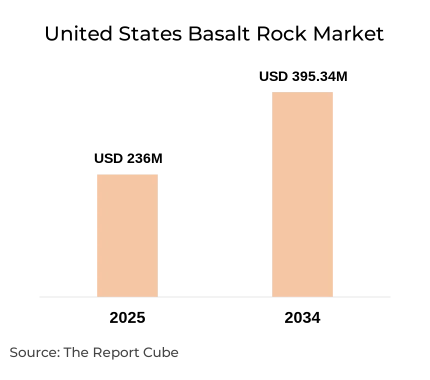
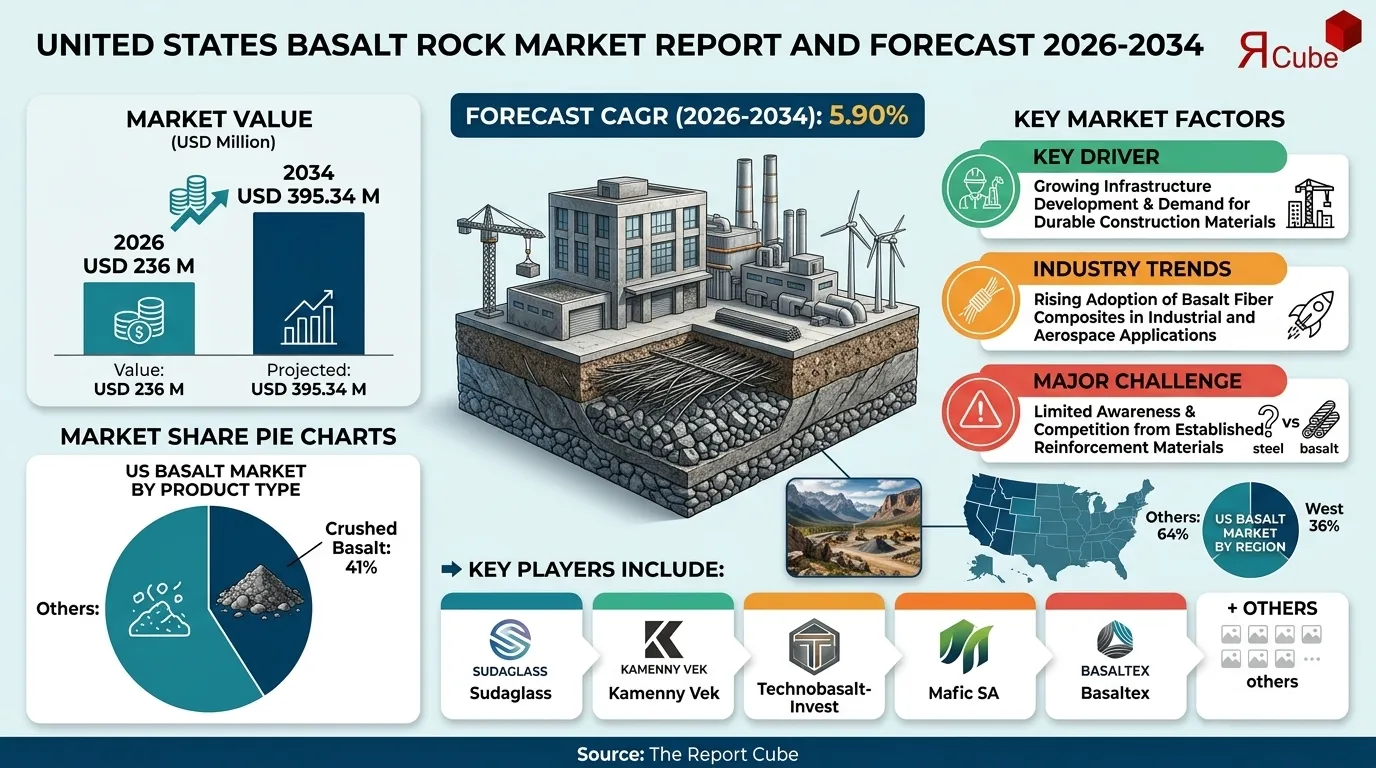
The United States Basalt Rock Market Market is anticipated to register a 5.90% during 2026-2034. The market size was valued at USD 236 Million and is projected to reach USD 395.34 Million by 2034.
The United States Basalt Rock Market is experiencing steady expansion driven by growing demand for durable and sustainable construction materials across infrastructure and industrial sectors. Basalt rock, a volcanic igneous material known for its strength, corrosion resistance, and high thermal stability, has become an important raw material for applications such as construction aggregates, fiber reinforcement, and road building. The rising need for resilient infrastructure and long-lasting construction materials has significantly increased the adoption of basalt-based products, particularly basalt fiber and basalt rebar. These materials offer superior mechanical properties compared to conventional steel reinforcement, including higher tensile strength, improved resistance to chemical corrosion, and reduced maintenance requirements. As infrastructure modernization initiatives gain momentum in the United States, basalt rock products are increasingly used in bridges, highways, and marine structures due to their long-term durability and structural stability.
Furthermore, technological advancements in basalt fiber production are expanding the scope of basalt rock applications across various industries. Basalt fibers are widely used in composite materials, automotive components, aerospace structures, and industrial insulation products due to their lightweight characteristics and exceptional heat resistance. Manufacturers are investing in advanced production technologies to improve fiber quality and reduce manufacturing costs, making basalt-based materials more competitive with traditional alternatives such as glass fiber and carbon fiber. Additionally, growing environmental awareness and the demand for sustainable construction materials are encouraging builders and infrastructure developers to adopt basalt-based reinforcement products. Since basalt is a naturally occurring material that requires minimal chemical processing, it is considered an environmentally friendly alternative for many construction applications.
United States Basalt Rock Market Recent Developments
- 2025: Mafic SA expanded its continuous basalt fiber production capacity in the United States to support infrastructure and composite manufacturing industries.
- 2025: Basaltex introduced advanced basalt fiber reinforcement solutions designed for high-performance construction and industrial applications.
Government Initiatives & Policies
- U.S. Infrastructure Investment and Jobs Act: Major federal program supporting road, bridge, and transportation infrastructure upgrades.
- Federal Highway Administration Sustainable Materials Initiative: Promotes durable and environmentally friendly construction materials in infrastructure projects.
United States Basalt Rock Market Dynamics
Key Driver: Growing Infrastructure Development and Demand for Durable Construction Materials
The expansion of infrastructure development projects across the United States is a major driver supporting the growth of the Basalt Rock Market. Federal and state governments are investing heavily in transportation networks, bridges, tunnels, and public infrastructure modernization to address aging infrastructure challenges. According to infrastructure development programs, billions of dollars are being allocated to improve highways, railways, and urban development projects over the coming decade. These projects require construction materials that can withstand heavy loads, environmental stress, and long-term wear. Basalt-based materials offer significant advantages in this context due to their high compressive strength and exceptional resistance to environmental degradation.
Basalt aggregates are widely used in road and highway construction because of their superior durability and skid resistance. Additionally, basalt rebar and basalt fiber composites are gaining popularity as alternatives to traditional steel reinforcement in reinforced concrete structures. Unlike steel, basalt reinforcement materials are resistant to corrosion caused by moisture, saltwater exposure, and chemical reactions. This property significantly extends the lifespan of infrastructure projects and reduces long-term maintenance costs. As government agencies prioritize resilient infrastructure development and sustainable construction practices, the adoption of basalt rock products is expected to increase steadily.
Book your FREE 30-minute expert consultation today
Contact UsIndustry Trends: Rising Adoption of Basalt Fiber Composites in Industrial and Aerospace Applications
A key trend shaping the United States Basalt Rock Market is the increasing adoption of basalt fiber composites across industrial manufacturing and aerospace sectors. Basalt fiber is produced by melting basalt rock at high temperatures and extruding it into fine fibers that can be woven into composite materials. These fibers exhibit exceptional mechanical strength, thermal stability, and resistance to chemical corrosion. As a result, basalt fiber composites are widely used in applications requiring lightweight yet durable materials.
In the aerospace and defense industries, basalt fiber composites are increasingly being used to manufacture structural components, insulation materials, and protective equipment. The material’s resistance to high temperatures and harsh environmental conditions makes it suitable for advanced engineering applications. Similarly, the automotive industry is exploring basalt fiber composites as lightweight alternatives for vehicle components to improve fuel efficiency and reduce emissions. Additionally, industrial manufacturers are incorporating basalt fiber materials into pipes, tanks, and insulation products designed for harsh operating environments. These technological developments are expanding the market potential for basalt rock products beyond traditional construction applications.
Major Challenge: Limited Awareness and Competition from Established Reinforcement Materials
Despite its promising applications, the United States Basalt Rock Market faces several challenges related to market awareness and competition from traditional construction materials. Steel reinforcement and fiberglass composites remain widely used in construction and industrial manufacturing due to their long-established market presence and well-developed supply chains. Many construction companies and infrastructure developers are more familiar with conventional reinforcement materials and may hesitate to adopt new alternatives without clear performance validation and cost advantages.
Another challenge is the relatively limited production capacity for basalt fiber materials compared to other composite materials such as glass fiber and carbon fiber. Basalt fiber manufacturing requires specialized processing facilities and advanced production technology. The availability of such facilities remains limited in certain regions, which can restrict large-scale production and distribution. Additionally, transportation costs associated with raw basalt rock extraction and processing may increase operational expenses for manufacturers. Overcoming these challenges will require greater industry awareness, improved manufacturing efficiency, and expanded supply chain infrastructure.
Opportunity: Expanding Use of Sustainable and Eco-Friendly Construction Materials
The growing emphasis on sustainability and environmentally responsible construction practices presents a significant opportunity for the United States Basalt Rock Market. Construction companies and infrastructure developers are increasingly seeking materials that minimize environmental impact while maintaining structural performance. Basalt rock products are considered environmentally friendly because basalt is a naturally occurring volcanic material that requires minimal chemical processing. Additionally, basalt fiber production generates fewer emissions compared to certain synthetic reinforcement materials.
Green building certification programs and sustainability initiatives are encouraging the use of environmentally responsible materials in construction projects. Basalt-based reinforcement products align with these sustainability goals due to their durability, recyclability, and reduced maintenance requirements. Furthermore, infrastructure developers are exploring basalt fiber reinforcement for coastal structures, bridges, and marine environments where corrosion resistance is critical. As sustainability regulations and environmental awareness continue to strengthen, basalt rock materials are expected to gain greater acceptance in construction and engineering projects across the United States.
United States Basalt Rock Market Segment-wise Analysis
By Product Type:
- Basalt Fiber
- Crushed Basalt
- Basalt Rebar
- Basalt Aggregate
Crushed basalt holds the largest share in the United States Basalt Rock Market, accounting for nearly 41% of the market. This dominance is primarily attributed to its extensive use in construction and infrastructure projects. Crushed basalt is widely utilized as an aggregate material in road construction, railway ballast, and concrete production due to its high compressive strength and resistance to weathering. Infrastructure developers prefer basalt aggregates for road surfaces because they provide excellent skid resistance and long-term durability under heavy traffic conditions.
Basalt fiber is also emerging as a rapidly growing segment due to its application in composite materials and industrial reinforcement products. Basalt fiber composites are increasingly used in aerospace structures, automotive components, and advanced insulation materials. Basalt rebar, which serves as an alternative to steel reinforcement in concrete structures, is gaining popularity due to its corrosion resistance and lightweight characteristics. As construction technologies evolve and sustainable materials gain prominence, basalt-based reinforcement products are expected to experience increased demand across multiple industries.
By Application:
- Construction & Infrastructure
- Road & Highway Construction
- Industrial Applications
- Marine Applications
Construction and infrastructure applications represent the leading segment in the United States Basalt Rock Market, accounting for approximately 48% of total market demand. Basalt rock materials are widely used in concrete reinforcement, structural foundations, and infrastructure development projects due to their superior mechanical properties and long-lasting durability. Infrastructure developers increasingly prefer basalt reinforcement materials because they reduce the risk of corrosion-related structural failures commonly associated with steel reinforcement.
Road and highway construction also represents a significant application segment due to the widespread use of basalt aggregates in asphalt mixtures and pavement layers. Basalt rock provides excellent resistance to abrasion and environmental stress, making it ideal for high-traffic transportation networks. Additionally, basalt-based materials are gaining traction in marine construction projects such as ports, docks, and coastal defense structures. Their resistance to saltwater corrosion and harsh marine conditions makes them suitable for long-term structural reinforcement. Industrial applications including pipelines, storage tanks, and insulation systems also contribute to market growth.
Need insights for a specific region within this market?
Request Regional DataRegional Projection of United States Basalt Rock Industry
- West United States
- Midwest United States
- South United States
- Northeast United States
The West United States dominates the United States Basalt Rock Market with an estimated market share of nearly 36%. The region’s leadership is primarily attributed to the abundance of natural basalt deposits across states such as Washington, Oregon, Idaho, and California. These geological formations provide a reliable source of raw basalt rock for extraction and processing. Additionally, the region has witnessed significant infrastructure development projects, including highway expansion, urban development, and renewable energy installations.
Infrastructure modernization initiatives across the western states have increased demand for durable construction materials capable of withstanding seismic activity and environmental stress. Basalt aggregates and basalt reinforcement materials are widely used in construction projects across the region due to their structural stability and long-term durability. Meanwhile, the Midwest and Southern United States are also experiencing growing demand for basalt-based materials due to expanding transportation infrastructure and industrial development. As infrastructure investment continues across the country, regional demand for basalt rock products is expected to grow steadily over the forecast period.
Why Choose This Report?
- Provides a comprehensive overview of the overall market analysis, encompassing key trends, consumer behavior analysis, and risk assessment to support strategic decision-making.
- Provides accurate, up-to-date insights into market size, segmentation, and emerging opportunities, helping to minimize risk & capitalizing on growth.
- Gives deep understanding of target audience preferences, investment habits, and communication channels for enhanced product development & marketing effectiveness.
- Delivers competitive analysis & benchmarking, uncovering the strengths & weaknesses of market competitors to guide strategies.
- Consolidate comprehensive market intelligence, reducing reasoning & streamlining research efforts.
- Facilitates customized market segmentation & risk mitigation strategies, fine-tuned to the business objectives.
- Aids in identifying both market challenges & untapped opportunities within the industry to drive long-term business growth.
- Provides valuable information based on actual customer data & search trends.
Table of Contents
- Introduction
- Objective of the Study
- Basalt Rock Market Definition
- Market Segmentation
- Study Variables
- Research Methodology
- Secondary Data Points
- Breakdown of Secondary Sources
- Primary Data Points
- Breakdown of Primary Interviews
- Secondary Data Points
- Executive Summary
- Market Dynamics
- Drivers
- Challenges
- Opportunity Assessment
- Recent Trends and Developments
- Regulatory and Policy Landscape
- United States Basalt Rock Market Overview (2026–2034)
- Market Size, By Value (USD Million)
- Market Share, By Product Type
- Basalt Fiber
- Crushed Basalt
- Basalt Rebar
- Basalt Aggregate
- Market Share, By Application
- Construction & Infrastructure
- Road & Highway Construction
- Industrial Applications
- Marine Applications
- Aerospace & Defense
- Other Applications
- Market Share, By End User
- Construction Companies
- Infrastructure Developers
- Industrial Manufacturers
- Government & Public Projects
- Market Share, By Distribution Channel
- Direct Sales
- Distributors & Wholesalers
- Market Share, By Company
- Competition Characteristics
- Revenue Shares & Analysis
- Market Share, By Region
- West United States Basalt Rock Market
- Market Size, By Value
- Market Share, By Product Type
- Market Share, By Application
- Midwest United States Basalt Rock Market
- Market Size, By Value
- Market Share, By Product Type
- Market Share, By Application
- South United States Basalt Rock Market
- Market Size, By Value
- Market Share, By Product Type
- Market Share, By Application
- Northeast United States Basalt Rock Market
- Market Size, By Value
- Market Share, By Product Type
- Market Share, By Application
- West United States Basalt Rock Market
- Competitive Outlook and Company Profiles
- Sudaglass Fiber Technology
- Company Overview
- Basalt Fiber Product Portfolio
- Strategic Alliances/Partnerships
- Recent Developments
- Kamenny Vek
- Company Overview
- Basalt Fiber Portfolio
- Strategic Alliances/Partnerships
- Recent Developments
- Technobasalt-Invest
- Company Overview
- Basalt Fiber & Rebar Portfolio
- Strategic Alliances/Partnerships
- Recent Developments
- Mafic SA
- Company Overview
- Continuous Basalt Fiber Solutions
- Strategic Alliances/Partnerships
- Recent Developments
- Basaltex
- Company Overview
- Basalt Fiber Reinforcement Products
- Strategic Alliances/Partnerships
- Recent Developments
- Others
- Company Overview
- Business Segments
- Strategic Alliances/Partnerships
- Recent Developments
- Sudaglass Fiber Technology
- Contact Us / Disclaimer
Top Key Players & Market Share Outlook
- Sudaglass Fiber Technology
- Kamenny Vek
- Technobasalt-Invest
- Mafic SA
- Basaltex
- Others
Frequently Asked Questions






