




Build Your Custom Market Intelligence Report
Customize Your ReportBrazil Battery Market Key Highlights
By Type:
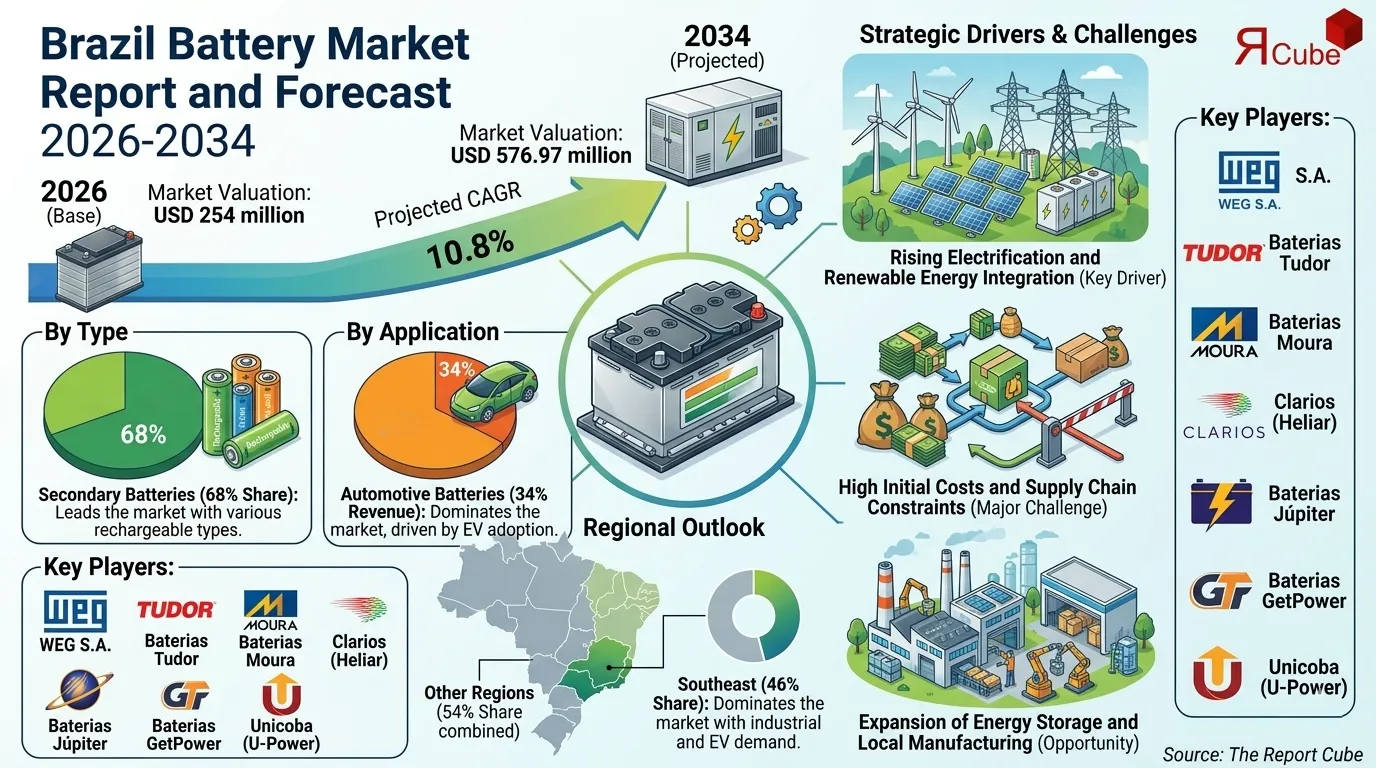
Secondary Batteries segment leads the market with 68% share.
By Application:
Automotive Batteries segment dominates the market with 34% of revenue.
Regional Outlook:
Southeast region dominates the Brazil Battery market with 46% share.
Brazil Battery Market Insights & Analysis
The Brazil Battery Market is anticipated to register a CAGR of around 10.8% during the forecast period 2026-2034. The market size is valued at USD 254 million in 2026 and is projected to reach USD 576.97 million by 2034. The growth of battery market is closely tied to the country’s rising demand for clean energy solutions and electrification across sectors. Strong adoption of electric mobility, combined with increasing use of backup power systems in telecom and residential sectors, is creating consistent demand for advanced battery technologies. Lithium-ion batteries are gaining traction due to their efficiency, longer lifecycle, and declining costs.
Brazil’s energy transition goals and expanding renewable capacity, particularly solar and wind, are pushing demand for stationary energy storage systems. Government-backed infrastructure upgrades and increased investments from domestic manufacturers are strengthening the battery ecosystem. In addition, consumer electronics demand and rising industrial automation are supporting steady growth in battery applications. Market trends show a clear shift toward sustainable and recyclable battery solutions, with companies focusing on innovation, local manufacturing, and supply chain optimization to improve competitiveness and reduce import dependence.
Brazil Battery Market Dynamics
Key Driver: Rising Electrification and Renewable Energy Integration
Brazil is witnessing strong electrification across transportation and energy sectors, which is driving battery market growth. The increasing adoption of electric vehicles and hybrid models is creating steady demand for high-performance batteries. Automotive manufacturers are expanding EV portfolios, while infrastructure for charging is gradually improving across major cities.
At the same time, Brazil’s growing solar and wind installations are boosting the need for efficient energy storage systems. Batteries are becoming essential for grid stability and uninterrupted power supply. This dual demand from mobility and renewable sectors is strengthening the overall battery market size and accelerating technology adoption.
Book your FREE 30-minute expert consultation today
Contact UsIndustry Trends: Shift Toward Lithium-Ion and Advanced Technologies
Lithium-ion batteries are becoming the preferred choice across applications due to higher energy density and longer lifespan. Manufacturers in Brazil are increasingly investing in advanced battery technologies such as solid-state and flow batteries to improve performance and safety. These innovations are shaping new market trends.
Another key trend is the rise of localized production. Companies are focusing on domestic manufacturing to reduce reliance on imports and improve cost efficiency. Recycling and refurbishment of batteries are gaining attention as sustainability becomes a central focus for industry players.
Major Challenge: High Initial Costs and Supply Chain Constraints
One of the main challenges in the Brazil battery market is the high upfront cost of advanced battery technologies. Lithium-ion batteries, although efficient, require significant investment, which limits adoption in price-sensitive segments. This cost barrier affects both consumers and small businesses.
Supply chain limitations, including dependency on imported raw materials such as lithium and cobalt, create additional pressure. Fluctuations in global prices and logistics disruptions can impact production timelines and pricing strategies, slowing down overall market growth.
Opportunity: Expansion of Energy Storage and Local Manufacturing
The rapid growth of renewable energy projects presents a strong opportunity for battery manufacturers. Energy storage systems are becoming essential for balancing power supply and demand, especially in remote and off-grid areas. This opens new revenue streams for companies operating in Brazil.
There is also significant opportunity in expanding local manufacturing capabilities. Investments in domestic production facilities can reduce costs, improve supply chain resilience, and create jobs. Companies that focus on innovation and strategic partnerships are likely to gain a competitive edge in the evolving market landscape.
Brazil Battery Market Segment-wise Analysis
By Type:
- Primary Batteries
- Secondary Batteries
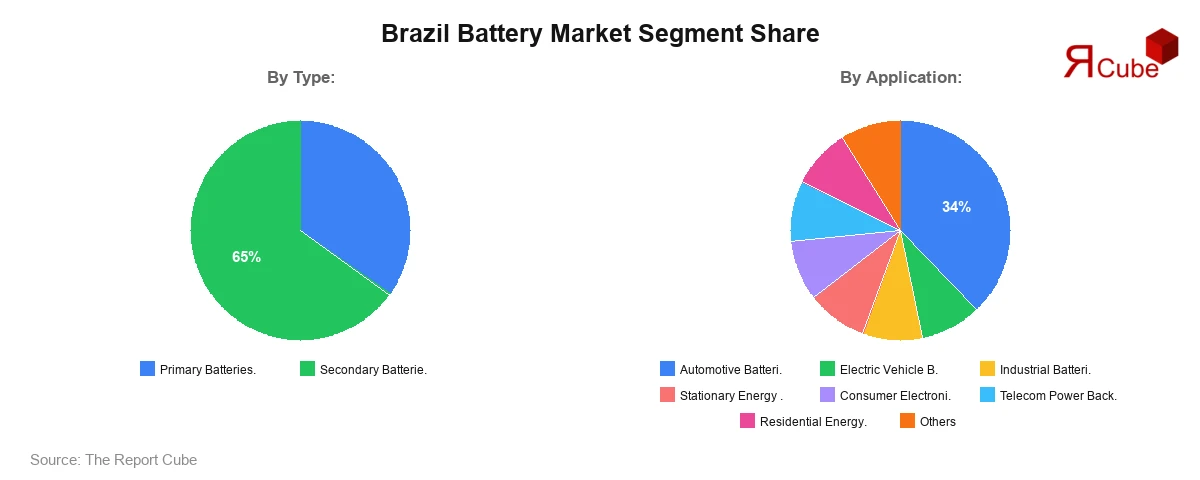
Secondary batteries hold the largest share of the Brazil battery market, accounting for nearly 65% of total revenue. These rechargeable batteries are widely used in automotive, industrial, and consumer electronics applications due to their cost efficiency over time.
The increasing use of electric vehicles and renewable energy storage systems has significantly boosted demand for secondary batteries. Lithium-ion and lead-acid batteries are the most commonly used types within this segment. Market trends indicate a gradual shift from traditional lead-acid batteries to lithium-ion variants, driven by improved performance and declining costs. Primary batteries, although still relevant in niche applications such as remote devices and backup systems, represent a smaller share due to limited reusability.
By Application:
- Automotive Batteries
- Electric Vehicle Batteries
- Industrial Batteries
- Stationary Energy Storage
- Consumer Electronics Batteries
- Telecom Power Backup Batteries
- Residential Energy Storage Batteries
- Commercial Energy Storage Batteries
- Others
Automotive batteries dominate the application segment, contributing approximately 34% of the market share. The strong presence of the automotive industry in Brazil and consistent demand for vehicle replacement batteries are key factors supporting this segment. Lead-acid batteries continue to be widely used in conventional vehicles, while lithium-ion batteries are gaining ground in electric and hybrid vehicles.
The electric vehicle battery segment is growing at a faster pace due to rising awareness and government incentives. Stationary energy storage and telecom backup applications are emerging as important segments, driven by the need for uninterrupted power and renewable energy integration. These segments are expected to see steady expansion during the forecast period.
Regional Projection of Brazil Battery Industry
- North
- Northeast
- Center-West
- Southeast
- South
The Southeast region leads the Brazil battery market with a share of around 44%, supported by strong industrial infrastructure and a high concentration of automotive manufacturing hubs. States such as São Paulo and Minas Gerais play a major role in battery production and consumption.
The presence of key market players and well-established supply chains further strengthens the region’s dominance. The South region follows with a notable share due to growing industrial activities and renewable energy projects. Meanwhile, the Northeast region is emerging as a promising market due to increasing solar energy installations. Regional growth patterns highlight a shift toward decentralized energy systems, with demand rising across less urbanized areas as well.
Need insights for a specific region within this market?
Request Regional DataGovernment Initiatives & Policies
- National Energy Transition Policy (2025): Brazil’s Ministry of Mines and Energy introduced programs to expand energy storage and battery integration in renewable grids.
- Electric Mobility Incentive Program (2026): Government incentives supporting EV adoption and local battery manufacturing to reduce emissions and import dependency.
Brazil Battery Industry Recent Developments
- 2025: Baterias Moura launched its first lithium battery line for light hybrid vehicles as part of its “Moura 2030” strategy. The initiative focuses on expanding into EV and energy storage solutions while strengthening competitiveness against global players.
- 2025: Unicoba (U-Power) secured a US$35 million investment from IDB Invest to expand battery production capacity in Brazil. The project aims to improve energy access and support large-scale manufacturing growth over the next four years.
Why Choose This Report? Brazil Battery Market
- Offers a holistic view of the market, including key trends, consumer insights, and risk analysis to enable strategic decision-making.
- Delivers reliable and current data on market size, segmentation, and growth opportunities to support risk reduction and value creation.
- Provides in-depth insights into customer behavior, preferences, and engagement channels for optimized marketing and product strategies.
- Equips businesses with competitive intelligence and benchmarking to assess market positioning effectively.
- Streamlines research through consolidated market intelligence, improving efficiency and clarity.
- Supports tailored segmentation and risk management strategies aligned with business goals.
- Identifies key challenges and untapped opportunities to drive sustained growth.
- Leverages real customer data and search insights for actionable outcomes.
Table of Contents
- Introduction
- Objective of the Study
- Product and Category Definition
- Market Segmentation
- Study Variables
- Research Methodology
- Secondary Data Points
- Breakdown of Secondary Sources
- Primary Data Points
- Breakdown of Primary Interviews
- Secondary Data Points
- Executive Summary
- Market Dynamics
- Emerging Opportunities
- Adoption Trends
- Demand Drivers
- Disruption Analysis (Challenges)
- Industry Analysis & Strategic Insights
- Supply/Value Chain Analysis
- Pricing Analysis
- Go-To-Market (GTM) Strategy
- BCG Matrix
- Recent Trends and Developments
- Import and Export Analysis
- Regulatory and Policy Landscape
- Region-wise Policies
- Government Initiatives
- Brazil Battery Market Overview and Forecast Analysis (2021-2034)
- Market Size, By Value, By Growth Rate (CAGR / USD Million)
- Market Share, By Type
- Primary Batteries
- Secondary Batteries
- Market Share, By Technology
- Lithium-Ion Batteries
- Lead-Acid Batteries
- Nickel-Metal Hydride Batteries
- Nickel-Cadmium Batteries
- Sodium-Sulfur Batteries
- Flow Batteries
- Solid-State Batteries
- Others
- Market Share, By Application
- Automotive Batteries
- Electric Vehicle Batteries
- Industrial Batteries
- Stationary Energy Storage
- Consumer Electronics Batteries
- Telecom Power Backup Batteries
- Residential Energy Storage Batteries
- Commercial Energy Storage Batteries
- Others
- Market Share, By State
- New Batteries
- Refurbished Batteries
- Recycled Batteries
- Market Share, By Region
- North
- Northeast
- Center-West
- Southeast
- South
- Market Share, By Company
- Revenue Shares and Analysis
- Competitive Landscape
- North Region Battery Market Overview and Forecast Analysis (2021-2034)
- Market Size, By Value, By Growth Rate (CAGR / USD Million)
- Market Share, By Type
- Market Share, By Technology
- Market Share, By Application
- Market Share, By State (New, Refurbished, Recycled)
- Northeast Region Battery Market Overview and Forecast Analysis (2021-2034)
- Market Size, By Value, By Growth Rate (CAGR / USD Million)
- Market Share, By Type
- Market Share, By Technology
- Market Share, By Application
- Market Share, By State (New, Refurbished, Recycled)
- Center-West Region Battery Market Overview and Forecast Analysis (2021-2034)
- Market Size, By Value, By Growth Rate (CAGR / USD Million)
- Market Share, By Type
- Market Share, By Technology
- Market Share, By Application
- Market Share, By State (New, Refurbished, Recycled)
- Southeast Region Battery Market Overview and Forecast Analysis (2021-2034)
- Market Size, By Value, By Growth Rate (CAGR / USD Million)
- Market Share, By Type
- Market Share, By Technology
- Market Share, By Application
- Market Share, By State (New, Refurbished, Recycled)
- South Region Battery Market Overview and Forecast Analysis (2021-2034)
- Market Size, By Value, By Growth Rate (CAGR / USD Million)
- Market Share, By Type
- Market Share, By Technology
- Market Share, By Application
- Market Share, By State (New, Refurbished, Recycled)
- Competitive Analysis, 2026
- Market Share of Key Players
- Competitive Mapping for Each Segment and Companies Operating by Region
- North Region Battery Companies Share and Competitive Analysis, 2026
- Northeast Region Battery Companies Share and Competitive Analysis, 2026
- Center-West Region Battery Companies Share and Competitive Analysis, 2026
- Southeast Region Battery Companies Share and Competitive Analysis, 2026
- South Region Battery Companies Share and Competitive Analysis, 2026
- Company Profile (Partial List)
- WEG S.A.
- Company Overview
- Product Portfolio
- Strategic Alliances/Partnerships
- Recent Developments
- Baterias Tudor
- Company Overview
- Product Portfolio
- Strategic Alliances/Partnerships
- Recent Developments
- Baterias Moura
- Company Overview
- Product Portfolio
- Strategic Alliances/Partnerships
- Recent Developments
- Clarios (Heliar)
- Company Overview
- Product Portfolio
- Strategic Alliances/Partnerships
- Recent Developments
- Baterias Júpiter
- Company Overview
- Product Portfolio
- Strategic Alliances/Partnerships
- Recent Developments
- Baterias GetPower
- Company Overview
- Product Portfolio
- Strategic Alliances/Partnerships
- Recent Developments
- Unicoba (U-Power)
- Company Overview
- Product Portfolio
- Strategic Alliances/Partnerships
- Recent Developments
- Baterias Zetta
- Company Overview
- Product Portfolio
- Strategic Alliances/Partnerships
- Recent Developments
- Baterias Erbs
- Company Overview
- Product Portfolio
- Strategic Alliances/Partnerships
- Recent Developments
- Baterias Cral
- Company Overview
- Product Portfolio
- Strategic Alliances/Partnerships
- Recent Developments
- Baterias Reifor
- Company Overview
- Product Portfolio
- Strategic Alliances/Partnerships
- Recent Developments
- Baterias Pioneiro
- Company Overview
- Product Portfolio
- Strategic Alliances/Partnerships
- Recent Developments
- BatFlex Baterias
- Company Overview
- Product Portfolio
- Strategic Alliances/Partnerships
- Recent Developments
- Others (Partial List)
- WEG S.A.
- Contact Us and Disclaimer
Top Key Players & Market Share Outlook
- WEG S.A.
- Baterias Tudor
- Baterias Moura
- Clarios (Heliar)
- Baterias Júpiter
- Baterias GetPower
- Unicoba (U-Power)
- Baterias Zetta
- Baterias Erbs
- Baterias Cral
- Baterias Reifor
- Baterias Pioneiro
- BatFlex Baterias
- Others
Frequently Asked Questions






