



Build Your Custom Market Intelligence Report
Customize Your ReportIndia Bike Market Key Takeaways
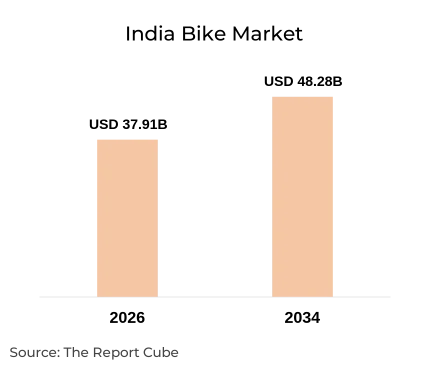
- The market is valued at USD 37.91 billion in 2026.
- Industry revenue should reach USD 48.28 billion by 2034.
- Market expansion is projected at a 3.07% CAGR through 2034.
- Hero MotoCorp, Honda, TVS, Bajaj, and Royal Enfield lead competition.
- Personal use dominates demand, with roughly 81% market share.
- West India leads regional revenue on strong urban demand.
- East India is the fastest-growing region through 2034.
- Sub-350cc models and electrification are reshaping buyer choices.
India Bike Market Insights & Analysis
The India Bike Market is anticipated to register a 3.07% CAGR during 2026-2034. The market size was valued at USD 37.91 billion in 2026 and is projected to reach USD 48.28 billion by 2034. Growth is steady rather than explosive, reflecting a large, mature installed base and replacement-led demand. The September 2025 GST revision, which cut the rate on motorcycles up to 350cc from 28% to 18%, lowered ticket prices by up to Rs 22,000 across major brands, improving affordability for first-time buyers.
Rural and semi-urban India remains the volume engine, as motorcycles serve farmers, small traders, and gig workers who depend on affordable mobility. Public support for manufacturing, including the Production Linked Incentive scheme for automotive and the FAME and PM E-DRIVE electric incentives, is encouraging OEMs to invest in new platforms and localized supply chains. Meanwhile, the shift of larger-displacement launches below the 350cc threshold, alongside premium motorcycle demand above 350cc, is widening the product mix and supporting overall value growth.
India Bike Market Dynamics
India's bike industry is moving through a policy-led reset. Lower GST on sub-350cc motorcycles, stable festive-season demand, and rising rural incomes are supporting volumes, while manufacturers rebalance portfolios toward commuter, 125cc, and mid-capacity models. At the same time, emission norms, tightening safety requirements, and the gradual arrival of electric motorcycles are pushing OEMs to modernize platforms. These forces collectively keep competition intense and product cycles shorter across the country's major riding clusters.
|
Factor |
Type |
Specific Impact on Market |
Magnitude |
|---|---|---|---|
|
GST cut on sub-350cc motorcycles |
Driver |
Lowers ticket prices, lifting entry-level and festive demand |
Very High |
|
Rural and semi-urban income growth |
Driver |
Sustains first-time ownership and replacement purchases |
High |
|
Electric motorcycle launches |
Trend |
Expands portfolios and gradually shifts urban commuter demand |
High |
|
Safety and emission regulations |
Challenge |
Increases platform redesign requirements across entry-level models |
Medium |
|
Delivery and rental fleet expansion |
Opportunity |
Creates recurring commercial demand for durable motorcycles |
High |
Key Market Driver: Affordability Reset After GST Reduction
The September 22, 2025 GST rationalization cut the tax on motorcycles up to 350cc to 18% from 28%, and leading OEMs passed on the benefit immediately. Royal Enfield trimmed 350cc prices by up to Rs 22,000, TVS by up to Rs 21,718, Bajaj by up to Rs 20,000, and Hero MotoCorp by up to Rs 15,743. For entry-level buyers, lower prices also reduce loan EMIs. Growing two-wheeler financing penetration in smaller cities is therefore amplifying the conversion of rural and semi-urban demand into actual purchases.
Major Industry Challenge: Rising Road Safety Compliance Pressure
Two-wheeler riders account for a large share of India's road fatalities, which keeps regulators focused on stricter safety rules. Safety-feature mandates such as ABS, helmet enforcement, and evolving emission requirements raise engineering complexity for manufacturers serving entry-level buyers. Enforcement of road safety and helmet compliance varies widely across states, creating uneven adoption of safety features. OEMs must therefore redesign platforms, train dealer networks, and coordinate with state authorities, which can often slow launch timelines and regional rollouts in price-sensitive segments.
Emerging Trend Shaping Outlook: Electric Motorcycles Enter Mainstream Portfolios
Established manufacturers are widening their electric lineups as battery costs ease and charging networks expand. The India electric motorcycle segment was valued at USD 1.54 billion in 2025, and Royal Enfield's Flying Flea C6 signals that heritage brands are entering the category. GST on electric vehicles stays at 5%, which sustains a tax advantage over petrol models. Rising electric motorcycle adoption in India, led by urban commuters and delivery fleets, is expected to gradually pull incremental share from conventional bikes.
Need Specific Data, Let’s Customize the Report for You
Request CustomizationIndia Bike Market Segment-wise Analysis
Demand in the India bike market is shaped by who rides and why. Gender-based adoption, usage purpose, and regional riding patterns create distinct demand pools. Manufacturers are tailoring ergonomics, engine capacity, pricing, and financing to each pool, which makes segment-level understanding essential for portfolio and distribution decisions.
By End Use
- Men
- Women
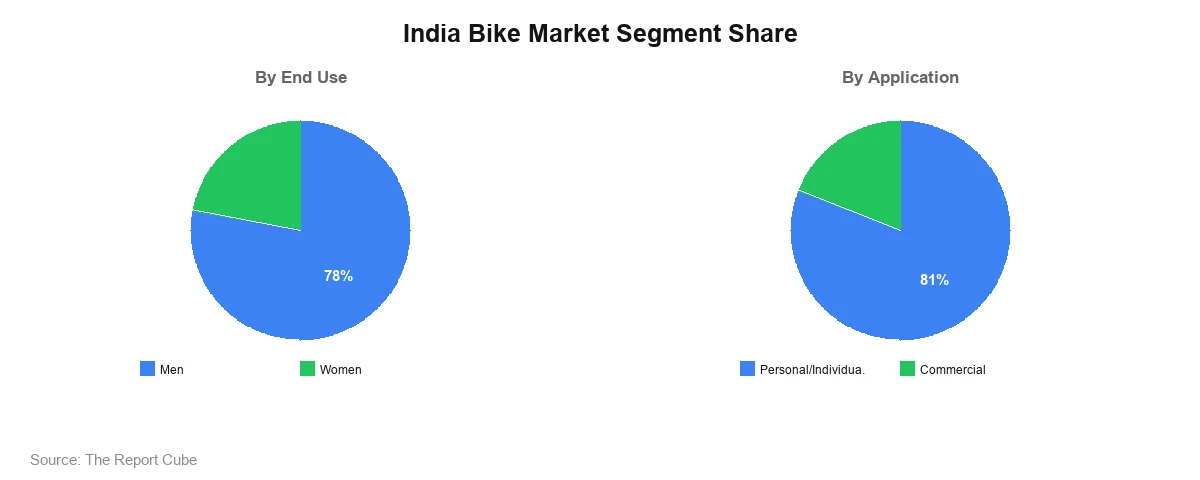
Men dominate the end-use segment with an estimated 78% market share, supported by long-standing and deeply rooted motorcycle ownership as the primary commuting and earning tool for farmers, tradespeople, and gig delivery riders. Standard commuter models in the 100cc to 125cc range account for the bulk of purchases, while men also represent nearly all demand for performance and 350cc-class cruisers. This base gives manufacturers predictable replacement cycles, strong dealer throughput, and consistent financing uptake across urban and rural markets.
Women represent the faster-growing end-use segment, holding roughly 22% of revenue as lighter motorcycles, lower seat heights, and easier clutch and weight management widen appeal. Rising female workforce participation, particularly in tier-2 cities, and targeted financing schemes are increasing first-time ownership. Many women buyers still choose scooters, so motorcycle makers are launching lightweight 110cc to 125cc commuters to counter scooter preference among women riders. Dealer-led riding training programs are now further improving conversion particularly among first-time buyers in smaller towns.
By Application
- Personal/Individual
- Commercial
Personal and individual use leads the application segment with an estimated 81% market share, reflecting the motorcycle's role as the default household vehicle for daily commuting, school runs, and small errands. Strong fuel economy, low maintenance, and wide service coverage make 100cc to 125cc models the volume anchor. Festive-season buying and rural income cycles tied to harvests continue to concentrate purchases into the October to November window, giving manufacturers clear early planning visibility.
Commercial use holds the remaining 19% share but is the faster-growing application. Food and parcel delivery, last-mile e-commerce, field sales, and rental fleets rely on fuel-efficient motorcycles and increasingly on electric variants. Rapid growth of motorcycle rental and delivery fleet demand is encouraging fleet-oriented financing, telematics integration, and durable platforms with lower downtime. Tourism-led rentals in hill and coastal destinations add seasonal demand, while gig workforce expansion sustains continuous fleet additions. Dealers are also launching dedicated commercial variants with reinforced racks and extended service intervals.
Region Insights: India Bike Market
Regional demand in the India bike market varies with income levels, road density, rural penetration, and urbanization. West India leads revenue on large urban and industrial clusters, while South India's dense commuter base supports steady replacement demand. East India is the fastest-growing region as rural connectivity improves, and North India remains a stable, volume-driven market.
|
Region |
Estimated Market Share |
Key Growth Factors |
Consumer Trends |
|---|---|---|---|
|
West India |
33.8% |
Industrial belts, urban commuting, high financing penetration |
Strong demand for premium and 350cc motorcycles |
|
South India |
27.4% |
Dense commuter traffic, high two-wheeler ownership |
Early electric motorcycle adoption |
|
North India |
24.6% |
Agricultural income, festive demand, Delhi NCR commuting |
Preference for fuel-efficient commuter models |
|
East India |
14.2% |
Rural road connectivity, rising incomes, financing access |
First-time ownership of entry-level motorcycles |
- West India: West India leads with approximately 33.8% share, driven by Maharashtra and Gujarat's industrial belts, strong urban commuter demand, high financing penetration, and robust premium and 350cc motorcycle sales.
- South India: South India holds a sizable share through dense commuter traffic, high two-wheeler ownership, and early adoption of electric motorcycles, supported by strong dealer networks in Tamil Nadu, Karnataka, and Kerala.
- East India: East India is the fastest-growing region, as improving rural roads, rising incomes in Bihar, Odisha, and West Bengal, and expanding financing access lift first-time motorcycle ownership.
- North India: North India remains a volume-driven market, anchored by Uttar Pradesh, Punjab, and Delhi NCR, where agricultural income, strong festive demand, and commuter needs sustain steady motorcycle replacement.
India Bike Market: Recent Development (2025)
- Royal Enfield cut 350cc motorcycle prices by up to Rs 22,000 following the GST reduction.
- Hero MotoCorp passed GST benefits of up to Rs 15,743 to buyers from September 22.
- TVS Motor cut prices by up to Rs 21,718 across its motorcycle and scooter portfolio.
- Bajaj Auto began repositioning its lineup below 350cc, cutting prices by up to Rs 20,000.
India Bike Market Future Outlook (2034)
The India Bike Market is expected to expand at a 3.07% CAGR, reaching approximately USD 48.28 billion by 2034. Growth opportunities lie in sub-350cc motorcycles, 125cc commuters, financing-led first-time ownership in East and North India, and fleet demand from delivery and rental operators. As the broader two-wheeler market in India matures, premiumization and portfolio rationalization will become central to revenue growth, even as volume growth stays moderate. Manufacturers that align product launches with tax thresholds and festive demand cycles will secure stronger share.
Technology will reshape the competitive landscape. Connected-bike features, ride-assist electronics, ABS, and AI-driven demand forecasting are improving product planning, dealer inventory, and predictive service. Electrification will expand as battery chains localize, while aftersales ecosystems, including replacement tire and component demand, grow with the vehicle parc. By 2034, manufacturers combining multi-fuel portfolios, digital retail, and efficient service networks are likely to hold the strongest long-term position. Software-defined features, over-the-air updates, and data-led customer engagement will also lengthen product lifecycles and improve ownership experience for riders.
India Bike Market Report Coverage
|
Report Attribute |
Details |
|---|---|
|
Market Name |
India Bike Market |
|
Market Size (2026) |
USD 37.91 Billion |
|
Market Size (2034) |
USD 48.28 Billion |
|
Forecast Period |
2026-2034 |
|
CAGR |
3.07% |
|
Base Year |
2026 |
|
Historical Years |
2021-2025 |
|
Forecast Years |
2026-2034 |
|
Segments Covered |
By Type, By Product, By End Use, By Application |
|
Regions Covered |
North India, South India, East India, West India |
|
Key Companies |
Hero MotoCorp Ltd, Honda Motorcycle and Scooter India, TVS Motor Company, Bajaj Auto Limited, Royal Enfield (Eicher Motors), India Yamaha Motor Pvt. Ltd., Suzuki Motorcycle India Private Limited, Others |
|
Report Format |
PDF, Excel, PPT |
|
Customization |
Available as per client requirements |
Why Choose This Report?
- Comprehensive coverage of India's motorcycle demand across regions and segments.
- Reliable market sizing with a transparent forecast through 2034.
- Clear segmentation by end use highlighting revenue-leading opportunities.
- Application insights covering personal commuting and commercial fleet adoption.
- Regional analysis reflecting GST reform and rural demand shifts.
- Competitive profiling of leading manufacturers and their 2025 strategies.
- Evidence-based outlook on electrification and sub-350cc product transitions.
- Actionable insights supporting investment, launch, and distribution planning.
Table of Contents
- Introduction
- Objective of the Study
- Product Definition
- Market Segmentation
- Study Variables
- Research Methodology
- Secondary Data Points
- Companies Interviewed
- Primary Data Points
- Breakdown of Primary Interviews
- Secondary Data Points
- Executive Summary
- Market Dynamics
- Drivers
- Challenges
- Opportunity Assessment
- Recent Trends and Developments
- Policy and Regulatory Landscape
- India Bike Market Overview and Forecast Analysis (2021-2034)
- Market Size, By Value, By Growth Rate (CAGR/USD Billions)
- Demand – Supply Trends
- Market Share, By Type
- Conventional
- Electric
- Market Share, By Product
- City/Commuter Bikes
- Road Bikes
- Mountain Bikes (MTB)
- Hybrid Bikes
- Cargo Bikes
- Others
- Market Share, By End Use
- Men
- Women
- Market Share, By Application
- Personal/Individual
- Commercial
- Market Share, By Region
- North India
- South India
- East India
- West India
- Market Share, By Competitors
- Competition Characteristics
- Revenue Shares
- Conventional India Bike Market Overview, 2021-2034F
- By Value (USD Million)
- By Product – Market Size & Forecast 2021-2034, USD Million
- City/Commuter Bikes
- Road Bikes
- Mountain Bikes (MTB)
- Hybrid Bikes
- Cargo Bikes
- Others
- Electric India Bike Market Overview, 2021-2034F
- By Value (USD Million)
- By Product – Market Size & Forecast 2021-2034, USD Million
- City/Commuter Bikes
- Road Bikes
- Mountain Bikes (MTB)
- Hybrid Bikes
- Cargo Bikes
- Others
- Competitive Outlook (Company Profile - Partial List)
- Hero MotoCorp Ltd
- Company Overview
- Business Segments
- Strategic Alliances/Partnerships
- Recent Developments
- Honda Motorcycle and Scooter India
- Company Overview
- Business Segments
- Strategic Alliances/Partnerships
- Recent Developments
- TVS Motor Company
- Company Overview
- Business Segments
- Strategic Alliances/Partnerships
- Recent Developments
- Bajaj Auto Limited
- Company Overview
- Business Segments
- Strategic Alliances/Partnerships
- Recent Developments
- Royal Enfield (Eicher Motors)
- Company Overview
- Business Segments
- Strategic Alliances/Partnerships
- Recent Developments
- India Yamaha Motor Pvt. Ltd.
- Company Overview
- Business Segments
- Strategic Alliances/Partnerships
- Recent Developments
- Suzuki Motorcycle India Private Limited
- Company Overview
- Business Segments
- Strategic Alliances/Partnerships
- Recent Developments
- Others
- Hero MotoCorp Ltd
- Contact Us & Disclaimer
Top Key Players & Market Share Outlook
- Hero MotoCorp Ltd
- Honda Motorcycle and Scooter India
- TVS Motor Company
- Bajaj Auto Limited
- Royal Enfield (Eicher Motors)
- India Yamaha Motor Pvt. Ltd.
- Suzuki Motorcycle India Private Limited
- Others
Frequently Asked Questions






