



Build Your Custom Market Intelligence Report
Customize Your ReportGlobal Bio-based Surfactants Market Key Takeaways
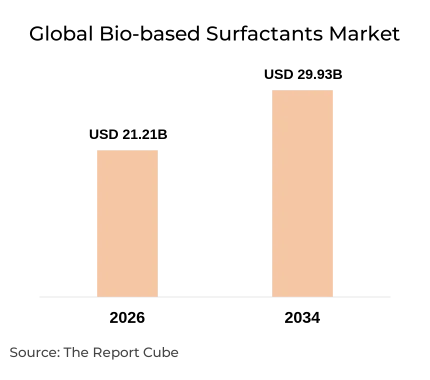
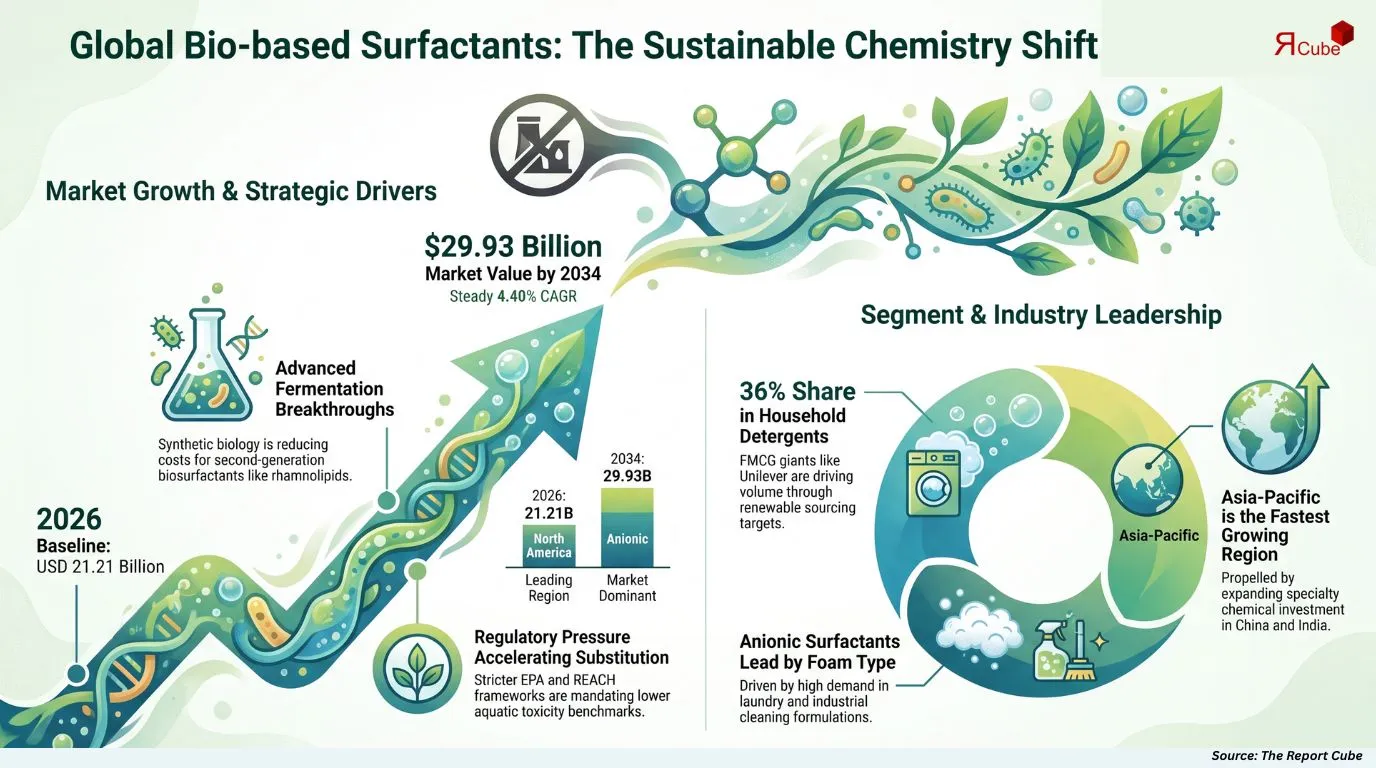
- Global Bio-based Surfactants Market was valued at USD 21.21 billion in 2026.
- The market is projected to reach USD 29.93 billion by 2034, reflecting steady expansion.
- Industry expected to register a 4.40% CAGR during the forecast period 2026–2034.
- BASF SE, Unilever PLC, Clariant AG, Evonik Industries AG, and Croda International PLC lead competitively.
- Anionic surfactants dominate the By Foam segment, commanding the largest revenue contribution.
- Household Detergents remain the leading end-use industry driving consistent global demand.
- Asia-Pacific represents the fastest-growing regional market for bio-based surfactant adoption.
- Fermentation-based biosurfactant manufacturing and renewable feedstock sourcing define key trends.
Global Bio-based Surfactants Market Insights & Analysis
The Global Bio-based Surfactants Market is anticipated to register a 4.40% CAGR during 2026–2034. The market size was valued at USD 21.21 billion in 2026 and is projected to reach USD 29.93 billion by 2034. Industry growth is supported by accelerating global demand for sustainable chemistry, tightening regulatory restrictions on petrochemical-derived surfactants, and rising consumer preference for biodegradable cleaning and personal care formulations. Governments across Europe and North America are actively funding bio-based chemical innovation, with the European Union's Horizon Europe program committing over EUR 95.5 billion to research and sustainable industrial development through 2027, directly benefiting the bio-based surfactants market.
The personal care industry, projected to surpass USD 500 billion globally by 2026, is incorporating bio-based surfactant ingredients at an accelerating pace as formulators reformulate products to meet clean-label commitments and eco-certification requirements. Unilever's publicly stated target to source 50% of all surfactant volume from renewable materials by 2028 underscores the scale of FMCG-driven offtake. Demand from industrial and institutional cleaning, oilfield chemical applications, and agricultural formulations further diversifies growth pathways, with alkyl polyglucoside and methyl ester sulfonate adoption in industrial cleaners expanding substantially as second-generation fermentation feedstocks achieve commercial scale.
Global Bio-based Surfactants Market Dynamics
The Global Bio-based Surfactants Market is experiencing accelerating momentum as household detergent brands, cosmetic manufacturers, agrochemical producers, and industrial cleaning formulators collectively accelerate the substitution of petrochemical surfactants with renewable alternatives. Stricter legislative frameworks, increasing eco-label procurement criteria, and expanding renewable feedstock availability are reinforcing long-term investment across the surfactant value chain, from oleochemical refining to advanced fermentation-based biosurfactant production.
|
Factor |
Type |
Specific Impact on Market |
Magnitude |
|---|---|---|---|
|
Regulatory bans on petrochemical surfactants |
Driver |
Accelerates bio-based substitution in detergent and personal care formulations |
Very High |
|
FMCG brand sustainability commitments |
Driver |
Secures long-term offtake for renewable surfactant producers |
High |
|
Fermentation-based biosurfactant manufacturing |
Trend |
Reduces production costs and improves functional performance parity |
High |
|
Volatile oleochemical feedstock pricing |
Challenge |
Introduces raw material cost uncertainty for manufacturers |
Moderate |
|
Agricultural and oilfield chemical demand |
Opportunity |
Opens high-volume growth segments beyond household applications |
High |
Key Market Driver: Regulatory Pressure Accelerating Renewable Substitution
European and North American regulators have implemented progressive bans and restrictions on nonylphenol ethoxylates, phosphate-containing surfactants, and other petrochemical-derived surface-active agents across cleaning, personal care, and agricultural formulations. The EU REACH framework and U.S. EPA Safer Choice program collectively mandate lower aquatic toxicity thresholds and improved biodegradability benchmarks that synthetic surfactants consistently fail to meet. These regulatory environments are compelling formulators to accelerate adoption of bio-based anionic, non-ionic, and amphoteric alternatives derived from vegetable oils, sucrose, and fermentation platforms, with procurement volumes in regulated markets rising approximately 18% year-over-year.
Major Industry Challenge: Oleochemical Feedstock Price Volatility
Bio-based surfactant manufacturers rely heavily on palm oil, coconut oil, soybean oil, and sugarcane derivatives as primary feedstocks, all of which are subject to agricultural commodity price fluctuations driven by weather events, crop disease, export policy changes, and competing demand from food and biofuel sectors. When palm kernel oil prices increased nearly 30% between late 2023 and early 2024, manufacturing margins for alkyl polyglucoside and methyl ester sulfonate producers contracted sharply. This raw material uncertainty creates formulation cost risk and complicates long-term pricing contracts with major FMCG buyers, slowing adoption in cost-sensitive markets. Vertical integration into sustainable palm and coconut oleochemical supply chains is increasingly critical for manufacturers seeking to stabilize input costs.
Emerging Trend Shaping Outlook: Fermentation-Based Second-Generation Biosurfactants
Advanced fermentation platforms using engineered microbial strains are enabling cost-competitive commercial production of rhamnolipids, sophorolipids, and other glycolipid biosurfactants at industrial scale. Evonik's Slovenská Ľupča fermentation facility achieved unit cost reductions that narrowed the historical price premium over petrochemical equivalents, while BASF's Ludwigshafen site doubled sophorolipid yields through synthetic biology strain engineering. These second-generation biosurfactants offer superior biodegradability, low ecotoxicity, and tailored hydrophilic-lipophilic balance values that outperform conventional oleochemical-derived alternatives in personal care and industrial cleaning applications, signaling a structural shift in how the global biosurfactant production technology landscape will evolve through 2034.
Need Specific Data, Let’s Customize the Report for You
Request CustomizationGlobal Bio-based Surfactants Market Segment-wise Analysis
The Global Bio-based Surfactants Market is segmented across foam type and end-use industry, reflecting the diverse functional and application requirements of bio-based surface-active agents across household, industrial, cosmetic, textile, oilfield, and agricultural end markets. Each segment offers distinct growth dynamics supported by regulatory pressure, formulation innovation, and expanding renewable feedstock availability.
By Foam
- Anionic
- Cationic
- Non-Ionic
- Amphoteric
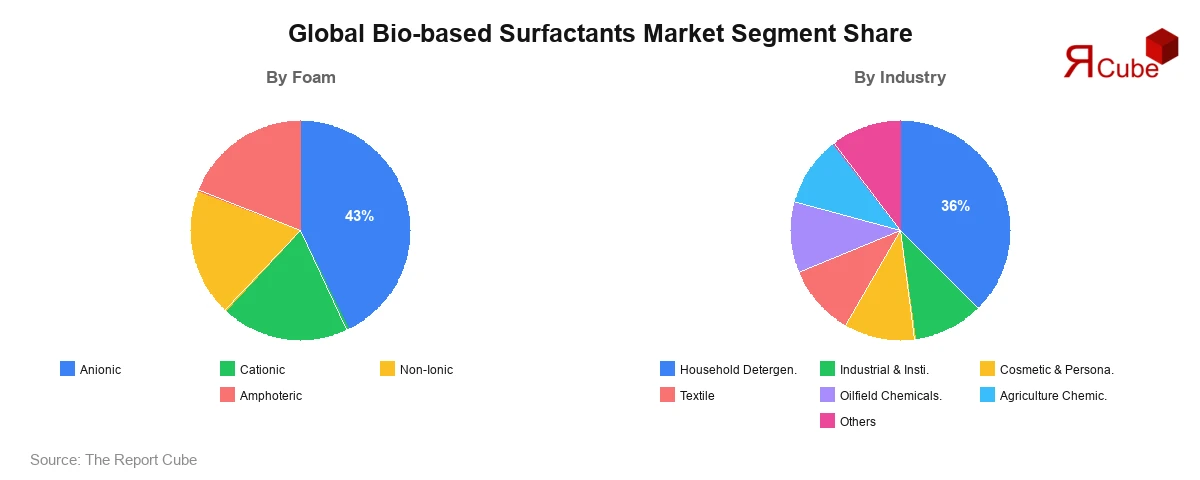
Anionic bio-based surfactants dominate the By Foam segment with an estimated 43% market share, driven by widespread deployment in household laundry detergents, dishwashing formulations, and industrial cleaning products where high foaming performance and superior soil removal are essential. Methyl ester sulfonates (MES) derived from palm-based fatty acids and bio-based linear alkylbenzene sulfonate equivalents represent the primary volume contributors within this sub-segment. Expanding FMCG procurement requirements for biodegradable surfactant inputs are reinforcing anionic dominance as formulators increasingly replace conventional sodium lauryl sulfate and LAS with renewable-derived substitutes certified under EU Ecolabel and EPA Safer Choice standards.
Non-ionic bio-based surfactants represent the fastest-growing sub-segment within the By Foam classification as consumer demand for mild, low-irritation formulations in personal care, sensitive-skin household products, and agricultural adjuvant applications accelerates adoption. Alkyl polyglucosides (APG), derived from glucose and fatty alcohols sourced from vegetable oils, captured approximately 30% of the non-ionic sub-segment share in 2025. Amphoteric surfactants, particularly cocamidopropyl betaine derived from coconut oil, are experiencing strong uptake in premium cosmetic and baby care formulations. Cationic bio-based variants, utilized primarily in fabric softener and hair conditioning applications, remain a niche but growing sub-segment as quaternary ammonium compounds derived from renewable feedstocks gain regulatory acceptance.
By Industry
- Household Detergents
- Industrial & Institutional Cleaners
- Cosmetic & Personal Care
- Textile
- Oilfield Chemicals
- Agriculture Chemicals
- Others
Household Detergents dominate the By Industry segment with an estimated 36% market share, supported by the massive global laundry, dishwashing, and multi-surface cleaning product market where consumer-facing eco-label requirements and retailer sustainability mandates are driving rapid reformulation. Bio-based surfactants in liquid pod and concentrated laundry formats require high-performance cold-water efficacy that APG and enzyme-compatible non-ionic variants increasingly deliver. FMCG brands including Unilever, Henkel, and Procter & Gamble have embedded bio-based surfactant sourcing commitments into supplier agreements, securing consistent volume offtake that underpins segment leadership through 2034.
Cosmetic & Personal Care represents the second-largest revenue contributor as premium personal care brands, dermocosmetic manufacturers, and private-label retailers accelerate adoption of natural-origin certified surfactants. Rhamnolipid and sophorolipid glycolipids command particular interest in luxury skin care and scalp care formulations given their skin compatibility and COSMOS-certified natural-origin credentials. Industrial & Institutional Cleaners are the fastest-growing application segment as regulatory restrictions on synthetic surfactants expand into commercial cleaning procurement frameworks across Europe and North America. Agriculture chemical surfactant applications, including bio-based adjuvants for herbicide and pesticide spray formulations, are emerging as high-growth opportunities, particularly across Brazil and Southeast Asian crop markets.
Regional Projection of Global Bio-based Surfactants Market
The Global Bio-based Surfactants Market demonstrates distinct regional growth trajectories shaped by the maturity of green chemistry regulations, renewable feedstock availability, consumer sustainability awareness, and the scale of end-use industries including personal care, household cleaning, agriculture, and oilfield services.
|
Region |
Estimated Market Share |
Key Growth Factors |
Consumer Trends |
|---|---|---|---|
|
North America |
37.5% |
EPA Safer Choice program, FMCG green sourcing, advanced fermentation capacity |
High adoption of APG and MES in laundry and personal care |
|
Europe |
29.3% |
EU REACH regulations, GDPR eco-label frameworks, FMCG sustainability targets |
Strong demand for COSMOS-certified and Ecolabel surfactants |
|
Asia-Pacific |
22.8% |
Rapid personal care market growth, China and India bio-chemical investment |
Rising preference for plant-based mild surfactants in beauty |
|
Latin America |
6.4% |
Agricultural sector demand, Brazil soybean and sugarcane feedstock supply |
Growing bio-based adjuvant adoption in crop protection |
|
Middle East & Africa |
4.0% |
Oilfield chemical applications, expanding personal care industry |
Increasing adoption of biodegradable institutional cleaners |
- North America: North America leads the global market with approximately 37.5% share, supported by robust EPA Safer Choice certification adoption, FMCG brand sustainability sourcing programs, and advanced commercial-scale fermentation biosurfactant production infrastructure across the United States.
- Europe: Europe commands the second-largest regional share, underpinned by the EU's progressive REACH restrictions on petrochemical surfactants, mandatory Ecolabel certification requirements across institutional procurement, and strong COSMOS natural cosmetic certification uptake.
- Asia-Pacific: Asia-Pacific is the fastest-growing regional market, propelled by China's expanding specialty chemical manufacturing investment, India's growing personal care and household cleaning product consumption, and ASEAN e-commerce channel growth supporting clean-beauty formulation demand.
- Latin America: Latin America benefits from abundant agricultural feedstock supply, particularly Brazilian soybean and sugarcane, supporting both local bio-based surfactant production and strong agricultural adjuvant demand across the region's extensive crop protection market.
- Middle East & Africa: The Middle East and Africa market is expanding driven by oilfield chemical applications of biosurfactants in enhanced oil recovery operations, alongside growing urban household cleaning and personal care product consumption in Gulf Cooperation Council markets.
Global Bio-based Surfactants Market: Recent Development (2025)
- BASF SE expanded specialty bio-based surfactant production capacity in Asia-Pacific in July 2025.
- Stepan Company enhanced biodegradable surfactant portfolio targeting household detergent and cleaner markets in May 2025.
- Clariant AG introduced renewable-ingredient solutions for personal care and home care formulations in October 2025.
- Evonik Industries AG advanced fermentation-based biosurfactant production efficiency supporting lower-carbon formulation development in 2025.
Global Bio-based Surfactants Market Future Outlook (2034)
The Global Bio-based Surfactants Market is projected to expand at a 4.40% CAGR, reaching approximately USD 29.93 billion by 2034. Continued regulatory tightening across the European Union, North America, and key Asia-Pacific markets will sustain substitution pressure on petrochemical surfactants, while FMCG procurement commitments and retailer sustainability mandates will accelerate renewable ingredient integration across laundry, personal care, industrial cleaning, and agricultural formulations. Second-generation fermentation biosurfactants achieving cost parity with conventional alternatives will structurally expand accessible market segments, with bio-based surfactants projected to represent 30–35% of total laundry detergent surfactant volume in developed markets by 2034, up from approximately 20% in 2025. End-of-life feedstock circularity and waste-biomass-derived surfactant production will become increasingly critical competitive differentiators.
Advances in synthetic biology, enzymatic functionalization, and continuous bioprocessing will further reduce fermentation cycle times and manufacturing costs, enabling smaller specialty formulators to access high-performance bio-based ingredients previously exclusive to large chemical conglomerates. AI-driven molecular design platforms are already accelerating the identification of novel glycolipid and sophorolipid structures with tailored performance profiles for specific applications including oilfield enhanced recovery, cold-water textile processing, and precision agriculture adjuvants. Companies investing in integrated biorefinery infrastructure, renewable feedstock vertical integration, and digital formulation development capabilities will be best positioned to capture long-term growth as the Global Bio-based Surfactants Market approaches its 2034 valuation milestone.
|
Report Attribute |
Details |
|---|---|
|
Market Name |
Global Bio-based Surfactants Market |
|
Market Size (2026) |
USD 21.21 Billion |
|
Market Size (2034) |
USD 29.93 Billion |
|
Forecast Period |
2026–2034 |
|
CAGR |
4.40% |
|
Base Year |
2026 |
|
Historical Years |
2021–2025 |
|
Forecast Years |
2026–2034 |
|
Segments Covered |
By Foam, By Industry, By Product Type |
|
Regions Covered |
North America, Europe, Asia-Pacific, Latin America, Middle East & Africa |
|
Key Companies |
BASF SE, Unilever PLC, Clariant AG, Evonik Industries AG, Croda International PLC, Solvay SA, Huntsman Corporation, Kraton Corporation, Stepan Company |
|
Report Format |
PDF, Excel, PPT |
|
Customization |
Available as per client requirements |
Why Choose This Report?
- Comprehensive analysis of bio-based surfactant demand across all key industries.
- Accurate market sizing and reliable forecast through 2034 based on data.
- Detailed By Foam and By Industry segmentation highlighting revenue opportunities.
- Regional insights supported by evolving regulatory and feedstock developments.
- Competitive profiling of nine major global bio-based surfactant producers.
- Analysis of fermentation biosurfactant adoption and renewable feedstock trends.
- Strategic insights supporting procurement, investment, and formulation decisions.
Table of Contents
- Introduction
- Objective of the study
- Product Definition
- Market Segmentation
- Study Variables
- Research Methodology
- Secondary Data Points
- Companies Interviewed
- Primary Data Points
- Breakdown of Primary Interviews
- Secondary Data Points
- Executive Summary
- Market Dynamics
- Drivers
- Challenges
- Opportunity Assessment
- Recent Trends and Developments
- Policy and Regulatory Landscape
- Global Bio-based Surfactants Market Overview and Forecast Analysis (2021-2034)
- Market Size, By Value, By growth rate (CAGR/USD Billions)
- Demand - Supply Trends
- Market Share, By Foam
- Anionic
- Cationic
- Non-Iconic
- Amphoteric
- Market Share, By Industry
- Household Detergents
- Industrial & Institutional Cleaners
- Cosmetic & Personal Care
- Textile
- Oilfield Chemicals
- Agriculture Chemicals
- Others
- Market Share, By Product Type
- Rhamnolipids
- Methyl Glucoside Esters
- Alkyl Polyglucosides (APG)
- Sucrose Esters
- Anionic APG Derivatives
- Methyl Ester Sulfonates (MES)
- Others
- Market Share, By Region
- North America
- Europe
- Asia-Pacific
- Latin America
- Middle East & Africa
- Market Share, By Competitors
- Competition Characteristics
- Revenue Shares
- Global Anionic Bio-based Surfactants Market Overview, 2021-2034F
- By Value (USD Million)
- By Industry- Market Size & Forecast 2021-2034, USD Million
- By Product Type- Market Size & Forecast 2021-2034, USD Million
- Global Cationic Bio-based Surfactants Market Overview, 2021-2034F
- By Value (USD Million)
- By Industry- Market Size & Forecast 2021-2034, USD Million
- By Product Type- Market Size & Forecast 2021-2034, USD Million
- Global Non-Iconic Bio-based Surfactants Market Overview, 2021-2034F
- By Value (USD Million)
- By Industry- Market Size & Forecast 2021-2034, USD Million
- By Product Type- Market Size & Forecast 2021-2034, USD Million
- Global Amphoteric Bio-based Surfactants Market Overview, 2021-2034F
- By Value (USD Million)
- By Industry- Market Size & Forecast 2021-2034, USD Million
- By Product Type- Market Size & Forecast 2021-2034, USD Million
- Competitive Outlook (Company Profile - Partial List)
- BASF SE
- Company Overview
- Business Segments
- Strategic Alliances/Partnerships
- Recent Developments
- Unilever PLC
- Company Overview
- Business Segments
- Strategic Alliances/Partnerships
- Recent Developments
- Clariant AG
- Company Overview
- Business Segments
- Strategic Alliances/Partnerships
- Recent Developments
- Evonik Industries AG
- Company Overview
- Business Segments
- Strategic Alliances/Partnerships
- Recent Developments
- Croda International PLC
- Company Overview
- Business Segments
- Strategic Alliances/Partnerships
- Recent Developments
- Solvay SA
- Company Overview
- Business Segments
- Strategic Alliances/Partnerships
- Recent Developments
- Huntsman Corporation
- Company Overview
- Business Segments
- Strategic Alliances/Partnerships
- Recent Developments
- Kraton Corporation
- Company Overview
- Business Segments
- Strategic Alliances/Partnerships
- Recent Developments
- Stepan Company
- Company Overview
- Business Segments
- Strategic Alliances/Partnerships
- Recent Developments
- Others
- BASF SE
- Contact Us & Disclaimer
Top Key Players & Market Share Outlook
- BASF SE
- Unilever PLC
- Clariant AG
- Evonik Industries AG
- Croda International PLC
- Solvay SA
- Huntsman Corporation
- Kraton Corporation
- Stepan Company
- Others
Frequently Asked Questions






