



Build Your Custom Market Intelligence Report
Customize Your ReportJapan Biodegradable Sanitary Napkins Market Key Takeaways
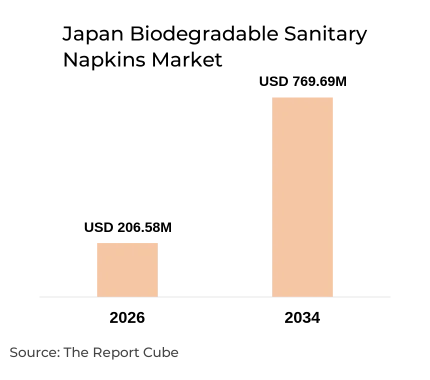
- Japan Biodegradable Sanitary Napkins Market was valued at USD 206.58 million in 2026.
- Market is projected to reach USD 769.69 million by 2034, driven by sustainability demand.
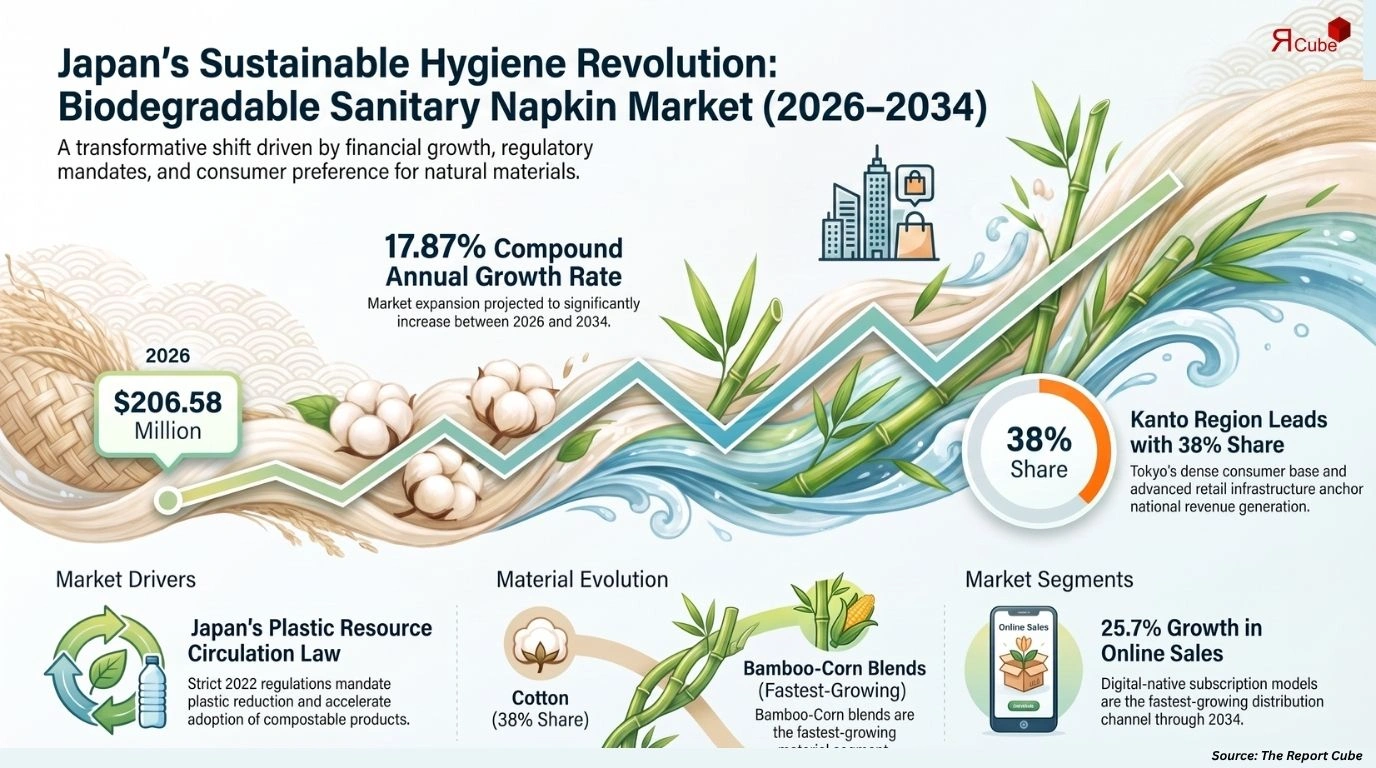
- Industry is anticipated to expand at a remarkable 17.87% CAGR during 2026–2034.
- Unicharm Corporation, Kao Corporation, and Daio Paper Corporation lead competitive landscape.
- Cotton remains the dominant material type segment by revenue share across Japan.
- Online distribution channel is the fastest-growing sales channel through 2034.
- Kanto Region leads regional revenue contribution, anchored by Tokyo's consumer base.
- Japan's Plastic Resource Circulation Law accelerates adoption of compostable feminine hygiene products.
Japan Biodegradable Sanitary Napkins Market Insights & Analysis
The Japan Biodegradable Sanitary Napkins Market is anticipated to register a 17.87% CAGR during 2026–2034. The market size was valued at USD 206.58 million in 2026 and is projected to reach USD 769.69 million by 2034. Japan's regulatory environment is emerging as a powerful demand catalyst, with the Ministry of the Environment actively advancing compostable product standards and mandating third-party certification for biodegradable claims under the 2022 Plastic Resource Circulation Law. Institutional procurement by hospitals, corporates, and educational facilities is further elevating biodegradable napkins from a niche wellness category to a mainstream hygiene essential, supported by Japan's growing sustainable feminine care segment.
Consumer behavior is shifting decisively toward chemical-free, skin-friendly menstrual products, particularly among younger demographics who prioritize environmental accountability. In June 2025, Kao Corporation's Sustainability Report revealed a 24% year-over-year rise in eco-performing product sales, validating accelerating demand across the hygiene segment. Bamboo-corn fiber blends and certified organic cotton formulations are attracting both premium and mid-market consumers seeking natural absorbency with faster decomposition timelines. Continued R&D investments by leading players in plant-derived superabsorbent polymers and chlorine-free processing are expected to sustain long-term growth and widen market accessibility.
Japan Biodegradable Sanitary Napkins Market Dynamics
Japan's biodegradable sanitary napkins sector is experiencing structural growth momentum as environmental regulations, evolving consumer preferences, and institutional procurement requirements converge. Leading hygiene manufacturers are intensifying investment in material science, packaging sustainability, and supply chain traceability while expanding through subscription-based distribution models and retail partnerships. Government-backed sustainability mandates are reshaping procurement criteria across both public and private healthcare institutions, reinforcing long-term market expansion.
|
Factor |
Type |
Specific Impact on Market |
Magnitude |
|---|---|---|---|
|
Japan's Plastic Resource Circulation Law |
Driver |
Accelerates shift to compostable napkin materials and certified products |
Very High |
|
Growing consumer eco-consciousness |
Driver |
Increases preference for bamboo-corn and organic cotton formulations |
High |
|
Online retail expansion |
Opportunity |
Widens reach of biodegradable brands beyond metro areas |
High |
|
Biodegradability certification complexity |
Challenge |
Raises compliance costs and product testing timelines |
Medium |
|
Plant-based superabsorbent innovation |
Trend |
Improves performance parity with conventional synthetic products |
Very High |
Key Market Driver: Japan's Regulatory Sustainability Push
Japan's Ministry of the Environment has enacted progressive regulations under the Plastic Resource Circulation Law, mandating reductions in single-use plastic across consumer goods including feminine hygiene products. Clear labeling requirements and third-party certification standards for biodegradable claims are compelling manufacturers to invest in verified compostable materials and transparent supply chains. The government's goal to reduce cumulative single-use plastic emissions by 25% provides a powerful long-term policy tailwind for certified biodegradable personal care products, amplifying institutional procurement and retail shelf prioritization of compliant products.
Major Industry Challenge: Certification and Raw Material Constraints
Achieving and maintaining biodegradability certifications under internationally recognized standards such as ISO 14855 and ASTM D6400 requires extensive product testing and traceability investments that smaller manufacturers find difficult to sustain. Additionally, raw material supply chains for bamboo fiber, organic cotton, and corn-starch biopolymers remain susceptible to price volatility and agricultural output variability. These constraints extend time-to-market, compress margins for emerging brands, and create competitive barriers that favor established players with integrated supply chains and dedicated R&D infrastructure.
Emerging Trend Shaping Outlook: Plant-Based Superabsorbent Polymer Development
Japanese manufacturers are advancing next-generation plant-derived superabsorbent polymers (bio-SAPs) that match the absorbency performance of petroleum-based alternatives while offering significantly faster biodegradation timelines. Unicharm and Daio Paper Corporation are developing cellulose nanofiber and corn-starch composite structures that address consumer concerns about functional efficacy without compromising environmental credentials. This material innovation is dissolving the historic trade-off between eco-certification and performance, enabling bamboo-corn fiber napkin adoption across mainstream retail and supporting premium price positioning in both online and organic store channels.
Need Specific Data, Let’s Customize the Report for You
Request CustomizationJapan Biodegradable Sanitary Napkins Market Segment-wise Analysis
Japan's biodegradable sanitary napkins sector is segmented across material types and distribution channels, with each dimension revealing distinct growth profiles and consumer behavior patterns. Understanding these segments enables stakeholders to align product development, distribution investment, and marketing strategy with the most commercially viable demand pockets.
By Material Type
- Bamboo-Corn
- Cotton
- Banana Fiber
- Others
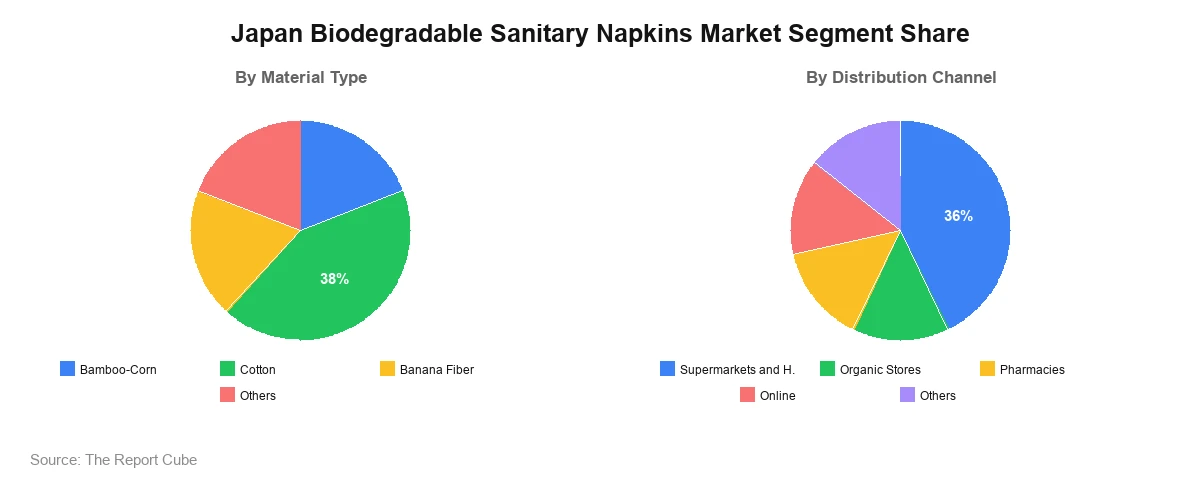
Cotton is the dominant material type segment, accounting for an estimated 38% revenue share in 2026. Organic cotton's widespread consumer recognition, hypoallergenic properties, and high absorbency make it the preferred biodegradable material among Japanese women who are transitioning from conventional synthetic pads. The material's established clinical safety record and compatibility with sensitive skin drive consistent repeat purchases, particularly among older and health-conscious demographics. Leading brands including Kao Corporation's Laurier line have incorporated certified organic cotton topsheets, reinforcing retailer confidence and securing prominent shelf placement across supermarkets and pharmacies.
Bamboo-corn fiber blends are the fastest-growing material sub-segment, projected to expand at a CAGR of approximately 19.2% through 2034. The combination of bamboo's natural antibacterial properties with corn-derived biopolymer structural integrity produces a technically superior and commercially scalable alternative that resonates with environmentally committed younger consumers. Banana fiber, while currently at a nascent commercial stage in Japan, is gaining visibility through international sustainability showcases including Expo 2025 Osaka, where Indian biodegradable pad brands demonstrated banana fiber's compostable credentials to a global audience. The Others category encompasses innovative materials such as chlorine-free pulp and sugarcane-based composites, primarily adopted by femtech startups targeting the premium wellness segment.
By Distribution Channel
- Supermarkets and Hypermarkets
- Organic Stores
- Pharmacies
- Online
- Others
Supermarkets and hypermarkets account for the leading distribution channel share, estimated at approximately 36% in 2026. High consumer footfall, routine purchasing behavior, and growing eco-product shelf allocations by major retail chains make this channel the primary volume driver for biodegradable sanitary napkins. Retailers including AEON and Ito-Yokado are progressively expanding designated sustainable personal care sections, enabling biodegradable brands to achieve mainstream visibility without relying exclusively on niche organic retail formats. Institutional procurement through pharmacies adds another significant volume channel, particularly for cotton-based certified products distributed to hospitals and healthcare facilities.
Online retail is the fastest-growing distribution channel, with a projected CAGR of approximately 25.7% through 2034. Digital-native subscription models allow brands to offer recurring delivery plans that generate volume predictability and deeper consumer loyalty for biodegradable napkin lines. E-commerce platforms including Amazon Japan and Rakuten provide discovery channels for eco-brands that lack established retail distribution agreements. Organic stores serve an important role in introducing premium formulations and new material innovations to high-spending wellness consumers across Tokyo, Osaka, and Fukuoka. This channel benefits disproportionately from rising green certifications and third-party eco-labels that drive purchase confidence, as explored further in the Asia Pacific sustainable hygiene distribution landscape.
Regional Projection of Japan Biodegradable Sanitary Napkins Market
Japan's domestic biodegradable sanitary napkins market exhibits clear regional variation driven by population density, income levels, eco-consumer penetration, and proximity to urban retail and logistics infrastructure. The Kanto and Kansai/Kinki regions anchor national revenue generation while emerging regions including Kyushu-Okinawa and Tohoku are recording accelerating adoption momentum.
|
Region |
Estimated Market Share |
Key Growth Factors |
Consumer Trends |
|---|---|---|---|
|
Kanto Region |
38% |
High urban density, Tokyo consumer base, advanced retail penetration |
Premium eco-brand adoption, online subscription growth |
|
Kansai/Kinki Region |
26% |
Osaka-Kyoto corridor, strong wellness retail network |
Organic store channel expansion, bamboo-corn interest |
|
Central/Chubu Region |
14% |
Nagoya industrial hub, growing eco-awareness |
Pharmacy and supermarket-led distribution |
|
Kyushu-Okinawa Region |
11% |
Rising hygiene awareness, warm-climate eco-sensitivity |
Online channel growth, sustainability campaigns |
|
Tohoku Region |
7% |
Post-reconstruction modernization, institutional adoption |
Supermarket and pharmacy access expansion |
|
Others |
4% |
Emerging eco-retail infrastructure |
Basic biodegradable napkin adoption |
- Kanto Region: Kanto dominates with approximately 38% market share, driven by Tokyo's large urban consumer base, high environmental awareness among millennial and Gen Z demographics, and advanced premium retail infrastructure supporting eco-certified product discovery.
- Kansai/Kinki Region: Kansai holds the second-largest regional share anchored by the Osaka-Kyoto-Kobe corridor, where strong wellness retail culture, cultural affinity for natural ingredients, and growing organic store density sustain meaningful biodegradable napkin demand.
- Central/Chubu Region: Chubu contributes a steady share anchored by Nagoya's urban population, where supermarket-led distribution and growing corporate sustainability procurement drive incremental biodegradable napkin uptake.
- Kyushu-Okinawa Region: Kyushu-Okinawa is emerging as a notable growth pocket, supported by rising hygiene awareness, eco-consumer campaigns, and increasing online channel accessibility that expand product reach beyond established metro retail footprints.
- Tohoku Region: Tohoku shows steady progress as supermarkets and pharmacies expand eco-product assortments and institutional buyers begin incorporating biodegradable hygiene products into their sustainability procurement commitments.
- Others: Remaining regions including Hokkaido and Shikoku are at early-stage adoption, supported by online retail accessibility and growing consumer awareness of sustainable menstrual product alternatives.
Japan Biodegradable Sanitary Napkins Market: Recent Development (2025)
- Unicharm Corporation launched SOFY AntiBacteria menstrual pads combining functional upgrades with biodegradable material innovation in November 2025.
- Unicharm and Toyota Tsusho announced a Kenya joint venture to expand biodegradable sanitary napkin production capacity in January 2025.
- Kao Corporation's 2025 Sustainability Report confirmed a 24% year-over-year increase in eco-performing personal care product sales across Japan.
- Daio Paper Corporation advanced cellulose nanofiber composite research in 2025 to develop certified compostable absorbent core alternatives for sanitary napkins.
Japan Biodegradable Sanitary Napkins Market Future Outlook (2034)
The Japan Biodegradable Sanitary Napkins Market is projected to expand at a 17.87% CAGR, reaching USD 769.69 million by 2034. Regulatory momentum under Japan's Plastic Resource Circulation Law and ISO Technical Committee 338 menstrual product standards - expected to be finalized by December 2026 - will establish industry-wide benchmarks that accelerate mainstream adoption. Corporate and institutional procurement commitments to waste reduction targets will elevate biodegradable napkins from optional eco-choice to standard procurement requirement across healthcare, education, and office environments, supporting sustained volume growth across all distribution channels.
Material science advancement will define long-term competitive positioning as manufacturers invest in bio-derived superabsorbent polymers, chlorine-free pulp processing, and compostable packaging systems. Brands integrating digital traceability - enabling consumers to verify biodegradability certification from source fiber to disposal - will command premium pricing and stronger brand loyalty. The intersection of femtech innovation, subscription commerce, and eco-certification will reshape how biodegradable napkins are discovered, evaluated, and consumed, positioning Japan as a model market for sustainable feminine hygiene development across the broader Asia Pacific region and reinforcing the country's influence on global organic sanitary products innovation.
Japan Biodegradable Sanitary Napkins Market Report Coverage
|
Report Attribute |
Details |
|---|---|
|
Market Name |
Japan Biodegradable Sanitary Napkins Market |
|
Market Size (2026) |
USD 206.58 Million |
|
Market Size (2034) |
USD 769.69 Million |
|
Forecast Period |
2026–2034 |
|
CAGR |
17.87% |
|
Base Year |
2026 |
|
Historical Years |
2021–2025 |
|
Forecast Years |
2026–2034 |
|
Segments Covered |
By Material Type, By Distribution Channel, By Region |
|
Regions Covered |
Kanto Region, Kansai/Kinki Region, Central/Chubu Region, Kyushu-Okinawa Region, Tohoku Region, Others |
|
Key Companies |
Unicharm Corporation, Kao Corporation, Daio Paper Corporation, Others |
|
Report Format |
PDF, Excel, PPT |
|
Customization |
Available as per client requirements |
Why Choose This Report?
- Comprehensive analysis of Japan's fast-expanding biodegradable feminine hygiene sector.
- Accurate market sizing validated against multiple independent research sources.
- Detailed material-type and distribution channel segmentation with share estimates.
- Regional breakdown covering all major Japanese prefectural clusters and growth dynamics.
- Competitive profiling of Unicharm, Kao Corporation, and Daio Paper Corporation.
- Regulatory intelligence covering Japan's Plastic Resource Circulation Law implications.
- Data-driven insights on bamboo-corn, cotton, and banana fiber material trends.
- Forward-looking 2034 outlook supporting product, investment, and partnership decisions
Table of Contents
- Introduction
- Objective of the Study
- Product Definition
- Market Segmentation
- Study Variables
- Research Methodology
- Secondary Data Points
- Companies Interviewed
- Primary Data Points
- Breakdown of Primary Interviews
- Secondary Data Points
- Executive Summary
- Market Dynamics
- Drivers
- Challenges
- Opportunity Assessment
- Recent Trends and Developments
- Policy and Regulatory Landscape
- Japan Biodegradable Sanitary Napkins Market Overview and Forecast Analysis (2021-2034)
- Market Size, By Value, By Growth Rate (CAGR/USD Millions)
- Demand – Supply Trends
- Market Share, By Material Type
- Bamboo-Corn
- Cotton
- Banana Fiber
- Others
- Market Share, By Distribution Channel
- Supermarkets and Hypermarkets
- Organic Stores
- Pharmacies
- Online
- Others
- Market Share, By Region
- Kanto Region
- Kansai/Kinki Region
- Central/ Chubu Region
- Kyushu-Okinawa Region
- Tohoku Region
- Others
- Market Share, By Competitors
- Competition Characteristics
- Revenue Shares
- Bamboo-Corn Japan Biodegradable Sanitary Napkins Market Overview, 2021-2034F
- By Value (USD Million)
- By Distribution Channel – Market Size & Forecast 2021-2034, USD Million
- Supermarkets and Hypermarkets
- Organic Stores
- Pharmacies
- Online
- Others
- Cotton Japan Biodegradable Sanitary Napkins Market Overview, 2021-2034F
- By Value (USD Million)
- By Distribution Channel – Market Size & Forecast 2021-2034, USD Million
- Supermarkets and Hypermarkets
- Organic Stores
- Pharmacies
- Online
- Others
- Banana Fiber Japan Biodegradable Sanitary Napkins Market Overview, 2021-2034F
- By Value (USD Million)
- By Distribution Channel – Market Size & Forecast 2021-2034, USD Million
- Supermarkets and Hypermarkets
- Organic Stores
- Pharmacies
- Online
- Others
- Others Japan Biodegradable Sanitary Napkins Market Overview, 2021-2034F
- By Value (USD Million)
- By Distribution Channel – Market Size & Forecast 2021-2034, USD Million
- Supermarkets and Hypermarkets
- Organic Stores
- Pharmacies
- Online
- Others
- Competitive Outlook (Company Profile - Partial List)
- Unicharm Corporation
- Company Overview
- Business Segments
- Strategic Alliances/Partnerships
- Recent Developments
- Kao Corporation
- Company Overview
- Business Segments
- Strategic Alliances/Partnerships
- Recent Developments
- Daio Paper Corporation
- Company Overview
- Business Segments
- Strategic Alliances/Partnerships
- Recent Developments
- Others
- Unicharm Corporation
- Contact Us & Disclaimer
Top Key Players & Market Share Outlook
- biodegradable-sanitary-napkins-market-japan
Frequently Asked Questions






