



Build Your Custom Market Intelligence Report
Customize Your ReportAfrica Cassava Market Key Highlights
By Product Type:
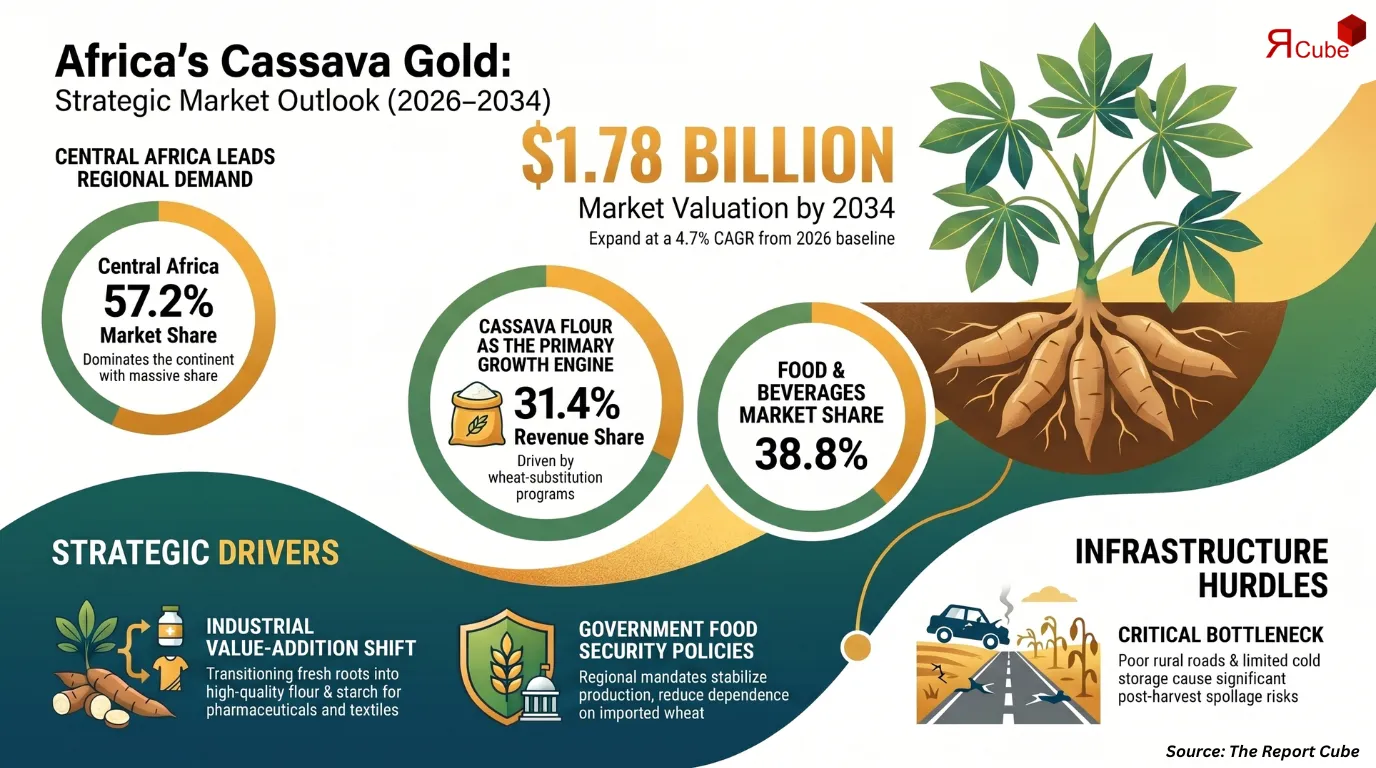
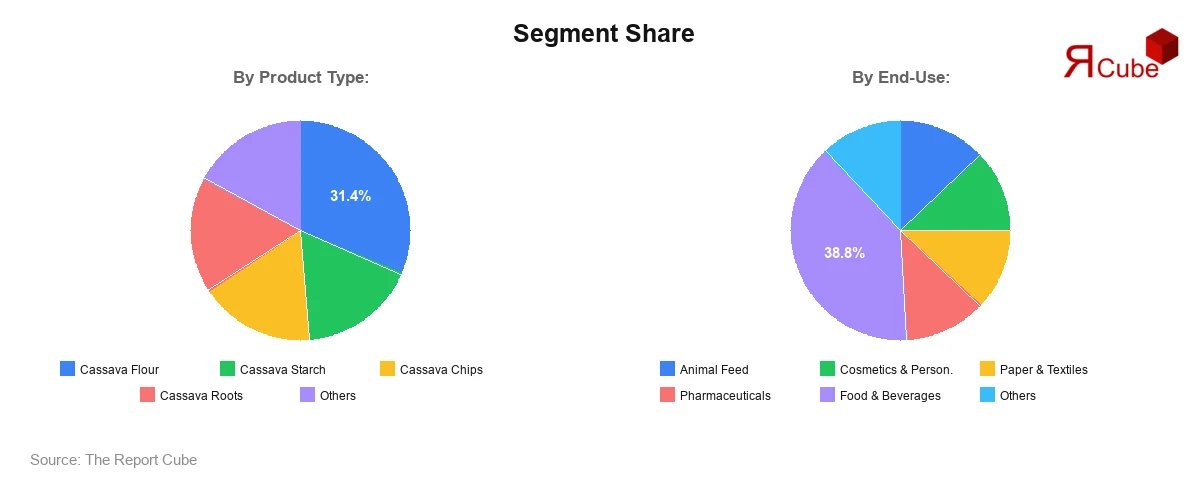
Cassava Flour segment leads the market with nearly 31.4% share.
By End-Use:
Food & Beverages segment dominates the market with approximately 38.8% of revenue.
Regional Outlook:
Central Africa region dominates the Africa Cassava Market with around 57.2% share.
Africa Cassava Market Insights & Analysis
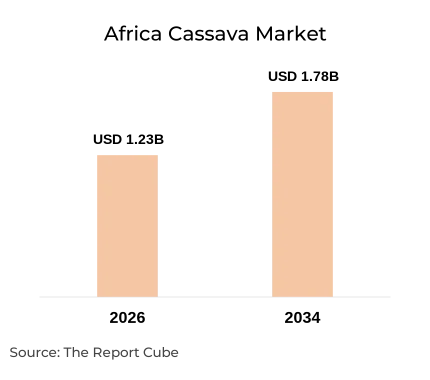
The Africa Cassava Market is anticipated to register a CAGR of around 4.7% during the forecast period 2026-2034. The market size is valued at USD 1.23 billion in 2026 and is projected to reach USD 1.78 billion by 2034. Growing demand for cassava-based food ingredients, industrial starch, animal nutrition products, and gluten-free alternatives is supporting long-term market expansion across the African continent. Countries such as Nigeria, Cameroon, the Democratic Republic of the Congo, and Angola continue to increase cassava cultivation as governments prioritize food security and agricultural self-sufficiency.
Investment activity across cassava processing facilities has accelerated as regional manufacturers expand flour, starch, and chip production capacities. Food processors are increasingly replacing imported wheat with cassava flour blends to reduce raw material costs and improve local sourcing. New agro-industrial partnerships, processing clusters, and contract farming programs are also strengthening supply chains. Rising consumption of packaged foods, growth in livestock feed production, and expanding pharmaceutical applications for cassava starch are creating additional revenue streams. Market participants are investing in mechanized harvesting, disease-resistant varieties, and value-added processing technologies to improve productivity and commercial competitiveness across Africa's cassava industry.
Africa Cassava Market Impact Analysis
| Factor | Type | Specific Impact on Market | Magnitude | Business Implication |
|---|---|---|---|---|
| Rising Food and Feed Demand | Market | Higher use of cassava for food, livestock and industrial feed blends increases baseline demand across multiple segments. | High | Supports capacity expansion in processing plants serving flour, feed and starch applications to lock in volume growth. |
| Government Food Security Policies | Regulatory | Support programs promoting cassava as a strategic staple crop stabilize production and encourage smallholder participation. | High | Enables partnerships with public agencies and NGOs to secure supply contracts and co-invest in farmer extension. |
| Yield and Area Expansion Drivers | Environmental | Improvements in yield and expansion of cultivated area raise overall cassava output in key African regions. | Medium | Creates scope for long term offtake agreements and investment in storage to handle fluctuating harvest volumes. |
| Infrastructure and Logistics Constraints | Market | Poor rural roads and limited storage cause post harvest losses and raise transport costs for fresh roots. | High | Necessitates localized processing hubs and investment in drying or chipping to reduce spoilage and logistics risk. |
| Starch and Industrial Demand Growth | Technological | Emerging starch, ethanol and industrial uses expand value addition opportunities beyond raw food markets. | Medium | Encourages diversification into starch processing, bioethanol and specialty ingredients targeting regional industries. |
| Price Volatility and Import Competition | Competitive | Exposure to imported starch and alternative staples drives price swings and pressure on local processors. | Medium | Requires flexible pricing, product differentiation and hedging strategies to protect margins and market share. |
| Climate Variability and Shocks | Environmental | Droughts and extreme weather events disrupt yields and supply stability in cassava producing zones. | Medium | Drives need for climate resilient varieties, geographic diversification and risk sharing with farmer networks. |
Africa Cassava Market Dynamics
Key Driver: Rising Demand for Food Security and Local Agricultural Processing
Africa's growing population and increasing focus on domestic food production are creating strong demand for cassava cultivation and processing. Cassava remains one of the continent's most resilient crops due to its ability to tolerate drought conditions and variable soil quality. Governments and agricultural agencies are encouraging farmers to increase cassava acreage as part of broader food security programs. The crop's versatility in producing flour, starch, chips, sweeteners, and animal feed ingredients is strengthening its commercial value.
Several African countries are promoting local agro-processing industries to reduce dependence on imported food ingredients. Cassava flour substitution programs in bakery products and industrial starch applications are helping domestic manufacturers lower import costs. As urbanization increases and processed food consumption rises, cassava-derived ingredients continue gaining acceptance among food manufacturers and industrial users, supporting market growth and value-chain development.
Industry Trends: Expansion of Value-Added Cassava Processing Facilities
Processing investments are becoming a major trend across the Africa cassava market. Companies are increasing production capacities for high-quality cassava flour, modified starch, and industrial-grade derivatives to meet demand from food processing, textile, pharmaceutical, and paper industries. Modern processing facilities equipped with automated drying and starch extraction systems are improving operational efficiency and product consistency.
Private investors and agribusiness firms are also focusing on integrated farming and processing models. These projects improve raw material availability while creating employment opportunities in rural regions. Demand for gluten-free food products, natural thickeners, and sustainable agricultural ingredients is encouraging innovation in cassava-based product development. Digital farming solutions and improved seed distribution programs are further supporting productivity gains across major cassava-producing countries.
Book your FREE 30-minute expert consultation today
Contact UsMajor Challenge: Post-Harvest Losses and Infrastructure Constraints
Limited transportation networks, inadequate storage facilities, and weak rural infrastructure continue to challenge the cassava value chain. Fresh cassava roots deteriorate rapidly after harvesting, leading to substantial post-harvest losses in several African countries. Smallholder farmers often struggle to access efficient processing centers, reducing profitability and limiting market access.
Price fluctuations and inconsistent raw material supply also create operational challenges for processors. Disease outbreaks such as cassava mosaic disease and cassava brown streak disease affect crop yields in some regions. Financing constraints among small-scale farmers and processors further restrict investment in mechanization and modern cultivation practices. These factors may slow productivity improvements and impact the overall pace of market expansion during the forecast period.
Opportunity: Growing Industrial Applications of Cassava Derivatives
The increasing use of cassava starch and related products across industrial sectors presents substantial growth opportunities. Manufacturers in pharmaceuticals, paper production, textiles, adhesives, and cosmetics are expanding their use of cassava-based ingredients due to favorable functional properties and local availability. Demand for biodegradable materials and sustainable industrial inputs is also supporting market development.
Export opportunities are emerging as international buyers seek alternative starch sources and gluten-free ingredients. Regional governments and development agencies are encouraging investment in cassava processing zones and agro-industrial parks to increase value addition. As processing technologies improve and production scales expand, African producers are expected to strengthen their presence in regional and global cassava product markets over the coming decade.
Africa Cassava Market Segment-wise Analysis
By Product Type:
- Cassava Flour
- Cassava Starch
- Cassava Chips
- Cassava Roots
- Others
Cassava Flour holds the largest share of the Africa Cassava Market, accounting for approximately 31.4% of total revenue in 2026. Demand continues to rise as food manufacturers increasingly incorporate cassava flour into bakery products, snacks, noodles, and gluten-free food formulations. The segment benefits from government efforts to encourage partial wheat flour substitution, particularly in countries seeking to reduce import dependence.
Urban consumers are also showing greater interest in locally sourced food ingredients, creating additional demand for cassava-based products. Growth in commercial baking operations and packaged food production across Nigeria, Cameroon, and the Democratic Republic of the Congo is supporting continued expansion. Improved processing technologies and quality certification programs are further enhancing product acceptance among industrial food processors.
By End-Use:
- Animal Feed
- Cosmetics & Personal Care
- Paper & Textiles
- Pharmaceuticals
- Food & Beverages
- Beverages
- Snacks
- Bakery & Confectionery
- Others
- Others
Food & Beverages remains the dominant end-use segment with an estimated market share of 38.8%. Cassava derivatives are widely used in bakery products, traditional foods, beverages, confectionery items, and snack manufacturing. Rising disposable incomes and growing urban populations are driving demand for processed food products across several African economies.
Food manufacturers are utilizing cassava starch and flour to improve texture, shelf life, and production efficiency. The beverage sector is also exploring cassava-based ingredients for brewing and fermentation applications. Increasing awareness of gluten-free dietary options and the availability of locally sourced raw materials continue to support segment growth. Strong consumption patterns and expanding food processing investments are expected to maintain the segment's leadership position through 2034.
Regional Projection of Africa Cassava Industry
- Central Africa
- Cameroon
- Central African Republic
- Chad
- Democratic Republic of the Congo
- Republic of the Congo
- Equatorial Guinea
- Gabon
- Southern Africa
- Angola
- Botswana
- Eswatini
- Lesotho
- Malawi
- Mozambique
- Namibia
- South Africa
- Zambia
- Zimbabwe
- Others
Central Africa accounts for the largest share of the Africa Cassava Market, representing approximately 57.2% of total industry revenue. The region benefits from favorable climatic conditions, extensive cultivation areas, and strong consumer dependence on cassava as a staple food source. Countries such as Cameroon and the Democratic Republic of the Congo continue to expand production volumes through improved farming practices and government-supported agricultural initiatives. Growing investments in local starch processing and flour manufacturing facilities are improving value addition across the region.
Demand from food processing, animal feed, and industrial sectors is also contributing to market expansion. Population growth, increasing food consumption, and efforts to strengthen domestic agricultural supply chains are expected to sustain Central Africa's leading position throughout the forecast period.
Need insights for a specific region within this market?
Request Regional DataAfrica Cassava Market Regional Analysis
The Africa cassava market varies significantly across regions due to diverse climatic conditions, production capacity, and consumption patterns.
| Region | Demand Level | Key Production Areas | Primary Use | Core Demand Logic | Growth Nature |
|---|---|---|---|---|---|
| Central Africa (DRC) | Extremely High | Kwilu, Kinshasa, South Kivu | Food staple & Processing | Highest per capita consumption globally (353kg) | Production-led expansion |
| Central Africa (Cameroon) | High | South, Center, East regions | Food & Industrial flour | Growing industrial demand (60,000 tons yearly) | Processing capacity gap |
| Central Africa (CAR, Chad) | Medium | Paoua, Bossangoa, Bocaranga | Subsistence food | Staple crop with 9% growth projected in 2025 | Climate-resilient farming |
| Southern Africa (Angola) | High | Northern provinces | Food staple | Consumption outpacing production (6.4M tons) | Import-dependent growth |
| Southern Africa (Mozambique) | Very High | Central & Northern zones | Food & Export | 36% production increase via UN projects | Fastest-growing segment |
| Southern Africa (Malawi, Zambia) | Medium to High | Lakeshore & Central areas | Food security & Drought hedge | Maize alternative; production quadrupled | Drought-driven adoption |
| Southern Africa (South Africa) | Low to Medium | Limited commercial zones | Industrial starch | Niche industrial processing demand | Import-based market |
| Central Africa (Gabon, Eq. Guinea) | Low | Coastal regions | Food staple (localized) | Low productivity; limited scale | Subsistence-level growth |
Government Initiatives & Policies
- Nigeria Special Agro-Industrial Processing Zones (SAPZ) Programme: The Federal Government of Nigeria continues expanding agro-processing infrastructure to strengthen value-added agricultural production, including cassava processing clusters, rural industrialization, storage systems, and supply-chain efficiency improvements.
- Nigeria Cassava Industrialization and Investment Initiative 2025: Industry and government stakeholders are promoting investment facilitation, supply-chain strengthening, processing expansion, and policy advocacy to position Nigeria as a major cassava manufacturing and export hub.
Africa Cassava Industry Recent Developments
- 2025: Premium Cassava Products Ltd (PCPL) expanded its processing operations to reduce Nigeria's cassava by-product imports and address growing demand for starch and high-quality flour. The company increased starch production capacity, with milk storage infrastructure reaching 10,000 litres while enhancing product quality and sustainability initiatives.
- 2026: Matna Foods Company Limited was acquired by Agbeyewa Industries to integrate large-scale cassava cultivation with industrial processing capabilities. The acquisition supports food security, import reduction, job creation, and long-term agro-industrial development through planned cultivation of 100,000 hectares over the next decade.
Why Choose This Report?
- Provides a comprehensive overview of the overall market analysis, encompassing key trends, consumer behavior analysis, and risk assessment to support strategic decision-making.
- Provides accurate, up-to-date insights into market size, segmentation, and emerging opportunities, helping to minimize risk & capitalizing on growth.
- Gives deep understanding of target audience preferences, investment habits, and communication channels for enhanced product development & marketing effectiveness.
- Delivers competitive analysis & benchmarking, uncovering the strengths & weaknesses of market competitors to guide strategies.
- Consolidate comprehensive market intelligence, reducing reasoning & streamlining research efforts.
- Facilitates customized market segmentation & risk mitigation strategies, fine-tuned to the business objectives.
- Aids in identifying both market challenges & untapped opportunities within the industry to drive long-term business growth.
- Provides valuable information based on actual customer data & search trends.
Table of Contents
- Introduction
- Objective of the Study
- Product and Category Definition
- Market Segmentation
- Study Variables
- Research Methodology
- Secondary Data Points
- Breakdown of Secondary Sources
- Primary Data Points
- Breakdown of Primary Interviews
- Secondary Data Points
- Executive Summary
- Market Dynamics
- Emerging Opportunities
- Adoption Trends
- Demand Drivers
- Disruption Analysis (Challenges)
- Industry Analysis & Strategic Insights
- Supply/Value Chain Analysis
- Pricing Analysis
- Go-To-Market (GTM) Strategy
- BCG Matrix
- Recent Trends and Developments
- Import and Export Analysis
- Regulatory and Policy Landscape
- Region-wise Policies
- Government Initiatives
- Africa Cassava Market Overview and Forecast Analysis (2021-2034)
- Market Size, By Value, By Growth Rate (CAGR/USD Billion)
- By Product Type
- Cassava Flour
- Cassava Starch
- Cassava Chips
- Cassava Roots
- Others
- By Nature
- Organic
- Conventional
- Others
- By Form
- Processed
- Fresh
- Others
- By End-Use
- Animal Feed
- Cosmetics & Personal Care
- Paper & Textiles
- Pharmaceuticals
- Food & Beverages
- Beverages
- Snacks
- Bakery & Confectionery
- Others
- Others
- Market Share, By Region
- Central Africa
- Cameroon
- Central African Republic
- Chad
- Democratic Republic of the Congo
- Republic of the Congo
- Equatorial Guinea
- Gabon
- Southern Africa
- Angola
- Botswana
- Eswatini
- Lesotho
- Malawi
- Mozambique
- Namibia
- South Africa
- Zambia
- Zimbabwe
- Others
- Central Africa
- Market Share, By Company
- Revenue Shares & Analysis
- Competitive Landscape
- Central Africa Cassava Market Overview and Forecast Analysis (2021-2034)
- Market Size, By Value, By Growth Rate (CAGR/USD Billion/Million)
- Market Share, By Product Type
- Market Share, By Nature
- Market Share, By Form
- Market Share, By End-Use
- Market Share, By Country
- Cameroon
- Central African Republic
- Chad
- Democratic Republic of the Congo
- Republic of the Congo
- Equatorial Guinea
- Gabon
- Southern Africa Cassava Market Overview and Forecast Analysis (2021-2034)
- Market Size, By Value, By Growth Rate (CAGR/USD Billion/Million)
- Market Share, By Product Type
- Market Share, By Nature
- Market Share, By Form
- Market Share, By End-Use
- Market Share, By Country
- Angola
- Botswana
- Eswatini
- Lesotho
- Malawi
- Mozambique
- Namibia
- South Africa
- Zambia
- Zimbabwe
- Competitive Analysis, 2026
- Market Share of Key Players
- Competitive Mapping for Each Segment and Companies Operating Regionally
- Central Africa Cassava Companies Share & Competitive Analysis, 2026
- Southern Africa Cassava Companies Share & Competitive Analysis, 2026
- Company Profile (Partial List)
- Premium Cassava Products Ltd (PCPL)
- Company Overview
- Product Portfolio
- Strategic Alliances/Partnerships
- Recent Developments
- Ayensu Starch Company Limited
- Company Overview
- Product Portfolio
- Strategic Alliances/Partnerships
- Recent Developments
- Crest Agro Products Limited
- Company Overview
- Product Portfolio
- Strategic Alliances/Partnerships
- Recent Developments
- Tongaat Hulett Africa
- Company Overview
- Product Portfolio
- Strategic Alliances/Partnerships
- Recent Developments
- Niji Foods Nigeria Limited
- Company Overview
- Product Portfolio
- Strategic Alliances/Partnerships
- Recent Developments
- Psaltry International Limited
- Company Overview
- Product Portfolio
- Strategic Alliances/Partnerships
- Recent Developments
- Amani Vineyards & Agro-Processing
- Company Overview
- Product Portfolio
- Strategic Alliances/Partnerships
- Recent Developments
- Lentus Foods Limited
- Company Overview
- Product Portfolio
- Strategic Alliances/Partnerships
- Recent Developments
- Dadtco Rivers Cassava Processing Company Ltd
- Company Overview
- Product Portfolio
- Strategic Alliances/Partnerships
- Recent Developments
- Verdantis Agro Produce Limited
- Company Overview
- Product Portfolio
- Strategic Alliances/Partnerships
- Recent Developments
- Matna Foods Company Limited
- Company Overview
- Product Portfolio
- Strategic Alliances/Partnerships
- Recent Developments
- Others (Partial List)
- Premium Cassava Products Ltd (PCPL)
- Contact Us and Disclaimer
Top Key Players & Market Share Outlook
- Premium Cassava Products Ltd (PCPL)
- Ayensu Starch Company Limited
- Crest Agro Products Limited
- Tongaat Hulett Africa
- Niji Foods Nigeria Limited
- Psaltry International Limited
- Amani Vineyards & Agro-Processing
- Lentus Foods Limited
- Dadtco Rivers Cassava Processing Company Ltd
- Verdantis Agro Produce Limited
- Matna Foods Company Limited
- Others
Frequently Asked Questions






