



Build Your Custom Market Intelligence Report
Customize Your ReportGlobal Construction 3D Printing Market Key Takeaways
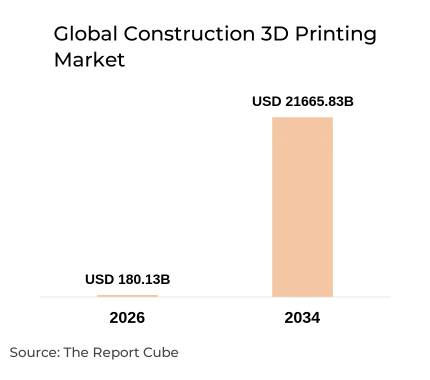
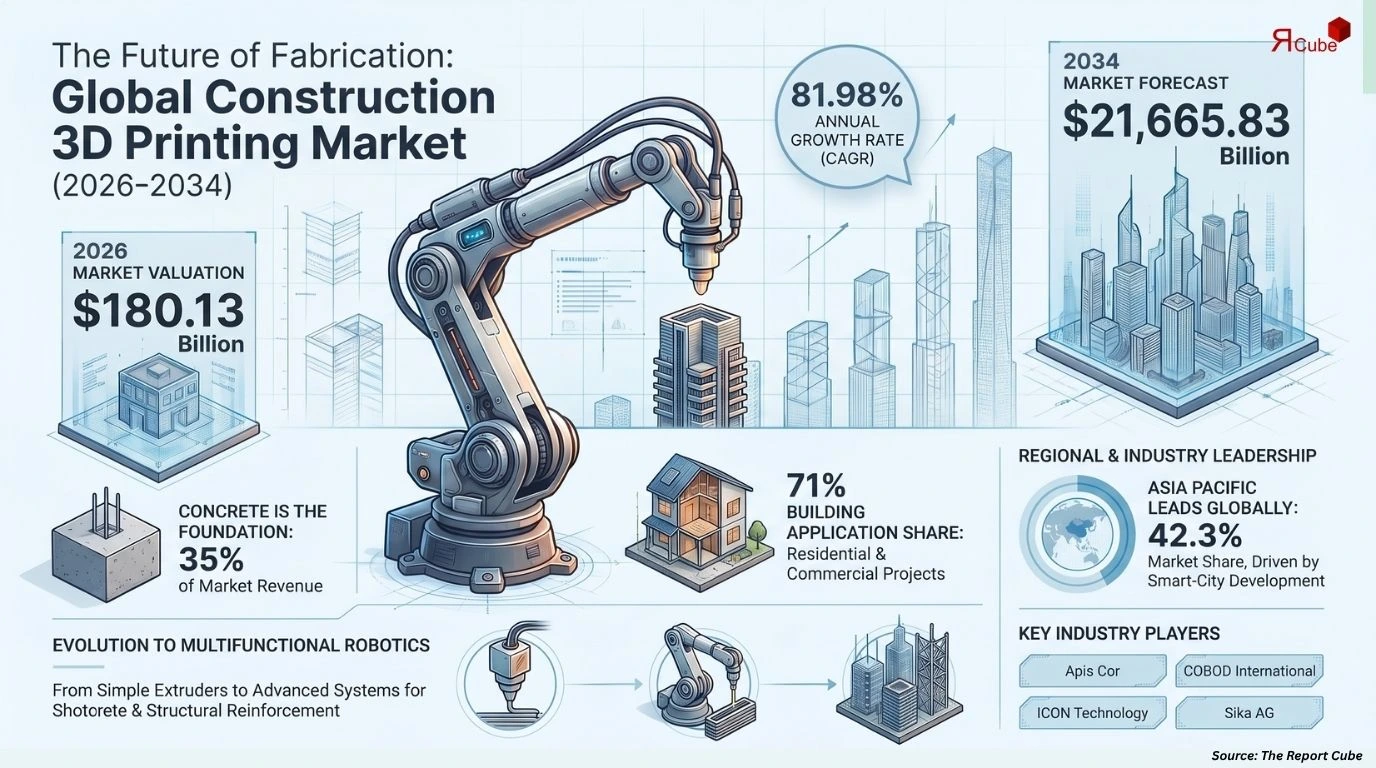
- The market is valued at USD 180.13 billion in 2026.
- The market reaches USD 21,665.83 billion by 2034.
- The market is projected to register an 81.98% CAGR.
- Key players include Apis Cor, COBOD, ICON, Sika, and MX3D.
- Concrete remains the dominant material segment across construction applications.
- Asia Pacific currently represents the leading regional market globally.
- Asia Pacific is also projected to remain fastest-growing region.
- Automation, robotics, and digital construction integration are accelerating adoption.
Global Construction 3D Printing Market Insights & Analysis
The Global Construction 3D Printing Market is anticipated to register an 81.98% CAGR during 2026-2034. The market size was valued at USD 180.13 billion in 2026 and is projected to reach USD 21,665.83 billion by 2034. Construction-scale additive manufacturing is transitioning from demonstration projects toward repeatable commercial construction. Concrete remains the most established material because extrusion-based systems can directly fabricate walls and structural components. Independent 2026 research from Grand View Research identifies concrete as the largest material category, accounting for 35.2% of 2025 revenue, while building applications represented 71.8%. These trends reflect growing demand for faster construction, digital fabrication, customized architectural geometries, and automated site execution.
Investment and institutional support are increasingly focused on construction automation, housing delivery, sustainability, and digitalization. In 2025, COBOD and TU Braunschweig introduced a commercially available multifunctional construction robot combining 3D construction printing with shotcrete capabilities. Government-supported projects are also emerging; a Colorado deployment received a USD 680,000 IHIP grant to scale 3D-printed housing. These initiatives demonstrate that public funding, research partnerships, and construction-industry commercialization are increasingly converging around automated building technologies.
Global Construction 3D Printing Market Dynamics
The market is gaining momentum as construction companies increasingly evaluate automated fabrication for housing, commercial buildings, infrastructure, and specialized structures. The strongest adoption is occurring where construction speed, labor availability, design flexibility, and housing requirements create clear operational benefits. Serial housing projects in Europe and large-scale residential deployments in the United States demonstrate that the technology is progressing from experimental prototypes toward repeatable construction workflows.
|
Factor |
Type |
Specific Impact on Market |
Magnitude |
|---|---|---|---|
|
Construction automation |
Driver |
Accelerates fabrication and reduces dependence on repetitive site activities |
High |
|
Printable material innovation |
Driver |
Expands structural performance, sustainability, and application flexibility |
High |
|
Regulatory standardization |
Opportunity |
Improves approval pathways for printed structural systems |
High |
|
Infrastructure applications |
Opportunity |
Extends adoption beyond residential and commercial buildings |
High |
|
Workforce availability |
Market Influence |
Encourages contractors to automate labor-intensive construction processes |
Medium-High |
Key Market Driver: Accelerating Automated Construction Deployment
Automation is a principal market catalyst because construction-scale printers can convert digital designs directly into physical structures. The technology enables repeatable deposition, complex geometries, and increasingly standardized construction workflows. COBOD’s European housing projects illustrate this transition: its Holstebro project produced 36 student apartments across six buildings, while printing productivity improved substantially as the project progressed. In Germany, the DREIHAUS project demonstrated a serial housing model with 21 residential units, reinforcing the potential for repeatable rather than isolated construction applications.
Major Industry Challenge: Establishing Consistent Construction Standards Globally
Regulatory acceptance remains a critical challenge because printed structures must satisfy structural, fire, seismic, durability, and safety requirements that vary between jurisdictions. Certification procedures can also differ according to building type and construction material. However, progress toward standardized construction practices is visible. COBOD reported that Ireland’s social housing project became the first project compliant with the ISO/ASTM 52939:2023 additive-manufacturing standard. Japan also approved its first government-approved two-story 3D-printed reinforced-concrete house in 2025, demonstrating that regulatory pathways are becoming more established.
Emerging Trend Shaping Outlook: Multifunctional Robotic Construction Platforms Expanding
Construction printers are increasingly evolving into multifunctional robotic platforms rather than remaining dedicated concrete-extrusion machines. COBOD and TU Braunschweig introduced a system incorporating a telescopic vertical extension and robotic arm capable of shotcrete applications. Such systems can potentially address tunnels, retaining walls, swimming pools, structural reinforcement, and other complex construction tasks. This expansion increases equipment utilization while broadening the technology's addressable market. Parallel research by Sika and ETH Zurich demonstrates another emerging direction: large-scale robotic printing using reclaimed thermoplastics for façade and roofing applications.
Need Specific Data, Let’s Customize the Report for You
Request CustomizationGlobal Construction 3D Printing Market Segment-wise Analysis
Material selection and end-use requirements remain central to market development. Concrete currently provides the strongest commercial foundation because its printing ecosystem is comparatively mature, while metal and composite technologies are expanding into specialized applications. Building construction remains the largest end-use area, although infrastructure is gaining momentum as printing systems become more versatile.
By Material Type
- Concrete
- Metal
- Composite
- Others
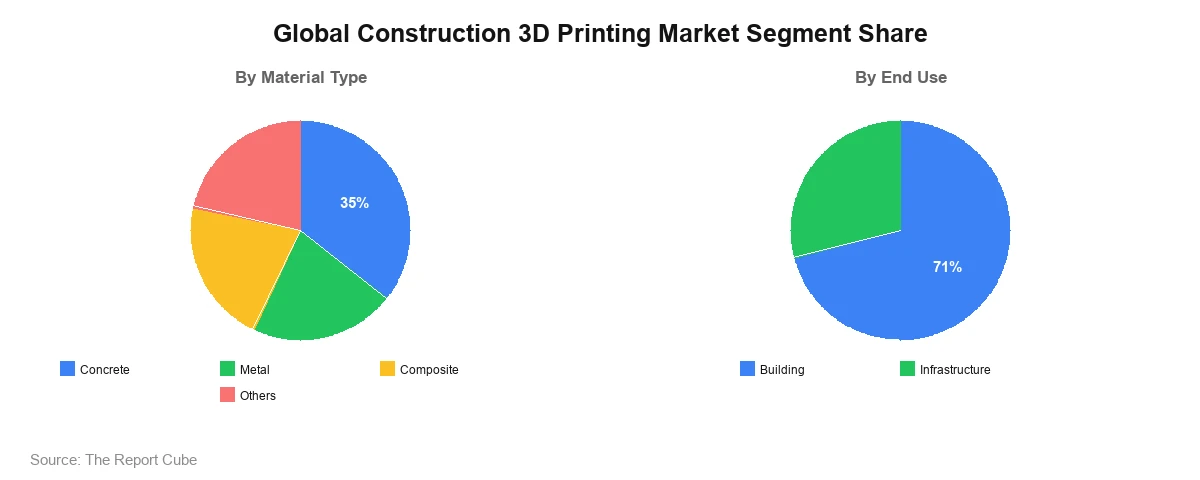
Concrete dominated the material landscape with a 35% revenue share in 2025, according to The Report Cube. Its leadership is supported by established extrusion technology, compatibility with conventional structural practices, and the ability to fabricate large wall sections directly at construction sites. Concrete printing also benefits from extensive commercial activity involving COBOD, ICON, Apis Cor, CyBe Construction, and other technology providers. The material remains particularly attractive for housing because printable concrete can support customized geometries while maintaining a familiar construction material profile.
Metal and composite materials represent important expansion opportunities as construction printing moves into more specialized applications. Metal printing can support structural components, architectural elements, reinforcement systems, bridges, and complex geometries. Composite materials offer lightweight construction, improved design flexibility, and potential integration of sensors or other functional technologies. Grand View Research identifies composites as a particularly fast-growing material area, with the segment projected to register growth exceeding 112.5% over its forecast period. Sika's 2025 collaboration with ETH Zurich further demonstrates the commercial relevance of recycled thermoplastic printing.
By End Use
- Building
- Infrastructure
Building applications dominated the market with a 71% revenue share in 2025. Residential, commercial, and industrial buildings represent the most established application environment because wall geometries can be standardized and printing can be integrated with conventional construction activities. Housing shortages and demand for faster project execution further strengthen adoption. COBOD's 36-apartment Danish project and ICON's Austin residential developments demonstrate increasing movement toward multi-unit housing rather than isolated prototype homes.
Infrastructure represents the emerging high-growth application area as robotic systems expand their functional capabilities. Applications include bridges, tunnels, retaining structures, marine structures, military facilities, and specialized civil-engineering components. Multifunctional systems such as COBOD's 2025 construction robot can combine concrete printing with shotcrete, increasing applicability across complex infrastructure environments. The infrastructure segment is therefore expected to benefit from increased public-sector experimentation, smart-city programs, and demand for digitally fabricated structures with customized geometries.
Regional Projection of Global Construction 3D Printing Market
Regional development varies according to construction automation, housing demand, infrastructure investment, regulatory maturity, and availability of technology providers. Asia Pacific currently leads the broader construction 3D printing market, while North America remains a major commercialization center and Europe maintains strong technology and project-development capabilities.
|
Region |
Estimated Market Share |
Key Growth Factors |
Consumer Trends |
|---|---|---|---|
|
Asia Pacific |
42.3% |
Urbanization, smart cities, modular construction, infrastructure |
Demand for rapid and digitally enabled construction |
|
North America |
Major market |
Housing programs, robotics, commercialization, defense |
Growing preference for resilient and efficient housing |
|
Europe |
Major market |
Sustainability, automation, serial housing, regulation |
Demand for low-waste and digitally fabricated buildings |
|
Latin America |
Emerging |
Housing shortages and construction modernization |
Increasing interest in affordable construction |
|
Middle East & Africa |
Emerging |
Mega-projects, infrastructure, smart cities |
Demand for customized and rapid construction |
- Asia Pacific: Asia Pacific held the leading regional position with 42.3% revenue share in 2025, supported by smart-city development, modular construction, urbanization, and China-led activity.
- North America: North America benefits from established technology companies, housing initiatives, defense applications, and commercial deployments, particularly across the United States.
- Europe: Europe remains a major innovation center, supported by serial housing projects, construction research, sustainability requirements, and increasingly standardized regulatory frameworks.
- Latin America: Latin America offers long-term opportunities through housing shortages, infrastructure requirements, and increasing interest in automated construction technologies.
- Middle East & Africa: The region presents opportunities through major infrastructure projects, smart-city programs, extreme-climate construction, and customized building requirements.
Global Construction 3D Printing Market: Recent Development (2025)
- COBOD completed Europe’s largest 3D-printed housing project, producing 36 student apartments in Denmark.
- ICON launched affordable 3D-printed homes within Austin’s Mueller residential community program in Texas.
- Sika partnered with ETH Zurich to transform reclaimed plastics into 3D-printed building components.
- COBOD introduced multifunctional robotic construction technology supporting concrete printing and automated shotcrete applications.
Global Construction 3D Printing Market Future Outlook (2034)
The market is projected to reach USD 21,665.83 billion by 2034, reflecting the supplied 81.98% CAGR assumption during 2026-2034. Growth opportunities will increasingly emerge from multi-unit housing, infrastructure, defense facilities, disaster-resilient structures, and specialized architectural components. Technology advancement will center on higher printing speeds, improved material formulations, multifunctional robotic platforms, automated inspection, digital twins, and AI-assisted design optimization. AI is expected to support automated geometry generation, material deposition planning, structural optimization, scheduling, and construction-site monitoring, strengthening the integration between digital design and physical construction.
Long-term expansion will depend on converting successful demonstration projects into standardized, repeatable commercial workflows. Integrated platforms combining printers, materials, software, engineering services, and construction expertise are likely to gain importance. ICON's expansion into builder-owned robotic construction systems and COBOD's growing project portfolio demonstrate this movement toward broader commercialization. Meanwhile, circular-material initiatives such as Sika and ETH Zurich's reclaimed thermoplastic printing work could expand the sustainability proposition. Regulatory standardization will remain equally important as developers pursue increasingly complex multi-story and infrastructure projects.
Global Construction 3D Printing Market Report Coverage
|
Report Attribute |
Details |
|---|---|
|
Market Name |
Global Construction 3D Printing Market |
|
Market Size (2026) |
USD 180.13 billion |
|
Market Size (2034) |
USD 21,665.83 billion |
|
Forecast Period |
2026-2034 |
|
CAGR |
81.98% |
|
Base Year |
2026 |
|
Historical Years |
2022-2025 |
|
Forecast Years |
2026-2034 |
|
Segments Covered |
Material Type, End Use, By Method |
|
Regions Covered |
North America, Europe, Asia Pacific, Latin America, Middle East & Africa |
|
Key Companies |
Apis Cor, COBOD International A/S, Constructions-3D, Contour Crafting Corporation, CyBe Construction, ICON Technology Inc., MX3D, Sika AG, WASP S.r.I, Others |
|
Report Format |
Market research report |
|
Customization |
Available according to client requirements |
Why Choose This Report?
- Provides structured analysis across material and end-use segments.
- Evaluates regional opportunities using industry-specific growth indicators.
- Profiles leading companies shaping construction printing commercialization.
- Examines emerging technologies influencing long-term market expansion.
- Incorporates verified corporate developments from major industry participants.
- Highlights concrete adoption alongside emerging material opportunities.
- Assesses infrastructure applications beyond conventional building construction.
- Supports strategic planning through forward-looking market analysis.
Table of Contents
- Introduction
- Objective of the Study
- Product Definition
- Market Segmentation
- Study Variables
- Research Methodology
- Secondary Data Points
- Companies Interviewed
- Primary Data Points
- Breakdown of Primary Interviews
- Secondary Data Points
- Executive Summary
- Market Dynamics
- Drivers
- Challenges
- Opportunity Assessment
- Recent Trends and Developments
- Policy and Regulatory Landscape
- Global Construction 3D Printing Market Overview and Forecast Analysis (2021-2034)
- Market Size, By Value, By Growth Rate (CAGR/USD Billions)
- Demand – Supply Trends
- Market Share, By Method
- Extrusion
- Powder Bonding
- Other
- Market Share, By Material Type
- Concrete
- Metal
- Composite
- Others
- Market Share, By End Use
- Building
- Infrastructure
- Market Share, By Region
- North America
- Europe
- Asia Pacific
- Latin America
- Middle East & Africa
- Market Share, By Competitors
- Competition Characteristics
- Revenue Shares
- Extrusion Global Construction 3D Printing Market Overview, 2021-2034F
- By Value (USD Million)
- By Material Type – Market Size & Forecast 2021-2034, USD Million
- Concrete
- Metal
- Composite
- Others
- Powder Bonding Global Construction 3D Printing Market Overview, 2021-2034F
- By Value (USD Million)
- By Material Type – Market Size & Forecast 2021-2034, USD Million
- Concrete
- Metal
- Composite
- Others
- Other Global Construction 3D Printing Market Overview, 2021-2034F
- By Value (USD Million)
- By Material Type – Market Size & Forecast 2021-2034, USD Million
- Concrete
- Metal
- Composite
- Others
- Competitive Outlook (Company Profile – Partial List)
- Apis Cor
- Company Overview
- Business Segments
- Strategic Alliances/Partnerships
- Recent Developments
- COBOD International A/S
- Company Overview
- Business Segments
- Strategic Alliances/Partnerships
- Recent Developments
- Constructions -3D
- Company Overview
- Business Segments
- Strategic Alliances/Partnerships
- Recent Developments
- Contour Crafting Corporation
- Company Overview
- Business Segments
- Strategic Alliances/Partnerships
- Recent Developments
- CyBe Construction
- Company Overview
- Business Segments
- Strategic Alliances/Partnerships
- Recent Developments
- ICON Technology Inc.
- Company Overview
- Business Segments
- Strategic Alliances/Partnerships
- Recent Developments
- MX3D
- Company Overview
- Business Segments
- Strategic Alliances/Partnerships
- Recent Developments
- Sika AG
- Company Overview
- Business Segments
- Strategic Alliances/Partnerships
- Recent Developments
- WASP S.r.I
- Company Overview
- Business Segments
- Strategic Alliances/Partnerships
- Recent Developments
- Others
- Apis Cor
- Contact Us & Disclaimer
Top Key Players & Market Share Outlook
- Apis Cor
- COBOD International A/S
- Constructions -3D
- Contour Crafting Corporation
- CyBe Construction
- ICON Technology Inc.
- MX3D
- Sika AG
- WASP S.r.I
- Others
Frequently Asked Questions






