




Build Your Custom Market Intelligence Report
Customize Your ReportSingapore Construction Market Insights & Analysis
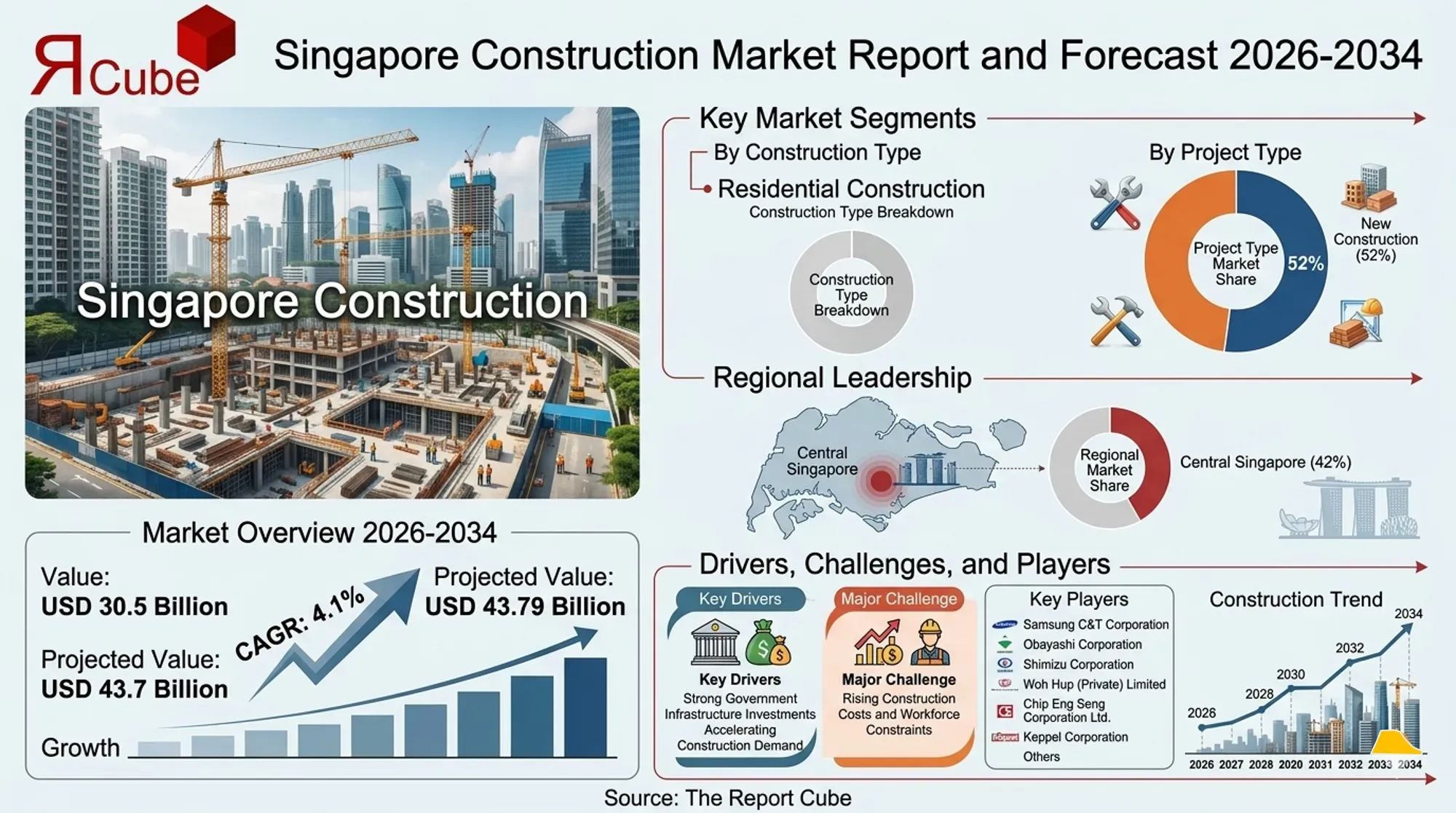
The Singapore Construction Market is anticipated to register a 4.1% during 2026-2034. The market size was valued at USD 30.5 Billion and is projected to reach USD 43.79 Billion by 2026-2034.
The Singapore Construction Market is expected to demonstrate steady expansion driven by strong infrastructure development, urban redevelopment projects, and continuous government investment in transportation and housing initiatives. Singapore has long been recognized as one of the most advanced construction markets in Asia-Pacific due to its strategic urban planning, advanced construction technologies, and strong regulatory oversight. The government’s ongoing infrastructure programs, such as mass transit expansion, smart city initiatives, and sustainable building regulations, continue to generate substantial demand for engineering, construction, and building materials. Additionally, public housing projects led by the Housing & Development Board (HDB) and private residential developments are contributing significantly to construction activity across the city-state.
Moreover, Singapore’s construction industry is increasingly integrating advanced technologies such as Building Information Modeling (BIM), prefabrication, and automation to improve productivity and reduce project timelines. The government’s push for green and sustainable buildings under programs like the Green Mark Certification has also accelerated the adoption of eco-friendly construction methods. Rising demand for commercial spaces, logistics hubs, and mixed-use developments driven by growing e-commerce and financial services sectors further strengthens market outlook. Additionally, redevelopment of aging infrastructure and industrial estates is expected to sustain project pipelines. With strong economic fundamentals, consistent public sector investment, and rapid urban modernization, the Singapore Construction Market is projected to maintain stable growth throughout the forecast period.
Additionally, growing foreign investment, rising demand for smart infrastructure, and modernization of public transport networks such as MRT expansion are anticipated to further strengthen construction activity across Singapore’s major regions. These factors collectively position the industry as a vital contributor to the country’s economic development. :contentReference[oaicite:0]{index=0}
Singapore Construction Market Recent Developments
- 2025: Samsung C&T Corporation secured contracts for sustainable high-rise mixed-use developments in Singapore’s central business district.
- 2025: Keppel Corporation launched advanced green construction solutions supporting energy-efficient infrastructure and smart urban redevelopment projects.
Government Initiatives & Policies
- Singapore Green Building Masterplan: Government initiative promoting sustainable buildings and energy-efficient construction technologies.
- Infrastructure Asia Initiative: National program encouraging infrastructure development and international construction collaboration.
Singapore Construction Market Dynamics
Key Driver: Strong Government Infrastructure Investments Accelerating Construction Demand
One of the primary drivers of the Singapore Construction Market is the strong commitment of the government toward infrastructure development and urban modernization. Singapore continues to allocate significant budgets toward transportation, housing, industrial development, and smart city infrastructure. Major projects such as the expansion of the Mass Rapid Transit (MRT) network, redevelopment of industrial estates, and modernization of airport and port infrastructure are creating substantial construction demand. Government initiatives also include large-scale public housing projects that aim to accommodate growing urban population needs. These programs support contractors, engineering firms, and material suppliers while boosting overall industry activity.
Furthermore, the government plays a dominant role in infrastructure planning and public sector projects, which historically account for nearly 60% of construction demand in Singapore. Housing & Development Board (HDB) developments remain a major contributor, delivering thousands of residential units annually. Additionally, redevelopment projects within mature estates and the transformation of the Greater Southern Waterfront are expected to drive construction demand in the coming decade. The government’s long-term infrastructure pipeline provides contractors with stable project visibility and investment confidence.
Beyond residential projects, investments in transportation infrastructure such as MRT extensions, highway upgrades, and airport expansion further strengthen the construction ecosystem. Singapore’s commitment to building world-class logistics, digital infrastructure, and commercial facilities ensures that the construction sector continues to grow steadily. With strong regulatory support, robust financing mechanisms, and efficient project management frameworks, government infrastructure initiatives remain a critical catalyst fueling the Singapore Construction Market.
Industry Trends: Rapid Adoption of Prefabrication and Green Construction Technologies
The Singapore Construction Market is witnessing a strong shift toward innovative construction technologies and sustainable building practices. Prefabricated Prefinished Volumetric Construction (PPVC), modular building techniques, and digital construction technologies are rapidly gaining adoption across residential, commercial, and institutional projects. These technologies significantly reduce construction timelines, improve project efficiency, and address labor shortages in the construction sector. Singapore has become one of the global leaders in adopting modular construction systems, particularly for high-rise residential developments and hotels.
Another important industry trend is the increasing focus on environmentally sustainable construction practices. Singapore’s Building and Construction Authority (BCA) has introduced strict sustainability standards through its Green Mark Certification program. Developers are now incorporating energy-efficient building designs, solar integration, water conservation systems, and sustainable materials in new projects. Green buildings have become a key priority as Singapore aims to achieve carbon reduction targets and enhance environmental resilience.
Additionally, digital transformation is reshaping construction processes across the industry. Technologies such as Building Information Modeling (BIM), digital twin platforms, and artificial intelligence-based project management tools are enabling better project planning, cost estimation, and construction monitoring. These solutions enhance collaboration among architects, engineers, and contractors while minimizing project delays. With increasing regulatory encouragement and technological advancements, sustainable and digital construction methods are expected to become mainstream across the Singapore Construction Market during the forecast period.
Major Challenge: Rising Construction Costs and Workforce Constraints
Despite strong market growth, the Singapore Construction Market faces several operational challenges, particularly rising construction costs and workforce constraints. Construction projects in Singapore often experience cost pressures due to high land prices, expensive building materials, and strict regulatory compliance requirements. The cost of steel, concrete, and other essential construction materials has fluctuated significantly in recent years, affecting overall project budgets. Additionally, Singapore’s limited land availability often requires complex engineering solutions, further increasing project costs.
Another challenge involves workforce availability and productivity. The construction sector has historically relied heavily on foreign labor, and regulatory controls on foreign worker quotas have increased labor shortages across the industry. As a result, contractors must adopt advanced technologies and productivity improvements to maintain project timelines. Training programs and workforce skill development initiatives have become increasingly important to address these workforce challenges.
Moreover, project delays caused by supply chain disruptions and regulatory approvals may also impact project schedules. Large infrastructure developments require extensive planning, environmental approvals, and safety compliance procedures. While these regulations ensure high-quality standards and safety, they may sometimes extend construction timelines. Despite these challenges, the industry is gradually improving efficiency through digital tools, prefabrication, and automation technologies to sustain long-term market growth.
Opportunity: Smart City Development and Urban Redevelopment Projects
Significant opportunities exist in the Singapore Construction Market due to the country’s focus on smart city infrastructure and urban redevelopment initiatives. Singapore is widely recognized as a leading smart city globally, and the government continues to invest in advanced infrastructure systems such as smart transport networks, intelligent buildings, and digitally connected urban environments. These initiatives require substantial construction investments in residential, commercial, and institutional infrastructure.
Urban redevelopment programs also present major opportunities for construction companies. Singapore has numerous aging residential and industrial zones that are being redeveloped into modern mixed-use communities. Projects involving redevelopment of older public housing estates, commercial districts, and waterfront areas are expected to generate significant construction activity in the coming years. Such initiatives aim to optimize land use, improve urban living standards, and create modern infrastructure environments.
Additionally, Singapore’s growing role as a regional financial and logistics hub is increasing demand for commercial buildings, data centers, and industrial facilities. The rapid expansion of digital infrastructure, e-commerce logistics parks, and high-tech manufacturing facilities is further boosting construction demand. With strong government planning frameworks, growing private sector investments, and continuous infrastructure modernization, the Singapore Construction Market presents promising opportunities for contractors, developers, and technology providers throughout the forecast period.
Singapore Construction Market Segment-wise Analysis
By Construction Type:
- Residential Construction
- Commercial Construction
- Industrial Construction
- Infrastructure Construction
Residential Construction remains the dominant segment in the Singapore Construction Market due to continuous demand for housing and government-backed development programs. Public housing initiatives led by the Housing & Development Board play a critical role in addressing housing demand, as nearly 80% of Singapore’s population resides in public housing developments. This segment accounts for approximately 38% of the total construction market share, making it the leading sub-segment within the construction type category. Government programs aimed at upgrading existing housing estates and developing new residential townships continue to generate consistent construction activity.
Additionally, private residential developments such as condominiums and luxury apartments are gaining traction in central districts and prime residential zones. Rising population density and increasing foreign investment in Singapore’s real estate market further stimulate demand for residential construction projects. Infrastructure construction is also witnessing strong growth due to MRT expansion and urban transportation improvements. However, residential construction remains the largest contributor to market revenue due to the continuous pipeline of housing projects and redevelopment initiatives across the country.
By Project Type:
- New Construction
- Renovation and Remodeling
- Maintenance and Repair
- Redevelopment Projects
New Construction dominates the Singapore Construction Market under the project type segment, accounting for nearly 52% of the total market share. The dominance of this segment is largely driven by ongoing infrastructure expansion projects, new residential developments, and large-scale commercial construction activities. Singapore continues to invest heavily in modern infrastructure systems, including MRT lines, airport terminals, logistics hubs, and digital infrastructure facilities. These projects require extensive construction work, contributing significantly to new construction demand.
Renovation and remodeling activities also represent a growing segment due to redevelopment of older buildings and modernization of commercial properties. Singapore has several aging residential estates and industrial facilities that require refurbishment and structural upgrades. Developers are increasingly transforming older structures into modern mixed-use developments that integrate residential, commercial, and retail spaces.
Maintenance and repair projects are essential for preserving existing infrastructure such as bridges, transportation systems, and government buildings. Meanwhile, redevelopment projects are gaining prominence as Singapore seeks to optimize land utilization and modernize urban spaces. Large-scale redevelopment initiatives like waterfront districts and integrated urban hubs are expected to generate long-term construction opportunities. Overall, new construction projects remain the leading segment due to continuous infrastructure expansion and growing real estate demand.
Regional Projection of Singapore Construction Industry
- Central Singapore
- North Region
- North-East Region
- East Region
Central Singapore leads the Singapore Construction Market and accounts for approximately 42% of the total market share due to its concentration of commercial districts, government infrastructure projects, and high-density residential developments. The region includes Singapore’s central business district and several key economic zones where large-scale commercial towers, mixed-use developments, and financial centers are located. Continuous redevelopment of office spaces, commercial complexes, and residential properties significantly contributes to construction demand within this region.
Major urban redevelopment initiatives such as the transformation of the Greater Southern Waterfront and modernization of existing commercial buildings further strengthen Central Singapore’s dominance in the construction sector. Additionally, infrastructure upgrades such as MRT network expansions and smart city infrastructure deployment are primarily concentrated in this region. These projects generate strong demand for contractors, engineering firms, and construction material suppliers.
Other regions such as the North and East regions are also witnessing increased construction activity due to residential expansion and industrial development. New housing estates and logistics facilities are being developed to accommodate population growth and expanding industrial sectors. However, Central Singapore remains the primary hub for large-scale construction projects due to its strategic economic importance, high real estate demand, and concentration of commercial infrastructure developments.
Why Choose This Report?
- Provides a comprehensive overview of the overall market analysis, encompassing key trends, consumer behavior analysis, and risk assessment to support strategic decision-making.
- Provides accurate, up-to-date insights into market size, segmentation, and emerging opportunities, helping to minimize risk & capitalizing on growth.
- Gives deep understanding of target audience preferences, investment habits, and communication channels for enhanced product development & marketing effectiveness.
- Delivers competitive analysis & benchmarking, uncovering the strengths & weaknesses of market competitors to guide strategies.
- Consolidate comprehensive market intelligence, reducing reasoning & streamlining research efforts.
- Facilitates customized market segmentation & risk mitigation strategies, fine-tuned to the business objectives.
- Aids in identifying both market challenges & untapped opportunities within the industry to drive long-term business growth.
- Provides valuable information based on actual customer data & search trends.
Table of Contents
- Introduction
- Objective of the Study
- Product and Category Definition
- Market Segmentation
- Study Variables
- Research Methodology
- Secondary Data Points
- Breakdown of Secondary Sources
- Primary Data Points
- Breakdown of Primary Interviews
- Secondary Data Points
- Executive Summary
- Market Dynamics
- Drivers
- Challenges
- Opportunity Assessment
- Recent Trends and Developments
- Regulatory and Policy Landscape
- Singapore Construction Market Overview (2026-2034)
- Market Size, By Value (USD Billion)
- Market Share, By Construction Type
- Residential Construction
- Commercial Construction
- Industrial Construction
- Infrastructure Construction
- Institutional Construction
- Market Share, By Project Type
- New Construction
- Renovation and Remodeling
- Maintenance and Repair
- Market Share, By Construction Method
- Traditional Construction
- Prefabricated/Modular Construction
- Green and Sustainable Construction
- Market Share, By Material Type
- Concrete
- Steel
- Wood
- Glass
- Others
- Market Share, By End User
- Government Projects
- Private Sector Projects
- Public‑Private Partnerships (PPP)
- Market Share, By Region
- Central Singapore
- North Region
- North-East Region
- East Region
- West Region
- Market Share, By Company
- Revenue Shares and Analysis
- Competitive Landscape
- Central Singapore Construction Market
- Market Size, By Value (USD Billion/Million)
- Market Share, By Construction Type
- Market Share, By Project Type
- Market Share, By Construction Method
- Market Share, By Material Type
- North Singapore Construction Market
- Market Size, By Value (USD Billion/Million)
- Market Share, By Construction Type
- Market Share, By Project Type
- Market Share, By Construction Method
- Market Share, By Material Type
- North-East Singapore Construction Market
- Market Size, By Value (USD Billion/Million)
- Market Share, By Construction Type
- Market Share, By Project Type
- Market Share, By Construction Method
- Market Share, By Material Type
- East Singapore Construction Market
- Market Size, By Value (USD Billion/Million)
- Market Share, By Construction Type
- Market Share, By Project Type
- Market Share, By Construction Method
- Market Share, By Material Type
- West Singapore Construction Market
- Market Size, By Value (USD Billion/Million)
- Market Share, By Construction Type
- Market Share, By Project Type
- Market Share, By Construction Method
- Market Share, By Material Type
- Competitive Outlook and Company Profiles
- Samsung C&T Corporation
- Company Overview
- Product Portfolio
- Strategic Alliances/Partnerships
- Recent Developments
- Obayashi Corporation
- Company Overview
- Product Portfolio
- Strategic Alliances/Partnerships
- Recent Developments
- Shimizu Corporation
- Company Overview
- Product Portfolio
- Strategic Alliances/Partnerships
- Recent Developments
- Woh Hup (Private) Limited
- Company Overview
- Product Portfolio
- Strategic Alliances/Partnerships
- Recent Developments
- Chip Eng Seng Corporation Ltd.
- Company Overview
- Product Portfolio
- Strategic Alliances/Partnerships
- Recent Developments
- Keppel Corporation
- Company Overview
- Product Portfolio
- Strategic Alliances/Partnerships
- Recent Developments
- Samsung C&T Corporation
- Contact Us and Disclaimer
Top Key Players & Market Share Outlook
-
Samsung C&T Corporation
-
Obayashi Corporation
-
Shimizu Corporation
-
Woh Hup (Private) Limited
-
Chip Eng Seng Corporation Ltd.
-
Keppel Corporation
-
Others
Frequently Asked Questions






