



Build Your Custom Market Intelligence Report
Customize Your ReportAustralia Data Center Market Insights & Analysis
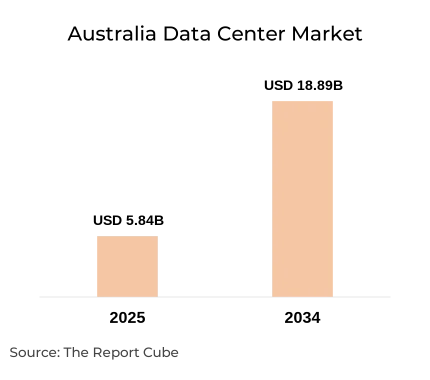
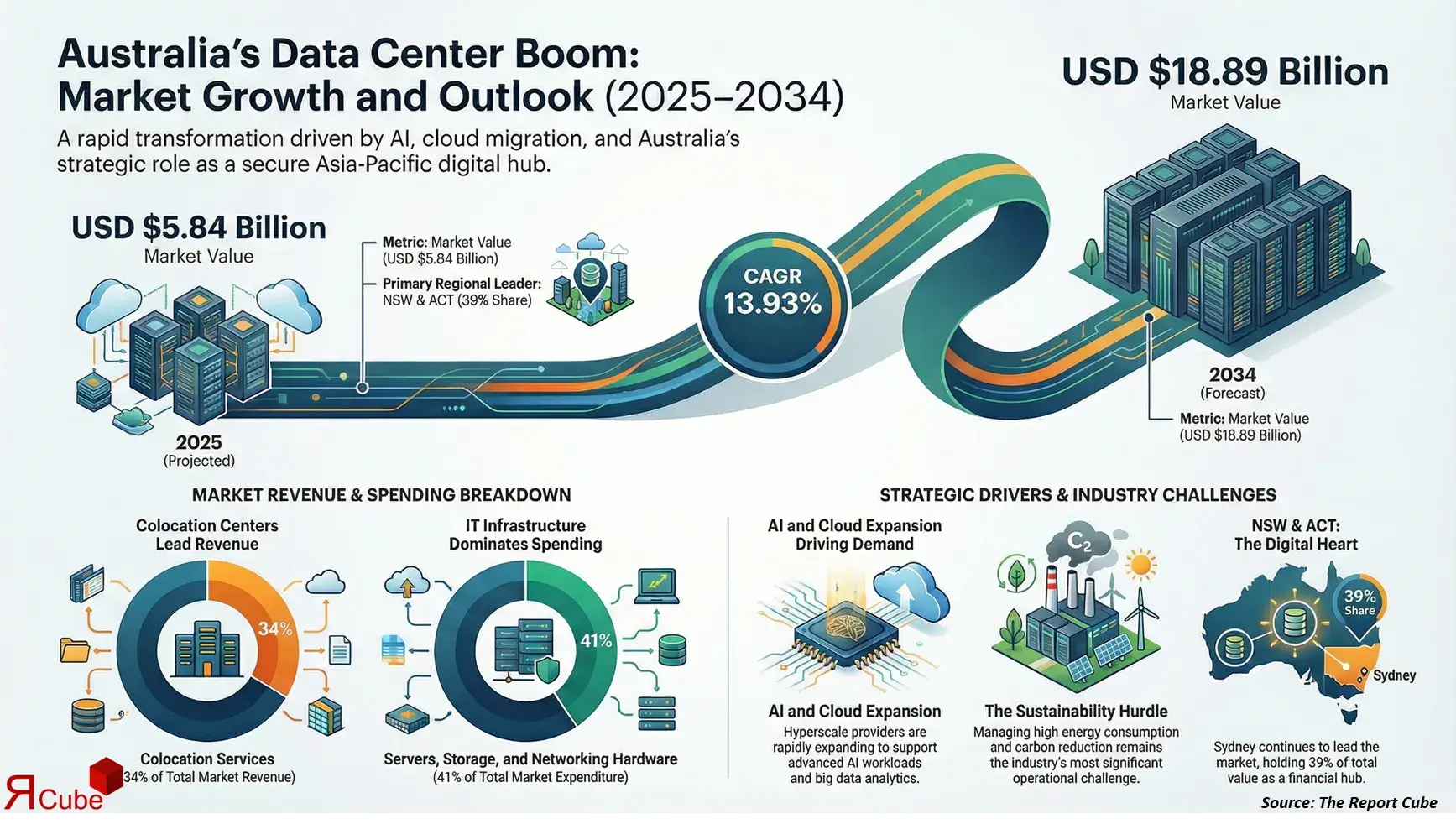
The Australia Data Center Market is anticipated to register a CAGR of 13.93% during the forecast period 2026-2034. The market size was valued at USD 5.84 billion in 2025 and is projected to reach USD 18.89 billion by 2034. This robust growth reflects Australia’s accelerating digital transformation, expanding cloud adoption, and rising demand for secure, scalable, and energy-efficient data infrastructure. As enterprises, governments, and digital-native businesses increasingly migrate workloads to cloud and hybrid environments, data centers have become a critical backbone of the national digital economy. Australia’s strategic geographic position, political stability, and strong data protection framework further enhance its attractiveness as a regional data hub for Asia-Pacific operations.
Market expansion is also driven by the rapid growth of hyperscale cloud providers, increasing data consumption from streaming, e-commerce, fintech, and artificial intelligence applications, and stricter data sovereignty requirements. Organizations across sectors are prioritizing local data hosting to ensure compliance, low latency, and operational resilience. Additionally, Australia’s rollout of 5G networks, growth in edge computing use cases, and sustained investment in renewable energy integration are reshaping data center design and deployment strategies. The presence of established domestic operators alongside global colocation and hyperscale providers ensures strong competition, continuous capacity expansion, and technology innovation, reinforcing long-term market momentum.
Australia Data Center Market Recent Developments
- 2025: AirTrunk commissioned new hyperscale data center capacity in Sydney to support cloud service providers.
- 2025: NEXTDC expanded its Melbourne and Brisbane facilities with high-density, energy-efficient infrastructure.
Government Initiatives & Policies
- Australia Digital Economy Strategy: National framework supporting cloud adoption, digital infrastructure, and data-driven innovation.
- Critical Infrastructure Protection Act: Regulations strengthening cybersecurity and resilience requirements for data centers.
Australia Data Center Market Dynamics
Key Driver: Cloud adoption and hyperscale expansion
The primary driver of the Australia data center market is the rapid adoption of cloud computing and the expansion of hyperscale data center capacity. Enterprises are migrating workloads to cloud platforms to improve scalability, resilience, and cost efficiency, while global cloud service providers continue to invest heavily in local infrastructure to meet latency, performance, and data residency requirements. Demand for hyperscale facilities is further fueled by growth in artificial intelligence, big data analytics, and software-as-a-service applications. As digital workloads increase in complexity and volume, organizations require high-density, energy-efficient data centers capable of supporting advanced computing needs, driving sustained investment across the market.
Major Challenge: Energy consumption and sustainability pressures
A major challenge facing the Australia data center market is managing rising energy consumption while meeting sustainability and carbon reduction goals. Data centers are energy-intensive by nature, and increasing rack densities and cooling requirements place pressure on power availability and grid infrastructure. Operators must balance expansion plans with rising electricity costs, environmental regulations, and community concerns around energy usage. Securing renewable energy sources, implementing advanced cooling technologies, and optimizing power usage effectiveness require significant capital investment. Smaller operators may face greater difficulty absorbing these costs, creating operational and financial challenges as sustainability expectations continue to rise.
Industry Trends: High-density design and edge computing
A key trend shaping the Australia data center market is the shift toward high-density designs and the growth of edge computing infrastructure. Hyperscale and colocation providers are deploying facilities capable of supporting higher power densities to accommodate AI workloads and high-performance computing. At the same time, edge and micro data centers are gaining traction to support low-latency applications such as 5G, IoT, autonomous systems, and real-time analytics. Modular and prefabricated data center designs are also becoming more common, enabling faster deployment and scalability. These trends reflect the industry’s response to evolving digital demand patterns and performance expectations.
Opportunity Ahead: Renewable energy integration and regional expansion
Significant opportunities exist in integrating renewable energy solutions and expanding data center capacity beyond traditional metropolitan hubs. Australia’s abundant renewable energy resources enable operators to pursue long-term sustainability goals while managing power costs. Increasing demand for regional data processing and disaster recovery solutions is encouraging investment in secondary markets and edge locations. Providers that combine energy-efficient design, renewable sourcing, and flexible service models can differentiate themselves in a competitive landscape. As digital services continue to expand across industries, these strategies position data center operators to capture long-term growth opportunities.
Australia Data Center Market Segment-wise Analysis
By Data Center Type:
- Enterprise Data Centers
- Colocation Data Centers
- Hyperscale Data Centers
- Edge / Micro Data Centers
- Managed / Modular Data Centers
Colocation data centers represent the leading segment, accounting for approximately 34% of total market revenue in 2025. This dominance reflects strong demand from enterprises seeking scalable, secure, and cost-efficient alternatives to in-house facilities. Hyperscale data centers are the fastest-growing segment, driven by investments from global cloud providers. Enterprise data centers continue to serve regulated industries, while edge and modular facilities are expanding rapidly to support latency-sensitive applications and rapid deployment requirements.
By Component:
- IT Infrastructure (Servers, Storage, Networking)
- Electrical Infrastructure (UPS, Generators, PDUs)
- Mechanical Infrastructure (Cooling, Racks, Others)
- Software & Management Platforms
- Services (Design & Consulting, Installation & Deployment, Maintenance & Support)
IT infrastructure constitutes the largest component segment, contributing approximately 41% of total market spending in 2025. Rising demand for high-performance servers, advanced storage solutions, and high-speed networking drives this dominance. Electrical and mechanical infrastructure segments remain critical as operators invest in resilient power and efficient cooling systems. Software platforms and managed services are growing steadily, reflecting the need for automation, monitoring, and lifecycle management across complex data center environments.
Regional Projection of Australia Data Center Industry
- New South Wales & Australian Capital Territory
- Victoria & Tasmania
- Queensland
- South Australia & Northern Territory
- Western Australia
New South Wales and the Australian Capital Territory lead the Australia data center market, accounting for approximately 39% of total market value in 2025. This leadership is driven by Sydney’s role as the country’s primary digital and financial hub, concentration of enterprises, and proximity to international connectivity infrastructure. Victoria follows with strong demand from enterprise and colocation customers, while Queensland is emerging as a growth market due to population expansion and infrastructure investment. Other regions contribute through specialized facilities supporting government, mining, and regional connectivity needs.
Why Choose This Report?
- Provides a comprehensive overview of the overall market analysis, encompassing key trends, consumer behavior analysis, and risk assessment to support strategic decision-making.
- Provides accurate, up-to-date insights into market size, segmentation, and emerging opportunities, helping to minimize risk & capitalizing on growth.
- Gives deep understanding of target audience preferences, investment habits, and communication channels for enhanced product development & marketing effectiveness.
- Delivers competitive analysis & benchmarking, uncovering the strengths & weaknesses of market competitors to guide strategies.
- Consolidate comprehensive market intelligence, reducing reasoning & streamlining research efforts.
- Facilitates customized market segmentation & risk mitigation strategies, fine-tuned to the business objectives.
- Aids in identifying both market challenges & untapped opportunities within the industry to drive long-term business growth.
- Provides valuable information based on actual customer data & search trends.
Table of Contents
- Introduction
- Objective of the Study
- Product/Category Definition
- Market Segmentation
- Study Variables
- Research Methodology
- Secondary Data Points
- Breakdown of Secondary Sources
- Primary Data Points
- Breakdown of Primary Interviews
- Secondary Data Points
- Executive Summary
- Market Dynamics
- Drivers
- Challenges
- Opportunity Assessment
- Recent Trends and Developments
- Policy and Regulatory Landscape
- Australia Data Center Market Overview (2020-2034)
- Market Size, By Volume & Value (MW IT Load / USD Billion)
- Market Share, By Data Center Type
- Enterprise Data Centers
- Colocation Data Centers
- Hyperscale Data Centers
- Edge / Micro Data Centers
- Managed / Modular Data Centers
- Market Share, By Component
- IT Infrastructure (Servers, Storage, Networking)
- Electrical Infrastructure (UPS, Generators, PDUs)
- Mechanical Infrastructure (Cooling, Racks, Others)
- Software & Management Platforms
- Services (Design & Consulting, Installation & Deployment, Maintenance & Support)
- Market Share, By Tier Standard
- Tier I
- Tier II
- Tier III
- Tier IV
- Market Share, By End User
- Cloud Service Providers & Hyperscalers
- IT & Telecom
- BFSI
- Government & Public Sector
- Energy & Utilities
- Media & Entertainment
- Others
- Market Share, By Region
- New South Wales & Australian Capital Territory
- Victoria & Tasmania
- Queensland
- South Australia & Northern Territory
- Western Australia
- Market Share, By Company
- Revenue Shares
- Competitive Landscape
- New South Wales & Australian Capital Territory Data Center Market
- Market Size, By IT Load & Value (USD Billion)
- Market Share, By Data Center Type
- Market Share, By Tier Standard
- Market Share, By End User
- Victoria & Tasmania Data Center Market
- Market Size, By IT Load & Value (USD Billion)
- Market Share, By Data Center Type
- Market Share, By Tier Standard
- Market Share, By End User
- Queensland Data Center Market
- Market Size, By IT Load & Value (USD Billion)
- Market Share, By Data Center Type
- Market Share, By Tier Standard
- Market Share, By End User
- South Australia & Northern Territory Data Center Market
- Market Size, By IT Load & Value (USD Billion)
- Market Share, By Data Center Type
- Market Share, By Tier Standard
- Market Share, By End User
- Western Australia Data Center Market
- Market Size, By IT Load & Value (USD Billion)
- Market Share, By Data Center Type
- Market Share, By Tier Standard
- Market Share, By End User
- Competitive Outlook & Company Profiles
- AirTrunk
- Company Overview
- Data Center Portfolio
- Strategic Alliances/Partnerships
- Recent Developments
- NEXTDC
- Company Overview
- Data Center Portfolio
- Strategic Alliances/Partnerships
- Recent Developments
- CDC Data Centres
- Company Overview
- Data Center Portfolio
- Strategic Alliances/Partnerships
- Recent Developments
- Equinix
- Company Overview
- Data Center Portfolio
- Strategic Alliances/Partnerships
- Recent Developments
- Digital Realty
- Company Overview
- Data Center Portfolio
- Strategic Alliances/Partnerships
- Recent Developments
- Global Switch
- Company Overview
- Data Center Portfolio
- Strategic Alliances/Partnerships
- Recent Developments
- Macquarie Data Centres
- Company Overview
- Data Center Portfolio
- Strategic Alliances/Partnerships
- Recent Developments
- DCI Data Centers
- Company Overview
- Data Center Portfolio
- Strategic Alliances/Partnerships
- Recent Developments
- STACK Infrastructure
- Company Overview
- Data Center Portfolio
- Strategic Alliances/Partnerships
- Recent Developments
- Others
- AirTrunk
- Contact Us / Disclaimer
Top Key Players & Market Share Outlook
- AirTrunk
- NEXTDC
- CDC Data Centres
- Equinix
- Digital Realty
- Global Switch
- Macquarie Data Centres
- DCI Data Centers
- STACK Infrastructure
- Others
Frequently Asked Questions






