



Build Your Custom Market Intelligence Report
Customize Your ReportKey Takeaways
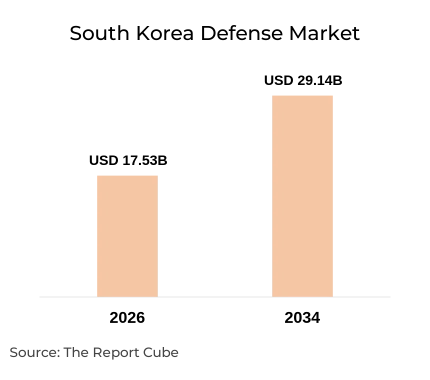
- South Korea Defense Market is valued at USD 17.53 billion in 2026.
- The market is projected to reach USD 29.14 billion by 2034, expanding at a CAGR of 6.56%.
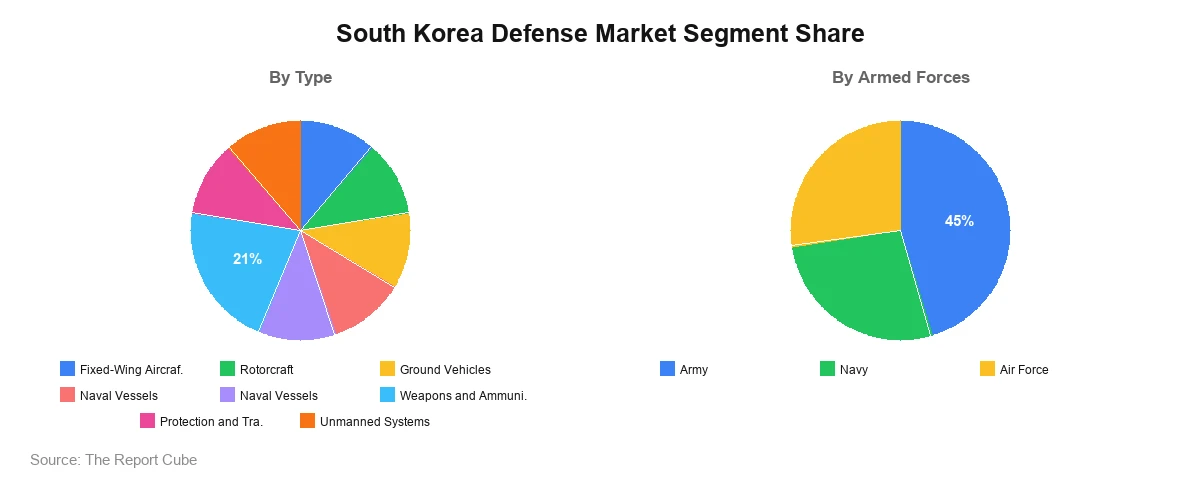
- Weapons and Ammunition represents a significant segment by type, accounting for an estimated 21% market share.
- Army represents the largest armed-forces segment, accounting for an estimated 45% market share.
- North Korea's nuclear and missile capabilities remain the primary demand driver. The 2026 budget allocates KRW 8.8387 trillion to the three-axis system, a 21.3% increase from 2025.
- The shift toward AI-based systems, manned-unmanned teaming and domestic defense technology is reshaping procurement priorities.
- Key players include Hanwha Aerospace, Hanwha Systems, Korea Aerospace Industries (KAI), Hyundai Rotem, HD Hyundai Heavy Industries, Hanwha Ocean, LIG Nex1, Korean Air, Hyundai WIA and SNT Dynamics.
Market Overview
South Korea Defense Market covers the equipment and systems that support the country's armed forces. By type, these include fixed-wing aircraft, rotorcraft, ground vehicles, naval vessels, C4ISR, weapons and ammunition, protection and training equipment, and unmanned systems. Demand is shaped by military modernization, national security requirements and the continued adoption of advanced defense technologies.
South Korea Defense Market is valued at USD 17.53 billion in 2026 and is projected to reach USD 29.14 billion by 2034, expanding at a CAGR of 6.56% over the forecast period. The market is structured across three views: defense type, armed forces and region. This allows procurement demand to be assessed by capability category, by service branch and by geography.
Procurement planning is closely linked to the security environment on the Korean Peninsula. The Ministry of National Defense states that the 2026 defense budget prioritizes strengthening the Korean three-axis system and expanding advanced capabilities in response to North Korean nuclear and missile threats and the changing international security environment. This sustains recurring requirements across missile defense, precision strike, ISR and command-and-control.
The market is also becoming more technology-intensive. Government emphasis on AI, drones and autonomous systems, together with a domestic-technology and export-oriented industrial strategy, is moving procurement toward integrated systems rather than standalone platforms. This raises opportunities for system integrators and technology suppliers, and it increases development, testing and integration requirements.
South Korea Defense Market Dynamics
|
Factor |
Type |
Specific Impact on Market |
Magnitude |
|---|---|---|---|
|
North Korean Nuclear and Missile Threat |
Driver |
Sustains requirements for missile defense, precision strike, ISR, command-and-control and advanced platforms, supporting recurring procurement across aircraft, C4ISR, weapons and unmanned systems |
High |
|
High Cost and Technical Complexity of Advanced Defense Systems |
Challenge |
Raises development costs, integration and testing requirements and program risk; can extend procurement timelines and concentrate work around companies with specialized engineering and systems-integration capabilities |
Medium–High |
|
Shift Toward AI and Manned-Unmanned Teaming |
Trend |
Moves demand from standalone platforms toward integrated systems combining AI, autonomous platforms, sensors, networks and command systems |
High |
|
Expansion of Domestic Defense Technology |
Trend |
Combines domestic technology development with export-oriented production, allowing manufacturers to build scale in aircraft, armored vehicles, naval systems, missiles and electronics |
High |
|
AI-Based Manned-Unmanned Systems and Drone Capability Building |
Opportunity |
Supported by increased 2026 investment in AI-based manned-unmanned combat systems and a drone-operator training initiative |
High |
South Korea Defense Market Growth Drivers
North Korean Nuclear and Missile Threat
South Korea's defense investment continues to be heavily influenced by North Korea's nuclear and missile capabilities. This shapes the country's force-planning priorities and the capabilities it seeks to acquire, from missile defense and precision strike to ISR and command-and-control.
The Ministry of National Defense states that the 2026 defense budget prioritizes strengthening the Korean three-axis system and expanding advanced capabilities in response to these threats and the changing international security environment. The 2026 budget allocates KRW 8.8387 trillion to the three-axis system, a 21.3% increase from 2025, according to DAPA.
For suppliers, the practical implication is recurring procurement demand rather than one-off program spending. These requirements span aircraft, C4ISR, weapons and ammunition and unmanned systems, and they reinforce the weight of the Weapons and Ammunition segment, which accounts for an estimated 21% market share.
South Korea Defense Market Opportunities
AI-Based Manned-Unmanned Systems and Drone Capability Building
South Korea's 2026 defense budget provides direct evidence of an opportunity in AI-based and unmanned capabilities. Investment in AI-based manned-unmanned combat systems increases materially in the 2026 budget. A separate initiative targets the training of 500,000 drone operators, with KRW 33 billion allocated in 2026 for commercial training drones and related insurance.
These initiatives point to demand beyond individual platforms. Operator training, commercial drone use and AI-enabled combat systems together indicate a broader build-out of unmanned capability, which could extend to autonomous platforms, sensors, networks and command systems. This aligns with the market's shift toward integrated systems rather than conventional standalone platforms.
For the Unmanned Systems segment, the commercial significance lies in being tied to explicit budget lines and national initiatives. Segment-level market values for Unmanned Systems were not supplied in the input and are therefore not quantified in this report.
South Korea Defense Market Challenges
High Cost and Technical Complexity of Advanced Defense Systems
South Korea's shift toward highly sophisticated defense systems increases the technological and financial complexity of procurement. The 2026 defense plan includes significant investment in advanced aerospace engines, stealth technologies, AI, space systems and other high-technology capabilities. Defense R&D within force-improvement spending is planned to rise 19.4%, reaching KRW 5.8396 trillion, according to DAPA.
Higher technological ambition raises development costs, integration requirements, testing requirements and program risk. These pressures can extend procurement timelines and place greater weight on suppliers with specialized engineering and systems-integration capabilities.
For market participants, the commercial implication is that complex programs can concentrate around companies able to carry sustained R&D and integration workloads. Smaller suppliers may find participation easier at the component, subsystem or technology level than at the prime-contractor level.
Need Specific Data, Let’s Customize the Report for You
Request CustomizationSouth Korea Defense Market Trends
Shift Toward AI and Manned-Unmanned Teaming
South Korea is moving toward a more technology-intensive military structure. The 2026 defense budget specifically expands investment in AI-based manned-unmanned combat systems, and the government has emphasized AI, drones and autonomous systems as central components of future military capability, according to DAPA.
DAPA's stated defense-industry strategy also identifies advanced and innovative technology, resilient supply chains and localization of defense materials and components as strategic priorities. Demand is shifting from conventional standalone platforms toward integrated systems involving AI, autonomous platforms, sensors, networks and command systems.
For suppliers, interoperability and systems integration become more important competitive factors. The shift is most relevant to C4ISR, unmanned systems and the platform categories that will be linked into networked, AI-enabled architectures.
Expansion of Domestic Defense Technology
South Korea is increasingly attempting to combine domestic technology development with export-oriented defense production. DAPA's current strategic targets include increasing Korean defense exports from USD 9.6 billion in 2024 toward USD 20 billion by 2030, while seeking to increase Korea's global defense-market share from 2.2% to 6%.
Domestic procurement and export production can reinforce each other, allowing Korean defense manufacturers to achieve scale in aircraft, armored vehicles, naval systems, missiles and electronics. Combined with DAPA's emphasis on localization of defense materials and components, this raises the strategic importance of domestic supply chains and advanced manufacturing capability.
South Korea Defense Market Segment-wise Analysis
Demand in the South Korea defense market is shaped by military modernization requirements, procurement priorities, service-branch needs, technological advancement and the country's evolving security environment. Each defense category generates distinct procurement requirements across aerospace, land systems, naval platforms, weapons, electronics and unmanned technologies, which makes segment-level analysis important for understanding where procurement priorities and growth are likely to concentrate.
By Type
- Fixed-Wing Aircraft
- Rotorcraft
- Ground Vehicles
- Naval Vessels
- C4ISR
- Weapons and Ammunition
- Protection and Training Equipment
- Unmanned Systems
Weapons and Ammunition represents a significant segment of the South Korea defense market, accounting for an estimated 21% market share. Demand is supported by the precision-strike and missile-related requirements arising from the North Korean threat environment and by the ongoing need to maintain operational readiness. The segment is closely tied to the three-axis system priorities in the 2026 budget and contributes recurring procurement demand. The remaining type segments, including C4ISR and Unmanned Systems, are expected to benefit from the shift toward integrated, AI-enabled systems, although no share values were supplied for them.
By Armed Forces
- Army
- Navy
- Air Force
The Army represents the largest armed-forces segment, accounting for an estimated 45% market share. This indicates strong procurement relevance across land-based platforms, weapons and associated defense technologies. Continued modernization of land capabilities and the growing role of unmanned and AI-enabled systems support the Army's substantial contribution to overall defense demand. The Navy and Air Force remain important procurement categories, linked to naval vessels and aircraft requirements respectively, with demand shaped by the same modernization and security priorities.
Competitive Landscape
South Korea Defense Market includes domestic companies across aerospace, defense electronics, land systems, naval shipbuilding, weapons and precision manufacturing. Competition is influenced by advanced technology capabilities, systems-integration expertise, platform development capacity and manufacturing scale. Rising technological complexity and the domestic-technology and export strategy place additional emphasis on engineering depth and supply-chain resilience.
Key Players
|
Company |
Position / Relevance |
|---|---|
|
Hanwha Aerospace |
Key participant in South Korea's defense and aerospace industrial base |
|
Korea Aerospace Industries (KAI) |
Key participant in aerospace and defense |
|
Hyundai Rotem |
Key participant relevant to land systems and military vehicles |
|
HD Hyundai Heavy Industries |
Key participant relevant to naval and shipbuilding capabilities |
|
Hanwha Ocean |
Key participant relevant to naval and shipbuilding capabilities |
|
LIG Defense & Aerospace |
Key participant relevant to defense technology and weapons |
Hanwha Aerospace
Hanwha Aerospace is the first company listed among the key players supplied for South Korea Defense Market and is profiled here for that reason. Company-specific financial, contract and product information was not supplied, so this analysis stays at the market-relevance level.
Its relevance is tied to the market's main structural themes: advanced aerospace and weapons-related technologies, domestic defense production and export-oriented growth. DAPA's targets of raising defense exports toward USD 20 billion by 2030 and increasing Korea's global defense-market share from 2.2% to 6% define the strategic environment in which domestic manufacturers operate.
As procurement shifts toward integrated, AI-enabled systems and technical complexity rises, companies with established defense and aerospace capabilities are well placed to remain important participants in the competitive landscape.
South Korea Defense Market Future Outlook (2034)
South Korea Defense Market is projected to expand from USD 17.53 billion in 2026 to USD 29.14 billion by 2034, a CAGR of 6.56%. Growth is expected to remain supported by defense modernization, national security requirements and continued investment in advanced military capabilities.
The threat environment will remain the main demand anchor. The 2026 budget's KRW 8.8387 trillion allocation to the three-axis system, up 21.3% from 2025, signals sustained priority for missile defense, precision strike, ISR and command-and-control, which supports recurring demand across weapons and ammunition, aircraft, C4ISR and unmanned systems.
Technology direction will increasingly shape procurement. AI-based manned-unmanned combat systems, autonomous platforms and drone capability building are expected to take a larger role, favoring integrated systems over standalone platforms. Domestic technology development, localization and export expansion may further strengthen the defense-industrial base by supporting manufacturing scale across aircraft, armored vehicles, naval systems, missiles and electronics.
Technological complexity remains the main constraint. Advanced aerospace engines, stealth, AI and space capabilities require significant R&D, integration and testing investment, and Defense R&D within force-improvement spending is planned to rise 19.4% to KRW 5.8396 trillion. This can extend procurement timelines and favor suppliers with specialized systems-integration capabilities.
South Korea Defense Market Report Coverage
|
Report Attribute |
Details |
|---|---|
|
Market Name |
South Korea Defense Market |
|
Market Size (2026) |
USD 17.53 billion |
|
Market Size (2034) |
USD 29.14 billion |
|
Forecast Period |
2026–2034 |
|
CAGR |
6.56% |
|
Base Year |
2026 |
|
Forecast Years |
2026–2034 |
|
Segments Covered |
By Type (Fixed-Wing Aircraft, Rotorcraft, Ground Vehicles, Naval Vessels, C4ISR, Weapons and Ammunition, Protection and Training Equipment, Unmanned Systems); By Armed Forces (Army, Navy, Air Force) |
|
Regions Covered |
Gyeonggi, South Gyeongsang, Chungcheong, Seoul & Incheon, Daejeon, Jeolla, Gangwon & Jeju |
|
Key Companies |
Hanwha Aerospace, Hanwha Systems, Korea Aerospace Industries (KAI), Hyundai Rotem, HD Hyundai Heavy Industries, Hanwha Ocean, LIG Nex1, Korean Air, Hyundai WIA, SNT Dynamics |
|
Report Format |
PDF, Excel, PPT |
|
Customization |
Available as per client requirements |
Why Choose This Report?
- Market sizing and forecast analysis for South Korea Defense Market covering 2026–2034.
- Segmentation by defense type and armed forces.
- Regional analysis across seven supplied South Korean regions.
- Assessment of the North Korean threat as a growth driver, supported by 2026 budget evidence.
- Analysis of AI, manned-unmanned teaming and domestic defense technology trends.
- Evaluation of the cost and technical complexity challenges facing advanced defense programs.
- Competitive landscape covering ten key South Korean defense and aerospace companies.
- Decision support for strategic planning, investment, procurement and business development.
Table of Contents
- Introduction
- Objective of the Study
- Product Definition
- Market Segmentation
- Study Variables
- Research Methodology
- Secondary Data Points
- Companies Interviewed
- Primary Data Points
- Breakdown of Primary Interviews
- Secondary Data Points
- Executive Summary
- Market Dynamics
- Drivers
- Challenges
- Opportunity Assessment
- Recent Trends and Developments
- Policy and Regulatory Landscape
- South Korea Defense Market Overview and Forecast Analysis (2021-2034)
- Market Size, By Value, By Growth Rate (CAGR/USD Billions)
- Demand – Supply Trends
- Market Share, By Type
- Fixed-Wing Aircraft
- Rotorcraft
- Ground Vehicles
- Naval Vessels
- C4ISR
- Weapons and Ammunition
- Protection and Training Equipment
- Unmanned Systems
- Market Share, By Armed Forces
- Army
- Navy
- Air Force
- Market Share, By Competitors
- Competition Characteristics
- Revenue Shares
- Fixed-Wing Aircraft South Korea Defense Market Overview, 2021-2034F
- By Value (USD Million)
- By Armed Forces – Market Size & Forecast 2021-2034, USD Million
- Army
- Navy
- Air Force
- Rotorcraft South Korea Defense Market Overview, 2021-2034F
- By Value (USD Million)
- By Armed Forces – Market Size & Forecast 2021-2034, USD Million
- Army
- Navy
- Air Force
- Ground Vehicles South Korea Defense Market Overview, 2021-2034F
- By Value (USD Million)
- By Armed Forces – Market Size & Forecast 2021-2034, USD Million
- Army
- Navy
- Air Force
- Naval Vessels South Korea Defense Market Overview, 2021-2034F
- By Value (USD Million)
- By Armed Forces – Market Size & Forecast 2021-2034, USD Million
- Army
- Navy
- Air Force
- C4ISR South Korea Defense Market Overview, 2021-2034F
- By Value (USD Million)
- By Armed Forces – Market Size & Forecast 2021-2034, USD Million
- Army
- Navy
- Air Force
- Weapons and Ammunition South Korea Defense Market Overview, 2021-2034F
- By Value (USD Million)
- By Armed Forces – Market Size & Forecast 2021-2034, USD Million
- Army
- Navy
- Air Force
- Protection and Training Equipment South Korea Defense Market Overview, 2021-2034F
- By Value (USD Million)
- By Armed Forces – Market Size & Forecast 2021-2034, USD Million
- Army
- Navy
- Air Force
- Unmanned Systems South Korea Defense Market Overview, 2021-2034F
- By Value (USD Million)
- By Armed Forces – Market Size & Forecast 2021-2034, USD Million
- Army
- Navy
- Air Force
- Competitive Outlook (Company Profile – Partial List)
- Hanwha Aerospace
- Company Overview
- Business Segments
- Strategic Alliances/Partnerships
- Recent Developments
- Korea Aerospace Industries (KAI)
- Company Overview
- Business Segments
- Strategic Alliances/Partnerships
- Recent Developments
- Hyundai Rotem
- Company Overview
- Business Segments
- Strategic Alliances/Partnerships
- Recent Developments
- HD Hyundai Heavy Industries
- Company Overview
- Business Segments
- Strategic Alliances/Partnerships
- Recent Developments
- Hanwha Ocean
- Company Overview
- Business Segments
- Strategic Alliances/Partnerships
- Recent Developments
- LIG Defense & Aerospace
- Company Overview
- Business Segments
- Strategic Alliances/Partnerships
- Recent Developments
- Others
- Hanwha Aerospace
- Contact Us & Disclaimer
Top Key Players & Market Share Outlook
- Hanwha Aerospace
- Korea Aerospace Industries (KAI)
- Hyundai Rotem
- HD Hyundai Heavy Industries
- Hanwha Ocean
- LIG Defense & Aerospace
- Others
Frequently Asked Questions






