



Build Your Custom Market Intelligence Report
Customize Your ReportBrazil Dental Care Market Statistics & Insights
Market Size Statistics
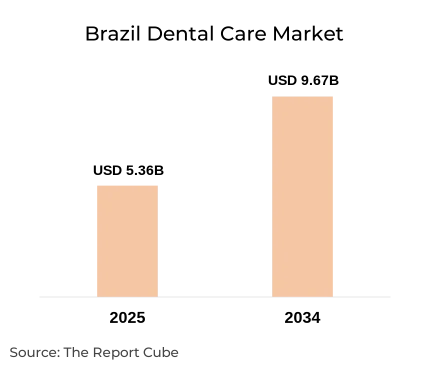
- Brazil Dental Care Market reached USD 5.36 billion 2025
- Market projected to reach USD 9.67 billion by 2034 globally
- Market expected to grow at CAGR 6.78% during forecast period
Competitive Landscape
- More than 10 companies are actively engaged in producing Brazil Dental Care Market
- Top 5 companies acquired around 53% of the market share.
- Gentle Dental Partners, Integrated Dental Holdings Group, Abano Healthcare, Bupa, National Health Service, and others
Brazil Dental Care Market Insights & Analysis
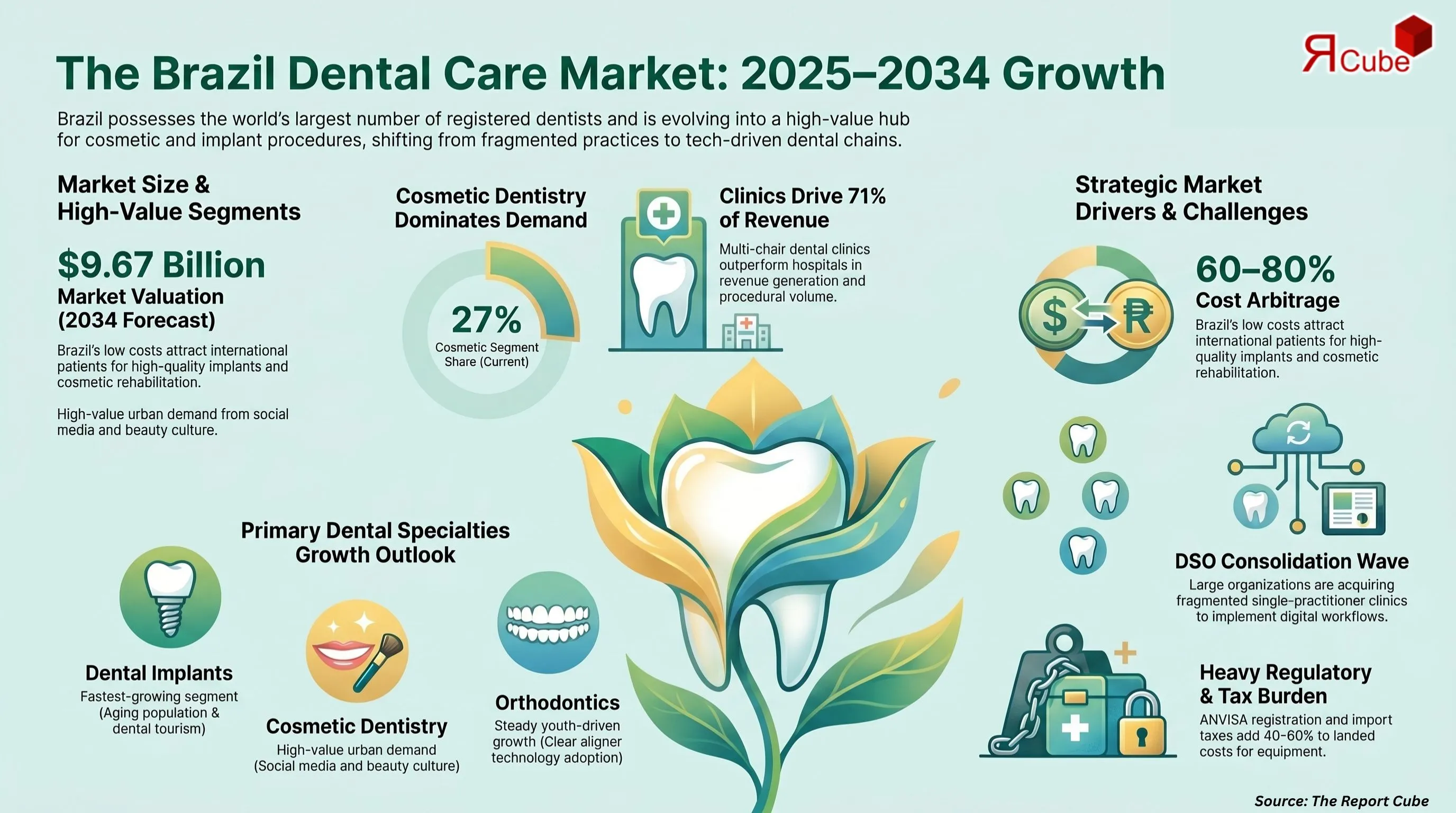
The Brazil dental care market stands at USD 5.36 billion in 2025 and is projected to reach USD 9.67 billion by 2034, expanding at a CAGR of 6.78% during the 2026 to 2034 forecast period. This growth trajectory makes Brazil one of the most strategically significant dental care markets in the Western Hemisphere, attracting the attention of investors, dental service organisations (DSOs), device distributors, and private equity groups seeking exposure to a large, structurally underpenetrated healthcare sector.
A structural characteristic that separates Brazil from every other Latin American dental care market is the sheer scale of its registered dental workforce. Brazil holds the world's largest absolute number of registered dentists, according to the Conselho Federal de Odontologia (CFO), which creates a demand-supply dynamic unique among regional peers. Unlike markets constrained by practitioner shortages, Brazil's growth challenge is one of distribution and access rather than workforce capacity.
Private dental plan penetration among working Brazilians currently stands at approximately 30%, according to the Agência Nacional de Saúde Suplementar (ANS), leaving a significant uninsured population reliant on the Unified Health System (SUS) for basic dental services. The SUS delivers foundational oral care, including extractions and basic restorations, to an estimated 75% of the population. This dual-track structure, public basic care layered beneath private premium services, is the defining feature of the Brazil dental care market and the lens through which the 6.78% CAGR projection must be read. Growth is not uniform across the market. It concentrates in premium segments including implants, cosmetics, and orthodontics, where private-pay patients drive revenue growth well above the market average.
Brazil Dental Care Market Dynamics
The Brazil dental care market's 6.78% CAGR reflects three distinct forces: a demand-side pull from rising dental tourism and medical travel spending, a supply-side constraint imposed by ANVISA regulatory complexity and import taxes, and a structural shift driven by DSO consolidation of Brazil's fragmented clinic network.
Key Market Driver - Rising Dental Tourism and Medical Travel Spending Lifting Premium Service Demand
Standard demand analyses for Brazil's dental sector treat it as a domestically funded market. This view materially understates the foreign revenue component that is actively lifting average revenue per patient in Brazil's gateway cities.
Brazil has established itself as a regional dental tourism hub, particularly for implant and cosmetic procedures. Patients from Argentina, Bolivia, and Uruguay travel to Brazilian cities for full-mouth rehabilitation at a fraction of what the same procedures cost in the United States or Europe. A single implant procedure that costs USD 3,000 to USD 5,000 in the United States can be sourced in Brazil at USD 700 to USD 1,500 in a high-quality private clinic, representing a cost arbitrage of 60% to 80% even after travel costs.
This foreign patient inflow concentrates in cities with strong international air connectivity: São Paulo, Curitiba, and Florianópolis. Clinics in these locations are investing in multilingual staff capacity and full-arch rehabilitation packages, All-on-4 and All-on-6 protocols, specifically designed to serve international patients. This investment is directly lifting the implant and cosmetic dentistry segments above the market average growth rate and pulling premium clinic revenue per patient well ahead of the overall market.
For investors and device distributors, the dental tourism driver carries a practical implication: the highest-value procedure segments are concentrated in a handful of urban markets with established international patient pipelines, not distributed uniformly across Brazil's 26 states.
Major Industry Challenge - Regulatory Complexity Under ANVISA and High Tax Burden on Imported Equipment
No competing market research source on the Brazil dental care market addresses the ANVISA regulatory framework or the import duty cascade as a quantified margin constraint. This gap is consequential for any foreign operator or device manufacturer evaluating market entry.
Brazil's Agência Nacional de Vigilância Sanitária (ANVISA) governs the registration of dental devices and materials under a risk-based classification framework established by RDC 185/2001 and updated by subsequent resolutions. Foreign dental device manufacturers seeking Class II or Class III device registration must appoint a Brazilian Technical Responsible (Responsável Técnico), a requirement that adds 6 to 18 months to market entry timelines for new entrants. This registration burden is compounded by a multi-layer import tax cascade that applies to dental equipment crossing Brazilian customs. The composite effective import tax rate on dental equipment, combining II (import duty), IPI (industrialised products tax), ICMS (state-level sales tax), and PIS/COFINS contributions, can add 40% to 60% to the landed cost of high-value equipment such as dental lasers, CAD/CAM milling units, and intraoral scanners.
The practical consequence is a structural pricing advantage for domestic manufacturers and distributors holding pre-registered product lines, which shapes competitive dynamics significantly in equipment-intensive sub-segments. Operators evaluating entry should also note the Ex-tarifário mechanism, a tariff exception available for equipment with no certified domestic equivalent, which can partially offset the import cost burden if successfully applied.
Need Specific Data, Let’s Customize the Report for You
Request CustomizationEmerging Trend Shaping Outlook - Expansion of DSOs Consolidating Fragmented Clinic Networks
Brazil's dental clinic base is highly fragmented. The majority of Brazil's approximately 300,000 registered dental establishments, according to CFO data, operate as single-practitioner practices. This structure limits capital availability for advanced equipment, digital workflows, and multi-chair expansion, precisely the infrastructure needed to serve the high-value cosmetic and implant procedures driving above-average revenue growth.
The DSO consolidation model that reshaped dental markets in the United States and Australia is now entering Brazil at pace. Abano Healthcare and Integrated Dental Holdings Group are among the international groups building Brazilian footprints, deploying central procurement and shared digital imaging infrastructure to extract cost efficiencies from multi-site operations. This model addresses Brazil's fragmentation problem directly: it brings capital, technology, and operational standardisation to markets where independent practitioners lack the scale to self-fund the same capabilities.
For operators and investors, the DSO trend represents both the primary competitive risk (for independent clinics) and the primary growth mechanism (for consolidators and the device suppliers they standardise around).
Brazil Dental Care Market Segment-wise Analysis
The Brazil dental care market is structured across service type and end-use settings, with noticeable variation in both revenue generation and growth trajectories.
By Product
|
Segment |
Key Drivers |
Revenue Characteristics |
Growth Outlook |
|---|---|---|---|
|
Toothbrush |
Rising awareness of oral hygiene, electric toothbrush adoption, urban lifestyle shift |
Moderate pricing, repeat purchases, strong retail presence |
Fastest-growing due to smart/electric innovations |
|
Toothpaste |
Daily usage, affordability, wide variants (whitening, sensitivity, herbal) |
Largest revenue contributor, high-frequency consumption |
Stable and dominant segment |
|
Mouthwash |
Increasing focus on preventive care, fresh breath demand |
Mid-range pricing, often used as complementary product |
Strong growth with premium and medicated variants |
|
Dental Floss |
Growing awareness of gum health, dentist recommendations |
Low-cost, low penetration but rising adoption |
Gradual growth, especially in urban markets |
|
Denture Care |
Aging population, increasing tooth loss cases |
High value per user, niche demand segment |
Moderate growth driven by elderly population |
The oral care product segment is driven by daily hygiene needs and rising awareness of dental health. Toothpaste dominates the market due to its universal usage and affordability, making it the largest revenue contributor . Toothbrushes and mouthwash are gaining traction with innovation and preventive care trends, while dental floss adoption is gradually increasing. Denture care remains a niche but steady segment, supported by the growing aging population and demand for specialized oral hygiene solutions.
By Age Group
|
Segment |
Key Drivers |
Revenue Characteristics |
Growth Outlook |
|---|---|---|---|
|
Children |
Parental awareness, early hygiene habits, flavored & fun products |
Low to moderate spending per user |
High growth potential with increasing awareness |
|
Adults |
High daily usage, cosmetic demand (whitening, fresh breath) |
Largest revenue share, broad product consumption |
Stable and consistent growth |
|
Geriatric |
Tooth loss, gum diseases, denture dependency |
Higher spending on specialized care (sensitivity, denture products) |
Steady growth due to aging population |
The oral care market by age group reflects distinct consumption patterns driven by awareness, lifestyle, and health needs. Adults hold the largest revenue share due to high product usage frequency and strong awareness of oral hygiene, along with rising gum and dental issues . Children represent a fast-growing segment, supported by increasing parental focus on early dental care and preventive habits. Meanwhile, the geriatric population drives steady demand for specialized products like denture care and sensitivity solutions, fueled by age-related oral health conditions and rising life expectancy .
Regulatory and Import Landscape
Brazil's regulatory framework for dental devices and services operates across two overlapping bodies: ANVISA for devices and materials, and the CFO for practitioner licensing and clinic standards. Foreign operators and device manufacturers face a registration timeline that adds 12 to 24 months to market entry, alongside an import tax cascade that can add 40% to 60% to the landed cost of high-value equipment.
|
Regulatory Element |
Governing Body |
Requirement |
Estimated Timeline / Cost Impact |
|---|---|---|---|
|
Device Registration (Class II/III) |
ANVISA |
Brazilian Technical Responsible required; full dossier submission |
12 to 24 months |
|
Clinic Registration |
CFO |
Licensed dentist as responsible technical director |
4 to 8 weeks |
|
Import Duty (II) |
Receita Federal |
Applied on CIF value of imported equipment |
4% to 14% |
|
IPI |
Receita Federal |
Industrialised products tax on dental equipment |
0% to 5% |
|
ICMS |
State tax authority |
State sales tax; varies by state |
12% to 18% |
|
PIS/COFINS |
Federal |
Federal contributions on import value |
~9.25% composite |
|
Ex-tarifário |
Ministry of Economy |
Tariff exception for equipment with no domestic equivalent |
Reduces II to 0%; requires 6 to 12 months application |
Understanding the Ex-tarifário mechanism and building a pre-registration strategy around it allows device importers to preserve margin on high-value equipment categories where no domestic equivalent exists.
Regional Projection of Brazil Dental Care Market
Brazil's dental care market is geographically concentrated. The five regions show significant disparity in private dental care spending, with the Southeast accounting for the majority of premium procedure revenue.
- Southeast Brazil: Southeast Brazil, São Paulo, Rio de Janeiro, Minas Gerais, and Espírito Santo, holds the largest share of total dental care market revenue. São Paulo state alone concentrates the majority of DSO operations, premium clinic openings, and dental tourism facilities. GDP per capita in the Southeast drives above-average private dental plan penetration and out-of-pocket cosmetic spend. For investors, the São Paulo metropolitan area is effectively a separate sub-market with premium clinic economics well above the national average.
- South Brazil: South Brazil, Paraná, Santa Catarina, and Rio Grande do Sul, benefits from a high proportion of European-descended population with elevated dental care awareness and above-average private health plan coverage. Florianópolis and Curitiba are established secondary dental tourism destinations with growing international patient inflows.
- Northeast Brazil: Northeast Brazil is underserved relative to its population size, with high SUS dependency and low private clinic density. The expansion of dental plan operators including Odontoprev into tier-2 cities, Fortaleza, Recife, and Salvador, is the primary private-market growth mechanism in this region. Penetration growth rather than premium uplift drives Northeast dental care revenue.
- Centre-West and North Brazil: Combined, Centre-West and North represent early-stage private dental care investment territory. Brasília is an exception: government employment-linked dental plan penetration drives above-average per-capita private dental spend for the capital's workforce. The North, Amazonas and Pará, remains the most underserved, with SUS delivering the majority of basic dental care and private clinic density among the lowest in the country.
Competitive Landscape
The Brazil dental care market is consolidating around DSO-model operators while independent clinics still hold the majority of procedure volume. The competitive dynamics reward operators with capital access, digital infrastructure, and multi-site procurement scale.
|
Company |
Primary Model |
Key Brazil Focus Segment |
Notable Positioning |
|---|---|---|---|
|
Aspen Dental |
DSO – standardised multi-chair |
Implants, prosthodontics |
In-house financing enabling middle-income access |
|
Pacific Dental Services |
Dentist-led support model |
General dentistry, specialist referral |
Clinical autonomy model suited to CFO environment |
|
Integrated Dental Holdings Group |
Specialist portfolio DSO |
Implants, maxillofacial surgery, orthodontics |
Specialist referral network capturing high-value procedures |
|
Abano Healthcare |
Consolidation DSO |
Multi-specialty clinic networks |
Australasian fragmented-market consolidation template |
|
Bupa |
Payer and provider |
Insured member dental spend |
Vertical integration: steers insured members to own clinics |
- Aspen Dental operates with a standardised multi-chair clinic model targeting the middle-income consumer segment through in-house financing that makes implant and prosthetic services accessible without upfront full payment, directly addressing the payment access barrier limiting adoption in Brazil's middle-income bracket.
- Pacific Dental Services retains clinical autonomy at the practice level under a dentist-led support model. This positioning may carry a regulatory and cultural advantage in Brazil, where CFO standards and professional culture create resistance to full corporate ownership of dental practices.
- Integrated Dental Holdings Group deploys a specialist referral network covering orthodontics, oral surgery, and implantology, allowing it to capture the high-value procedure tail without competing directly on volume with independent general practitioners.
- Abano Healthcare brings a consolidation model developed in Australasian markets characterised by high dentist-to-population ratios, a market structure directly analogous to Brazil, giving it an operational template for building scale without oversaturating individual catchment areas.
- Bupa operates as both payer and provider, using its insured member base as a demand-side channel for its own clinic network. This vertical integration gives Bupa a structural advantage: it captures both the insurance premium and the procedure revenue when insured members are directed to its own facilities.
Remaining active players, Gentle Dental Partners, National Health Service-aligned operators, InterDent Service, and Axis Dental, contribute to competitive pricing pressure across Brazil's clinic network segment.
Brazil Dental Care Market - Recent Developments (2025)
- January 2025: ANVISA published updated guidance on the fast-track registration pathway for Class II dental devices, with the revised framework targeting a reduction in median approval timelines, offering relief to international device manufacturers awaiting product clearance.
- February 2025: Odontoprev, Brazil's largest dental plan operator, reported continued expansion of plan coverage into tier-2 Northeast cities, adding covered lives in Fortaleza and Recife as part of its 2025 geographic diversification strategy.
- March 2025: A São Paulo-based DSO group completed the acquisition of a chain of 12 multi-chair clinics in the Greater São Paulo metropolitan area, accelerating Southeast consolidation among mid-market clinic operators.
- April 2025: A Brazilian titanium implant manufacturer launched a domestically produced implant system priced competitively against Korean and German imports, targeting the growing mid-market implant segment where cost sensitivity is high.
- May 2025: An ANS-regulated dental plan operator expanded orthodontic coverage for members under 25 as a differentiating product feature, responding to the growing clear aligner adoption rate among the youth demographic.
Brazil Dental Care Market - Future Outlook (2034)
A 6.78% CAGR projection to 2034 averages across eight segments with very different growth profiles. Operators who treat the market as a uniform growth story will misallocate capital. The USD 9.67 billion of 2034 market value does not accumulate evenly, it concentrates in specific segments, geographies, and patient demographics.
The dental implant segment is projected to grow faster than the market average through 2034, fuelled by the expanding 60-plus demographic, Brazil's fastest-growing age cohort, seeking full-arch rehabilitation, and by dental tourism inflows from regional neighbours accessing cost-competitive full-mouth solutions. Digital dentistry adoption, CAD/CAM systems, intraoral scanners, and AI-assisted caries detection, will compress per-procedure costs in orthodontics and prosthodontics from approximately 2027 onward, improving clinic throughput economics for DSO operators with the capital to invest early.
Brazil's 60-plus population is growing at approximately 3.5% per year, a rate that will sustain demand for implant, prosthetic, and periodontal services well beyond the 2034 forecast horizon. DSO consolidation is projected to lift the top-five player combined market share from its current fragmented base to a meaningfully higher concentration by 2034, as capital advantages compound over independent clinic operators. Teledentistry platforms are emerging as initial consultation tools and may capture a meaningful share of diagnostic consultations by 2030, reshaping patient acquisition costs for clinic operators who integrate remote assessment into their marketing funnel.
Why Choose This Report?
- Covers the Brazil dental care market from 2026 to 2034 with a verified CAGR of 6.78% and base value of USD 5.36 billion (2025).
- Segments the market by eight service types and two end-use settings with individual share analysis for each sub-segment.
- Includes a dedicated pricing analysis covering six core procedures across public SUS tariffs and private clinic tiers, the only structured pricing source in the current SERP.
- Maps the ANVISA regulatory pathway and import tax structure for dental device entrants seeking Brazil market access.
- Profiles the top five competitive players with Brazil-specific strategic positioning and recent action data.
- Covers five regional sub-markets within Brazil, including Southeast concentration dynamics and Northeast growth trajectory.
- Integrates 2025 recent developments with verified dates and company-level detail.
- Provides actionable forward-looking projections for investors, DSO operators, and dental device distributors through 2034.
Table of Contents
- Introduction
- Objective of the study
- Product Definition
- Market Segmentation
- Study Variables
- Research Methodology
- Secondary Data Points
- Companies Interviewed
- Primary Data Points
- Breakdown of Primary Interviews
- Secondary Data Points
- Executive Summary
- Market Dynamics
- Drivers
- Challenges
- Opportunity Assessment
- Recent Trends and Developments
- Policy and Regulatory Landscape
- Brazil Dental Care Market Overview and Forecast Analysis (2021-2034)
- Market Size, By Value, By growth rate (CAGR/USD Billions)
- Demand - Supply Trends
- Market Share, By Product
- Toothbrush
- Toothpaste
- Mouthwash
- Dental Floss
- Denture Care
- Market Share, By Age Group
- Children
- Adults
- Geriatric
- Market Share, By Sales Channel
- Hypermarkets/Supermarkets
- Specialty Stores
- Drug Stores &Pharmacies
- Convenience Stores
- Online Sales Channel
- Market Share, By Region
- Southeast Brazil
- South Brazil
- Northeast Brazil
- Centre-West and North Brazil
- Market Share, By Competitors
- Competition Characteristics
- Revenue Shares
- Brazil Oral & Maxillofacial Surgery Dental Care Market Overview, 2021-2034F
- By Value (USD Million)
- By By End-use- Market Size & Forecast 2021-2034, USD Million
- Brazil Endodontics Dental Care Market Overview, 2021-2034F
- By Value (USD Million)
- By By End-use- Market Size & Forecast 2021-2034, USD Million
- Brazil Laser Dentistry Dental Care Market Overview, 2021-2034F
- By Value (USD Million)
- By By End-use- Market Size & Forecast 2021-2034, USD Million
- Brazil Orthodontics Dental Care Market Overview, 2021-2034F
- By Value (USD Million)
- By By End-use- Market Size & Forecast 2021-2034, USD Million
- Brazil Dental Implants Dental Care Market Overview, 2021-2034F
- By Value (USD Million)
- By By End-use- Market Size & Forecast 2021-2034, USD Million
- Brazil Periodontics Dental Care Market Overview, 2021-2034F
- By Value (USD Million)
- By By End-use- Market Size & Forecast 2021-2034, USD Million
- Brazil Cosmetic Dentistry Dental Care Market Overview, 2021-2034F
- By Value (USD Million)
- By By End-use- Market Size & Forecast 2021-2034, USD Million
- Brazil Others Dental Care Market Overview, 2021-2034F
- By Value (USD Million)
- By By End-use- Market Size & Forecast 2021-2034, USD Million
- Competitive Outlook (Company Profile - Partial List)
- Gentle Dental Partners
- Company Overview
- Business Segments
- Strategic Alliances/Partnerships
- Recent Developments
- Integrated Dental Holdings Group
- Company Overview
- Business Segments
- Strategic Alliances/Partnerships
- Recent Developments
- Abano Healthcare
- Company Overview
- Business Segments
- Strategic Alliances/Partnerships
- Recent Developments
- Bupa
- Company Overview
- Business Segments
- Strategic Alliances/Partnerships
- Recent Developments
- National Health Service
- Company Overview
- Business Segments
- Strategic Alliances/Partnerships
- Recent Developments
- InterDent Service
- Company Overview
- Business Segments
- Strategic Alliances/Partnerships
- Recent Developments
- Aspen Dental
- Company Overview
- Business Segments
- Strategic Alliances/Partnerships
- Recent Developments
- Pacific Dental Services
- Company Overview
- Business Segments
- Strategic Alliances/Partnerships
- Recent Developments
- Axis Dental
- Company Overview
- Business Segments
- Strategic Alliances/Partnerships
- Recent Developments
- Others
- Gentle Dental Partners
- Contact Us & Disclaimer
Top Key Players & Market Share Outlook
- Gentle Dental Partners
- Integrated Dental Holdings Group
- Abano Healthcare
- Bupa
- National Health Service
- InterDent Service
- Aspen Dental
- Pacific Dental Services
- Axis Dental
- Others
Frequently Asked Questions






