



Build Your Custom Market Intelligence Report
Customize Your ReportIndia Disinfectant Market Key Takeaways
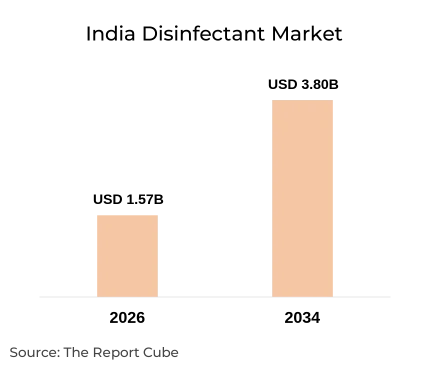
- India Disinfectant Market valued at USD 1.57 billion in 2026, driven by intensifying hygiene awareness.
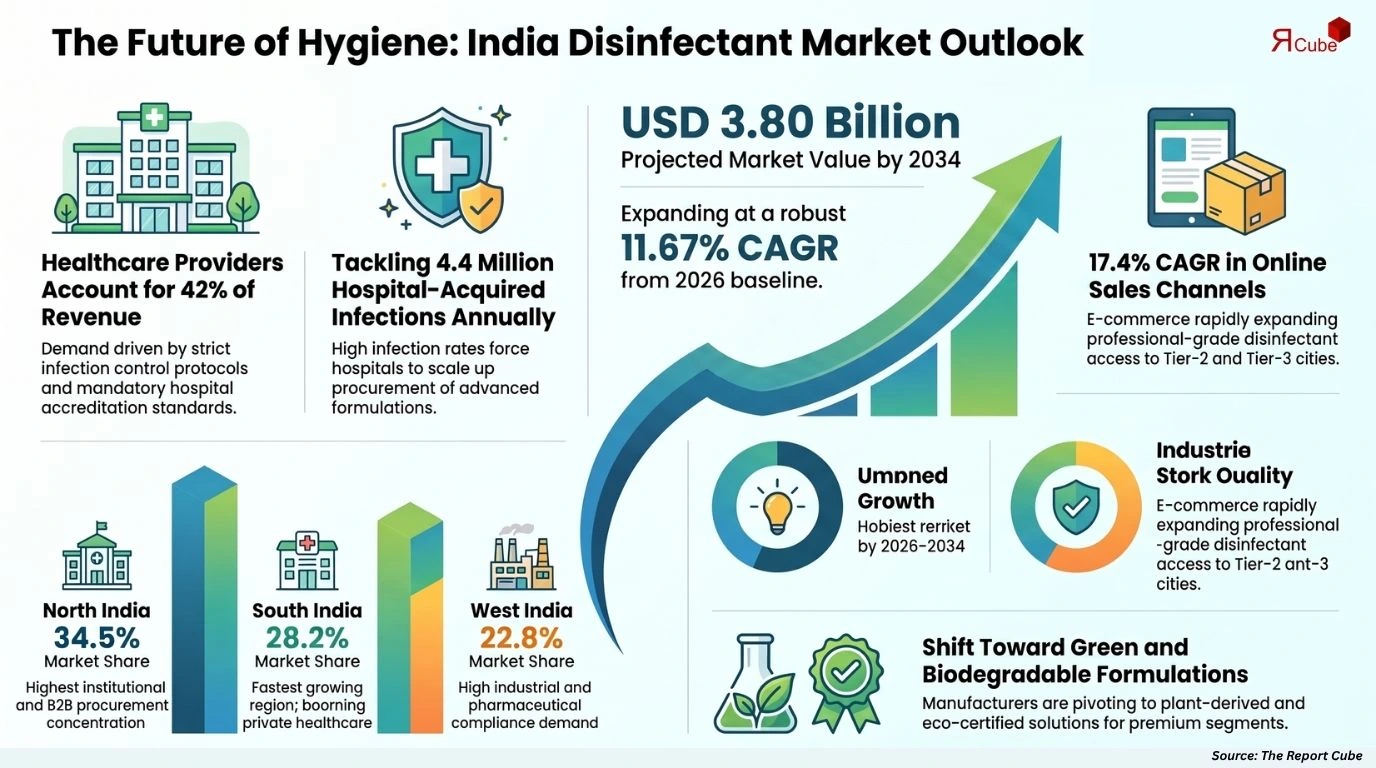
- Market projected to reach USD 3.80 billion by 2034, expanding at a robust 11.67% CAGR.
- Healthcare providers remain the dominant end-user segment due to stringent infection control protocols.
- B2B distribution channel leads revenue contribution across institutional and industrial disinfectant procurement.
- North India holds regional leadership supported by dense healthcare infrastructure and urban commercial activity.
- South India emerges as the fastest-growing region driven by expanding hospital networks and food processing.
- Leading companies include Hindustan Unilever, Reckitt Benckiser, Ecolab, ITC Limited, and Diversey India.
- Post-pandemic hygiene permanence and regulatory food safety mandates continue accelerating disinfectant adoption.
India Disinfectant Market Insights & Analysis
The India Disinfectant Market is anticipated to register a 11.67% CAGR during 2026–2034. The market size was valued at USD 1.57 billion in 2026 and is projected to reach USD 3.80 billion by 2034. Growth is underpinned by the Government of India's sustained investments in public health infrastructure, including allocations exceeding INR 89,000 crore in the Union Budget 2024–25 toward healthcare and sanitation expansion. Rising institutional procurement from AIIMS hospitals, government-run clinics, and private healthcare chains further reinforces consistent baseline demand for surface, air, and equipment disinfectants across India's healthcare tier.
Beyond healthcare, commercial establishments including food processing units, hospitality chains, and educational institutions are embedding disinfection protocols as standard operational requirements. The Food Safety and Standards Authority of India (FSSAI) has tightened hygiene compliance norms for food manufacturers, compelling manufacturers to adopt industry-grade surface and equipment disinfection solutions approved under Schedule M standards. Procter & Gamble, Hindustan Unilever, and Reckitt Benckiser have collectively expanded their India disinfection product portfolios, introducing hospital-grade formulations accessible through retail and e-commerce platforms.
India Disinfectant Market Dynamics
India's disinfectant industry is navigating an inflection point where post-pandemic behavioral shifts have permanently elevated hygiene spending across healthcare, food service, hospitality, and residential sectors. Government-mandated sanitation programs, expanding urban middle-class awareness, and institutional procurement from healthcare networks sustain demand momentum. Simultaneously, innovation in formulation chemistry and distribution channel expansion is broadening market accessibility across semi-urban and rural India.
|
Factor |
Type |
Specific Impact on Market |
Magnitude |
|---|---|---|---|
|
Rising hospital-acquired infection (HAI) rates |
Driver |
Accelerates surface and equipment disinfectant procurement across hospitals |
Very High |
|
FSSAI hygiene compliance mandates |
Driver |
Boosts institutional disinfectant adoption in food processing and hospitality |
High |
|
E-commerce channel penetration |
Opportunity |
Expands disinfectant access to Tier-2 and Tier-3 cities and domestic consumers |
High |
|
Quaternary ammonium formulation innovation |
Trend |
Improves product efficacy and surface compatibility across healthcare and commercial use |
High |
|
Counterfeit and unregulated product proliferation |
Challenge |
Erodes brand trust and undercuts compliance-grade disinfectant market share |
Medium |
Key Market Driver: Hospital-Acquired Infection Prevention Mandates
India reports approximately 4.4 million hospital-acquired infections (HAIs) annually, according to estimates from the National Centre for Disease Control, placing enormous pressure on healthcare providers to strengthen surface disinfection and sterilization protocols. The National Accreditation Board for Hospitals (NABH) accreditation standards explicitly require documented disinfection cycles, driving procurement of quaternary ammonium compounds, chlorine-based solutions, and hydrogen peroxide formulations. Private hospital chains, including Apollo Hospitals and Fortis Healthcare, have scaled dedicated infection prevention budgets, supporting consistent volume-based procurement from Ecolab, Diversey India, and 3M India across their multi-city networks.
Major Industry Challenge: Unregulated Market and Counterfeit Products
A significant structural challenge facing the India Disinfectant Market is the widespread prevalence of substandard and counterfeit products, particularly in unorganized retail and informal distribution channels. Regulatory enforcement under the Drugs and Cosmetics Act and Bureau of Indian Standards (BIS) certification remains inconsistent across states, allowing non-compliant formulations to undercut premium brands on price. This dynamic suppresses upgrade purchasing among cost-sensitive commercial and domestic users, limits the penetration of hospital-grade antimicrobial cleaning solutions, and reduces overall average selling price realization for compliant manufacturers.
Emerging Trend Shaping Outlook: Green and Biodegradable Disinfectant Formulations
Environmental sustainability is reshaping product development priorities across India's disinfectant industry. Manufacturers are increasingly launching plant-derived quaternary ammonium compounds, enzyme-based cleaners, and biodegradable surface disinfectants that meet efficacy standards without contributing to chemical residue accumulation. Ecolab India and Henkel have both introduced eco-certified disinfection lines targeting the hotel, food processing, and premium residential segments. Regulatory tailwinds from India's Extended Producer Responsibility (EPR) framework and growing green procurement policies among large corporates are expected to accelerate adoption of sustainable disinfectant formulations through 2034.
Need Specific Data, Let’s Customize the Report for You
Request CustomizationIndia Disinfectant Market Segment-wise Analysis
India's disinfectant demand is shaped by a diverse end-user base and an evolving multi-channel distribution landscape. Healthcare, commercial, and domestic buyers demonstrate distinct procurement behaviors, formulation preferences, and channel dependencies that together define the market's segmentation architecture and growth trajectory.
By End-User
- Healthcare Providers
- Commercial Users
- Domestic Users
- Others
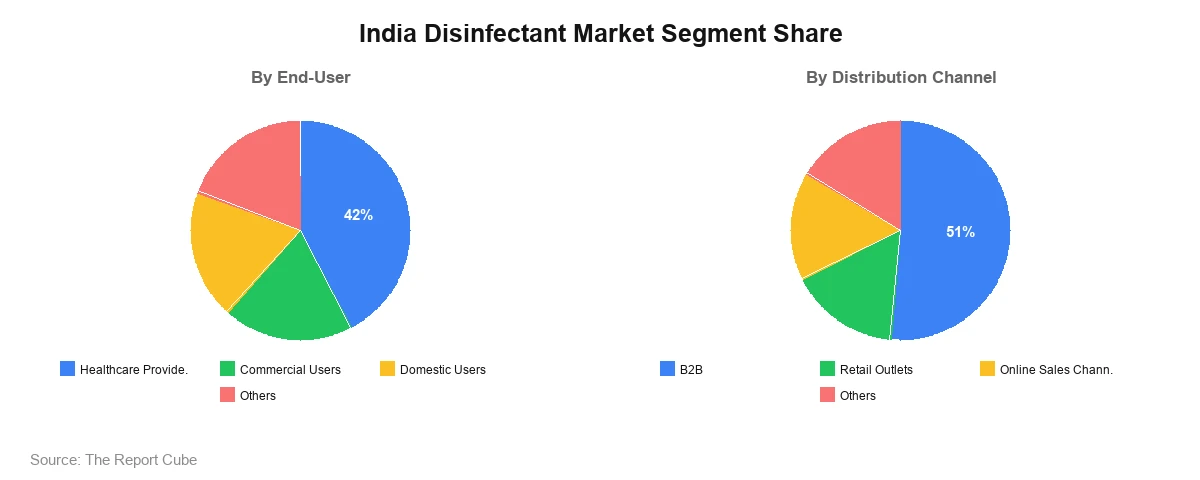
Healthcare Providers dominate the India Disinfectant Market end-user segment, accounting for an estimated 42% of total market revenue in 2026. Hospitals, diagnostic laboratories, nursing homes, and ambulatory care centers represent the most consistent and volume-driven disinfectant buyers in the country. NABH accreditation requirements, infection control committee mandates, and growing HAI prevention budgets compel procurement of premium, verified-efficacy formulations. Companies such as Ecolab, Diversey India, and 3M India have established dedicated healthcare channel teams specifically to service this segment with validated surface, instrument, and air disinfection solutions.
Commercial Users - comprising food processing facilities, hospitality chains, educational institutions, airports, and corporate campuses - represent the fastest-growing end-user category, expanding at an estimated 13.2% CAGR through 2034. FSSAI's revised hygienic processing guidelines and post-pandemic facility re-opening protocols have institutionalized regular disinfection across previously underserved commercial verticals. Domestic Users, while individually low-volume, contribute meaningful aggregate revenue through branded surface disinfectants and sanitizer sprays distributed via retail and online channels. The Others category includes government buildings, defense establishments, and public transportation operators.
By Distribution Channel
- B2B
- Retail Outlets
- Online Sales Channel
- Others
B2B channels command an estimated 51% share of India's disinfectant distribution revenue, reflecting the institutional dominance of bulk procurement contracts between manufacturers and healthcare networks, food processing companies, and facility management organizations. Long-term supply agreements between Diversey India and hotel chains, and between Ecolab and hospital groups, consolidate significant volume through direct sales and authorized distributors, insulating these channels from retail price volatility. The B2B segment also captures high-margin institutional formulations unavailable in retail formats.
Retail Outlets continue serving the domestic and small-commercial user base through pharmacies, supermarkets, and general trade, supported by strong brand visibility from Reckitt Benckiser's Dettol, Hindustan Unilever's Domex, and SC Johnson's range. Online Sales Channels are accelerating rapidly, growing at an estimated 17.4% CAGR through 2034, as e-commerce-driven disinfectant retail penetration enables direct-to-consumer delivery of professional-grade disinfectants in Tier-2 and Tier-3 markets. Platforms including Amazon India, Flipkart, and JioMart are increasingly stocking institutional formats at consumer-accessible pack sizes.
Regional Projection of India Disinfectant Market
India's disinfectant market exhibits pronounced regional variation shaped by healthcare infrastructure density, commercial activity concentration, urbanization pace, and awareness of hygiene compliance requirements. North India leads overall revenue generation while South India demonstrates the strongest growth momentum through expanding hospital networks and food industry investment.
|
Region |
Estimated Market Share |
Key Growth Factors |
Consumer Trends |
|---|---|---|---|
|
North India |
34.5% |
Dense healthcare infrastructure, government hospital procurement, urban commercial concentration |
High institutional and B2B procurement of surface disinfectants |
|
South India |
28.2% |
Expanding private hospitals, food processing investment, tech-park facility hygiene |
Growing demand for eco-certified and enzyme-based disinfectants |
|
West India |
22.8% |
Industrial and pharmaceutical manufacturing compliance, large hospitality sector |
Rising adoption of automated and spray disinfection systems |
|
East India |
14.5% |
Increasing healthcare investment, post-pandemic domestic awareness growth |
Expanding organized retail disinfectant availability |
- North India: North India holds approximately 34.5% of the India Disinfectant Market, supported by the highest concentration of NABH-accredited hospitals, government medical colleges, and urban commercial establishments requiring structured disinfection programs.
- South India: South India represents the fastest-growing regional market, driven by a booming private hospital sector in cities such as Chennai, Bengaluru, and Hyderabad, alongside FSSAI-compliant food processing expansion and growing sustainability-driven procurement preferences among corporates.
- West India: West India benefits from a large pharmaceutical manufacturing base in Gujarat and Maharashtra requiring validated disinfection protocols under Schedule M and GMP guidelines, combined with a robust hospitality and real estate sector sustaining commercial demand.
- East India: East India is an emerging growth corridor where increasing central government healthcare infrastructure investments under Ayushman Bharat and rising urban middle-class hygiene awareness are steadily expanding organized disinfectant consumption.
India Disinfectant Market: Recent Development (2025)
- Hindustan Unilever expanded Domex hospital-grade surface disinfectant range targeting institutional healthcare procurement in India.
- Reckitt Benckiser India launched Dettol Pro Solutions disinfectant portfolio for commercial facility management and food service clients.
- Ecolab India signed a multi-year supply agreement with a leading pan-India private hospital chain for validated disinfection solutions.
- Diversey India introduced biodegradable quaternary ammonium disinfectant formulations under its sustainability-aligned commercial hygiene product line.
India Disinfectant Market Future Outlook (2034)
The India Disinfectant Market is projected to expand at a remarkable 11.67% CAGR, reaching approximately USD 3.80 billion by 2034. Long-term growth will be anchored by India's expanding universal healthcare coverage under Ayushman Bharat, continued NABH accreditation proliferation across tier-2 cities, and the deepening of FSSAI hygiene compliance enforcement across food processing value chains. Technological advancement in electrostatic spray disinfection, UV-C automated room disinfection, and no-rinse food-contact surface solutions will further elevate product value and per-unit revenue realization across institutional channels.
The domestic and commercial consumer segments will benefit from sustained e-commerce penetration, private label expansion by organized retailers, and increasing consumer education on surface disinfection efficacy standards. Manufacturers investing in green formulation R&D and BIS-certified product ranges will be best positioned to capture premium pricing and long-term institutional contract renewals. Strategic investments in cold-chain-compatible disinfection solutions for India's rapidly modernizing food distribution infrastructure represent an emerging adjacency within the broader India cleaning and hygiene chemicals market.
India Disinfectant Market Report Coverage
|
Report Attribute |
Details |
|---|---|
|
Market Name |
India Disinfectant Market |
|
Market Size (2026) |
USD 1.57 Billion |
|
Market Size (2034) |
USD 3.80 Billion |
|
Forecast Period |
2026–2034 |
|
CAGR |
11.67% |
|
Base Year |
2026 |
|
Historical Years |
2021–2025 |
|
Forecast Years |
2026–2034 |
|
Segments Covered |
By End-User, By Distribution Channel, By Formulation, By Type |
|
Regions Covered |
North India, South India, West India, East India |
|
Key Companies |
Reckitt Benckiser (India) Limited, 3M India Limited, Ecolab Food Safety and Hygiene Solutions Pvt Ltd, Clorox Limited, ITC Limited, SC Johnson Product Pvt. Ltd, Henkel Adhesives Technologies India Private Limited, Procter & Gamble Hygiene & Health Care Limited, Hindustan Unilever Limited, Diversey India Hygiene Pvt. Ltd. |
|
Report Format |
PDF, Excel, PPT |
|
Customization |
Available as per client requirements |
Why Choose This Report?
- Comprehensive analysis of India's disinfectant demand across all key end-user categories.
- Accurate market sizing with data-backed forecast through 2034 across segments.
- Detailed segmentation covering end-user and distribution channel revenue dynamics.
- Regional insights capturing North, South, West, and East India growth trajectories.
- Competitive profiling of leading domestic and multinational disinfectant manufacturers.
- Analysis of green formulation trends and regulatory compliance impact on market.
- Strategic insights enabling investment, procurement, and product portfolio decisions.
- Research grounded in FSSAI, NABH, and BIS regulatory and accreditation frameworks.
Table of Contents
- Introduction
- Objective of the Study
- Product Definition
- Market Segmentation
- Study Variables
- Research Methodology
- Secondary Data Points
- Companies Interviewed
- Primary Data Points
- Breakdown of Primary Interviews
- Secondary Data Points
- Executive Summary
- Market Dynamics
- Drivers
- Challenges
- Opportunity Assessment
- Recent Trends and Developments
- Policy and Regulatory Landscape
- India Disinfectant Market Overview and Forecast Analysis (2021-2034)
- Market Size, By Value, By Growth Rate (CAGR/USD Billions)
- Demand – Supply Trends
- Market Share, By Type
- Quaternary Ammonium Compound
- Aqueous Ozone Disinfectant
- Alcohol Based Disinfectant
- Others
- Market Share, By Formulation
- Liquid
- Wipes
- Spray
- Others
- Market Share, By End-User
- Healthcare Providers
- Commercial Users
- Domestic Users
- Others
- Market Share, By Distribution Channel
- B2B
- Retail Outlets
- Online Sales Channel
- Others
- Market Share, By Region
- North India
- South India
- East India
- West India
- Market Share, By Competitors
- Competition Characteristics
- Revenue Shares
- Quaternary Ammonium Compound India Disinfectant Market Overview, 2021-2034F
- By Value (USD Million)
- By Formulation – Market Size & Forecast 2021-2034, USD Million
- Liquid
- Wipes
- Spray
- Others
- Aqueous Ozone Disinfectant India Disinfectant Market Overview, 2021-2034F
- By Value (USD Million)
- By Formulation – Market Size & Forecast 2021-2034, USD Million
- Liquid
- Wipes
- Spray
- Others
- Alcohol Based Disinfectant India Disinfectant Market Overview, 2021-2034F
- By Value (USD Million)
- By Formulation – Market Size & Forecast 2021-2034, USD Million
- Liquid
- Wipes
- Spray
- Others
- Others India Disinfectant Market Overview, 2021-2034F
- By Value (USD Million)
- By Formulation – Market Size & Forecast 2021-2034, USD Million
- Liquid
- Wipes
- Spray
- Others
- Competitive Outlook (Company Profile – Partial List)
- Reckitt Benckiser (India) Limited
- Company Overview
- Business Segments
- Strategic Alliances/Partnerships
- Recent Developments
- 3M India Limited
- Company Overview
- Business Segments
- Strategic Alliances/Partnerships
- Recent Developments
- Ecolab Food Safety and Hygiene Solutions Pvt Ltd
- Company Overview
- Business Segments
- Strategic Alliances/Partnerships
- Recent Developments
- Clorox Limited
- Company Overview
- Business Segments
- Strategic Alliances/Partnerships
- Recent Developments
- ITC Limited
- Company Overview
- Business Segments
- Strategic Alliances/Partnerships
- Recent Developments
- SC Johnson Product Pvt. Ltd
- Company Overview
- Business Segments
- Strategic Alliances/Partnerships
- Recent Developments
- Henkel Adhesives Technologies India Private Limited
- Company Overview
- Business Segments
- Strategic Alliances/Partnerships
- Recent Developments
- Procter & Gamble Hygiene & Health Care Limited
- Company Overview
- Business Segments
- Strategic Alliances/Partnerships
- Recent Developments
- Hindustan Unilever Limited
- Company Overview
- Business Segments
- Strategic Alliances/Partnerships
- Recent Developments
- Diversey India Hygiene Pvt. Ltd.
- Company Overview
- Business Segments
- Strategic Alliances/Partnerships
- Recent Developments
- Reckitt Benckiser (India) Limited
- Contact Us & Disclaimer
Top Key Players & Market Share Outlook
- Reckitt Benckiser (India) Limited
- 3M India Limited
- Ecolab Food Safety and Hygiene Solutions Pvt Ltd
- Clorox Limited
- ITC Limited
- SC Johnson Product Pvt. Ltd
- Henkel Adhesives Technologies India Private Limited
- Procter & Gamble Hygiene & Health Care Limited
- Hindustan Unilever Limited
- Diversey India Hygiene Pvt. Ltd.
Frequently Asked Questions






