




Build Your Custom Market Intelligence Report
Customize Your ReportIndia Electric Three‑Wheeler Market Size, Share, Trends & Forecast 2026-2034
Key Takeaways
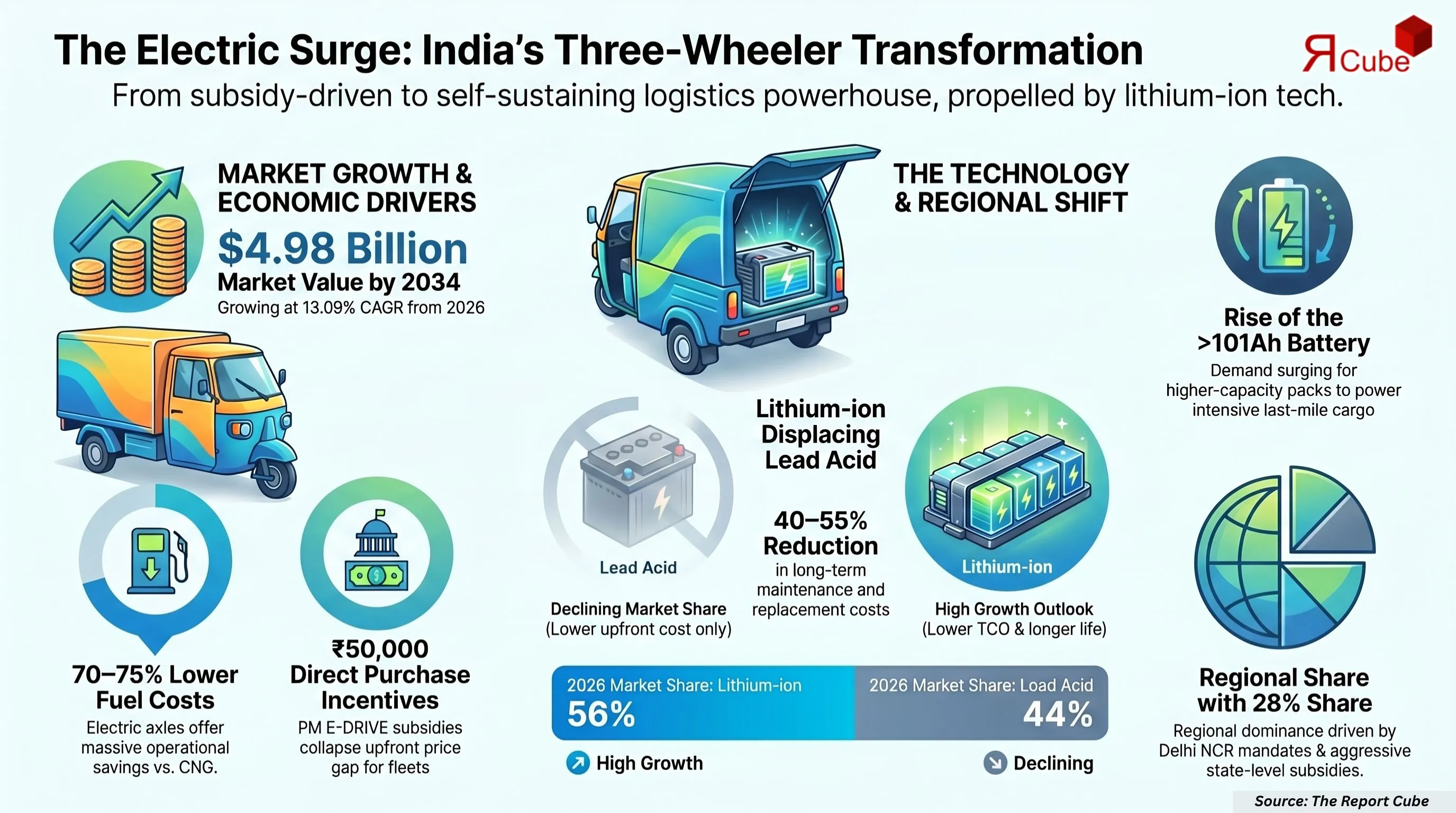
- The India electric three-wheeler market is projected to grow from USD 1.86 billion in 2026 to USD 4.98 billion by 2034, at a CAGR of 13.09%.
- Lithium-ion battery adoption is accelerating across cargo and passenger three-wheeler segments, displacing lead acid chemistry in new vehicle registrations.
- Government subsidy schemes under FAME II and PM E-DRIVE are directly reducing upfront acquisition costs for fleet operators and individual drivers.
- The >101Ah battery capacity segment is gaining share as range anxiety concerns among last-mile delivery operators push demand for higher-energy-density packs.
- India accounted for the largest share of electric three-wheeler deployments in Asia-Pacific, driven by dense urban freight corridors and a well-established auto-rickshaw culture.
India Electric Three‑Wheeler Market Insights & Analysis
Three-wheelers carrying petrol or diesel engines still dominate India's informal logistics and passenger transport grid, yet every new route mapped by a gig-economy delivery platform now arrives on an electric axle. That structural lag is the core market problem: a fleet of roughly 7.2 million registered three-wheelers (Ministry of Road Transport & Highways, 2024) where electrification penetration remained below 12% as of late 2024, despite policy incentives active since 2019. The commercial math has turned decisively: at prevailing electricity tariffs, per-kilometre fuel cost for an electric three-wheeler runs approximately 70–75% below that of a comparable CNG variant (NITI Aayog, 2023), closing the total-cost-of-ownership gap within 24–30 months at typical utilisation rates.
This report maps how that economics-driven conversion plays out across battery capacity tiers, battery chemistry types, and India's heterogeneous regional infrastructure from 2026 to 2034.
Two structural forces are pulling in opposite directions. On the demand side, e-commerce logistics growth, India's quick-commerce segment alone processed an estimated 10 million daily orders in 2024 (India Brand Equity Foundation, 2024), is creating captive demand for last-mile electric cargo carriers. Platforms including Swiggy Instamart, Blinkit, and Zepto have publicly committed to all-electric last-mile fleets, generating fleet-size purchase orders that de-risk OEM capital allocation. On the supply side, domestic battery manufacturing capacity is scaling unevenly: lithium-ion cell production remains import-dependent, with China supplying an estimated 70–80% of India's cell requirements (Ministry of New and Renewable Energy, 2024), exposing OEMs to currency and supply-chain risk.
The 2026–2034 forecast window captures the transition from early-adopter commercial fleets to broad-base urban replacement of ICE three-wheelers. Growth at 13.09% CAGR reflects a compounding of three forces: policy pull (FAME III discussions, state EV policies), technology push (cell cost declines projected at 5–7% per annum through 2030 per BloombergNEF), and platform demand (formalisation of gig logistics shifting procurement from individual owner-operators to fleet aggregators). The report covers all passenger and cargo variants, across public and private sector fleet channels.
India Electric Three‑Wheeler Market Dynamics
Key Market Driver: FAME II Subsidy and PM E-DRIVE Incentive Stack
Unsubsidised electric three-wheelers carried a sticker-price premium of 25–35% over their CNG equivalents as recently as 2022 (NITI Aayog, 2023), a gap that blocked fleet replacement for capital-constrained owner-operators. PM E-DRIVE, announced in September 2024 with an outlay of INR 10,900 crore (Ministry of Heavy Industries, 2024), extended direct purchase incentives of up to INR 50,000 per electric three-wheeler, collapsing that upfront gap to under 10% in most vehicle categories. This policy changes the buying decision from a speculative bet on future fuel savings to an arithmetic certainty. The report segments demand by incentive-eligible and non-eligible vehicle classes to isolate the subsidy-driven portion of forecast growth.
Major Industry Challenge: Charging Infrastructure Deficit in Tier-2 and Tier-3 Cities
Fleet economics proven in Mumbai or Bengaluru do not replicate automatically in Patna, Coimbatore, or Guwahati, yet those are precisely the corridors where three-wheeler replacement volumes are highest. India had approximately 12,000 public EV charging stations as of March 2024 (Bureau of Energy Efficiency, 2024), a figure that sounds substantial until mapped against 4,500-plus urban centres with active three-wheeler fleets. Charging downtime that exceeds 4 hours per day eliminates the daily-trip economics that justify electrification for a driver earning INR 800–1,200 per day. The report quantifies the charging-gap-adjusted addressable market by region and models two infrastructure build-out scenarios, base case and accelerated, to bracket the 2034 outcome.
Emerging Trend: Lithium-ion Displacing Lead Acid at the Fleet Level
Lead acid batteries dominated India's electric three-wheeler market through 2022, primarily because their lower upfront cost matched the purchasing capacity of individual owner-operators. Fleet aggregators and logistics companies, however, operate on total-cost-of-ownership models over 3–5-year asset cycles, and on that basis, lithium-ion delivers a 40–55% reduction in battery replacement and maintenance costs over a five-year period (NITI Aayog, 2023). As fleet procurement scales from individual buyers to platform-level purchase orders, the chemistry decision shifts decisively toward lithium-ion.
Need Specific Data, Let’s Customize the Report for You
Request CustomizationEmerging Opportunity: Battery-as-a-Service Models Reducing Entry Barriers
Battery cost represents 35-45% of an electric three-wheeler's sticker price (BloombergNEF, 2024). Battery-as-a-Service (BaaS) models, pioneered by players including Ola Electric and Sun Mobility, decouple the battery cost from vehicle acquisition, cutting upfront prices by up to 30% and shifting the battery expense to a per-kilometre operating charge. For individual owner-operators who cannot access institutional fleet financing, BaaS converts an unaffordable capex into an affordable opex, unlocking a segment that fleet-only analysis would miss. The report models BaaS-enabled demand separately from conventional vehicle sales to prevent forecast conflation.
India Electric Three‑Wheeler Market Segment-wise Analysis
By Battery Capacity
|
Battery Capacity |
2026 Share (Est.) |
Growth Outlook |
Key Application |
|---|---|---|---|
|
Below 101Ah |
58% |
Moderate |
Passenger auto-rickshaws, short-range urban routes |
|
Above 101Ah |
42% |
High |
Cargo last-mile delivery, intercity freight |
Below-101Ah configurations currently dominate the fleet by unit count, reflecting the installed base of passenger three-wheelers optimised for intra-city ranges of 80-120 km per charge. The segment suits traditional auto-rickshaw operators where overnight home charging is feasible and daily range does not exceed metropolitan trip patterns. However, cargo logistics operators, particularly those running 2-3 daily shifts, demand range per charge that sub-101Ah packs cannot deliver without mid-route charging stops. The above-101Ah segment, while smaller today, is forecast to grow at a materially higher rate through 2034 as quick-commerce and D2C logistics platforms specify minimum range thresholds in fleet procurement contracts. Battery pack standardisation, currently fragmented across 12-15 form factors among leading OEMs, remains the key efficiency lever for the segment.
By Battery Type
|
Battery Type |
2026 Share (Est.) |
Growth Outlook |
Key Advantage |
|---|---|---|---|
|
Lead Acid |
44% |
Declining |
Lower upfront cost, established service network |
|
Lithium-ion |
56% |
High |
Lower TCO, longer cycle life, faster charge |
Lead acid batteries retain a meaningful installed-base share through the forecast period, sustained by their price accessibility for individual owner-operators in Tier-3 and rural markets and by the existing service network of roadside mechanics capable of maintaining flooded cell and VRLA variants. Their energy density disadvantage, approximately 30–50 Wh/kg against 150–250 Wh/kg for lithium-ion, becomes commercially disqualifying only when daily utilisation exceeds one full charge cycle. Lithium-ion already commands majority share by value and is forecast to widen that lead as fleet procurement eclipses individual purchases, cell costs decline, and BaaS models remove the upfront price barrier that previously protected lead acid in the sub-INR 1.5 lakh vehicle segment.
Regional Projection of India Electric Three‑Wheeler Market
|
Region |
Share (Est. 2026) |
Key Driver |
Infrastructure Gap |
|---|---|---|---|
|
North India |
28% |
Delhi NCR fleet mandates, state EV policies (UP, Rajasthan) |
Moderate, dense urban cores, thin peri-urban charging |
|
West India |
24% |
Maharashtra & Gujarat industrial corridor logistics |
Low in Mumbai-Pune; high in secondary towns |
|
South India |
22% |
Tamil Nadu & Karnataka EV manufacturing base; Bengaluru tech logistics |
Low in metro; growing in Tier-2 |
|
East India |
14% |
Kolkata urban transport reform; FAME-II fleet adoption |
High, charging network nascent |
|
Central India |
12% |
MP and Chhattisgarh state subsidy stacking |
High, sparse public charging |
- North India leads by market share, anchored by Delhi NCR's Supreme Court-mandated shift away from ICE three-wheelers in urban transport and by Uttar Pradesh's state EV policy offering additional purchase subsidies of up to INR 20,000 per vehicle (Uttar Pradesh New EV Manufacturing and Mobility Policy, 2022).
- West India follows closely, driven by Maharashtra's aggressive EV policy and Gujarat's logistics corridors connecting the Mundra-JNPT port axis.
- South India benefits from proximity to EV manufacturing capacity, Ola Electric's Krishnagiri plant and Omega Seiki's assembly lines in the region, which compresses delivery lead times for fleet operators.
- East and Central India represent the highest-growth opportunity on a percentage basis precisely because baseline penetration is lowest; the constraint is charging infrastructure, not demand.
India Electric Three‑Wheeler Market, Recent Developments (2025)
- Mahindra Electric Mobility launched the Treo Zor cargo variant with a 10.24 kWh lithium-ion pack in Q1 2025, targeting pharmaceutical and FMCG last-mile logistics operators. (Press Release, Mahindra Electric, January 2025)
- Euler Motors raised INR 200 crore in Series C funding in March 2025 to scale its HiLoad EV cargo three-wheeler manufacturing capacity at its Manesar facility. (Economic Times, March 2025)
- Piaggio Vehicles crossed the 50,000-unit cumulative production milestone for its Ape E-City passenger three-wheeler in April 2025, the first Indian EV three-wheeler OEM to achieve that threshold. (Press Release, Piaggio India, April 2025)
- Omega Seiki Mobility signed a fleet supply agreement with Shadowfax Technologies for 5,000 units of its Rage+ cargo EV to be deployed across 18 cities through 2026. (Business Standard, February 2025)
- Bureau of Energy Efficiency updated the FAME II claiming portal in Q2 2025 to integrate real-time OEM production data, accelerating subsidy disbursement timelines from 90 days to an estimated 21 days. (BEE Circular, May 2025)
- Terra Motors India partnered with EESL (Energy Efficiency Services Limited) to supply 2,500 electric three-wheelers for government-contracted last-mile connectivity routes in Bihar and Jharkhand. (Press Release, Terra Motors India, June 2025)
India Electric Three‑Wheeler Market Future Outlook (2034)
Electric three-wheelers have not yet exhausted their policy tailwind, and by 2034, they will not need it. The market reaches structural self-sustainability before the end of the forecast window when lithium-ion cell costs cross below USD 80/kWh, projected for 2027–2028 per BloombergNEF. At that threshold, total cost of ownership for a lithium-ion electric three-wheeler falls below an equivalent CNG vehicle without any subsidy, removing the policy-dependency that characterises the 2026–2028 growth phase.
Three forces will define the 2029–2034 acceleration. First, domestic cell manufacturing under the PLI scheme for Advanced Chemistry Cell (ACC) batteries, targeting 50 GWh of annual capacity by 2030 (Ministry of Heavy Industries, 2023), will reduce import exposure and compress OEM battery procurement costs. Second, swappable battery standardisation, currently under draft specification by the Bureau of Indian Standards, will enable multi-OEM swap network economics to scale, reducing per-charge downtime from 4–6 hours to under 5 minutes for operator-enrolled fleets. Third, formalisation of the gig logistics sector under DPIIT's proposed social security frameworks will increase fleet-owner creditworthiness, unlocking institutional financing that today excludes the majority of individual three-wheeler owner-operators.
By 2034, the electric three-wheeler market in India at USD 4.98 billion will represent a fully commercialised sector led by platform-scale fleet operators, not individual driver-owners, a structural shift from the market's origins that this report tracks across every segment and region.
India Electric Three‑Wheeler Market Report Coverage
|
Report Features |
Details |
|---|---|
|
Market Size (Value) |
USD 1.86 Billion (2026) |
|
Forecast Period |
2026-2034 |
|
CAGR |
13.09% |
|
Base Year |
2026 |
|
Historical Data |
2021–2025 |
|
Customization |
Available |
|
Segments Covered |
By Battery Capacity; By Type; By Vehicle Type |
|
Regions Covered |
North India, West India, South India, East India, Central India |
|
Key Companies |
Mahindra Electric Mobility, Euler Motors, Piaggio Vehicles, Kinetic Green Energy, Omega Seiki Mobility |
|
Report Format |
PPT, PDF & Excel |
Why Choose This Report?
- Granular battery-capacity segmentation (sub-101Ah vs. above-101Ah) isolates the cargo logistics demand surge from the passenger auto-rickshaw replacement cycle, providing separate CAGR trajectories for each operator type.
- Chemistry substitution modelling tracks lead acid-to-lithium-ion conversion rates by fleet size and geography, with scenario analysis for BaaS penetration impact on each chemistry's market share.
- Regional analysis covers five distinct Indian sub-markets with separate infrastructure-gap assessments, preventing national-average figures from masking state-level variance in EV policy and charging coverage.
- PM E-DRIVE and FAME II subsidy impact is quantified as a separate demand component, allowing readers to model market size under three policy continuation scenarios.
- Competitive profiles for all 10 named key players include production capacity data, recent funding rounds, and fleet contract disclosures as of H1 2025.
- Total-cost-of-ownership modelling compares electric, CNG, and diesel three-wheelers across 5-year fleet cycles at current and projected battery costs.
- All forecasts carry named-source attribution traceable to primary government and institutional databases - no unverifiable secondary estimates.
Table of Contents
- Introduction
- Objective of the study
- Product Definition
- Market Segmentation
- Study Variables
- Research Methodology
- Secondary Data Points
- Companies Interviewed
- Primary Data Points
- Breakdown of Primary Interviews
- Secondary Data Points
- Executive Summary
- Market Dynamics
- Drivers
- Challenges
- Opportunity Assessment
- Recent Trends and Developments
- Policy and Regulatory Landscape
- India Electric Three‑Wheeler Market Overview and Forecast Analysis (2021-2034)
- Market Size, By Value, By growth rate (CAGR/USD Billions)
- Demand - Supply Trends
- Market Share, By Vehicle Type
- Passenger Carrier
- Load Carrier
- Market Share, By Battery Capacity
- <101Ah
- >101Ah
- Market Share, By Type
- Lead Acid
- Lithium-ion
- Market Share, By Region
- North India
- West India
- South India
- East India
- Central India
- Market Share, By Competitors
- Competition Characteristics
- Revenue Shares
- India Passenger Carrier Electric Three‑Wheeler Market Overview, 2021-2034F
- By Value (USD Million)
- By Battery Capacity- Market Size & Forecast 2021-2034, USD Million
- By Type- Market Size & Forecast 2021-2034, USD Million
- India Load Carrier Electric Three‑Wheeler Market Overview, 2021-2034F
- By Value (USD Million)
- By Battery Capacity- Market Size & Forecast 2021-2034, USD Million
- By Type- Market Size & Forecast 2021-2034, USD Million
- Competitive Outlook (Company Profile - Partial List)
- Atul Motors Private Limited
- Company Overview
- Business Segments
- Strategic Alliances/Partnerships
- Recent Developments
- Euler Motors Private Limited
- Company Overview
- Business Segments
- Strategic Alliances/Partnerships
- Recent Developments
- Kinetic Green Energy & Power Solutions Ltd
- Company Overview
- Business Segments
- Strategic Alliances/Partnerships
- Recent Developments
- Lohia Auto Industries Limited
- Company Overview
- Business Segments
- Strategic Alliances/Partnerships
- Recent Developments
- Mahindra Electric Mobility Limited
- Company Overview
- Business Segments
- Strategic Alliances/Partnerships
- Recent Developments
- Omega Seiki Mobility Private Limited
- Company Overview
- Business Segments
- Strategic Alliances/Partnerships
- Recent Developments
- Piaggio Vehicles Pvt. Ltd
- Company Overview
- Business Segments
- Strategic Alliances/Partnerships
- Recent Developments
- Saera Electric Auto Pvt. Ltd
- Company Overview
- Business Segments
- Strategic Alliances/Partnerships
- Recent Developments
- Terra Motors India Private Limited
- Company Overview
- Business Segments
- Strategic Alliances/Partnerships
- Recent Developments
- Others
- Atul Motors Private Limited
- Contact Us & Disclaimer
Top Key Players & Market Share Outlook
- Atul Motors Private Limited
- Euler Motors Private Limited
- Kinetic Green Energy & Power Solutions Ltd
- Lohia Auto Industries Limited
- Mahindra Electric Mobility Limited
- Omega Seiki Mobility Private Limited
- Piaggio Vehicles Pvt. Ltd
- Saera Electric Auto Pvt. Ltd
- Terra Motors India Private Limited
- Others
Frequently Asked Questions






