




Build Your Custom Market Intelligence Report
Customize Your ReportWhat Is the APAC Electrophysiology Devices Market Size & Value?
The APAC Electrophysiology Devices Market is anticipated to register a CAGR of around 10.82% during the forecast period, 2026-34. Additionally, the market size was valued at nearly USD 2.11 billion in 2025 and is projected to reach almost USD 5.32 billion by 2034.
APAC Electrophysiology Devices Market Key Highlights
- Increasing Atrial fibrillation (AF) popularity & broader cardiac arrhythmia treatment in APAC to drive demand for minimally invasive cardiac procedures & advanced EP labs.
- Quick healthcare infrastructure development & an aging population expand case volumes, enhancing the Asia-Pacific Electrophysiology Market size & high‑acuity cardiac care.
- Robust growth in 3D mapping systems in EP, diagnostic EP catheters Asia-Pacific, and intracardiac echocardiography (ICE) enhances precision & multifaceted arrhythmia management.
- Incorporation of EP lab platforms & hospital IT, workflow optimization, and greater application of mapping, ablation, and imaging equipment.
- Leading players like Medtronic, Abbott, and Boston Scientific expand tailored EP portfolios, solidifying Electrophysiology Devices Market share in Japan & China.
- Japan dominates regional revenue in EP mapping & ablation, while China displays fastest growth, expanding APAC cardiac ablation devices market.
- Government initiatives: China’s Healthy China 2030 and Japan’s national cardiovascular disease plans, support reimbursement policies for EP devices & advanced cardiac care options.
- Rising adoption of cryoablation devices, robotic-assisted ablation, and electrophysiology mapping systems in APAC strengthens long‑term industry growth.
APAC Electrophysiology Devices Market Dynamics
What is the key driver of the APAC Electrophysiology Devices Market?
Aging Hearts & AF Burden to Drive the Market: Aging population & increasing Atrial fibrillation (AF) prevalence across the APAC is promptly surging the candidates for catheter ablation, raising the need for cardiac arrhythmia treatment, hence driving market demand. Also, urban lifestyles, obesity, hypertension, and diabetes augment demand for minimally invasive cardiac procedures, solidifying long‑term growth for electrophysiology devices, as well as requirement for diagnostic EP catheters, mapping systems, and ablation platforms.
What are the major challenges that affect the APAC Electrophysiology Devices Industry?
Irregular EP Infrastructure & Specialist Access to Hinder the Industry: Uneven EP lab distribution & specialist shortages between Japan, South Korea, urban China, and developing Southeast Asia limit access. Moreover, the market penetration of premium APAC cardiac ablation technologies is restricted due to limited procedural capacity & variable operator proficiency, slow adoption of modern 3D mapping systems in EP, electrophysiological mapping systems in Asia, and intracardiac echocardiography (ICE).
What are the future opportunities in the APAC Electrophysiology Devices Market during 2026-34?
Integrated EP Labs & Advanced Mapping Ecosystems: Robotic-assisted ablation, ICE, imaging navigation, and 3D mapping technologies in EP are all part of fully integrated EP lab amalgamation ecosystems that provides substantial benefits. Also, the Asia-Pacific Electrophysiology Devices Market size in China, India, ASEAN, and Australia can be augmented by governments & hospitals escalating advanced cardiac care alternatives via the growth of healthcare infrastructure & favorable reimbursement policies.
What trends are affecting the APAC Electrophysiology Devices Market Outlook?
Shift Toward Complex Ablation & Novel Energy Modalities: Simple SVT procedures are giving way to complex AF & VT ablation utilizing contact force, cryoablation devices, and high-density electrophysiological mapping systems in Asia. Also, Asia-Pacific's growing robotic-assisted ablation, ICE, and diagnostic EP catheters enhance capacity, while China & Japan upsurge their market shares for electrophysiological devices.
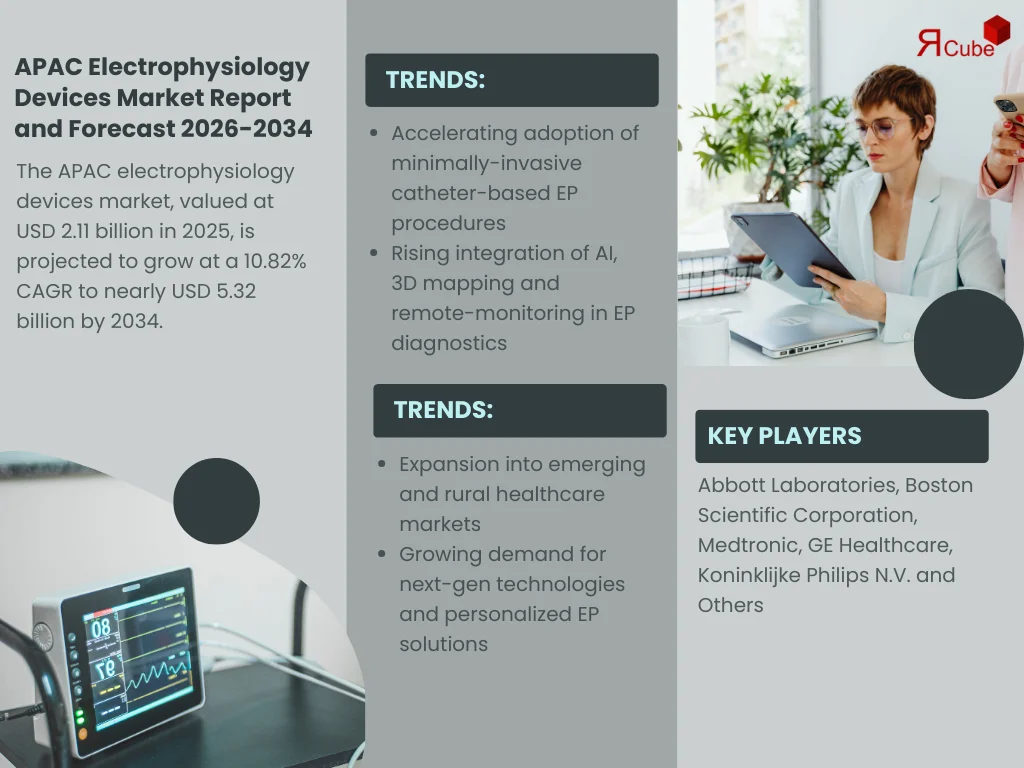
APAC Electrophysiology Devices Industry Analysis (2026–2034)
Electrophysiology (EP) devices, are the systems or devices utilized to diagnose & treat cardiac electrical disorders like AFib (catheters, mapping systems, ablation platforms and accessories), is entering a high-growth phase compelled by aging populations, booming arrhythmia prevalence, increasing tertiary cardiac centres, and quicker adoption of advanced mapping & pulsed-field ablation (PFA) technologies.
Moreover, as suppliers invest in integrated mapping-and-ablation workflows, the APAC Electrophysiology Devices Market is predicted to expand quickly, with a multi-billion USD potential by 2034. For instance, industry projections show strong growth as the market becomes more appealing to established market players (Abbott/Biosense Webster, Boston Scientific, J&J, Medtronic) & new entrants (represented by recent launches (CARTOTM 3 v8 and VARIPULSE PFA approvals/rollout), as well as Boston Scientific's Farapulse momentum & acquisitions to expand mapping capabilities.
Furthermore, hospital buying cycles, elective treatment volumes, and reimbursement growth, all affect market profitability. Also, concerns such as competitive pricing, cost sensitivity in lower-income APAC countries, and irregular reimbursement to hamper the market growth. Further, procedure growth & device uptake are supported by national programs that enhances access to cardiac care (like China's Healthy China agenda & India's PM-JAY expansions).
In all, APAC EP devices are sited for substantial demand & investment during 2026–2034 due to strong epidemiology, government health programs, clinic improvements, and rapid technology innovation.
What is the Impact of AI in the APAC Electrophysiology Devices Market?
By automating lesion targeting & signal interpretation, artificial intelligence (AI) enhances electrophysiological mapping systems in Asia & EP lab incorporation. Also, AI-enhanced 3D mapping systems in EP & robotic-assisted ablation platforms from companies such as Medtronic, Abbott, and Boston Scientific support the growth of the APAC Electrophysiology Devices Market & long-term growth drivers, by standardizing the treatment of complex cardiac arrhythmias.
How are the APAC Electrophysiology Devices Market Segments Defined?
The APAC Electrophysiology Devices Market Research Reports provide detailed market data & insights in accordance with market segmentation. Some of the segments are:
- Product: EP Ablation Catheters, EP Diagnostic Catheters, EP Laboratory Capital Equipment/Systems (EP Lab or Mapping & Lab Systems), Access/Accessory Devices (Sheaths, Introducers, Cables, Etc.), Other EP Consumables/Devices
- Indication / Application: Atrial Fibrillation, Atrial Flutter, Atrioventricular Nodal Reentrant Tachycardia (AVNRT), Wolff–Parkinson–White (WPW) Syndrome & Other Supraventricular Tachycardias, Ventricular Tachycardia & Other Arrhythmias
By Product:
EP Ablation Catheters segment is the dominant product segment in APAC, seizing biggest market share, as hospitals prioritize minimally invasive cardiac procedures over surgery for cardiac arrhythmia treatment in APAC. Also, the growth is strengthened by booming Atrial fibrillation (AF) prevalence, aging population, and modernization in 3D mapping systems, further assisting in enhancing the overall market share.
By Indication/Application:
Atrial fibrillation is considered to be one of the primary deployment case for EP devices in APAC, commanding for potential market share. Its high prevalence & strong guideline support for ablation upscales demand for diagnostic EP catheters, 3D mapping systems in EP, and intracardiac echocardiography (ICE) in cardiac arrhythmia treatment across the APAC.
APAC Electrophysiology Devices Industry: Regional Insights
The APAC Electrophysiology Devices Market is geographically diversified, covering:
- China
- Japan
- India
- South Korea
- Australia
- Southeast Asia
- Rest of the APAC
The China Electrophysiology Devices Market dominates the APAC Industry, commanding for biggest market share. This is instigated by large patient volumes, fast healthcare infrastructure development, and heavy investment in tertiary cardiac centers & EP labs. Also, strong domestic manufacturing, expanded catheter ablation programs, and increasing adoption of 3D mapping systems in EP, electrophysiology mapping systems, and diagnostic EP catheters, underpin its leading position. Also, supportive policy initiatives & surging reimbursement coverage for AF ablation procedures are central to the Electrophysiology Devices Market expansion across China.
APAC Electrophysiology Devices Market: Recent Developments & Government Initiatives
Recent Developments
- 2025: Abbott introduced TactiFlex sensor-enabled ablation catheter for AF, improving precision with EnSite X EP incorporation.
- 2025: Boston Scientific launched AI‑improved real‑time 3D mapping systems in EP to optimize intricate cardiac arrhythmia treatment workflows.
Government Initiatives & Policies
- Healthy China 2030 is a long-term national goal that was initiated to prioritize cardiovascular care, healthcare infrastructure development in Asia, and sophisticated cardiac services, which indirectly promote EP lab integration & the APAC Electrophysiology Devices Market.
- Japan’s National Plan was initiated to promotion of measures against cerebrovascular and cardiovascular disease. The framework was introduced to minimize CVD burden, supporting adoption of minimally invasive cardiac procedures, diagnostic EP catheters, and advanced EP services, strengthening electrophysiology devices market share.
How does the APAC Electrophysiology Devices Market (2034) future outlook appear?
Sustained Growth: With the upscale in the AF cases, catheter ablation, and establishments of more centers across China, India, and Southeast Asia, the market is destined to have a favorable future, with predicted CAGR of about 10.82% & market value of nearly USD 5.32 billion by 2034.
Technological Upgrade: Constant technological upgrade would emphasize greater‑density 3D mapping systems in EP, next‑generation pulsed‑field & cryoablation devices, robotic-assisted ablation, and integrated intracardiac echocardiography (ICE), enabling shorter procedures, better safety, and more tailored cardiac arrhythmia treatment.
Future Opportunities: Growing EP capacity beyond tier‑1 hospitals, leveraging tele‑enabled follow‑up, and tailoring portfolios for mid‑income markets, are creating lucrative market opportunities.
What Does Our APAC Electrophysiology Devices Market Research Study Entail?
- The APAC Electrophysiology Devices Market Research Report highlights the forecast growth rate (CAGR) by anticipating the market size and share.
- The market analysis & market scope sheds light upon the primary industry trends, driving aspects, potential opportunities, growth challenges, and other major factors.
- The APAC Electrophysiology Devices Market Research Report entails details about the most critical shifts in market share in the prominent regions.
- Considering the statistics & the developments by the primary market competitors, our report also strives to demonstrate the most sought-after strategies of the key players.
Table of Contents
- Introduction
- Objective of the Study
- Product Definition
- Market Segmentation
- Study Variables
- Research Methodology
- Secondary Data Points
- Companies Interviewed
- Primary Data Points
- Breakdown of Primary Interviews
- Secondary Data Points
- Executive Summary
- Market Dynamics
- Drivers
- Challenges
- Opportunity Assessment
- Recent Trends and Developments
- Policy and Regulatory Landscape
- APAC Electrophysiology Devices Market Overview (2020–2034)
- Market Size, By Value (USD Billion)
- Market Share, By Product
- EP Ablation Catheters
- EP Diagnostic Catheters
- EP Laboratory Capital Equipment/Systems (EP Lab or Mapping & Lab Systems)
- Access/Accessory Devices (Sheaths, Introducers, Cables, Etc.)
- Other EP Consumables/Devices
- Market Share, By Indication / Application
- Atrial Fibrillation
- Atrial Flutter
- Atrioventricular Nodal Reentrant Tachycardia (AVNRT)
- Wolff–Parkinson–White (WPW) Syndrome & Other Supraventricular Tachycardias
- Ventricular Tachycardia & Other Arrhythmias
- Market Share, By Application
- Diagnostic Devices
- Treatment Devices
- Market Share, By End-User
- Ambulatory Surgical Centers
- Hospitals
- Others
- Market Share, By Country
- China
- Japan
- India
- South Korea
- Australia
- Southeast Asia
- Rest of the APAC
- Market Share, By Company
- Revenue Shares
- Competition Characteristics
- APAC Electrophysiology Devices Market Overview, 2026-2034F
- By Product
- By Indication / Application
- By Application
- By End-User
- By Country
- Forecast Year Tables
- Competitive Outlook (Company Profiles)
- Abbott Laboratories
- Company Overview
- Business Segments
- Strategic Alliances/Partnerships
- Recent Developments
- Boston Scientific Corporation
- Company Overview
- Business Segments
- Strategic Alliances/Partnerships
- Recent Developments
- Medtronic
- Company Overview
- Business Segments
- Strategic Alliances/Partnerships
- Recent Developments
- GE Healthcare
- Company Overview
- Business Segments
- Strategic Alliances/Partnerships
- Recent Developments
- Koninklijke Philips N.V.
- Company Overview
- Business Segments
- Strategic Alliances/Partnerships
- Recent Developments
- MicroPort Scientific Corporation
- Company Overview
- Business Segments
- Strategic Alliances/Partnerships
- Recent Developments
- Johnson & Johnson Services
- Company Overview
- Business Segments
- Strategic Alliances/Partnerships
- Recent Developments
- Siemens Healthineers
- Company Overview
- Business Segments
- Strategic Alliances/Partnerships
- Recent Developments
- Biotronik
- Company Overview
- Business Segments
- Strategic Alliances/Partnerships
- Recent Developments
- Olympus Corporation
- Company Overview
- Business Segments
- Strategic Alliances/Partnerships
- Recent Developments
- Others
- Abbott Laboratories
- Contact Us & Disclaimer
Top Key Players & Market Share Outlook
- Abbott Laboratories
- Boston Scientific Corporation
- Medtronic
- GE Healthcare
- Koninklijke Philips N.V.
- MicroPort Scientific Corporation
- Johnson & Johnson Services
- Siemens Healthineers
- Biotronik
- Olympus Corporation
- Others
Frequently Asked Questions






