



Build Your Custom Market Intelligence Report
Customize Your ReportUAE Energy-Efficient Building Solutions Market Insights & Analysis
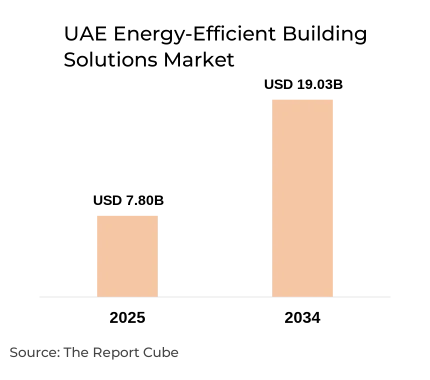
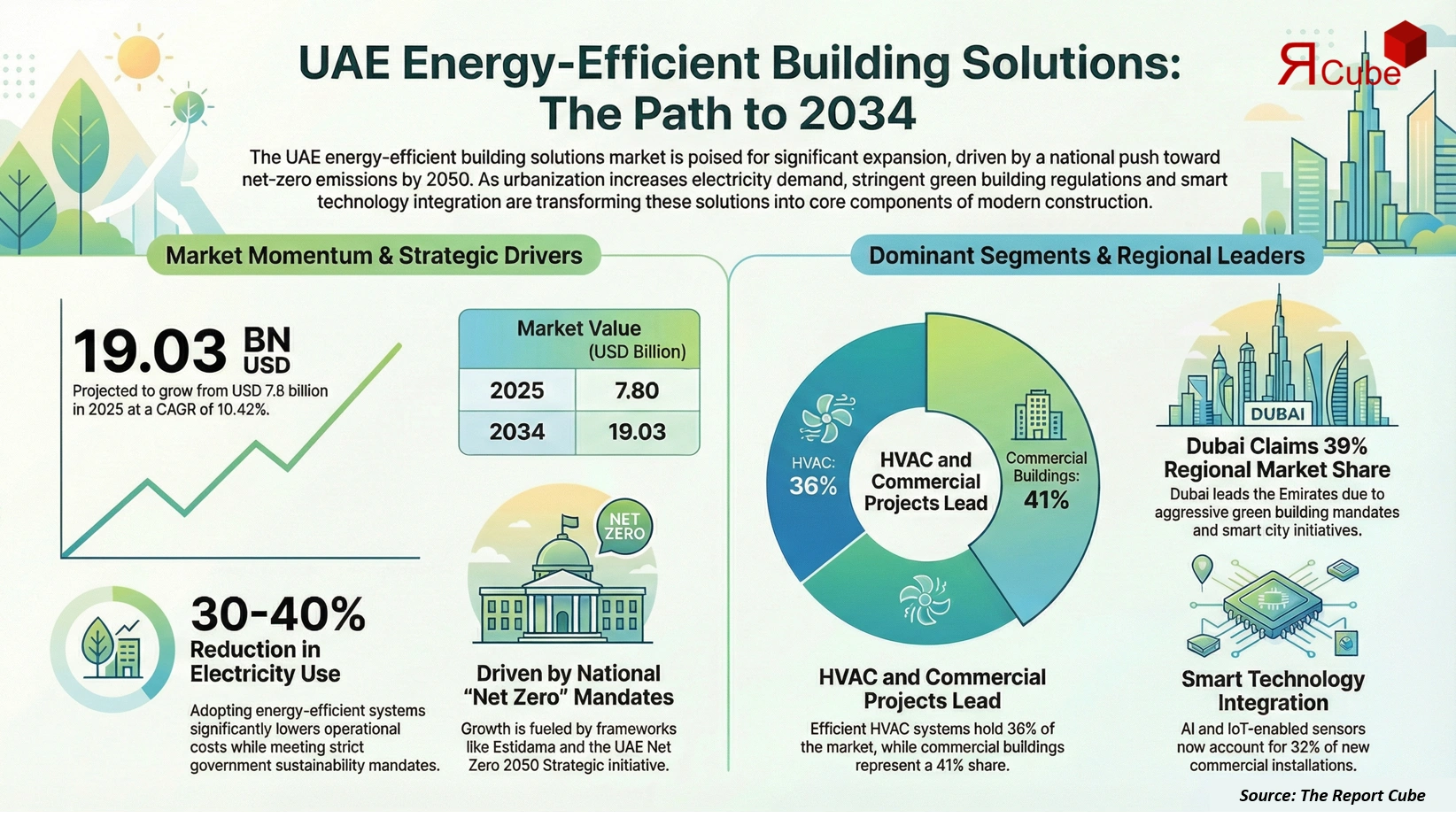
The UAE Energy-Efficient Building Solutions Market is anticipated to register a CAGR of 10.42% during 2026-2034. The market size was valued at USD 7.8 billion in 2025 and is projected to reach USD 19.03 billion by 2034. The market is expanding rapidly as the UAE intensifies its focus on sustainability, carbon reduction, and energy optimization across the built environment. Rising electricity demand from urbanization and mega infrastructure projects has made energy efficiency a strategic priority for both public and private stakeholders.
This momentum is reinforced by stringent green building regulations, such as Estidama and Dubai Green Building Regulations, which mandate energy-efficient designs and technologies. Commercial developers and government entities are increasingly integrating high-performance building systems to lower operational costs and meet compliance requirements. At the same time, residential consumers are becoming more conscious of energy bills and indoor comfort, accelerating adoption of efficient HVAC systems, smart lighting, and building automation solutions.
Moreover, the UAE’s long-term vision to achieve net-zero emissions by 2050 is driving large-scale investments in smart infrastructure and renewable integration. As a result, energy-efficient building solutions are transitioning from optional enhancements to core components of modern construction, positioning the market for sustained growth through 2034.
UAE Energy-Efficient Building Solutions Market Recent Developments
- 2025: Schneider Electric expanded its EcoStruxure Building platform deployments across large commercial projects in Dubai.
- 2025: Johnson Controls launched next-generation smart HVAC optimization systems tailored for Gulf climate conditions.
Government Initiatives & Policies
- UAE Net Zero by 2050 Strategic Initiative: National framework promoting energy efficiency and low-carbon buildings.
- Dubai Clean Energy Strategy 2050: Policy driving efficient buildings and smart energy use across the emirate.
UAE Energy-Efficient Building Solutions Market Dynamics
Key Driver: Stringent Energy Regulations and Sustainability Mandates
The primary driver of the UAE Energy-Efficient Building Solutions Market is the implementation of stringent energy regulations and sustainability mandates across emirates. Government-led frameworks require new and retrofitted buildings to meet minimum energy performance standards, directly boosting demand for efficient HVAC, smart lighting, and building automation systems. Energy-efficient buildings can reduce electricity consumption by nearly 30-40%, offering long-term cost savings for developers and occupants. These regulations, combined with rising utility tariffs, are encouraging faster adoption of advanced energy-saving technologies across residential, commercial, and institutional projects.
Book your FREE 30-minute expert consultation today
Contact UsIndustry Trends: Integration of Smart Building Technologies
A key trend shaping the market is the growing integration of smart building technologies that enable real-time energy monitoring and optimization. Building automation systems, IoT-enabled sensors, and AI-driven analytics are increasingly deployed to optimize cooling, lighting, and power usage. In 2025, smart building solutions accounted for an estimated 32% of new commercial installations in the UAE. This trend aligns with the country’s smart city initiatives, enhancing operational efficiency while improving occupant comfort and sustainability performance.
Major Challenge: High Initial Capital Investment
Despite long-term benefits, high upfront capital costs remain a significant challenge for market adoption. Advanced HVAC systems, high-performance building envelopes, and automation platforms require substantial initial investment, which can deter small developers and retrofit projects. Although lifecycle cost savings are substantial, budget constraints and limited awareness of return-on-investment timelines slow decision-making. This challenge is particularly evident in older buildings where retrofitting costs can be complex and disruptive.
Opportunity: Rising Demand for District Cooling and Efficient Cooling Solutions
The UAE’s hot climate creates a strong opportunity for efficient cooling solutions, particularly district cooling systems. Cooling accounts for nearly 60% of building energy consumption, making efficiency gains highly impactful. Large-scale developments increasingly adopt district cooling to reduce energy use and carbon emissions. Companies specializing in efficient cooling and renewable integration stand to benefit as developers prioritize scalable, sustainable cooling infrastructure over the forecast period.
UAE Energy-Efficient Building Solutions Market Segment-wise Analysis
By Solution Type:
- High-Performance Envelope
- Efficient HVAC
- Smart Lighting
- Building Automation
Efficient HVAC systems dominate the solution type segment, accounting for approximately 36% of market share in 2025. This leadership is driven by extreme climatic conditions and the need to reduce cooling-related energy consumption. Advanced chillers, variable refrigerant flow systems, and smart thermostats are widely adopted across commercial and residential buildings. Building automation solutions are also gaining traction, supporting centralized energy management and compliance with green building standards.
By Building Type:
- Residential
- Commercial
- Industrial
- Institutional
The commercial segment leads the market by building type, holding nearly 41% market share in 2025. Office towers, malls, hotels, and mixed-use developments are early adopters of energy-efficient solutions due to high energy consumption and regulatory oversight. Commercial developers prioritize integrated energy systems to reduce operational costs and enhance asset value. Residential adoption is accelerating steadily, supported by green housing initiatives and increasing consumer awareness.
Regional Projection of UAE Energy-Efficient Building Solutions Industry
- Abu Dhabi
- Dubai
- Sharjah
- Northern Emirates
Dubai leads the UAE Energy-Efficient Building Solutions Market with an estimated 39% market share in 2025. The emirate’s aggressive green building mandates, high concentration of commercial developments, and smart city initiatives drive strong demand for advanced building technologies. Abu Dhabi follows closely, supported by Estidama regulations and large institutional projects. Sharjah and the Northern Emirates are emerging markets, benefiting from infrastructure expansion and increasing regulatory alignment.
Need insights for a specific region within this market?
Request Regional DataWhy Choose This Report?
- Provides a comprehensive overview of the overall market analysis, encompassing key trends, consumer behavior analysis, and risk assessment to support strategic decision-making.
- Provides accurate, up-to-date insights into market size, segmentation, and emerging opportunities, helping to minimize risk & capitalizing on growth.
- Gives deep understanding of target audience preferences, investment habits, and communication channels for enhanced product development & marketing effectiveness.
- Delivers competitive analysis & benchmarking, uncovering the strengths & weaknesses of market competitors to guide strategies.
- Consolidate comprehensive market intelligence, reducing reasoning & streamlining research efforts.
- Facilitates customized market segmentation & risk mitigation strategies, fine-tuned to the business objectives.
- Aids in identifying both market challenges & untapped opportunities within the industry to drive long-term business growth.
- Provides valuable information based on actual customer data & search trends.
Table of Contents
- Introduction
- Objective of the Study
- Product and Category Definition
- Market Segmentation
- Study Variables
- Research Methodology
- Secondary Data Points
- Breakdown of Secondary Sources
- Primary Data Points
- Breakdown of Primary Interviews
- Secondary Data Points
- Executive Summary
- Market Dynamics
- Drivers
- Challenges
- Opportunity Assessment
- Recent Trends and Developments
- Regulatory and Policy Landscape
- UAE Energy-Efficient Building Solutions Market Overview (2020-2034)
- Market Size, By Value (USD Billion)
- Market Share, By Solution Type
- High‑Performance Envelope
- Efficient HVAC
- Smart Lighting
- Building Automation
- Renewable Integration
- Efficient Cooling
- Market Share, By Building Type
- Residential
- Commercial
- Industrial
- Institutional
- Market Share, By Technology
- Energy Management Systems
- Smart Sensors
- Advanced Controls
- Insulation Materials
- Market Share, By End User
- Real Estate Developers
- Facility Managers
- Public Sector
- Industrial Operators
- Market Share, By Region
- Abu Dhabi
- Dubai
- Sharjah
- Northern Emirates
- Market Share, By Company
- Market Share, By Company
- Competition Characteristics
- Revenue Shares & Analysis
- Abu Dhabi Energy-Efficient Building Solutions Market
- Market Size, By Value (USD Billion)
- Market Share, By Solution Type
- Market Share, By Building Type
- Market Share, By Technology
- Market Share, By End User
- Dubai Energy-Efficient Building Solutions Market
- Market Size, By Value (USD Billion)
- Market Share, By Solution Type
- Market Share, By Building Type
- Market Share, By Technology
- Market Share, By End User
- Sharjah Energy-Efficient Building Solutions Market
- Market Size, By Value (USD Billion)
- Market Share, By Solution Type
- Market Share, By Building Type
- Market Share, By Technology
- Market Share, By End User
- Northern Emirates Energy-Efficient Building Solutions Market
- Market Size, By Value (USD Billion)
- Market Share, By Solution Type
- Market Share, By Building Type
- Market Share, By Technology
- Market Share, By End User
- Competitive Outlook and Company Profiles
- Siemens AG
- Company Overview
- Product Portfolio
- Strategic Alliances/Partnerships
- Recent Developments
- Schneider Electric SE
- Company Overview
- Product Portfolio
- Strategic Alliances/Partnerships
- Recent Developments
- Honeywell International Inc.
- Company Overview
- Product Portfolio
- Strategic Alliances/Partnerships
- Recent Developments
- Johnson Controls International plc
- Company Overview
- Product Portfolio
- Strategic Alliances/Partnerships
- Recent Developments
- ABB Ltd.
- Company Overview
- Product Portfolio
- Strategic Alliances/Partnerships
- Recent Developments
- Al-Futtaim Engineering and Technologies LLC
- Company Overview
- Product Portfolio
- Strategic Alliances/Partnerships
- Recent Developments
- Drake & Scull International PJSC
- Company Overview
- Product Portfolio
- Strategic Alliances/Partnerships
- Recent Developments
- Emirates Building Systems Co. LLC
- Company Overview
- Product Portfolio
- Strategic Alliances/Partnerships
- Recent Developments
- National Central Cooling Company PJSC (Tabreed)
- Company Overview
- Product Portfolio
- Strategic Alliances/Partnerships
- Recent Developments
- Masdar (Abu Dhabi Future Energy Company)
- Company Overview
- Product Portfolio
- Strategic Alliances/Partnerships
- Recent Developments
- Others
- Siemens AG
- Contact Us and Disclaimer
Top Key Players & Market Share Outlook
- Siemens AG
- Schneider Electric SE
- Honeywell International Inc.
- Johnson Controls International plc
- ABB Ltd.
- Al-Futtaim Engineering and Technologies LLC
- Drake & Scull International PJSC
- Emirates Building Systems Co. LLC
- National Central Cooling Company PJSC (Tabreed)
- Masdar (Abu Dhabi Future Energy Company)
- Others
Frequently Asked Questions






