



Build Your Custom Market Intelligence Report
Customize Your ReportSouth America Environmental Risk Management Market Key Highlights
By Component:
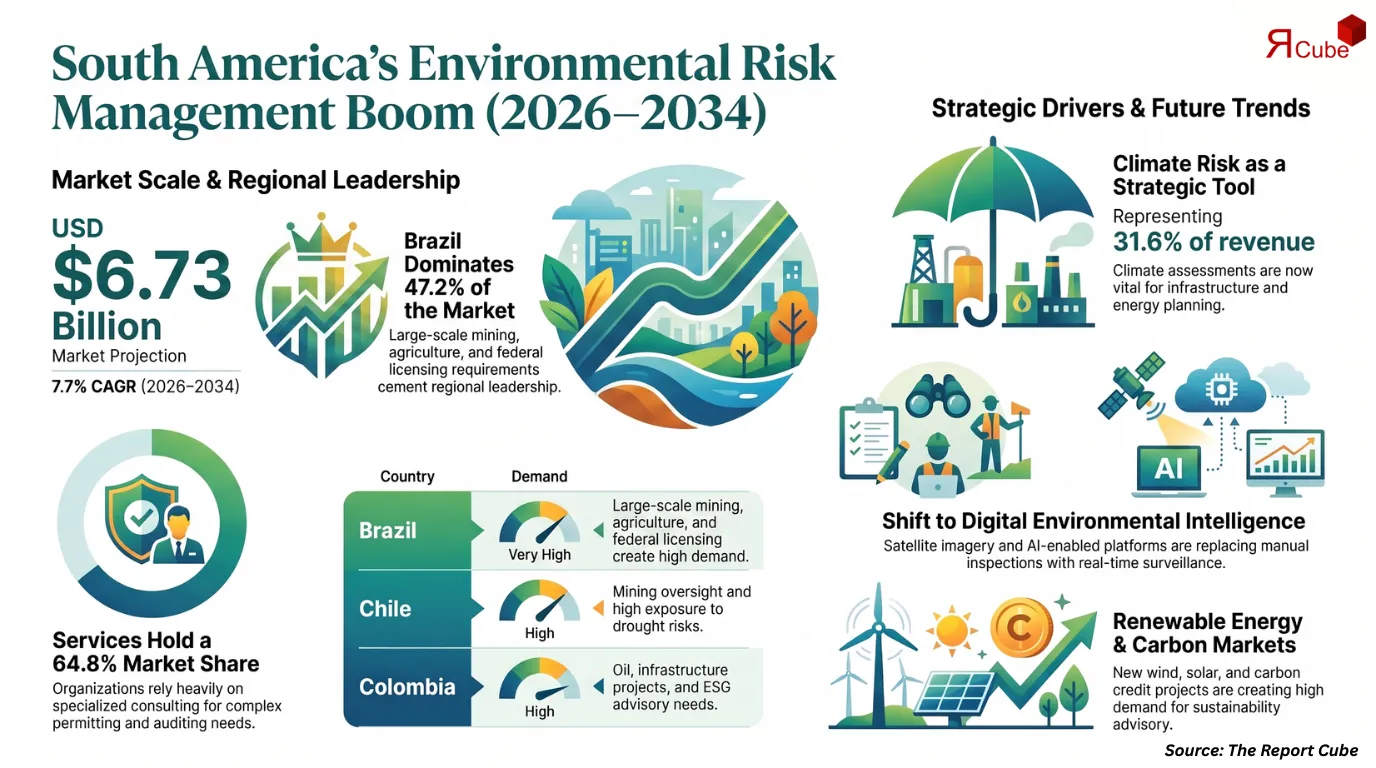
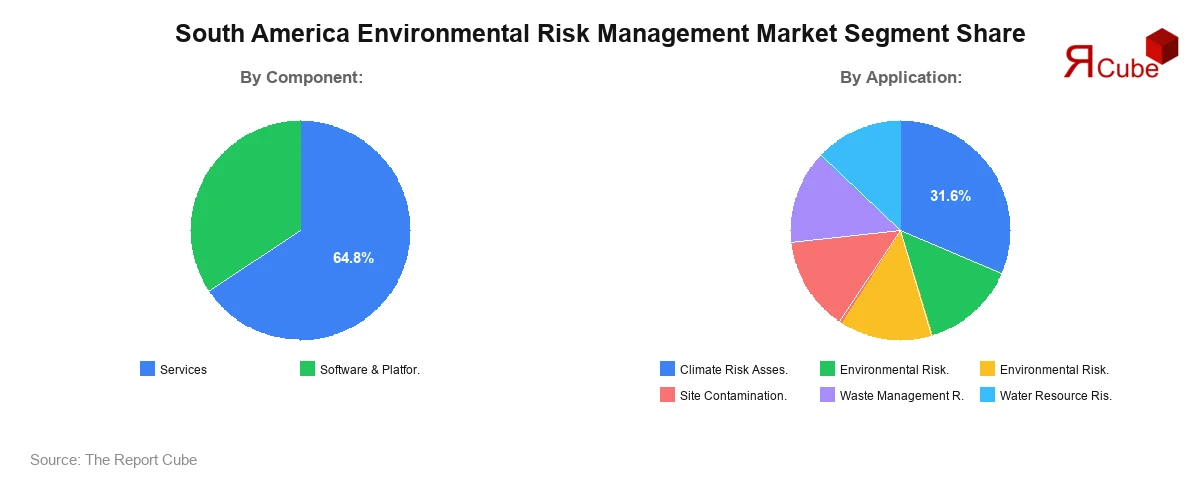
Services segment leads the market with approximately 64.8% share.
By Application:
Climate Risk Assessment dominates the market with nearly 31.6% of total revenue.
Countries Outlook:
Brazil dominates the South America Environmental Risk Management Market with around 47.2% market share.
South America Environmental Risk Management Market Insights & Analysis
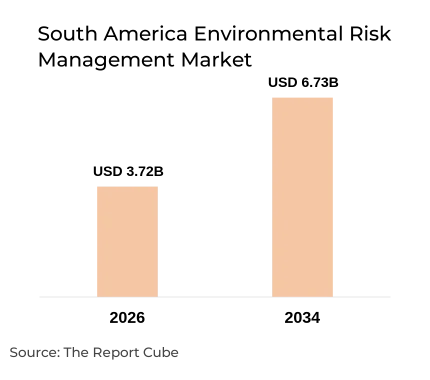
The South America Environmental Risk Management Market is anticipated to register a CAGR of around 7.7% during the forecast period 2026-2034. The market size is valued at USD 3.72 billion in 2026 and is projected to reach USD 6.73 billion by 2034. Industrial operators throughout South America are strengthening environmental governance as governments tighten permitting requirements and sustainability expectations continue to influence investment decisions. Environmental Risk Management has become an essential component of project planning across mining, oil and gas, chemicals, agriculture, transportation, and renewable energy sectors, where organizations must evaluate ecological impacts before expanding operations. Environmental Impact Assessment (EIA), Environmental Health and Safety (EHS) programs, and Environmental Hazard Management strategies are increasingly integrated into corporate risk frameworks to reduce environmental liabilities, improve regulatory compliance, and strengthen long-term operational resilience. Growing pressure from financial institutions and international investors to demonstrate measurable environmental performance is further encouraging organizations to adopt comprehensive environmental risk assessment solutions.
Public and private investments are accelerating the deployment of digital environmental monitoring technologies across South America. Brazil, Chile, Colombia, and Argentina continue to invest in sustainable infrastructure, biodiversity conservation, water resource protection, and climate adaptation programs that require continuous environmental monitoring and reporting. These initiatives are expanding opportunities for providers of Climate Risk Assessment platforms, environmental compliance software, remote sensing technologies, and consulting services. Organizations are increasingly combining satellite observations, geographic information systems, environmental monitoring networks, and cloud-based reporting platforms to improve decision-making and strengthen regulatory transparency. The growing integration of ESG reporting requirements with environmental risk management practices is also encouraging businesses to modernize compliance processes while improving environmental performance across complex industrial operations.
South America Environmental Risk Management Market Impact Analysis
| Factor | Type | Specific Impact on Market | Magnitude | Business Implication |
|---|---|---|---|---|
| Stricter Environmental Regulations | Regulatory | Tighter rules raise demand for compliance and audit services | High | Drives uptake of structured risk management and consulting tools |
| Growth in Renewable Energy Projects | Market | New wind and solar sites need detailed impact assessments | High | Expands advisory work for project risks and sustainability plans |
| Rising Pollution and Ecosystem Stress | Environmental | Higher health and ecosystem risks trigger monitoring demand | Medium | Supports services in risk assessment, remediation, and controls |
| Increasing Corporate Sustainability Commitments | Consumer | Companies adopt ESG goals that include environmental risk | Medium | Boosts need for integrated ERM frameworks and reporting support |
| Advances in Monitoring and Analytics | Technological | Use of sensors and data platforms improves risk detection | Medium | Enables proactive management and premium tech enabled services |
| Dependence on Specialist Consulting Firms | Competitive | Regional players shape standards and capture key projects | Medium | Encourages partnerships or niche focus to secure market share |
| Economic and Political Volatility | Environmental | Funding cycles and policy shifts affect project pipelines | Medium | Requires flexible service models and diversified client base |
South America Environmental Risk Management Market Dynamics
Key Driver: Strengthening Environmental Regulations and Corporate Sustainability Requirements
Environmental legislation continues to evolve across South America as governments reinforce natural resource protection while supporting responsible industrial development. Regulatory agencies have expanded environmental permitting requirements for mining, energy, transportation, construction, and manufacturing projects, making Environmental Impact Assessment (EIA) and Environmental Health and Safety (EHS) compliance essential throughout the project lifecycle. Organizations are conducting more detailed environmental baseline studies, contamination assessments, biodiversity evaluations, and water resource analyses before initiating new developments. These regulatory expectations have substantially increased demand for environmental consulting, environmental auditing, environmental monitoring, and environmental risk assessment services throughout the region.
Corporate sustainability strategies have become equally influential in shaping investment decisions. International lenders, export partners, institutional investors, and insurance providers increasingly evaluate environmental performance before financing industrial projects. Companies are responding by integrating Climate Risk Assessment and Environmental Hazard Management into enterprise risk management programs to identify operational vulnerabilities and strengthen long-term resilience. Continuous environmental monitoring, transparent sustainability reporting, and proactive compliance management have become important competitive advantages, contributing to sustained growth in the South America Environmental Risk Management Market.
Industry Trends: Digital Environmental Intelligence Supporting Risk-Based Decision Making
Environmental management practices across South America are becoming increasingly data-driven as organizations invest in technologies capable of delivering continuous environmental intelligence. Cloud-based monitoring platforms, satellite imagery, drone inspections, geographic information systems, and connected environmental sensors are replacing periodic manual inspections with real-time environmental surveillance. These technologies enable operators to detect pollution incidents, monitor ecosystem changes, evaluate air and water quality, and generate compliance reports with greater accuracy while reducing operational costs. Environmental monitoring platforms are also improving collaboration among consultants, regulators, and industrial operators by providing centralized access to verified environmental data.
Climate Risk Assessment has emerged as a strategic planning tool rather than simply a regulatory requirement. Energy developers, mining companies, agricultural producers, and infrastructure operators are increasingly evaluating long-term climate scenarios before making capital investment decisions. Advanced environmental analytics support flood risk mapping, drought forecasting, biodiversity conservation planning, and water resource management while strengthening business continuity planning. As digital technologies become more accessible across the region, organizations are expanding investments in integrated environmental software platforms capable of supporting Environmental Health and Safety (EHS), environmental reporting, and regulatory compliance within a unified operating framework.
Book your FREE 30-minute expert consultation today
Contact UsMajor Challenge: Uneven Regulatory Implementation and High Compliance Costs
Building comprehensive environmental risk management programs requires substantial financial and technical resources, particularly for organizations operating large industrial facilities or projects spanning multiple jurisdictions. Costs associated with environmental consulting, laboratory testing, continuous monitoring systems, remediation planning, environmental software implementation, and specialized compliance personnel remain significant for many businesses. Small and medium-sized enterprises often face greater financial limitations, delaying investments in advanced Environmental Hazard Management technologies and comprehensive environmental monitoring programs despite increasing regulatory obligations.
Differences in environmental governance across South American countries also create operational complexity for multinational organizations. Environmental permitting procedures, reporting standards, enforcement capacity, and compliance timelines vary considerably between jurisdictions, increasing administrative burdens for businesses operating regionally. In some developing markets, fragmented environmental datasets, limited technical infrastructure, and shortages of specialized environmental professionals can affect the consistency of Environmental Impact Assessment (EIA) processes and long-term monitoring activities. Strengthening regional cooperation and harmonizing environmental reporting standards will remain important for improving market efficiency over the coming years.
Opportunity: Expanding Investments in Climate Resilience and Sustainable Natural Resource Management
Public infrastructure modernization and ecological restoration initiatives are creating long-term opportunities for environmental risk management providers across South America. Governments are increasing investments in renewable energy, climate adaptation projects, watershed protection, sustainable mining, transportation infrastructure, and ecosystem restoration, all of which require comprehensive environmental assessments before implementation. Environmental consulting firms, monitoring technology providers, and compliance specialists are expected to benefit from increasing demand for Environmental Impact Assessment (EIA), site contamination studies, biodiversity monitoring, and environmental permitting support associated with these large-scale developments.
Carbon reduction initiatives and conservation finance programs are also expanding the commercial value of reliable environmental data throughout the region. Payment for ecosystem services, biodiversity conservation projects, carbon credit verification, and sustainable agriculture programs require continuous environmental monitoring, land-use assessments, and transparent compliance verification. As organizations increasingly recognize environmental information as a strategic business asset, demand is expected to grow for integrated Climate Risk Assessment platforms, Environmental Health and Safety (EHS) management systems, and Environmental Hazard Management solutions capable of supporting informed investment decisions and long-term environmental stewardship.
South America Environmental Risk Management Market Segment-wise Analysis
By Component:
- Services
- Environmental Auditing & Compliance
- Environmental Consulting & Engineering
- Environmental Due Diligence
- Environmental Monitoring
- Environmental Risk Assessment
- Environmental Testing & Laboratory Services
- ESG Advisory
- Remediation & Mitigation Planning
- Site Investigation
- Software & Platforms
- Climate Risk Analytics
- Environmental Compliance Software
- Environmental Monitoring Platforms
- Environmental Reporting Platforms
- Environmental Risk Analytics
- ESG Software with Environmental Risk Modules
The Services segment accounted for nearly 64.8% of the South America Environmental Risk Management Market in 2026, maintaining its leading position as organizations continue to rely on specialized environmental expertise to meet increasingly stringent regulatory requirements. Mining, oil and gas, construction, energy, agriculture, and manufacturing companies regularly engage environmental consultants for Environmental Impact Assessment (EIA), Environmental Health and Safety (EHS) compliance, environmental due diligence, site investigations, contamination studies, and remediation planning before initiating new projects or expanding existing operations. The growing complexity of environmental regulations across South America has also increased demand for independent auditing and compliance verification services.
Environmental consulting firms are expanding multidisciplinary capabilities by combining regulatory expertise with geospatial analysis, environmental monitoring, hydrogeological studies, biodiversity assessments, and sustainability advisory services. Large infrastructure projects, renewable energy developments, and critical mineral exploration activities require continuous environmental oversight throughout planning, construction, and operational phases, supporting sustained demand for professional services. Since many organizations still depend on experienced environmental specialists to interpret evolving regulations and prepare technical documentation, the services segment is expected to preserve its market leadership during the forecast period despite increasing adoption of digital environmental software platforms.
By Application:
- Climate Risk Assessment
- Environmental Risk Management Impact Assessment
- Environmental Risk Management Monitoring & Reporting
- Site Contamination Assessment & Remediation
- Waste Management Risk
- Water Resource Risk
Climate Risk Assessment represented approximately 31.6% of total market revenue in 2026, making it the largest application segment within the South America Environmental Risk Management Market. Rising exposure to prolonged droughts, severe flooding, changing precipitation patterns, wildfires, and extreme temperatures has encouraged organizations to integrate climate risk evaluation into investment planning and operational management. Infrastructure developers, mining companies, agricultural producers, utility providers, and financial institutions increasingly conduct climate vulnerability assessments to minimize operational disruptions while strengthening long-term business resilience. Growing climate disclosure obligations and sustainability reporting frameworks have further accelerated adoption across both public and private sectors.
Organizations are increasingly incorporating climate projections with environmental monitoring systems, satellite observations, hydrological models, and geographic information systems to support evidence-based decision-making. Climate Risk Assessment also plays an important role in identifying physical risks affecting transportation infrastructure, water resources, renewable energy assets, and industrial facilities exposed to changing environmental conditions. The growing emphasis on adaptation planning, disaster preparedness, and sustainable infrastructure investments throughout South America is expected to strengthen demand for climate risk assessment solutions as organizations seek to improve resilience while meeting evolving environmental governance and corporate sustainability objectives.
Regional Projection of South America Environmental Risk Management Industry
- Brazil
- Argentina
- Chile
- Colombia
Brazil accounted for approximately 47.2% of the South America Environmental Risk Management Market in 2026, supported by its extensive natural resources, large industrial base, and well-established environmental regulatory framework. The country maintains significant demand for Environmental Impact Assessment (EIA), Environmental Health and Safety (EHS) services, environmental monitoring, and Environmental Hazard Management across mining, agriculture, oil and gas, manufacturing, and infrastructure sectors. Federal environmental licensing requirements, combined with stricter oversight of deforestation, water resources, and industrial emissions, continue to encourage organizations to invest in advanced environmental risk management solutions. The expansion of renewable energy projects and sustainable mining initiatives has further strengthened market demand.
Government-backed conservation programs, biodiversity protection initiatives, and investments in environmental monitoring technologies continue to reinforce Brazil's leadership within the regional market. The growing adoption of satellite-based ecosystem monitoring, digital environmental compliance platforms, and climate resilience strategies is improving environmental governance while supporting more transparent regulatory enforcement. Brazil's expanding carbon market initiatives, ecosystem restoration projects, and sustainable finance programs are also generating new opportunities for environmental consulting firms and software providers. Although Chile, Argentina, and Colombia continue strengthening environmental regulations and sustainability investments, Brazil is expected to maintain its dominant regional position throughout the forecast period due to the scale of its industrial activities and environmental management requirements.
Need insights for a specific region within this market?
Request Regional DataSouth America Environmental Risk Management Market Country Analysis
South America environmental risk management demand is rising as regulation, climate events, and industrial compliance tighten.
| Country | Demand Level | Key Areas | System Dominance | Core Demand Logic | Growth Nature |
|---|---|---|---|---|---|
| Brazil | Very High | São Paulo, Minas Gerais, Rio de Janeiro | Cloud Platforms & Compliance Tools | Mining, agribusiness, and tighter licensing | Fastest scale-up; broad sector adoption |
| Argentina | Medium | Buenos Aires, Neuquén, Córdoba | Risk Audit & Due Diligence | Energy, agri-exports, and cost pressure | Recovery-led growth; selective project demand |
| Chile | High | Santiago, Antofagasta, Valparaíso | Monitoring, Audits & Water Risk Tools | Mining oversight and drought exposure | High-value growth; compliance-led expansion |
| Colombia | High | Bogotá, Medellín, Cartagena | Monitoring & ESG Advisory | Oil, infrastructure, and licensing needs | Steady growth; regulation and ESG support |
Government Initiatives & Policies
- Brazil Ecological Transformation Plan (2025): Brazil continues expanding its Ecological Transformation Plan to mobilize sustainable investments, strengthen environmental governance, encourage low-carbon industrial development, and improve biodiversity conservation while supporting climate resilience.
- Brazil Eco Invest Program (2026): The Eco Invest Program promotes private investment in environmental restoration, sustainable agriculture, carbon markets, and biodiversity protection through blended finance mechanisms that support long-term environmental sustainability projects.
South America Environmental Risk Management Industry Recent Developments
- 2026: Amazon Conservation launched the first edition of its Amazon Mining Watch Panorama, an AI-enabled quarterly monitoring platform designed to detect illegal mining activities across all nine Amazon countries using satellite imagery. The platform identified nearly 6,000 hectares of new mining scars during the final quarter of 2025, including around 2,000 hectares in Brazil. It also estimates the environmental and socio-economic costs associated with illegal mining, including deforestation, mercury contamination, and riverbank erosion. The solution strengthens cross-border environmental monitoring while supporting enforcement agencies with standardized evidence for investigations, regulatory actions, and environmental restoration initiatives.
- 2026: Agrotools secured financial backing through Brazil's Eco Invest Program to establish one of the world's largest Payment for Environmental Services (PES) platforms alongside a national low-carbon project platform. The initiative received BRL 80 million in catalytic funding and is expected to mobilize at least BRL 300 million in additional private investment. The platform enables landowners to receive market-based payments for preserving native vegetation while providing governments and businesses with verified environmental data, compliance monitoring, and land-use intelligence. The initiative is anticipated to significantly increase demand for environmental risk assessment, monitoring, and compliance verification services across Brazil.
Why Choose This Report?
- Provides a comprehensive overview of the overall market analysis, encompassing key trends, consumer behavior analysis, and risk assessment to support strategic decision-making.
- Provides accurate, up-to-date insights into market size, segmentation, and emerging opportunities, helping organizations minimize risks while capitalizing on future growth potential.
- Gives a deep understanding of target audience preferences, investment priorities, regulatory developments, and communication channels to strengthen product development and marketing strategies.
- Delivers competitive analysis and benchmarking, uncovering the strengths, business strategies, and market positioning of leading competitors operating across the regional market.
- Consolidates comprehensive market intelligence into a single report, reducing research efforts while improving business planning and investment decisions.
- Facilitates customized market segmentation and risk mitigation strategies that align with specific business objectives, operational priorities, and sustainability goals.
- Assists in identifying major market challenges, regulatory developments, and untapped opportunities that support sustainable long-term business growth.
- Provides valuable insights based on verified industry trends, environmental developments, investment activities, regulatory initiatives, and evolving customer requirements.
Table of Contents
- Introduction
- Objective of the Study
- Product and Category Definition
- Market Segmentation
- Study Variables
- Research Methodology
- Secondary Data Points
- Breakdown of Secondary Sources
- Primary Data Points
- Breakdown of Primary Interviews
- Secondary Data Points
- Executive Summary
- Market Dynamics
- Emerging Opportunities
- Adoption Trends
- Demand Drivers
- Disruption Analysis (Challenges)
- Industry Analysis & Strategic Insights
- Supply/Value Chain Analysis
- Pricing Analysis
- Go-To-Market (GTM) Strategy
- BCG Matrix
- Recent Trends and Developments
- Regulatory and Policy Landscape
- Region-wise Policies
- Government Initiatives
- South America Environmental Risk Management Market Overview and Forecast Analysis (2021-2034)
- Market Size, By Value, By Growth Rate (CAGR/USD Billion)
- Market Share, By Component
- Services
- Environmental Auditing & Compliance
- Environmental Consulting & Engineering
- Environmental Due Diligence
- Environmental Monitoring
- Environmental Risk Assessment
- Environmental Testing & Laboratory Services
- ESG Advisory
- Remediation & Mitigation Planning
- Site Investigation
- Software & Platforms
- Climate Risk Analytics
- Environmental Compliance Software
- Environmental Monitoring Platforms
- Environmental Reporting Platforms
- Environmental Risk Analytics
- ESG Software with Environmental Risk Modules
- Services
- Market Share, By Risk Type
- Climate & Physical Risk
- Environmental Contamination Risk
- Natural Resources & Biodiversity Risk
- Regulatory & Compliance Risk
- Water Resource Risk
- Market Share, By Deployment Mode
- Cloud-Based
- On-Premises
- Market Share, By Enterprise Size
- Large Enterprises
- Small & Medium Enterprises (SMEs)
- Market Share, By Application
- Climate Risk Assessment
- Environmental Risk Management Impact Assessment
- Environmental Risk Management Monitoring & Reporting
- Site Contamination Assessment & Remediation
- Waste Management Risk
- Water Resource Risk
- Market Share, By End-Use Industry
- Agriculture & Forestry
- Chemicals & Petrochemicals
- Construction & Infrastructure
- Energy & Utilities
- Government & Public Sector
- Manufacturing
- Mining & Metals
- Oil & Gas
- Transportation & Logistics
- Others
- Market Share, By Region
- Brazil
- Argentina
- Chile
- Colombia
- Market Share, By Company
- Revenue Shares & Analysis
- Competitive Landscape
- Brazil Environmental Risk Management Market Overview and Forecast Analysis (2021-2034)
- Market Size, By Value, By Growth Rate (CAGR/USD Billion/Million)
- Market Share, By Component
- Market Share, By Risk Type
- Market Share, By Deployment Mode
- Market Share, By Enterprise Size
- Market Share, By Application
- Market Share, By End-Use Industry
- Argentina Environmental Risk Management Market Overview and Forecast Analysis (2021-2034)
- Market Size, By Value, By Growth Rate (CAGR/USD Billion/Million)
- Market Share, By Component
- Market Share, By Risk Type
- Market Share, By Deployment Mode
- Market Share, By Enterprise Size
- Market Share, By Application
- Market Share, By End-Use Industry
- Chile Environmental Risk Management Market Overview and Forecast Analysis (2021-2034)
- Market Size, By Value, By Growth Rate (CAGR/USD Billion/Million)
- Market Share, By Component
- Market Share, By Risk Type
- Market Share, By Deployment Mode
- Market Share, By Enterprise Size
- Market Share, By Application
- Market Share, By End-Use Industry
- Colombia Environmental Risk Management Market Overview and Forecast Analysis (2021-2034)
- Market Size, By Value, By Growth Rate (CAGR/USD Billion/Million)
- Market Share, By Component
- Market Share, By Risk Type
- Market Share, By Deployment Mode
- Market Share, By Enterprise Size
- Market Share, By Application
- Market Share, By End-Use Industry
- Competitive Analysis, 2026
- Market Share of Key Players
- Competitive Mapping for Each Component, Risk Type, Deployment Mode, Enterprise Size, Application, and End-Use Industry
- Brazil Environmental Risk Management Companies Share & Competitive Analysis, 2026
- Argentina Environmental Risk Management Companies Share & Competitive Analysis, 2026
- Chile Environmental Risk Management Companies Share & Competitive Analysis, 2026
- Colombia Environmental Risk Management Companies Share & Competitive Analysis, 2026
- Company Profile (Partial List)
- SLR Consulting
- Company Overview
- Product Portfolio
- Strategic Alliances/Partnerships
- Recent Developments
- Arcadis N.V.
- Company Overview
- Product Portfolio
- Strategic Alliances/Partnerships
- Recent Developments
- Geoambiente S.A.
- Company Overview
- Product Portfolio
- Strategic Alliances/Partnerships
- Recent Developments
- Jacobs Solutions Inc.
- Company Overview
- Product Portfolio
- Strategic Alliances/Partnerships
- Recent Developments
- Wood plc
- Company Overview
- Product Portfolio
- Strategic Alliances/Partnerships
- Recent Developments
- Tetra Tech, Inc.
- Company Overview
- Product Portfolio
- Strategic Alliances/Partnerships
- Recent Developments
- Environmental Resources Management (ERM)
- Company Overview
- Product Portfolio
- Strategic Alliances/Partnerships
- Recent Developments
- Ambipar Group
- Company Overview
- Product Portfolio
- Strategic Alliances/Partnerships
- Recent Developments
- Stantec Inc.
- Company Overview
- Product Portfolio
- Strategic Alliances/Partnerships
- Recent Developments
- WSP Global Inc.
- Company Overview
- Product Portfolio
- Strategic Alliances/Partnerships
- Recent Developments
- Ramboll Group A/S
- Company Overview
- Product Portfolio
- Strategic Alliances/Partnerships
- Recent Developments
- AECOM
- Company Overview
- Product Portfolio
- Strategic Alliances/Partnerships
- Recent Developments
- Others (Partial List)
- SLR Consulting
- Contact Us and Disclaimer
Top Key Players & Market Share Outlook
- SLR Consulting
- Arcadis N.V.
- Geoambiente S.A.
- Jacobs Solutions Inc.
- Wood plc
- Tetra Tech, Inc.
- Environmental Resources Management (ERM)
- Ambipar Group
- Stantec Inc.
- WSP Global Inc.
- Ramboll Group A/S
- AECOM
- Others
Frequently Asked Questions






