




Build Your Custom Market Intelligence Report
Customize Your ReportUnited Kingdom (UK) Equipment Rental Market Insights & Analysis
The United Kingdom (UK) Equipment Rental Market is anticipated to register a CAGR of 3.50% during 2026-2034. The market size was valued at USD 11.5 billion in 2025 and is projected to reach USD 15.67 billion by 2034. The UK equipment rental industry plays a critical role in supporting infrastructure development, commercial construction, and industrial activity by providing flexible access to high-value machinery without the burden of ownership. This rental-led approach has become increasingly attractive as businesses focus on capital efficiency, operational flexibility, and risk mitigation.
Market growth is closely tied to sustained construction activity across residential, commercial, and public infrastructure projects. Large-scale investments in transport modernization, renewable energy installations, and urban redevelopment continue to generate steady demand for earthmoving, lifting, and access equipment. Additionally, contractors are increasingly adopting rental solutions to manage fluctuating project timelines and labor availability, ensuring optimal equipment utilization without long-term financial commitments.
Technological advancements and sustainability considerations are also reshaping the competitive landscape. Rental companies are expanding fleets with electric and hybrid equipment to meet stricter emissions standards and customer sustainability goals. Digital fleet management, telematics, and predictive maintenance are improving asset utilization and reducing downtime, strengthening the market’s long-term growth outlook through 2034.
United Kingdom (UK) Equipment Rental Market Recent Developments
- 2025: Sunbelt UK expanded its electric equipment fleet to support low-emission construction projects nationwide.
- 2025: Speedy Hire launched an advanced fleet analytics platform to optimize equipment availability and utilization.
Government Initiatives & Policies
- UK Net Zero Strategy: Supports adoption of low-emission construction equipment across infrastructure projects.
- National Infrastructure Strategy: Drives long-term investment in transport, energy, and public works.
United Kingdom (UK) Equipment Rental Market Dynamics
Key Driver: Rising Infrastructure and Construction Activity Across the UK
The primary driver of the UK equipment rental market is the steady increase in infrastructure and construction activity. Public and private sector investments in road upgrades, rail electrification, renewable energy facilities, and housing developments are sustaining consistent demand for rented machinery. Equipment rental allows contractors to scale operations quickly while managing capital expenditure efficiently. Approximately 65% of medium-sized construction firms in the UK prefer renting equipment over purchasing, reflecting a strong structural shift toward asset-light business models. This preference is further reinforced by rising equipment prices and the need for compliance with evolving safety and emissions regulations.

Book your FREE 30-minute expert consultation today
Contact UsIndustry Trends: Shift Toward Sustainable and Digitally Enabled Rental Fleets
Sustainability and digitalization are defining key industry trends within the UK equipment rental market. Rental providers are increasingly investing in electric and hybrid machinery, particularly for urban construction projects subject to low-emission zones. Electric aerial platforms and material handling equipment are witnessing double-digit growth in rental demand. Simultaneously, digital platforms for booking, fleet tracking, and predictive maintenance are enhancing customer experience and operational efficiency. These technologies reduce idle time, improve asset lifespan, and enable data-driven decision-making, positioning leading rental firms for competitive advantage.
Major Challenge: High Fleet Investment and Maintenance Costs
Despite positive demand fundamentals, high capital requirements for fleet acquisition and maintenance remain a significant challenge. Advanced equipment with low-emission technologies commands premium pricing, increasing upfront investment for rental companies. Additionally, ongoing maintenance, compliance checks, and skilled technician requirements add to operational costs. Smaller rental providers face margin pressure as they compete with larger players that benefit from scale economies. Economic uncertainty and fluctuating construction cycles further complicate investment planning, making cost control a critical success factor.
Opportunity: Growth in Long-Term and Project-Based Rental Models
The increasing adoption of long-term and project-based rental agreements presents a strong growth opportunity. Large infrastructure and industrial projects favor predictable, long-duration equipment supply arrangements that reduce administrative complexity and ensure availability. These models provide rental companies with stable revenue streams and improved fleet planning visibility. As the UK advances major transport, energy, and housing initiatives, demand for customized rental solutions tailored to project timelines is expected to rise, supporting sustained market expansion through 2034.
United Kingdom (UK) Equipment Rental Market Segment-wise Analysis
By Equipment Type:
- Earthmoving Equipment
- Material Handling
- Road Construction
- Aerial Platforms
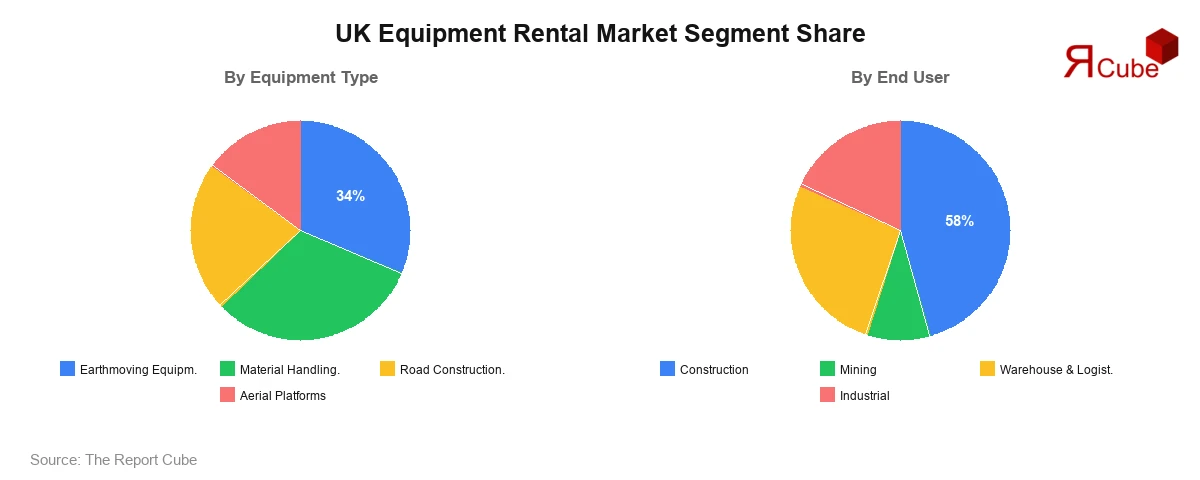
Earthmoving equipment dominates the UK equipment rental market, accounting for approximately 34% of total rental revenue in 2025. This leadership is driven by continuous demand from large-scale infrastructure and housing projects requiring excavators, loaders, and dumpers. High utilization rates and frequent replacement cycles make earthmoving equipment well-suited for rental models. Aerial platforms follow closely, supported by maintenance, industrial, and commercial construction activities, particularly in urban environments.
By End User:
- Construction
- Mining
- Warehouse & Logistics
- Industrial
The construction sector remains the largest end user, contributing nearly 58% of market demand. Ongoing residential developments, commercial projects, and public infrastructure investments sustain consistent rental requirements. Warehouse and logistics applications are also expanding, driven by e-commerce growth and increased demand for material handling equipment. Industrial users favor rental solutions to manage maintenance shutdowns and short-term capacity needs efficiently.
Regional Projection of United Kingdom (UK) Equipment Rental Industry
- England
- Scotland
- Wales
- Northern Ireland
England leads the UK equipment rental market, accounting for approximately 72% of total market share in 2025. The region benefits from concentrated construction activity, large infrastructure projects, and a dense industrial base. London and the South East remain key demand centers, supported by commercial development and transport upgrades. While England dominates, Scotland and Wales are experiencing steady growth driven by renewable energy projects and regional infrastructure investment.
Need insights for a specific region within this market?
Request Regional DataWhy Choose This Report?
- Provides a comprehensive overview of the overall market analysis, encompassing key trends, consumer behavior analysis, and risk assessment to support strategic decision-making.
- Provides accurate, up-to-date insights into market size, segmentation, and emerging opportunities, helping to minimize risk & capitalizing on growth.
- Gives deep understanding of target audience preferences, investment habits, and communication channels for enhanced product development & marketing effectiveness.
- Delivers competitive analysis & benchmarking, uncovering the strengths & weaknesses of market competitors to guide strategies.
- Consolidate comprehensive market intelligence, reducing reasoning & streamlining research efforts.
- Facilitates customized market segmentation & risk mitigation strategies, fine-tuned to the business objectives.
- Aids in identifying both market challenges & untapped opportunities within the industry to drive long-term business growth.
- Provides valuable information based on actual customer data & search trends.
Table of Contents
- Introduction
- Objective of the Study
- Product and Category Definition
- Market Segmentation
- Study Variables
- Research Methodology
- Secondary Data Points
- Breakdown of Secondary Sources
- Primary Data Points
- Breakdown of Primary Interviews
- Secondary Data Points
- Executive Summary
- Market Dynamics
- Drivers
- Challenges
- Opportunity Assessment
- Recent Trends and Developments
- Regulatory and Policy Landscape
- United Kingdom Equipment Rental Market Overview (2020-2034)
- Market Size, By Value (GBP Billion)
- Market Share, By Equipment Type
- Earthmoving Equipment
- Material Handling
- Road Construction
- Aerial Platforms
- Other Equipment
- Market Share, By End User
- Construction
- Mining
- Warehouse & Logistics
- Industrial
- Others
- Market Share, By Rental Model
- Short-Term Rental
- Long-Term Rental
- Project-Based Rental
- Market Share, By Power Source
- Diesel Equipment
- Electric Equipment
- Hybrid Equipment
- Market Share, By Region
- England
- Scotland
- Wales
- Northern Ireland
- Market Share, By Company
- Competition Characteristics
- Revenue Shares & Analysis
- England Equipment Rental Market
- Market Size, By Value (GBP Billion)
- Market Share, By Equipment Type
- Market Share, By End User
- Market Share, By Rental Model
- Market Share, By Power Source
- Scotland Equipment Rental Market
- Market Size, By Value (GBP Billion)
- Market Share, By Equipment Type
- Market Share, By End User
- Market Share, By Rental Model
- Market Share, By Power Source
- Wales Equipment Rental Market
- Market Size, By Value (GBP Billion)
- Market Share, By Equipment Type
- Market Share, By End User
- Market Share, By Rental Model
- Market Share, By Power Source
- Northern Ireland Equipment Rental Market
- Market Size, By Value (GBP Billion)
- Market Share, By Equipment Type
- Market Share, By End User
- Market Share, By Rental Model
- Market Share, By Power Source
- Competitive Outlook and Company Profiles
- Ashtead Group (Sunbelt)
- Company Overview
- Equipment Portfolio
- Strategic Alliances/Partnerships
- Recent Developments
- Speedy Hire
- Company Overview
- Equipment Portfolio
- Strategic Alliances/Partnerships
- Recent Developments
- HSS Hire
- Company Overview
- Equipment Portfolio
- Strategic Alliances/Partnerships
- Recent Developments
- GAP Group
- Company Overview
- Equipment Portfolio
- Strategic Alliances/Partnerships
- Recent Developments
- Boels Rental
- Company Overview
- Equipment Portfolio
- Strategic Alliances/Partnerships
- Recent Developments
- Loxam (Nationwide Platforms)
- Company Overview
- Equipment Portfolio
- Strategic Alliances/Partnerships
- Recent Developments
- Ainscough Crane Hire
- Company Overview
- Equipment Portfolio
- Strategic Alliances/Partnerships
- Recent Developments
- Flannery Plant Hire
- Company Overview
- Equipment Portfolio
- Strategic Alliances/Partnerships
- Recent Developments
- Briggs Equipment
- Company Overview
- Equipment Portfolio
- Strategic Alliances/Partnerships
- Recent Developments
- Riwal UK
- Company Overview
- Equipment Portfolio
- Strategic Alliances/Partnerships
- Recent Developments
- Others
- Ashtead Group (Sunbelt)
- Contact Us and Disclaimer
Top Key Players & Market Share Outlook
- Ashtead Group (Sunbelt)
- Speedy Hire
- HSS Hire
- GAP Group
- Boels Rental
- Loxam (Nationwide Platforms)
- Ainscough Crane Hire
- Flannery Plant Hire
- Briggs Equipment
- Riwal UK
- Others
Frequently Asked Questions