


Build Your Custom Market Intelligence Report
Customize Your ReportIndia Fine Jewelry Market Key Highlights
By Product Type:
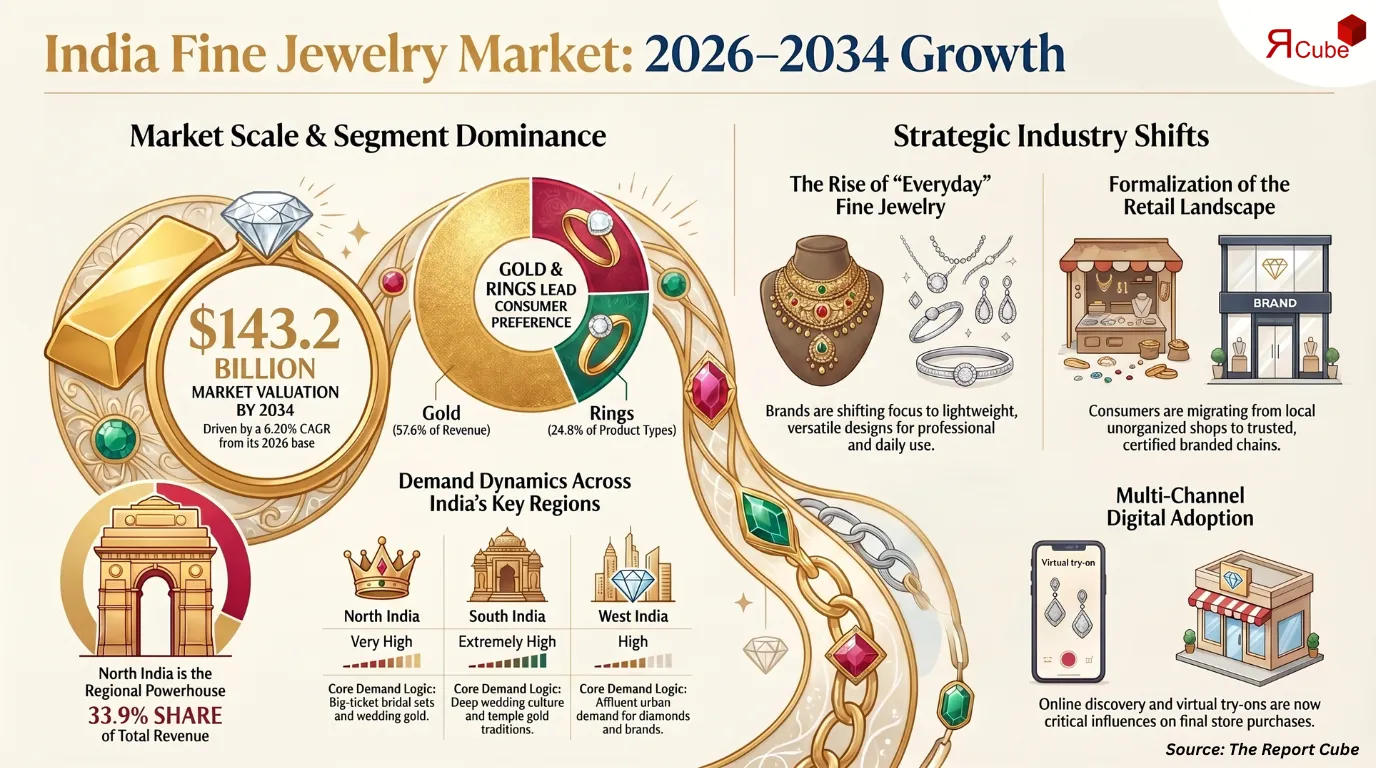
Rings segment leads the market with nearly 24.8% share.
By Material Type:
Gold segment dominates the market with around 57.6% of revenue.
Regional Outlook:
North India region dominates the India Fine Jewelry market with approximately 33.9% share.
India Fine Jewelry Market Insights & Analysis
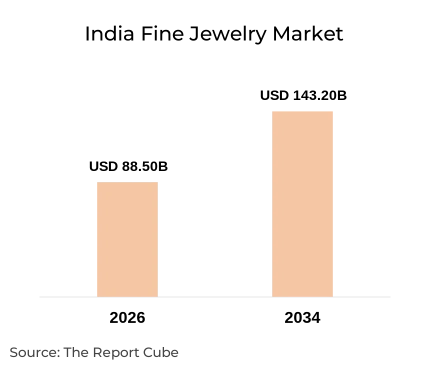
The India Fine Jewelry Market is anticipated to register a CAGR of around 6.20% during the forecast period 2026-2034. The market size is valued at USD 88.50 billion in 2026 and is projected to reach USD 143.20 billion by 2034. The growth of the market is being shaped by the country's evolving consumption patterns, increasing household wealth, and the continued cultural significance of fine jewelry. India remains one of the largest global markets for gold and diamond jewelry, with wedding-related purchases accounting for a substantial portion of annual sales. However, the industry is increasingly witnessing demand beyond ceremonial occasions as consumers invest in lightweight, versatile jewelry suitable for professional and daily use. This shift is particularly evident among urban millennials and working women who view jewelry as a combination of fashion, personal expression, and long-term value.
The market landscape is becoming increasingly organized, supported by the expansion of established retailers such as Titan, Kalyan Jewellers, Malabar Gold & Diamonds, Joyalukkas, and Senco Gold. Leading brands are investing heavily in product innovation, certification, digital commerce, and transparent pricing models to strengthen consumer trust. The launch of Tanishq's Hues gemstone collection, the expansion of lab-grown diamond retail formats, and the introduction of affordable fine jewelry ranges demonstrate how brands are responding to changing consumer preferences. In parallel, government-backed hallmarking initiatives and growing awareness of certified products are encouraging a gradual shift from unorganized purchases toward branded retail channels, supporting sustainable long-term market growth.
India Fine Jewelry Market Impact Analysis
| Factor | Type | Specific Impact on Market | Magnitude | Business Implication |
|---|---|---|---|---|
| Rising Affluent and Middle Class | Market | Higher disposable income lifts demand for branded fine jewelry | High | Supports premium collections and wider nationwide store rollout |
| Shift Toward Light Trendy Designs | Consumer | Customers favor everyday wearable pieces over heavy sets | High | Requires design refresh with lightweight contemporary assortments |
| Formalization and Branded Retail Growth | Competitive | Organized chains gain share over fragmented unorganized players | High | Encourages expansion of omni channel formats and loyalty programs |
| Gold Price Volatility and Investment Demand | Market | Price swings influence purchase timing and ticket size decisions | Medium | Drives focus on value engineered designs and exchange schemes |
| Policy Support and Export Opportunities | Regulatory | Trade agreements enhance export potential for fine jewelry | Medium | Opens scope for export focused lines and global partnerships |
| Digital Commerce and Omni Channel Adoption | Technological | Online discovery and purchase influence brand consideration | High | Necessitates strong ecommerce, virtual tryons and digital CRM |
| Ethical Sourcing and Trust Assurance | Environmental | Growing awareness on authenticity and responsible sourcing | Medium | Needs certification led branding and transparent provenance |
India Fine Jewelry Market Dynamics
Key Driver: Expanding Wedding Economy and Premium Jewelry Spending
The strongest growth catalyst for the India Fine Jewelry Market remains the country's large and resilient wedding economy. Jewelry continues to occupy a central position in wedding expenditure across regions, communities, and income groups. Gold jewelry is widely regarded as both a cultural asset and a store of wealth, making it one of the most important components of bridal purchases. In metropolitan areas, consumers are increasingly allocating larger budgets toward diamond engagement rings, customized bridal sets, and designer collections. Premium wedding packages offered by leading jewelry retailers have further strengthened spending across high-value product categories.
Beyond weddings, rising disposable income has increased spending on aspirational luxury products among urban households. Consumers are progressively shifting from unbranded jewelry toward certified and branded collections that provide greater transparency, exchange value, and product assurance. This transition has improved revenue realization for organized retailers while supporting higher average transaction values. The growing presence of premium shopping malls, luxury retail destinations, and digital jewelry platforms is further enhancing accessibility to fine jewelry products across Tier I and Tier II cities.
Industry Trends: Everyday Fine Jewelry and Gemstone Diversification
A notable trend reshaping the India Fine Jewelry Market is the movement toward everyday fine jewelry collections. Traditionally, jewelry purchases were concentrated around weddings and festivals. However, manufacturers are now developing lightweight necklaces, rings, earrings, bracelets, and chains designed for routine wear. Collections such as Malabar's ZOUL and similar offerings from leading brands reflect growing demand for practical, fashion-oriented jewelry with lower entry price points. This strategy enables retailers to increase purchase frequency rather than relying solely on seasonal demand cycles.
The market is also witnessing greater diversification into natural gemstones and premium colored stone jewelry. Historically, gemstone jewelry represented a relatively small share of organized retail sales due to concerns regarding authenticity and quality grading. Recent launches from major brands have addressed these concerns through certification, transparent sourcing practices, and standardized pricing structures. As a result, gemstone jewelry is emerging as an attractive category for consumers seeking differentiation beyond traditional gold and diamond products. This trend is expected to contribute meaningfully to future India Fine Jewelry Market share expansion.
Book your FREE 30-minute expert consultation today
Contact UsMajor Challenge: Precious Metal Price Volatility and Affordability Constraints
Price volatility remains one of the most significant challenges facing jewelry manufacturers and retailers across India. International gold prices have remained elevated due to geopolitical uncertainty, central bank purchases, and fluctuations in global financial markets. Since gold constitutes the primary raw material for a large proportion of fine jewelry products, sustained price increases directly affect retail pricing and consumer affordability. Smaller purchases and delayed buying decisions often become more common during periods of sharp price appreciation.
Jewelry companies are responding by introducing lightweight collections, lower carat-weight products, and flexible purchase programs. Nevertheless, prolonged increases in precious metal prices can impact demand within middle-income consumer segments. Manufacturers also face pressure from inventory management costs, working capital requirements, and margin fluctuations. These challenges are particularly relevant for businesses operating within highly competitive markets where pricing flexibility remains limited. Maintaining profitability while preserving affordability will remain a critical strategic priority throughout the forecast period.
Opportunity: Organized Retail Penetration and Branded Jewelry Adoption
One of the largest opportunities within the India Fine Jewelry Market lies in the continued migration from unorganized retailers toward branded jewelry chains. Although local jewelers still maintain a substantial presence across the country, consumers increasingly prioritize trust, certification, transparent pricing, and structured exchange policies when making high-value purchases. Organized retailers have successfully leveraged these advantages to expand market share in both metropolitan and emerging urban centers.
In addition, omni-channel retail models are creating new avenues for customer acquisition and engagement. Consumers now research collections online before completing purchases in physical stores, while virtual consultations and digital catalogs have improved product accessibility. The expansion of branded jewelry networks into Tier II and Tier III cities is expected to unlock significant untapped demand. Combined with growing interest in diamond, platinum, and gemstone jewelry, this trend positions organized retailers to capture a larger share of industry revenue over the coming decade.
India Fine Jewelry Market Segment-wise Analysis
By Product Type:
- Earrings
- Chains
- Bangles & Bracelets
- Necklaces
- Rings
- Others
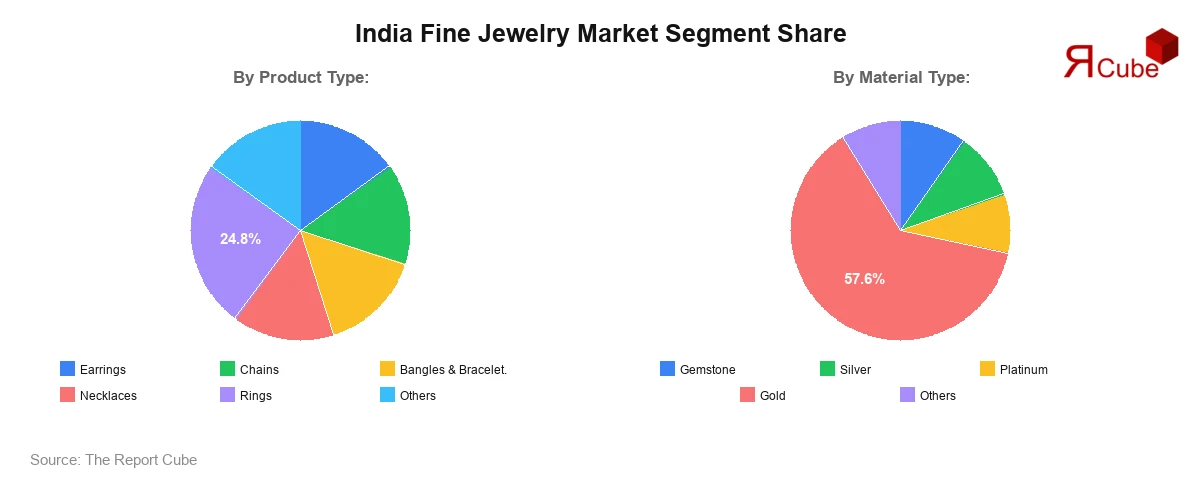
Rings account for the largest share of the India Fine Jewelry Market, contributing approximately 24.8% of total revenue in 2026. The segment benefits from strong demand across engagement ceremonies, weddings, anniversaries, gifting occasions, and self-purchase categories. Diamond engagement rings have witnessed particularly strong adoption among younger consumers in urban India, supported by changing lifestyle preferences and rising disposable income. Leading jewelry brands continue to expand ring portfolios through customization services, solitaire collections, and gemstone-enhanced designs that cater to diverse consumer tastes.
The segment has also benefited from the growth of organized retail and e-commerce channels, which provide wider product visibility and transparent pricing. Compared with larger jewelry items, rings typically require lower investment values, making them more accessible to first-time buyers. Their versatility and suitability for daily wear further support recurring purchases. As fine jewelry increasingly becomes a lifestyle-oriented category, rings are expected to maintain their leadership position throughout the forecast period.
By Material Type:
- Gemstone
- Silver
- Platinum
- Gold
- Others
Gold continues to dominate the India Fine Jewelry Market, accounting for approximately 57.6% of total revenue. The metal retains unparalleled cultural significance across Indian households and remains closely associated with weddings, festivals, inheritance, and long-term wealth preservation. Gold jewelry purchases often serve dual purposes as adornment and financial security, making demand relatively resilient even during periods of economic uncertainty.
The segment is increasingly evolving through innovative product development rather than volume growth alone. Jewelry manufacturers are introducing lightweight designs, contemporary collections, and daily-wear products to appeal to younger consumers who prioritize affordability and style. Organized retailers are also leveraging hallmarking compliance and purity certification to strengthen consumer trust. While diamonds, platinum, and gemstones continue to gain popularity, gold is expected to remain the foundation of India's fine jewelry industry due to its deep-rooted cultural acceptance and investment value.
Regional Projection of India Fine Jewelry Industry
- North India
- South India
- East India
- West India
North India represents the largest regional market, accounting for approximately 33.9% of India Fine Jewelry Market revenue. The region benefits from a high concentration of wedding expenditure, strong urban purchasing power, and extensive retail infrastructure. Major consumption centers including Delhi NCR, Jaipur, Chandigarh, Lucknow, and surrounding cities generate significant demand for gold, diamond, and bridal jewelry collections. Consumer spending patterns in North India often favor elaborate wedding sets and premium jewelry purchases, supporting higher average transaction values compared with several other regions.
Organized jewelry retailers continue to strengthen their presence across the region through showroom expansion and localized product offerings. Demand for certified diamonds, natural gemstones, and designer bridal collections has increased steadily among affluent consumers. Additionally, growing adoption of lightweight and everyday fine jewelry among working professionals is creating a complementary demand stream beyond traditional ceremonial purchases. These factors collectively position North India as the leading regional contributor to market revenue through 2034.
Need insights for a specific region within this market?
Request Regional DataIndia Fine Jewelry Market Regional Analysis
The India fine jewelry market is shaped by regional culture, income, and wedding-led gold demand across urban and tier-2/3 cities [web:2156][web:2161][web:2166].
| Region | Demand Level | Key Areas | System Dominance | Core Demand Logic | Growth Nature |
|---|---|---|---|---|---|
| North India | Very High | Delhi, Jaipur, Lucknow | Wedding gold & polki sets | Big-ticket bridal and gifting | Upgrade and premium growth |
| South India | Extremely High | Chennai, Hyderabad, Kochi | Temple gold and wedding sets [web:2155][web:2159] | Deep wedding and festival culture | Fastest regional volume growth |
| West India | High | Mumbai, Surat, Ahmedabad | Diamond and branded fine jewelry [web:2157][web:2160] | Affluent urban and NRI demand | Brand-led value expansion |
| East India | Medium | Kolkata, Bhubaneswar, Guwahati | Traditional gold and lightweight sets [web:2156] | Rural gold savings and rituals | Steady, festival-led growth |
| Central India | Medium | Indore, Bhopal, Raipur | Value gold and modern designs [web:2161][web:2166] | Rising middle class and tier-2 demand | Emerging organized retail growth |
Government Initiatives & Policies
- Mandatory Gold Hallmarking Expansion (2025-2026): The Government of India and BIS continued expanding mandatory hallmarking coverage, strengthening product authenticity, consumer protection, and transparency across the jewelry industry.
- Maharashtra Gems & Jewellery Policy 2025: The policy aims to attract investments, support manufacturing clusters, develop skilled talent, and improve infrastructure across the gems and jewelry value chain.
India Fine Jewelry Industry Recent Developments
- 2026: Tanishq launched its ‘Hues’ collection featuring 100% natural colored gemstones set in 18KT gold. The collection expands the brand’s presence within the gemstone jewelry segment while addressing growing consumer demand for certified, design-focused, and lifestyle-oriented fine jewelry products.
- 2026: Sennes opened its first exclusive lab-grown diamond store in Noida. The new retail format combines jewelry with lifestyle products, strengthening consumer accessibility and supporting broader adoption of lab-grown diamond offerings among urban consumers.
- 2026: Malabar Gold & Diamonds introduced the ZOUL collection featuring lightweight natural diamond jewelry in 14KT and 18KT gold. The launch targets everyday wear consumers and reflects rising demand for accessible premium jewelry across younger demographic groups.
Why Choose This Report?
- Provides a comprehensive overview of the overall market analysis, encompassing key trends, consumer behavior analysis, and risk assessment to support strategic decision-making.
- Provides accurate, up-to-date insights into market size, segmentation, and emerging opportunities, helping to minimize risk & capitalizing on growth.
- Gives deep understanding of target audience preferences, investment habits, and communication channels for enhanced product development & marketing effectiveness.
- Delivers competitive analysis & benchmarking, uncovering the strengths & weaknesses of market competitors to guide strategies.
- Consolidate comprehensive market intelligence, reducing reasoning & streamlining research efforts.
- Facilitates customized market segmentation & risk mitigation strategies, fine-tuned to the business objectives.
- Aids in identifying both market challenges & untapped opportunities within the industry to drive long-term business growth.
- Provides valuable information based on actual customer data & search trends.
Table of Contents
- Introduction
- Objective of the Study
- Product and Category Definition
- Market Segmentation
- Study Variables
- Research Methodology
- Secondary Data Points
- Breakdown of Secondary Sources
- Primary Data Points
- Breakdown of Primary Interviews
- Secondary Data Points
- Executive Summary
- Market Dynamics
- Emerging Opportunities
- Adoption Trends
- Demand Drivers
- Disruption Analysis (Challenges)
- Industry Analysis & Strategic Insights
- Supply/Value Chain Analysis
- Pricing Analysis
- Go-To-Market (GTM) Strategy
- BCG Matrix
- Recent Trends and Developments
- Import and Export Analysis
- Regulatory and Policy Landscape
- Region-wise Policies
- Government Initiatives
- India Fine Jewelry Market Overview and Forecast Analysis (2021-2034)
- Market Size, By Value, By Growth Rate (CAGR/USD Billion)
- Market Share, By Product Type
- Earrings
- Chains
- Bangles & Bracelets
- Necklaces
- Rings
- Others
- Market Share, By Material Type
- Gemstone
- Silver
- Platinum
- Gold
- Others
- Market Share, By Manufacturing Type
- Outsourced
- In House
- Market Share, By Manufacturing Process Type
- Machine Made
- Handmade
- Market Share, By Occasion
- Wedding Wear
- Earrings
- Chains
- Necklaces
- Rings
- Bangles
- Others
- Other Occasions
- Chains
- Bangles
- Rings
- Earrings
- Necklaces
- Others
- Daily Wear
- Necklaces
- Bangles
- Chains
- Rings
- Earrings
- Others
- Wedding Wear
- Market Share, By Market Type
- Unorganized
- Organized
- Market Share, By Price Range
- Luxury (Above USD 650)
- Economy (Up to USD 150)
- Mid-Tier (USD 151 - USD 650)
- Market Share, By Distribution Channel
- Online
- Offline
- Independent Jewelers
- Brand Outlets
- Multibrand Outlets
- Others
- Market Share, By Company
- Revenue Shares & Analysis
- Competitive Landscape
- North India Fine Jewelry Market Overview and Forecast Analysis (2021-2034)
- Market Size, By Value, By Growth Rate (CAGR/USD Billion/Million)
- Market Share, By Product Type
- Market Share, By Material Type
- Market Share, By Manufacturing Type
- Market Share, By Manufacturing Process Type
- Market Share, By Occasion
- Market Share, By Market Type
- Market Share, By Price Range
- Market Share, By Distribution Channel
- South India Fine Jewelry Market Overview and Forecast Analysis (2021-2034)
- Market Size, By Value, By Growth Rate (CAGR/USD Billion/Million)
- Market Share, By Product Type
- Market Share, By Material Type
- Market Share, By Manufacturing Type
- Market Share, By Manufacturing Process Type
- Market Share, By Occasion
- Market Share, By Market Type
- Market Share, By Price Range
- Market Share, By Distribution Channel
- West India Fine Jewelry Market Overview and Forecast Analysis (2021-2034)
- Market Size, By Value, By Growth Rate (CAGR/USD Billion/Million)
- Market Share, By Product Type
- Market Share, By Material Type
- Market Share, By Manufacturing Type
- Market Share, By Manufacturing Process Type
- Market Share, By Occasion
- Market Share, By Market Type
- Market Share, By Price Range
- Market Share, By Distribution Channel
- East India Fine Jewelry Market Overview and Forecast Analysis (2021-2034)
- Market Size, By Value, By Growth Rate (CAGR/USD Billion/Million)
- Market Share, By Product Type
- Market Share, By Material Type
- Market Share, By Manufacturing Type
- Market Share, By Manufacturing Process Type
- Market Share, By Occasion
- Market Share, By Market Type
- Market Share, By Price Range
- Market Share, By Distribution Channel
- Central India Fine Jewelry Market Overview and Forecast Analysis (2021-2034)
- Market Size, By Value, By Growth Rate (CAGR/USD Billion/Million)
- Market Share, By Product Type
- Market Share, By Material Type
- Market Share, By Manufacturing Type
- Market Share, By Manufacturing Process Type
- Market Share, By Occasion
- Market Share, By Market Type
- Market Share, By Price Range
- Market Share, By Distribution Channel
- Competitive Analysis, 2026
- Market Share of Key Players
- Competitive Mapping for Each Segment and Companies Operating Regionally
- North India Fine Jewelry Companies Share & Competitive Analysis, 2026
- South India Fine Jewelry Companies Share & Competitive Analysis, 2026
- West India Fine Jewelry Companies Share & Competitive Analysis, 2026
- East India Fine Jewelry Companies Share & Competitive Analysis, 2026
- Central India Fine Jewelry Companies Share & Competitive Analysis, 2026
- Company Profile (Partial List)
- Joyalukkas Holdings
- Company Overview
- Product Portfolio
- Strategic Alliances/Partnerships
- Recent Developments
- Senco Gold
- Company Overview
- Product Portfolio
- Strategic Alliances/Partnerships
- Recent Developments
- Reliance
- Company Overview
- Product Portfolio
- Strategic Alliances/Partnerships
- Recent Developments
- BlueStone
- Company Overview
- Product Portfolio
- Strategic Alliances/Partnerships
- Recent Developments
- Kalyan Jewellers
- Company Overview
- Product Portfolio
- Strategic Alliances/Partnerships
- Recent Developments
- TBZ
- Company Overview
- Product Portfolio
- Strategic Alliances/Partnerships
- Recent Developments
- Titan
- Company Overview
- Product Portfolio
- Strategic Alliances/Partnerships
- Recent Developments
- Malabar Gold & Diamonds
- Company Overview
- Product Portfolio
- Strategic Alliances/Partnerships
- Recent Developments
- PN Gadgil
- Company Overview
- Product Portfolio
- Strategic Alliances/Partnerships
- Recent Developments
- PC Jeweller
- Company Overview
- Product Portfolio
- Strategic Alliances/Partnerships
- Recent Developments
- Gitanjali
- Company Overview
- Product Portfolio
- Strategic Alliances/Partnerships
- Recent Developments
- Thangamayil Jewelry Ltd
- Company Overview
- Product Portfolio
- Strategic Alliances/Partnerships
- Recent Developments
- Others (Partial List)
- Joyalukkas Holdings
- Contact Us and Disclaimer
Top Key Players & Market Share Outlook
- Joyalukkas Holdings
- Senco Gold
- Reliance
- BlueStone
- Kalyan Jewellers
- TBZ
- Titan
- Malabar Gold & Diamonds
- PN Gadgil
- PC Jeweller
- Gitanjali
- Thangamayil Jewelry Ltd
- Others
Frequently Asked Questions