




Build Your Custom Market Intelligence Report
Customize Your ReportGlobal Frozen Food Market Insights & Analysis
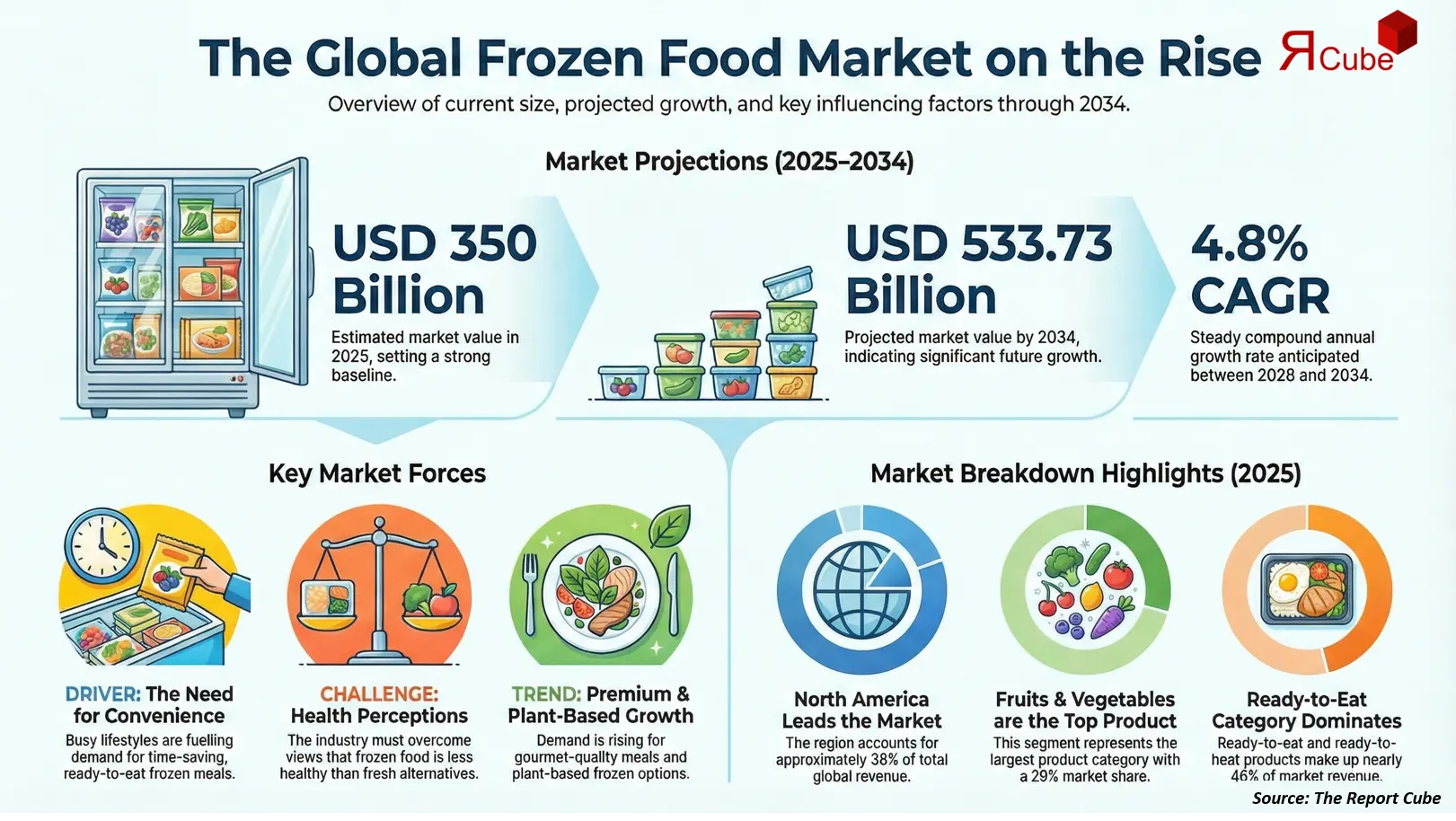
The Global Frozen Food Market is anticipated to register a CAGR of 4.8% during the forecast period 2026-2034. The market size was valued at USD 350 Billion in 2025 and is projected to reach USD 533.73 Billion by 2034. This steady expansion reflects changing consumer lifestyles, increasing demand for convenient meal solutions, and continuous improvements in cold chain logistics and freezing technologies. Frozen food products have evolved significantly from basic preservation options to high-quality, nutritious, and diverse meal alternatives catering to busy urban populations worldwide.
The frozen food industry has become an integral part of the global food system, supporting food security, reducing waste, and extending product shelf life without compromising quality. Advances in individual quick freezing (IQF), packaging innovation, and temperature-controlled transportation have improved product taste, texture, and nutritional retention. Rising participation of women in the workforce, growing single-person households, and increasing reliance on ready-to-eat and ready-to-heat meals are further driving adoption. As modern retail formats and e-commerce grocery platforms expand, frozen food accessibility continues to improve across both developed and emerging markets.
Global Frozen Food Market Recent Developments
- 2025: Nestlé expanded its frozen ready meal portfolio focusing on healthier and plant-based formulations.
- 2025: McCain Foods invested in advanced freezing and processing facilities to enhance capacity and efficiency.
Government Initiatives & Policies
- EU Farm to Fork Strategy: Encourages food waste reduction and sustainable food processing practices.
- U.S. USDA Cold Chain Modernization Programs: Supports infrastructure upgrades for frozen and perishable foods.
Global Frozen Food Market Dynamics
Key Driver: Rising Demand for Convenience and Time-Saving Foods
The primary driver of the global frozen food market is the growing consumer preference for convenient, time-saving meal options. Busy work schedules, urban lifestyles, and changing family structures have increased reliance on frozen ready meals, snacks, and partially cooked products. Frozen foods offer consistent quality, extended shelf life, and minimal preparation time, making them ideal for modern households. Additionally, improved nutritional labeling and clean-label formulations have enhanced consumer confidence, further accelerating market growth.
Major Challenge: Perception of Health and Freshness
A major challenge facing the frozen food market is lingering consumer perception regarding health and freshness. Some consumers associate frozen foods with high sodium content, preservatives, or inferior quality compared to fresh alternatives. Although technological advancements have significantly improved nutritional retention, overcoming outdated perceptions remains a challenge. Manufacturers are addressing this issue by reformulating products with reduced additives, highlighting nutritional benefits, and promoting transparency through clear labeling and marketing.
Industry Trends: Premiumization and Plant-Based Frozen Foods
An important trend shaping the frozen food market is premiumization and the rise of plant-based frozen offerings. Consumers are increasingly seeking gourmet-quality frozen meals, ethnic cuisines, and specialty products. At the same time, demand for plant-based frozen foods, including vegetables, meat alternatives, and vegan ready meals, is growing rapidly. These trends are expanding the frozen food category beyond traditional staples and supporting higher value growth.
Opportunity Ahead: Expansion of Cold Chain and E-commerce Channels
Significant growth opportunities exist in expanding cold chain infrastructure and online grocery platforms, particularly in emerging markets. Investments in refrigerated storage, transportation, and last-mile delivery are improving frozen food penetration in previously underserved regions. E-commerce and quick-commerce platforms are also enabling consumers to access a wide variety of frozen products conveniently. These developments are expected to unlock new demand pools and support long-term market expansion.
Global Frozen Food Market Segment-wise Analysis
By Product Type:
- Frozen Fruits and Vegetables
- Frozen Meat and Poultry
- Frozen Fish and Seafood
- Frozen Ready Meals
- Frozen Bakery and Snacks
- Frozen Dairy and Desserts
- Frozen Potatoes and Appetizers
- Other Frozen Products
Frozen fruits and vegetables represent the largest product type segment, accounting for approximately 29% of total market revenue in 2025. Their popularity is driven by year-round availability, minimal processing, and strong nutritional retention. Frozen ready meals are among the fastest-growing segments due to increasing demand for convenience foods. Frozen meat, poultry, and seafood continue to hold significant market share, supported by foodservice demand and household consumption.
By Category:
- Raw Material
- Half Cooked
- Ready to Eat and Ready to Heat
The ready to eat and ready to heat category dominates the market, contributing nearly 46% of total revenue in 2025. Consumers favor these products for their ease of preparation and consistent taste. Half-cooked products are also gaining traction as they balance convenience with customization during final preparation. Raw material frozen foods remain essential for households and foodservice operators seeking flexibility in meal preparation.
Regional Projection of Global Frozen Food Industry
- North America
- Europe
- Asia Pacific
- Middle East and Africa
- South America
North America leads the global frozen food market, accounting for approximately 38% of total revenue in 2025. The region benefits from high consumer acceptance, advanced cold chain infrastructure, and strong presence of major frozen food brands. Europe follows closely, driven by premium frozen offerings and sustainability-focused consumption. Asia Pacific is the fastest-growing region due to urbanization, rising disposable incomes, and expansion of modern retail. The Middle East and Africa and South America present emerging opportunities supported by infrastructure development and changing dietary habits.
Why Choose This Report?
- Provides a comprehensive overview of the global frozen food market and consumption trends.
- Delivers accurate, up-to-date insights into market size, segmentation, and growth outlook.
- Offers deep understanding of product innovation, cold chain dynamics, and consumer behavior.
- Presents competitive analysis & benchmarking of leading frozen food manufacturers.
- Consolidates market intelligence to support strategic planning and investment decisions.
- Supports customized segmentation and regional market assessment.
- Identifies challenges and untapped opportunities in the frozen food value chain.
- Grounded in real-world food industry trends, retail expansion, and policy frameworks.
Table of Contents
- Introduction
- Objective of the Study
- Product and Category Definition
- Market Segmentation
- Study Variables
- Research Methodology
- Secondary Data Points
- Breakdown of Secondary Sources
- Primary Data Points
- Breakdown of Primary Interviews
- Secondary Data Points
- Executive Summary
- Market Dynamics
- Drivers
- Challenges
- Opportunity Assessment
- Recent Trends and Developments
- Regulatory and Policy Landscape
- Global Frozen Food Market Overview (2020-2034)
- Market Size, By Value (USD Billion)
- Market Share, By Product Type
- Frozen Fruits and Vegetables
- Frozen Meat and Poultry
- Frozen Fish and Seafood
- Frozen Ready Meals
- Frozen Bakery and Snacks
- Frozen Dairy and Desserts
- Frozen Potatoes and Appetizers
- Other Frozen Products
- Market Share, By Category
- Raw Material
- Half Cooked
- Ready to Eat and Ready to Heat
- Market Share, By Consumption
- Retail Consumption
- Foodservice and HoReCa
- Market Share, By Distribution Channel
- Supermarkets and Hypermarkets
- Convenience Stores
- Specialty Stores
- Online Retail and E Commerce
- Other Distribution Channels
- Market Share, By Freezing Technology
- Individual Quick Freezing IQF
- Blast Freezing
- Belt Freezing
- Other Freezing Technologies
- Market Share, By Region
- North America
- Europe
- Asia Pacific
- Middle East and Africa
- South America
- Market Share, By Company
- Revenue Shares
- Competitive Landscape
- North America Frozen Food Market
- Market Size, By Value (USD Billion)
- Market Share, By Product Type
- Market Share, By Category
- Market Share, By Consumption
- Market Share, By Distribution Channel
- Market Share, By Freezing Technology
- Market Share, By Country
- United States
- Canada
- Mexico
- Europe Frozen Food Market
- Market Size, By Value (USD Billion)
- Market Share, By Product Type
- Market Share, By Category
- Market Share, By Consumption
- Market Share, By Distribution Channel
- Market Share, By Freezing Technology
- Market Share, By Country
- Germany
- United Kingdom
- France
- Italy
- Spain
- Northern and Nordic Countries
- Rest of Europe
- Asia Pacific Frozen Food Market
- Market Size, By Value (USD Billion)
- Market Share, By Product Type
- Market Share, By Category
- Market Share, By Consumption
- Market Share, By Distribution Channel
- Market Share, By Freezing Technology
- Market Share, By Country
- China
- India
- Japan
- South Korea
- Australia and New Zealand
- Rest of Asia Pacific
- Middle East and Africa Frozen Food Market
- Market Size, By Value (USD Billion)
- Market Share, By Product Type
- Market Share, By Category
- Market Share, By Consumption
- Market Share, By Distribution Channel
- Market Share, By Freezing Technology
- Market Share, By Country
- Saudi Arabia
- United Arab Emirates
- South Africa
- Rest of Middle East and Africa
- South America Frozen Food Market
- Market Size, By Value (USD Billion)
- Market Share, By Product Type
- Market Share, By Category
- Market Share, By Consumption
- Market Share, By Distribution Channel
- Market Share, By Freezing Technology
- Market Share, By Country
- Brazil
- Argentina
- Rest of South America
- Competitive Outlook and Company Profiles
- Nestle
- Company Overview
- Frozen Food Product Portfolio
- Strategic Alliances and Partnerships
- Recent Developments
- Conagra Brands
- Company Overview
- Frozen Food Product Portfolio
- Strategic Alliances and Partnerships
- Recent Developments
- General Mills
- Company Overview
- Frozen Food Product Portfolio
- Strategic Alliances and Partnerships
- Recent Developments
- Unilever
- Company Overview
- Frozen Food and Dessert Portfolio
- Strategic Alliances and Partnerships
- Recent Developments
- Tyson Foods
- Company Overview
- Frozen Meat and Prepared Foods Portfolio
- Strategic Alliances and Partnerships
- Recent Developments
- The Kraft Heinz Company
- Company Overview
- Frozen Meals and Snacks Portfolio
- Strategic Alliances and Partnerships
- Recent Developments
- Nomad Foods
- Company Overview
- Frozen Meals Seafood and Vegetables Portfolio
- Strategic Alliances and Partnerships
- Recent Developments
- McCain Foods
- Company Overview
- Frozen Potatoes and Appetizers Portfolio
- Strategic Alliances and Partnerships
- Recent Developments
- Ajinomoto
- Company Overview
- Frozen Meals and Appetizers Portfolio
- Strategic Alliances and Partnerships
- Recent Developments
- Kellanova
- Company Overview
- Frozen Breakfast and Snack Portfolio
- Strategic Alliances and Partnerships
- Recent Developments
- Others
- Nestle
- Contact Us and Disclaimer
Top Key Players & Market Share Outlook
- Nestle
- Conagra Brands
- General Mills
- Unilever
- Tyson Foods
- The Kraft Heinz Company
- Nomad Foods
- McCain Foods
- Ajinomoto
- Kellanova
- Others
Frequently Asked Questions






