



Build Your Custom Market Intelligence Report
Customize Your ReportAustralia Hair Care Market Key Highlights
By Product Type:
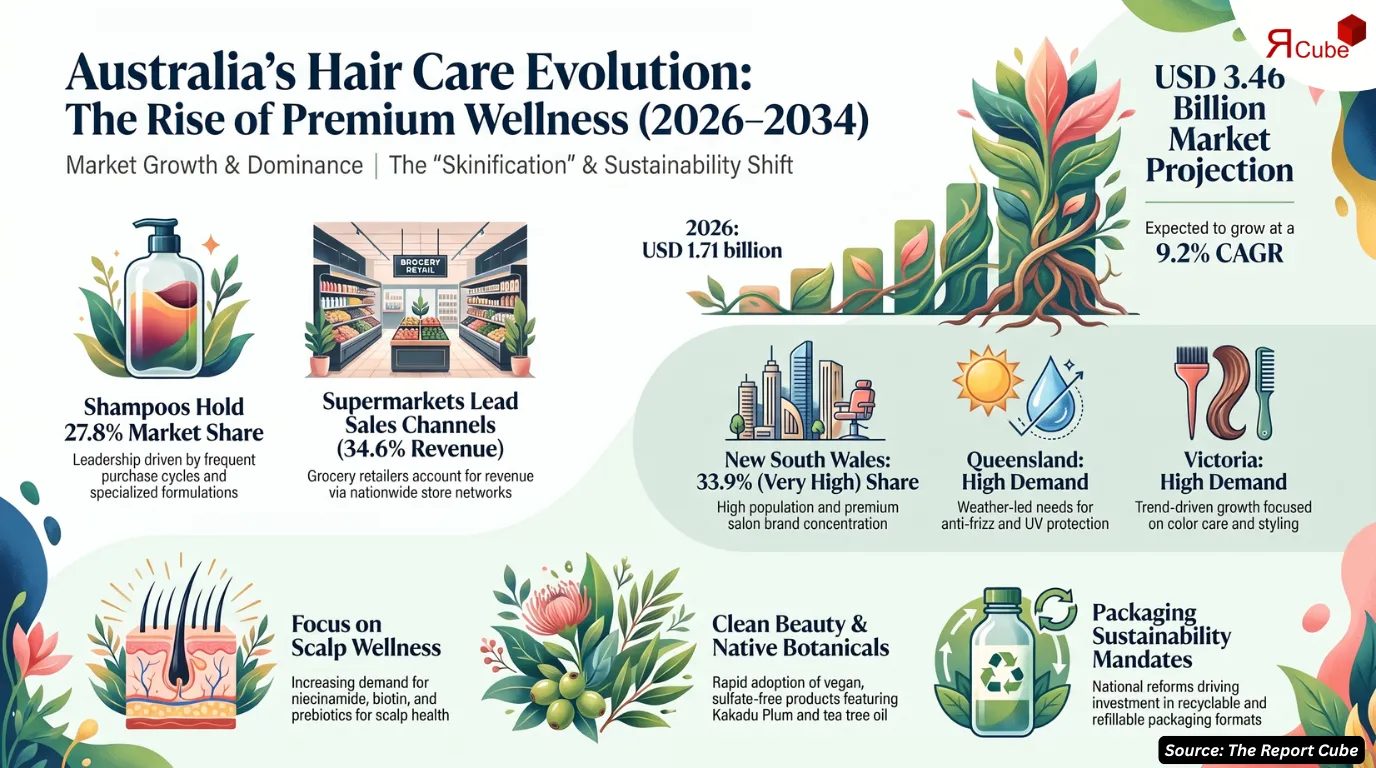
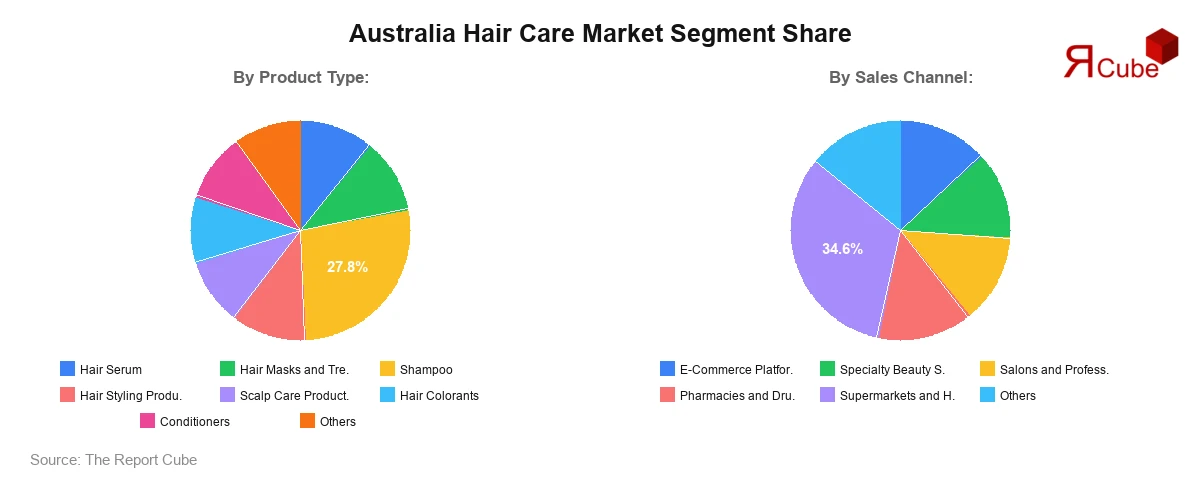
Shampoo segment leads the market with nearly 27.8% share.
By Sales Channel:
Supermarkets and Hypermarkets dominate the market with approximately 34.6% of total revenue.
Regional Outlook:
New South Wales dominates the Australia Hair Care Market with an estimated 33.9% share.
Australia Hair Care Market Insights & Analysis
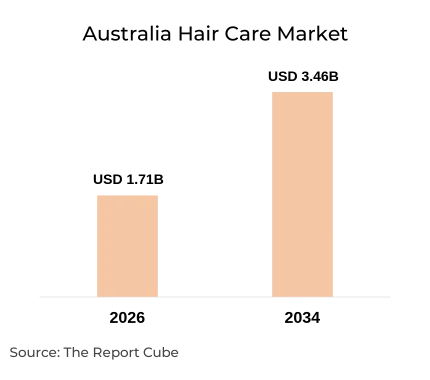
The Australia Hair Care Market is anticipated to register a CAGR of around 9.2% during the forecast period 2026-2034. The market size is valued at USD 1.71 billion in 2026 and is projected to reach USD 3.46 billion by 2034. The growth of the market is driven by rising expenditure on premium personal care products and changing consumer preferences toward specialized hair care solutions. Australian consumers are moving beyond conventional cleansing products and increasingly selecting formulations designed for scalp nourishment, hydration, color protection, hair repair, and anti-hair fall benefits. This shift has accelerated demand for shampoos, conditioners, serums, scalp treatments, and hair masks formulated with clinically supported ingredients and naturally derived extracts. Higher awareness of environmental stress, UV exposure, chemical treatments, and heat styling has also encouraged consumers to adopt preventive hair care routines, strengthening long-term demand across both mass-market and premium product categories.
Product innovation remains central to the competitive landscape of the Australia Hair Care Industry as manufacturers continue investing in research and advanced formulations that deliver measurable performance while meeting sustainability expectations. Demand for sulfate-free, vegan, botanical, and microbiome-supportive products has encouraged both global companies and Australian brands to expand premium product portfolios using scientifically validated ingredients. At the same time, omnichannel retail strategies have improved accessibility through supermarkets, pharmacies, salons, specialty beauty retailers, and rapidly growing e-commerce platforms. Investment in recyclable packaging, refill solutions, and ethically sourced raw materials is further strengthening brand positioning among environmentally conscious consumers. As premiumization, dermatology-inspired formulations, and clean-label innovation continue to reshape purchasing behavior, the market is expected to maintain healthy and sustainable growth throughout the forecast period.
Australia Hair Care Market Impact Analysis
| Factor | Type | Specific Impact on Market | Magnitude | Business Implication |
|---|---|---|---|---|
| Growing Demand for Natural Products | Consumer | Consumers increasingly prefer clean, organic and vegan hair products | High | Brands must reformulate with botanicals and eco labels to stay competitive |
| Ageing Population and Grey Coverage Needs | Market | Older consumers drive demand for colour care and anti hair fall items | Medium | Supports growth in specialised colour, repair and treatment ranges |
| Rising Focus on Scalp Health | Consumer | Scalp care lines gain traction as wellness and dermatology trends spread | Medium | Encourages innovation in medicated, soothing and exfoliating solutions |
| E commerce and Omnichannel Expansion | Market | Online platforms broaden reach and enable niche brands to scale quickly | High | Requires strong digital marketing and direct to consumer engagement focus |
| Environmental and Sustainability Concerns | Environmental | Customers favour recyclable packaging and low impact manufacturing practices | Medium | Drives investment in green packaging, refill formats and certifications |
| Professional Salon and Premiumisation Trend | Competitive | Salon grade treatments and styling services gain a higher revenue share | Medium | Opens partnership opportunities with salons and high end product lines |
| Overall Market Growth Momentum | Market | Sector projected to grow steadily with mid single digit annual expansion | High | Supports long term portfolio investment and new product development |
Australia Hair Care Market Dynamics
Key Driver: Growing Preference for Premium Scalp Wellness and Preventive Hair Care
Australian consumers are increasingly viewing hair care as an essential component of their overall wellness routine rather than a basic personal hygiene practice. Greater awareness of scalp health, hair barrier protection, and long-term hair maintenance has significantly increased demand for products addressing dandruff, scalp sensitivity, hair thinning, dryness, and chemically damaged hair. Consumers are actively choosing formulations containing ingredients such as niacinamide, biotin, peptides, keratin, ceramides, and botanical extracts that provide targeted benefits supported by scientific research. This transition toward preventive care has encouraged manufacturers to diversify product portfolios beyond conventional shampoos and conditioners into specialized treatment-based solutions.
The premium segment continues to benefit from growing confidence in dermatologist-inspired formulations and salon-quality products that demonstrate visible results. Professional recommendations, educational campaigns, and wider availability of ingredient information have improved consumer understanding of product efficacy, encouraging repeat purchases across high-value categories. This trend has also created opportunities for Australian manufacturers to introduce locally developed formulations incorporating native botanical ingredients while addressing the country's climate-related hair care concerns. As consumers increasingly prioritize product performance over price, premium hair care continues to contribute significantly to overall market expansion.
Industry Trends: Clean Beauty and Science-Based Innovation Continue to Shape Product Development
Product development across the Australia Hair Care Market is increasingly influenced by consumer demand for formulations that combine naturally derived ingredients with scientifically proven performance. Sulfate-free, silicone-free, vegan, and cruelty-free products continue gaining wider acceptance across multiple demographic groups as consumers become more selective about ingredient transparency and product safety. Australian native botanicals including Kakadu Plum, tea tree oil, eucalyptus, macadamia oil, and lemon myrtle are being incorporated into premium formulations because of their recognized antioxidant and nourishing properties. These ingredients allow brands to differentiate their products while responding to rising demand for locally inspired beauty solutions.
The growing integration of skincare science into hair care has become another defining industry trend. Manufacturers are developing scalp-focused formulations enriched with prebiotics, postbiotics, probiotics, peptides, and barrier-supporting ingredients that promote healthier scalp conditions and stronger hair growth. Sustainable packaging innovations, refillable product formats, and environmentally responsible sourcing practices are also becoming important purchasing considerations among Australian consumers. These developments continue encouraging established multinational companies and emerging domestic brands to strengthen research investments and accelerate product innovation across premium and professional hair care categories.
Book your FREE 30-minute expert consultation today
Contact UsMajor Challenge: Rising Production Costs and Highly Competitive Market Environment
Competition within the Australia Hair Care Industry has intensified as international manufacturers, domestic brands, salon-exclusive companies, and private-label retailers continue expanding their product offerings. Frequent product launches, promotional pricing strategies, and increasing consumer expectations regarding formulation quality have made product differentiation more challenging. Companies must consistently invest in research, ingredient innovation, packaging improvements, and brand development to maintain market relevance while responding to rapidly changing consumer preferences. This competitive environment places considerable pressure on both established manufacturers and emerging brands seeking to strengthen market share.
Operating costs have also increased due to higher prices for premium botanical ingredients, sustainable packaging materials, logistics, manufacturing, and regulatory compliance. Many companies are balancing the need to maintain competitive pricing while preserving product quality and profitability. Smaller manufacturers often face additional challenges related to production scale and distribution capabilities compared with multinational competitors that benefit from established supply chains and stronger retail partnerships. These factors may temporarily affect profit margins, although continued product innovation remains essential for sustaining long-term business growth.
Opportunity: Personalized Hair Care and Digital Retail Continue to Unlock Future Growth
Expanding digital commerce is creating significant opportunities across the Australia Hair Care Market by improving access to premium products and personalized customer experiences. Online beauty platforms enable consumers to compare formulations, review ingredient information, receive expert guidance, and purchase products tailored to specific hair concerns. Subscription services, virtual consultations, and educational content have strengthened consumer confidence while increasing customer retention across both domestic and international brands. The rapid expansion of digital retail has also enabled emerging Australian companies to reach a broader customer base without extensive physical store networks.
Growing demand for customized hair care solutions is expected to remain a major growth opportunity during the forecast period. Consumers increasingly seek products developed for individual hair texture, scalp condition, lifestyle, age, and environmental exposure rather than standardized formulations. Manufacturers are responding through personalized treatment systems, diagnostic technologies, and targeted product collections designed to deliver measurable results. Continued investment in customized formulations, premium ingredients, and digitally enabled customer engagement is expected to strengthen market growth while supporting higher-value product sales across Australia's evolving hair care industry.
Australia Hair Care Market Segment-wise Analysis
By Product Type:
- Hair Serum
- Hair Masks and Treatments
- Shampoo
- Hair Styling Products
- Scalp Care Products
- Hair Colorants
- Conditioners
- Hair Sprays and Gels
- Hair Oil
- Others
Among all product categories, the shampoo segment accounted for approximately 27.8% of the Australia Hair Care Market in 2026, making it the largest product category. Its leadership is primarily supported by frequent purchase cycles and widespread use across all age groups. Australian consumers are increasingly selecting shampoos formulated for specific hair concerns, including dandruff, scalp sensitivity, color-treated hair, hair thinning, and moisture retention. The growing popularity of sulfate-free, silicone-free, and pH-balanced formulations has further strengthened demand within both premium and mass-market categories. Manufacturers are also introducing products enriched with Australian botanical ingredients such as tea tree oil, Kakadu Plum, eucalyptus, and macadamia oil to appeal to consumers seeking naturally derived yet high-performing formulations.
Continuous product innovation remains a major factor supporting segment growth. Premium shampoo brands are incorporating ingredients such as peptides, niacinamide, ceramides, probiotics, and plant proteins to improve scalp health while repairing damaged hair fibers. Dermatologist-tested formulations and salon-quality products continue to gain wider acceptance as consumers become more focused on preventive hair care rather than corrective treatments alone. In addition, supermarkets, pharmacies, beauty retailers, and online platforms have expanded premium shampoo assortments, improving accessibility across metropolitan and regional areas. The combination of higher consumer awareness, premium product adoption, and continuous formulation advancements is expected to enable the shampoo segment to maintain its market leadership throughout the forecast period.
By Sales Channel:
- E-Commerce Platforms
- Specialty Beauty Stores
- Salons and Professional Channels
- Pharmacies and Drug Stores
- Supermarkets and Hypermarkets
- Others
Supermarkets and Hypermarkets represented nearly 34.6% of total Australia Hair Care Market revenue in 2026, making them the leading sales channel. Their dominance is supported by extensive nationwide store networks, competitive pricing strategies, and broad product availability across economy, premium, and luxury categories. Consumers continue to prefer these retail formats because they provide convenient one-stop shopping, regular promotional discounts, and immediate access to trusted domestic and international brands. Large retailers have also expanded shelf space dedicated to clean-label, sulfate-free, vegan, and botanical hair care products in response to evolving consumer preferences for healthier formulations.
Retail chains continue strengthening partnerships with leading manufacturers by introducing exclusive product launches, loyalty rewards, and seasonal promotional campaigns that encourage repeat purchases. Investment in omnichannel retailing, including click-and-collect services and integrated online ordering, has further enhanced customer convenience while supporting higher product visibility. Although e-commerce platforms are recording the fastest growth rate, supermarkets and hypermarkets remain the preferred purchasing destination for everyday hair care essentials because consumers value product availability, price competitiveness, and immediate purchase fulfillment. These advantages are expected to preserve the channel's leading position across the Australian hair care industry over the coming years.
Regional Projection of Australia Hair Care Industry
- Queensland
- New South Wales
- Victoria
- South Australia
- Others
New South Wales held the largest share of the Australia Hair Care Market at approximately 33.9% in 2026. The region benefits from Australia's highest population concentration, elevated household spending on personal care products, and a well-developed beauty retail ecosystem. Sydney serves as a major commercial center for multinational beauty companies, premium salons, specialty retailers, and digital beauty brands, creating strong product availability across every price category. Consumers in New South Wales also demonstrate higher adoption of premium scalp treatments, botanical formulations, and salon-grade hair care products compared to several other Australian regions, reflecting increasing awareness of long-term hair and scalp wellness.
Regional growth is further supported by strong retail infrastructure, widespread e-commerce penetration, and increasing investment by manufacturers in new product launches and brand partnerships. The presence of leading dermatology clinics, professional salons, and beauty specialists has contributed to growing demand for clinically formulated products designed to address hair loss, scalp sensitivity, color protection, and hair repair. Sustainability also remains an important purchasing factor, encouraging brands to introduce recyclable packaging and naturally sourced ingredients. Supported by continuous innovation, premium beauty spending, and expanding omnichannel distribution networks, New South Wales is expected to retain its leading contribution to the Australia Hair Care Market throughout the forecast period.
Need insights for a specific region within this market?
Request Regional DataAustralia Hair Care Market Regional Analysis
The Australia hair care market shows varied regional demand driven by climate, lifestyle, and income patterns.
| Region | Demand Level | Key Areas | Category Dominance | Core Demand Logic | Growth Nature |
|---|---|---|---|---|---|
| Queensland | High | Brisbane, Gold Coast, Cairns | Anti-frizz & UV care | Humid heat and sun exposure | Weather-led steady growth |
| New South Wales | Very High | Sydney, Newcastle, Wollongong | Premium and salon brands | Affluent, urban, style focused | Premiumization and mix shift |
| Victoria | High | Melbourne, Geelong, Ballarat | Color care and styling | Trendy, multicultural users | Stable, trend driven growth |
| South Australia | Medium | Adelaide, Mount Gambier | Value and family packs | Mid income, value seeking | Slow, price led expansion |
| Others | Medium | WA, ACT, NT, Tasmania | Basic and scalp care lines | Dry climate and hard water | Ecommerce led long tail |
Government Initiatives & Policies
- National Plastics Plan and Packaging Reforms (2025-2026): The Australian Government continues implementing packaging sustainability initiatives that encourage recyclable, reusable, and reduced-plastic packaging across consumer goods, including hair care products. These measures promote environmentally responsible product development and support circular economy practices.
- Australian Industrial Chemicals Introduction Scheme (AICIS): AICIS continues regulating cosmetic and personal care ingredients introduced into Australia, ensuring product safety while encouraging innovation using compliant ingredients. The framework supports transparent ingredient assessment and strengthens consumer confidence in hair care formulations.
Australia Hair Care Industry Recent Developments
- 2025: AMPERNA expanded into the Australian hair care industry with the launch of its microbiome-focused DERMACARE range, introducing the Cleanse & Rebalance Dermal Care Shampoo and Strengthen & Protect Dermal Care Conditioner. Developed around the growing skinification trend, the formulations contain prebiotics and postbiotics that help support scalp microbiome balance while extending the company's dermatology-led expertise into premium scalp wellness. The launch strengthens competition within Australia's science-backed scalp care segment and encourages wider innovation in clinically inspired hair care products.
- 2025: Kadūra Beauty introduced a botanical-focused hair care portfolio in Australia featuring vegan, pH-balanced formulations made without silicones, sulfates, or microplastics. The range includes shampoo, conditioner, scalp serum, scalp scrub, hair mask, and botanical hair perfume oil formulated with Australian botanicals such as Kakadu Plum, Guarana, and Lemon Peel Oil. The launch reflects rising demand for clean-label, sustainable, and naturally derived hair care products while encouraging manufacturers to expand premium botanical product offerings.
Why Choose This Report?
- Provides a comprehensive overview of the overall market analysis, encompassing key trends, consumer behavior analysis, and risk assessment to support strategic decision-making.
- Provides accurate, up-to-date insights into market size, segmentation, and emerging opportunities, helping to minimize risk while capitalizing on growth.
- Gives deep understanding of target audience preferences, purchasing habits, and communication channels for enhanced product development and marketing effectiveness.
- Delivers competitive analysis and benchmarking, uncovering the strengths and weaknesses of market competitors to guide business strategies.
- Consolidates comprehensive market intelligence, reducing research effort and streamlining strategic planning.
- Facilitates customized market segmentation and risk mitigation strategies that align with business objectives and investment priorities.
- Aids in identifying both market challenges and untapped opportunities within the industry to drive long-term business growth.
- Provides valuable information based on actual customer behavior, evolving beauty trends, and industry developments.
Table of Contents
- Introduction
- Objective of the Study
- Product and Category Definition
- Market Segmentation
- Study Variables
- Research Methodology
- Secondary Data Points
- Breakdown of Secondary Sources
- Primary Data Points
- Breakdown of Primary Interviews
- Secondary Data Points
- Executive Summary
- Market Dynamics
- Emerging Opportunities
- Adoption Trends
- Demand Drivers
- Disruption Analysis (Challenges)
- Industry Analysis & Strategic Insights
- Supply/Value Chain Analysis
- Pricing Analysis
- Go-To-Market (GTM) Strategy
- BCG Matrix
- Recent Trends and Developments
- Import and Export Analysis
- Regulatory and Policy Landscape
- Region-wise Policies
- Government Initiatives
- Australia Hair Care Market Overview and Forecast Analysis (2021-2034)
- Market Size, By Value and Growth Rate (CAGR/USD Million)
- Market Share, By Product Type
- Hair Serum
- Hair Masks and Treatments
- Shampoo
- Hair Styling Products
- Scalp Care Products
- Hair Colorants
- Conditioners
- Hair Sprays and Gels
- Hair Oil
- Others
- Market Share, By Ingredient
- Natural and Organic
- Vegan
- Herbal and Botanical
- Conventional
- Sulfate-Free
- Market Share, By Price Category
- Luxury
- Economy/Mass Market
- Premium
- Mid-Premium
- Market Share, By End User
- Women
- Kids
- Men
- Market Share, By Sales Channel
- E-Commerce Platforms
- Specialty Beauty Stores
- Salons and Professional Channels
- Pharmacies and Drug Stores
- Supermarkets and Hypermarkets
- Others
- Market Share, By Region
- Queensland
- New South Wales
- Victoria
- South Australia
- Others
- Market Share, By Company
- Revenue Shares and Analysis
- Competitive Landscape
- Queensland Hair Care Market Overview and Forecast Analysis (2021-2034)
- Market Size, By Value and Growth Rate (CAGR/USD Million)
- Market Share, By Product Type
- Market Share, By Ingredient
- Market Share, By Price Category
- Market Share, By End User
- Market Share, By Sales Channel
- New South Wales Hair Care Market Overview and Forecast Analysis (2021-2034)
- Market Size, By Value and Growth Rate (CAGR/USD Million)
- Market Share, By Product Type
- Market Share, By Ingredient
- Market Share, By Price Category
- Market Share, By End User
- Market Share, By Sales Channel
- Victoria Hair Care Market Overview and Forecast Analysis (2021-2034)
- Market Size, By Value and Growth Rate (CAGR/USD Million)
- Market Share, By Product Type
- Market Share, By Ingredient
- Market Share, By Price Category
- Market Share, By End User
- Market Share, By Sales Channel
- South Australia Hair Care Market Overview and Forecast Analysis (2021-2034)
- Market Size, By Value and Growth Rate (CAGR/USD Million)
- Market Share, By Product Type
- Market Share, By Ingredient
- Market Share, By Price Category
- Market Share, By End User
- Market Share, By Sales Channel
- Competitive Analysis, 2026
- Market Share of Key Players
- Competitive Mapping for Each Segment and Companies Operating Regionally
- Queensland Hair Care Companies Share and Competitive Analysis, 2026
- New South Wales Hair Care Companies Share and Competitive Analysis, 2026
- Victoria Hair Care Companies Share and Competitive Analysis, 2026
- South Australia Hair Care Companies Share and Competitive Analysis, 2026
- Company Profile (Partial List)
- Johnson & Johnson
- Company Overview
- Product Portfolio
- Strategic Alliances/Partnerships
- Recent Developments
- Davines
- Company Overview
- Product Portfolio
- Strategic Alliances/Partnerships
- Recent Developments
- Henkel
- Company Overview
- Product Portfolio
- Strategic Alliances/Partnerships
- Recent Developments
- Aveda Corporation
- Company Overview
- Product Portfolio
- Strategic Alliances/Partnerships
- Recent Developments
- Muk Haircare
- Company Overview
- Product Portfolio
- Strategic Alliances/Partnerships
- Recent Developments
- Kao Corporation
- Company Overview
- Product Portfolio
- Strategic Alliances/Partnerships
- Recent Developments
- Shiseido Company
- Company Overview
- Product Portfolio
- Strategic Alliances/Partnerships
- Recent Developments
- L'Oréal Group
- Company Overview
- Product Portfolio
- Strategic Alliances/Partnerships
- Recent Developments
- Unilever PLC
- Company Overview
- Product Portfolio
- Strategic Alliances/Partnerships
- Recent Developments
- Procter & Gamble Company
- Company Overview
- Product Portfolio
- Strategic Alliances/Partnerships
- Recent Developments
- Others (Partial List)
- Johnson & Johnson
- Contact Us and Disclaimer
Top Key Players & Market Share Outlook
- Johnson & Johnson
- Davines
- Henkel
- Aveda Corporation
- Muk Haircare
- Kao Corporation
- Shiseido Company
- L'Oréal Group
- Unilever PLC
- Procter & Gamble Company
- Others
Frequently Asked Questions






