



Build Your Custom Market Intelligence Report
Customize Your ReportGlobal Healthcare Cybersecurity Market Key Takeaways
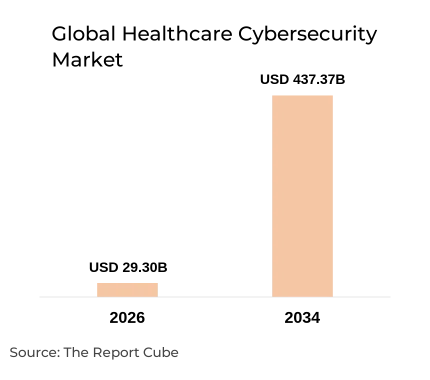
- Market valued at USD 29.3 billion in 2026, reflecting accelerating digital healthcare security investments.
- Industry projected to reach USD 437.37 billion by 2034, expanding at 40.20% CAGR.
- Hospitals remain the leading end-use segment owing to extensive electronic health record adoption.
- Malware and ransomware continue dominating threat landscapes across global healthcare infrastructure and connected medical ecosystems.
- North America maintains regional leadership through mature cybersecurity regulations and advanced healthcare digitalization initiatives.
- Cloud security, zero-trust architecture, and AI-driven threat detection significantly strengthen healthcare cyber resilience strategies.
- Leading companies include Cisco Systems, IBM, Fortinet, Kaspersky, Trend Micro, Imperva, McAfee, Claroty, and Symantec.
- Increasing IoMT deployment, stricter compliance frameworks, and rising cyberattacks continue accelerating enterprise cybersecurity adoption.
Global Healthcare Cybersecurity Market Insights & Analysis
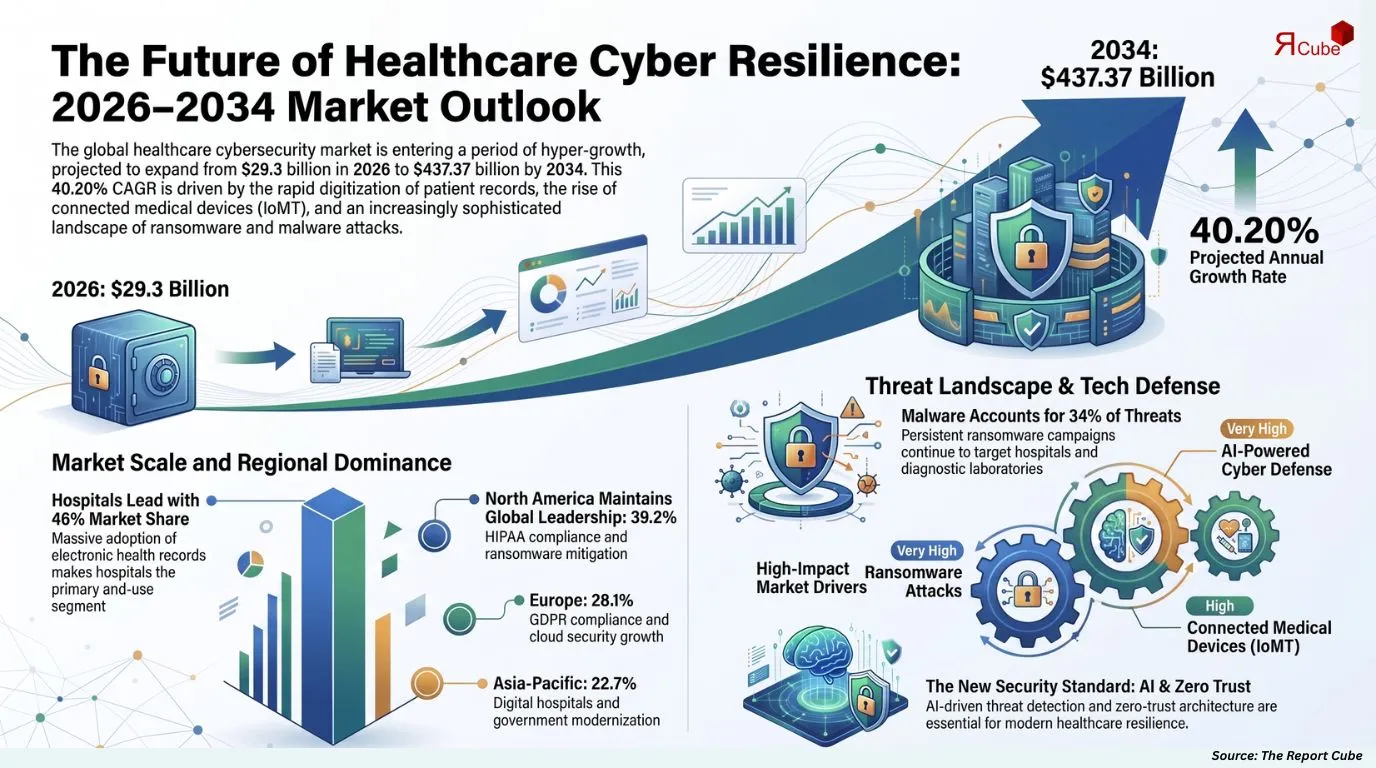
The Global Healthcare Cybersecurity Market is anticipated to register a 40.20% CAGR during 2026–2034. The market size was valued at USD 29.3 billion in 2026 and is projected to reach USD 437.37 billion by 2034. The industry is benefiting from rapid digitization of healthcare, increasing deployment of connected medical devices, and expanding electronic health record ecosystems requiring comprehensive protection against sophisticated cyber threats. Governments and regulators are strengthening cybersecurity mandates while healthcare providers continue increasing investments in resilient digital infrastructure.
Healthcare organizations remain among the world's most targeted industries as ransomware, phishing campaigns, and supply-chain attacks become increasingly sophisticated. Security platforms integrating artificial intelligence, behavioral analytics, extended detection and response (XDR), cloud workload protection, and zero-trust frameworks are becoming essential components of healthcare cybersecurity strategies. Continued investments in hospital security operations, medical device protection, and regulatory compliance are expected to sustain long-term market expansion.
Global Healthcare Cybersecurity Market Dynamics
Healthcare cybersecurity demand continues expanding as hospitals, pharmaceutical companies, insurers, and medical device manufacturers accelerate digital transformation. Increasing cyberattacks targeting patient records, connected medical equipment, cloud platforms, and healthcare supply chains have elevated cybersecurity from an IT function to a strategic business priority. Continuous regulatory modernization further reinforces investment across public and private healthcare organizations.
|
Factor |
Type |
Specific Impact on Market |
Magnitude |
|---|---|---|---|
|
Rising ransomware attacks |
Driver |
Accelerates security platform deployment across hospitals |
Very High |
|
Healthcare cloud adoption |
Opportunity |
Increases demand for cloud security solutions |
High |
|
Connected medical devices |
Driver |
Expands IoMT cybersecurity investments |
High |
|
Regulatory compliance |
Driver |
Boosts spending on identity, encryption, and monitoring |
High |
|
AI-powered cyber defense |
Trend |
Improves threat detection and incident response |
Very High |
Key Market Driver: Escalating Healthcare Cyber Threats
Healthcare organizations increasingly manage massive volumes of protected patient information across cloud platforms, electronic health records, diagnostic systems, and connected medical devices. Rising ransomware incidents, phishing attacks, and supply-chain compromises are compelling providers to deploy advanced endpoint protection, identity management, security analytics, and zero-trust architectures that improve operational resilience and regulatory compliance.
Major Industry Challenge: Legacy Infrastructure Security Risks
Many healthcare institutions continue operating legacy clinical applications and aging medical devices that lack modern security capabilities. Integrating these systems with cloud platforms, IoMT devices, and digital care environments increases operational complexity, creating larger attack surfaces and making continuous vulnerability management, segmentation, and secure modernization increasingly critical for healthcare organizations.
Emerging Trend Shaping Outlook: AI-Driven Security Operations
Healthcare providers are increasingly adopting artificial intelligence, behavioral analytics, extended detection and response, automated threat intelligence, and security orchestration platforms. These technologies accelerate attack detection, prioritize vulnerabilities, reduce response times, improve incident investigation, and strengthen protection for connected healthcare ecosystems while supporting regulatory compliance and operational continuity.
Need Specific Data, Let’s Customize the Report for You
Request CustomizationGlobal Healthcare Cybersecurity Market Segment-wise Analysis
Healthcare organizations continue expanding cybersecurity investments across multiple deployment environments as digital healthcare services become increasingly interconnected. Advanced security platforms now protect hospitals, insurers, pharmaceutical companies, research institutions, medical devices, and cloud-based healthcare applications from increasingly sophisticated cyber threats.
By Type of Threat
- Malware
- DDoS
- Advanced Persistent Threat
- Spyware
- Lost or Stolen Devices
- Others
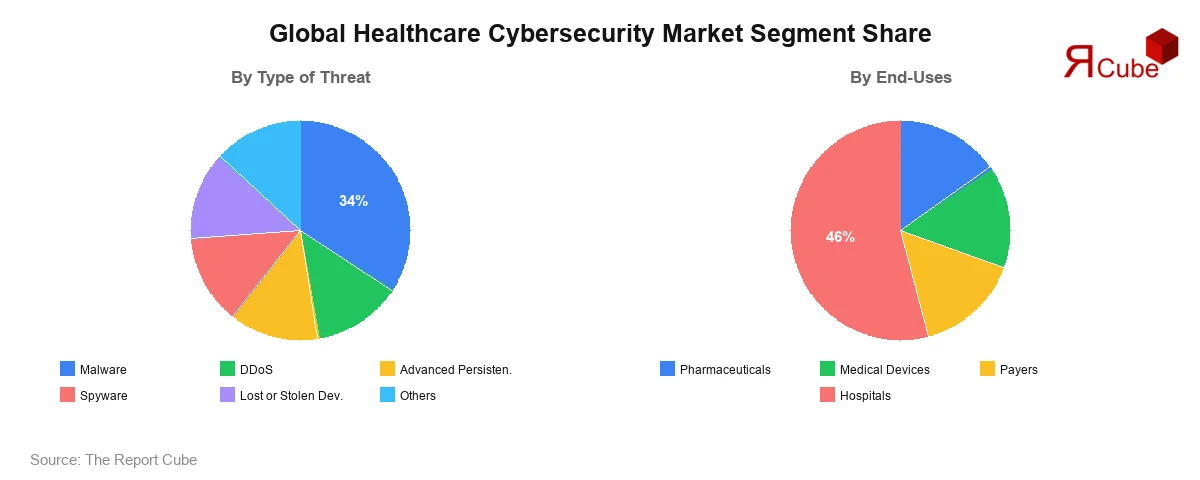
Malware remains the dominant threat category, accounting for an estimated 34% market share due to persistent ransomware campaigns targeting hospitals, diagnostic laboratories, and electronic health record systems. Advanced persistent threats continue expanding as nation-state actors increasingly target healthcare research organizations, while spyware and credential theft attacks exploit remote healthcare environments. Healthcare organizations are therefore investing heavily in endpoint detection, network monitoring, email security, and AI-driven threat intelligence platforms.
Growing adoption of connected medical devices and cloud-hosted healthcare platforms further increases exposure to sophisticated attacks. Distributed denial-of-service (DDoS) incidents and compromised clinical systems are encouraging continuous investment in secure access service edge (SASE), zero-trust networking, threat intelligence, and automated incident response solutions across both public and private healthcare institutions.
By End-Uses
- Pharmaceuticals
- Medical Devices
- Payers
- Hospitals
Hospitals dominate the end-use segment with an estimated 46% market share due to their extensive use of electronic health records, connected diagnostic equipment, telemedicine infrastructure, and patient management platforms. Continuous cybersecurity investments are driven by increasing regulatory compliance requirements, expanding digital healthcare ecosystems, and the need to maintain uninterrupted patient care while protecting sensitive health information.
Pharmaceutical companies, medical device manufacturers, and healthcare payers are also strengthening cybersecurity capabilities to safeguard intellectual property, clinical trial data, manufacturing systems, and financial transactions. Growing digital collaboration across healthcare value chains continues supporting demand for identity management, cloud security, encryption, and advanced threat detection technologies.
Regional Projection of Global Healthcare Cybersecurity Market
The global healthcare cybersecurity market demonstrates strong regional variation based on digital healthcare maturity, regulatory frameworks, healthcare infrastructure, and cyber threat exposure. North America continues leading global revenue generation, while Europe benefits from strict data privacy regulations. Asia-Pacific is emerging as the fastest-growing regional market due to rapid healthcare digitization, expanding hospital networks, and increasing investments in cybersecurity infrastructure.
|
Region |
Estimated Market Share |
Key Growth Factors |
Consumer Trends |
|---|---|---|---|
|
North America |
39.2% |
Strong healthcare IT adoption, HIPAA compliance, ransomware mitigation |
High adoption of AI and Zero Trust security |
|
Europe |
28.1% |
GDPR compliance, connected healthcare expansion |
Cloud security and identity management growth |
|
Asia-Pacific |
22.7% |
Digital hospitals, government healthcare modernization |
Rising demand for managed security services |
|
Latin America |
6.0% |
Expanding digital health infrastructure |
Increased endpoint protection adoption |
|
Middle East & Africa |
4.0% |
Smart hospital initiatives and healthcare investments |
Growing cloud cybersecurity implementation |
- North America: North America dominates the global market with approximately 39.2% share owing to widespread adoption of electronic health records, connected medical devices, cloud-based healthcare platforms, and mature cybersecurity regulations. Large healthcare providers continue investing heavily in AI-powered security analytics, zero-trust architecture, extended detection and response (XDR), and medical device protection following several high-profile ransomware incidents. Strong government cybersecurity initiatives and increasing regulatory requirements continue reinforcing long-term regional leadership.
- Europe: Europe continues expanding healthcare cybersecurity investments through stringent GDPR compliance, modernization of healthcare IT infrastructure, and increasing adoption of secure cloud environments. Healthcare providers are strengthening identity management, encryption technologies, and continuous monitoring to protect patient information while ensuring regulatory compliance. Public-private cybersecurity collaborations further support regional market expansion.
- Asia-Pacific: Asia-Pacific represents the fastest-growing regional market as hospitals, pharmaceutical companies, and governments accelerate digital healthcare transformation. Expanding telemedicine services, connected medical devices, and smart hospital initiatives are increasing cybersecurity spending across China, Japan, India, South Korea, and Southeast Asian countries. Continued healthcare modernization creates substantial long-term opportunities for cybersecurity vendors.
Global Healthcare Cybersecurity Market: Recent Development (2025)
- Cisco expanded AI-powered XDR healthcare security capabilities, improving hospital threat detection, automation, and incident response efficiency.
- Claroty strengthened healthcare CPS security platform protecting connected medical devices against sophisticated cyberattack vectors across hospitals.
- Fortinet enhanced Zero Trust healthcare architecture supporting secure cloud migration, medical devices, and remote clinical environments.
- Healthcare providers accelerated cybersecurity modernization following proposed HIPAA Security Rule enhancements emphasizing encryption and multifactor authentication.
Global Healthcare Cybersecurity Market Future Outlook (2034)
The Global Healthcare Cybersecurity Market is projected to expand at a remarkable 40.20% CAGR, reaching approximately USD 437.37 billion by 2034. Growing dependence on connected healthcare ecosystems, cloud-native hospital platforms, electronic medical records, and Internet of Medical Things (IoMT) devices will continue driving cybersecurity investments across healthcare organizations worldwide. AI-powered analytics, predictive threat intelligence, and autonomous security operations will become core components of enterprise cyber defense.
Future market growth will be supported by increasing adoption of zero-trust architecture, secure access service edge (SASE), cloud workload protection, and automated incident response technologies. Healthcare organizations will increasingly prioritize continuous risk assessment, medical device security, identity governance, and regulatory compliance to strengthen operational resilience while protecting sensitive patient information against evolving cyber threats.
Global Healthcare Cybersecurity Market Report Coverage
|
Report Attribute |
Details |
|---|---|
|
Market Name |
Global Healthcare Cybersecurity Market |
|
Market Size (2026) |
USD 29.3 Billion |
|
Market Size (2034) |
USD 437.37 Billion |
|
Forecast Period |
2026-2034 |
|
CAGR |
40.20% |
|
Base Year |
2026 |
|
Historical Years |
2021-2025 |
|
Forecast Years |
2026-2034 |
|
Segments Covered |
By Type of Threat, By End-Uses, By Type |
|
Regions Covered |
North America, Europe, Asia-Pacific, Latin America, Middle East & Africa |
|
Key Companies |
Cisco Systems, Inc., IBM, Marubeni Information Systems Co., Ltd., Symantec Corporation, Trend Micro Incorporated, McAfee, LLC., Intel Corporation, AO Kaspersky Lab, Lockheed Martin Corporation, Northrop Grumman, Imperva, Fortinet, Inc., Medigate (Claroty) |
|
Report Format |
PDF, Excel, PPT |
|
Customization |
Available as per client requirements |
Why Choose This Report?
- Comprehensive analysis covering emerging cybersecurity threats across healthcare ecosystems.
- Accurate market sizing with reliable forecast through 2034.
- Detailed segmentation highlighting revenue-leading market opportunities.
- Regional insights supported by evolving regulatory developments.
- Competitive profiling of major global cybersecurity vendors.
- Analysis of AI-driven security and Zero Trust adoption.
- Strategic insights supporting investment and business planning.
- Data-driven research following industry best practices and current trends.
Table of Contents
- Introduction
- Objective of the study
- Product Definition
- Market Segmentation
- Study Variables
- Research Methodology
- Secondary Data Points
- Companies Interviewed
- Primary Data Points
- Break Down of Primary Interviews
- Secondary Data Points
- Executive Summary
- Market Dynamics
- Drivers
- Challenges
- Opportunity Assessment
- Recent Trends and Developments
- Policy and Regulatory Landscape
- Global Healthcare Cybersecurity Market Overview and Forecast Analysis (2021-2034)
- Market Size, By Value, By growth rate (CAGR/USD Billions)
- Demand - Supply Trends
- Market Share, By Type
- Solutions
- Services
- Market Share, By Type of Threat
- Malware
- DDoS
- Advanced Persistent Threat
- Spyware
- Lost or Stolen Devices
- Others
- Market Share, By End-Uses
- Pharmaceuticals
- Medical Devices
- Payers
- Hospitals
- Market Share, By Region
- North America
- Europe
- Asia-Pacific
- Latin America
- Middle East & Africa
- Market Share, By Competitors
- Competition Characteristics
- Revenue Shares
- Global Solutions Healthcare Cybersecurity Market Overview, 2021-2034F
- By Value (USD Million)
- By Type of Threat- Market Size & Forecast 2021-2034, USD Million
- By End-Uses- Market Size & Forecast 2021-2034, USD Million
- Global Services Healthcare Cybersecurity Market Overview, 2021-2034F
- By Value (USD Million)
- By Type of Threat- Market Size & Forecast 2021-2034, USD Million
- By End-Uses- Market Size & Forecast 2021-2034, USD Million
- Competitive Outlook (Company Profile - Partial List)
- Cisco Systems, Inc.
- Company Overview
- Business Segments
- Strategic Alliances/Partnerships
- Recent Developments
- IBM
- Company Overview
- Business Segments
- Strategic Alliances/Partnerships
- Recent Developments
- Marubeni Information Systems Co., Ltd.
- Company Overview
- Business Segments
- Strategic Alliances/Partnerships
- Recent Developments
- Symantec Corporation
- Company Overview
- Business Segments
- Strategic Alliances/Partnerships
- Recent Developments
- Trend Micro Incorporated
- Company Overview
- Business Segments
- Strategic Alliances/Partnerships
- Recent Developments
- McAfee, LLC.
- Company Overview
- Business Segments
- Strategic Alliances/Partnerships
- Recent Developments
- Intel Corporation
- Company Overview
- Business Segments
- Strategic Alliances/Partnerships
- Recent Developments
- AO Kaspersky Lab
- Company Overview
- Business Segments
- Strategic Alliances/Partnerships
- Recent Developments
- Lockheed Martin Corporation
- Company Overview
- Business Segments
- Strategic Alliances/Partnerships
- Recent Developments
- Others
- Cisco Systems, Inc.
- Contact Us & Disclaimer
Top Key Players & Market Share Outlook
- Cisco Systems, Inc.
- IBM
- Marubeni Information Systems Co., Ltd.
- Symantec Corporation
- Trend Micro Incorporated
- McAfee, LLC.
- Intel Corporation
- AO Kaspersky Lab
- Lockheed Martin Corporation
- Others
Frequently Asked Questions






