



Build Your Custom Market Intelligence Report
Customize Your ReportJapan Heavy-Duty Automotive Aftermarket Market Insights & Analysis
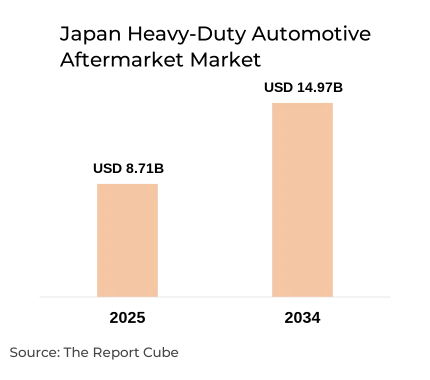
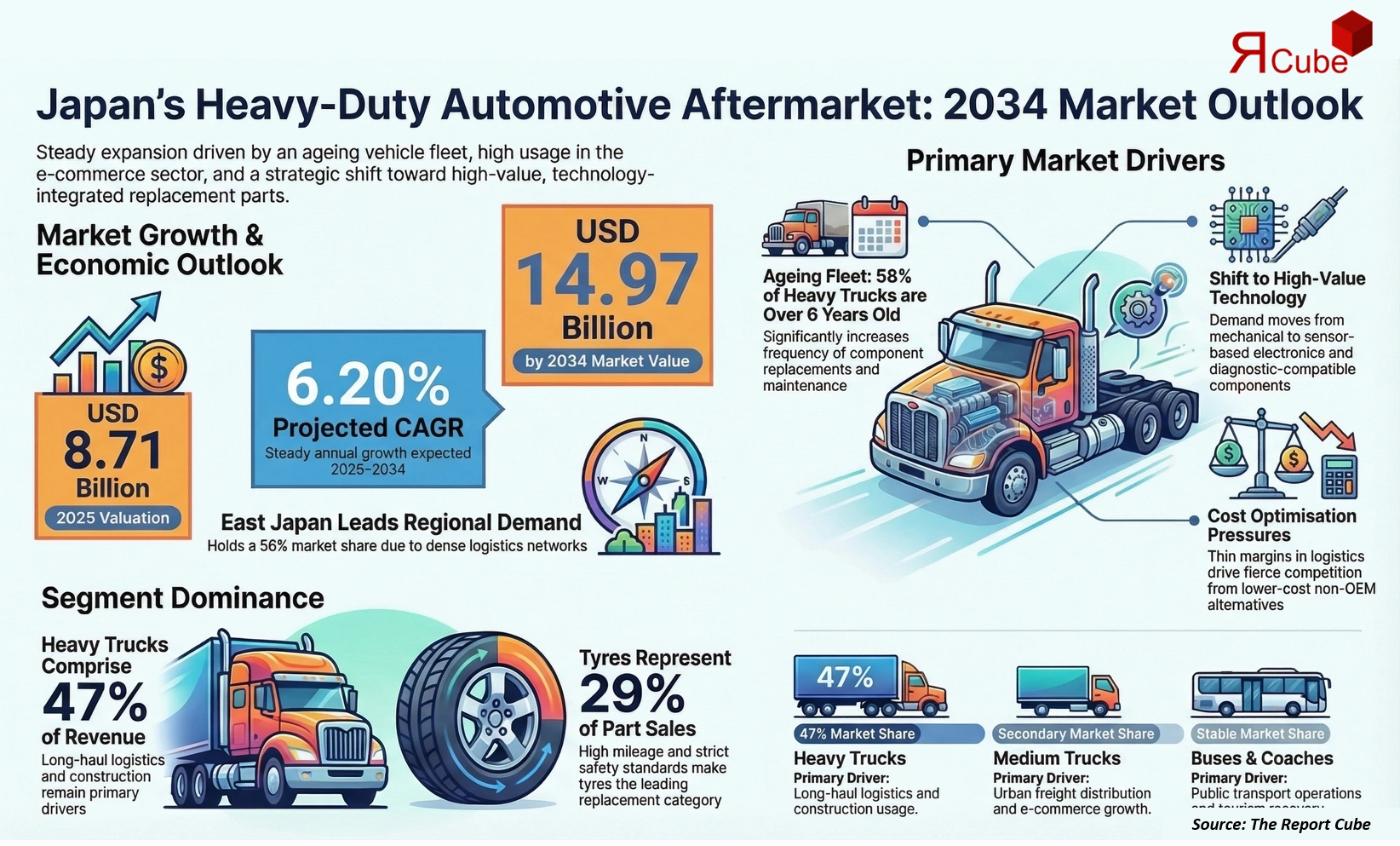
The Japan Heavy-Duty Automotive Aftermarket Market is anticipated to register a CAGR of 6.20% during the forecast period 2026-2034. The market size was valued at USD 8.71 billion in 2025 and is projected to reach USD 14.97 billion by 2034. This steady expansion reflects Japan’s strong logistics backbone, high utilization rates of commercial vehicles, and a growing focus on extending vehicle lifecycle efficiency.
Japan’s heavy-duty vehicle fleet is aging, with a significant proportion of trucks and buses operating beyond seven years, which directly drives replacement demand for critical components. Fleet operators increasingly prioritize preventive maintenance and timely replacement of wear-and-tear parts to reduce downtime and comply with strict safety and emission regulations. This behavior supports consistent demand across tires, brake systems, filters, and electronic components, forming the backbone of aftermarket revenues.
Additionally, the rapid growth of e-commerce, urban freight distribution, and intercity logistics has intensified vehicle usage, accelerating component replacement cycles. At the same time, technological integration in heavy-duty vehicles has increased the value share of advanced electronics and diagnostic-compatible parts. These interconnected factors position the Japan Heavy-Duty Automotive Aftermarket Market as a resilient and opportunity-rich segment within the country’s broader automotive ecosystem.
Japan Heavy-Duty Automotive Aftermarket Market Recent Developments
- 2025: Bridgestone expanded its premium truck tire lineup in Japan, focusing on fuel efficiency and extended tread life.
- 2025: Denso Corporation enhanced aftermarket electronic diagnostics support for heavy-duty commercial vehicles.
Government Initiatives & Policies
- Green Growth Strategy: Promotes low-emission commercial vehicles and maintenance efficiency improvements.
- Logistics DX Policy: Supports digitalization and efficiency upgrades across commercial transport operations.
Japan Heavy-Duty Automotive Aftermarket Market Dynamics
Key Driver: Aging Commercial Vehicle Fleet and High Utilization Rates
The primary driver of the Japan Heavy-Duty Automotive Aftermarket Market is the aging profile of the country’s commercial vehicle fleet combined with consistently high utilization rates. Trucks and buses in Japan often operate for extended service lives due to high upfront acquisition costs and disciplined maintenance culture. As vehicles age, the frequency of component replacement increases, particularly for tires, brake parts, filters, and batteries. In 2024, over 58% of heavy-duty trucks in operation were older than six years, directly supporting aftermarket demand. High daily mileage in logistics and public transport further accelerates wear, making routine maintenance unavoidable. This structural dependence on replacement parts ensures stable revenue streams for aftermarket suppliers, even during periods of slower new vehicle sales.
Book your FREE 30-minute expert consultation today
Contact UsIndustry Trends: Shift Toward High-Value and Technology-Integrated Components
A key trend shaping the market is the shift toward high-value replacement parts that integrate electronic and sensor-based technologies. Modern heavy-duty vehicles increasingly rely on electronic braking systems, engine management sensors, and advanced lighting solutions. As a result, the aftermarket is evolving beyond mechanical components toward technology-intensive products. Lighting and electronics, turbochargers, and advanced exhaust systems are witnessing faster growth than traditional parts. Additionally, predictive maintenance tools and compatibility with onboard diagnostics are becoming critical differentiators among suppliers. This trend is strengthening partnerships between OEMs and aftermarket players while raising average revenue per vehicle serviced.
Major Challenge: Price Sensitivity and Cost Optimization Pressures
Despite growth prospects, cost sensitivity among fleet operators poses a significant challenge. Logistics companies operate on thin margins and often seek cost-effective aftermarket alternatives, intensifying competition among suppliers. The presence of parallel imports and lower-cost non-OEM parts exerts downward pressure on pricing. Moreover, rising raw material and logistics costs have squeezed supplier margins, limiting pricing flexibility. Balancing affordability with quality assurance remains a persistent challenge, particularly for smaller aftermarket players competing against established OEM-backed brands.
Opportunity: Expansion of Preventive Maintenance and Service Contracts
The growing adoption of preventive maintenance programs presents a strong opportunity for the Japan Heavy-Duty Automotive Aftermarket Market. Fleet operators are increasingly shifting from reactive repairs to scheduled maintenance contracts to minimize unexpected breakdowns. This approach increases demand consistency for filters, brake parts, fluids, and electronic components. Service bundling and long-term supply agreements are gaining popularity, enabling aftermarket players to secure predictable revenue streams. As logistics digitalization expands, data-driven maintenance planning is expected to further boost demand for high-quality replacement parts, creating sustained growth opportunities.
Japan Heavy-Duty Automotive Aftermarket Market Segment-wise Analysis
By Replacement Part:
- Tires
- Batteries
- Brake Parts
- Filters
- Body Parts
- Lighting & Electronics
- Wheels
- Exhaust Parts
- Turbochargers
- Others
Tires dominate the replacement part segment, accounting for approximately 29% of the total market share in 2025. High mileage, stringent safety standards, and seasonal tire replacement requirements drive consistent demand. Brake parts follow closely, supported by regulatory inspection cycles and urban stop-and-go driving conditions. Lighting and electronics are emerging as fast-growing sub-segments due to increasing vehicle electrification and safety upgrades. Together, these segments highlight a balanced demand mix between high-volume consumables and higher-margin technology-driven components.
By Vehicle Type:
- Medium Trucks
- Heavy Trucks
- Buses & Coaches
Heavy trucks represent the leading vehicle type, contributing nearly 47% of aftermarket revenue. Their extensive use in long-haul logistics and construction results in frequent component replacement. Medium trucks follow, driven by urban and regional distribution growth linked to e-commerce. Buses and coaches maintain stable demand, supported by public transport operations and tourism recovery. Each vehicle category contributes uniquely, ensuring diversified demand across the aftermarket ecosystem.
Regional Projection of Japan Heavy-Duty Automotive Aftermarket Industry
- East Japan
- West Japan
East Japan leads the market with an estimated 56% share, supported by dense logistics networks, industrial hubs, and higher vehicle concentration around metropolitan areas such as Tokyo and Yokohama. The region experiences higher fleet utilization, accelerating replacement cycles for tires, brakes, and electronic components. West Japan follows with steady growth driven by manufacturing activity and regional freight movement. East Japan’s dominance is expected to continue through 2034, supported by infrastructure investment and logistics modernization initiatives.
Need insights for a specific region within this market?
Request Regional DataWhy Choose This Report?
- Provides a comprehensive overview of the overall market analysis, encompassing key trends, consumer behavior analysis, and risk assessment to support strategic decision-making.
- Provides accurate, up-to-date insights into market size, segmentation, and emerging opportunities, helping to minimize risk & capitalizing on growth.
- Gives deep understanding of target audience preferences, investment habits, and communication channels for enhanced product development & marketing effectiveness.
- Delivers competitive analysis & benchmarking, uncovering the strengths & weaknesses of market competitors to guide strategies.
- Consolidate comprehensive market intelligence, reducing reasoning & streamlining research efforts.
- Facilitates customized market segmentation & risk mitigation strategies, fine-tuned to the business objectives.
- Aids in identifying both market challenges & untapped opportunities within the industry to drive long-term business growth.
- Provides valuable information based on actual customer data & search trends.
Table of Contents
- Introduction
- Objective of the Study
- Product and Category Definition
- Market Segmentation
- Study Variables
- Research Methodology
- Secondary Data Points
- Breakdown of Secondary Sources
- Primary Data Points
- Breakdown of Primary Interviews
- Secondary Data Points
- Executive Summary
- Market Dynamics
- Drivers
- Challenges
- Opportunity Assessment
- Recent Trends and Developments
- Regulatory and Policy Landscape
- Japan Heavy-Duty Automotive Aftermarket Overview (2020-2034)
- Market Size, By Value (USD Billion)
- Market Share, By Replacement Part
- Tires
- Batteries
- Brake Parts
- Filters
- Body Parts
- Lighting & Electronics
- Wheels
- Exhaust Parts
- Turbochargers
- Others
- Market Share, By Vehicle Type
- Medium Trucks
- Heavy Trucks
- Buses & Coaches
- Market Share, By Service Channel
- OEM Workshops
- Independent Garages
- Fleet Workshops
- Online Platforms
- Market Share, By Customer Type
- Fleet Operators
- Owner-Drivers
- Logistics Firms
- Public Transport
- Market Share, By Region
- East
- West
- Market Share, By Company
- Competition Characteristics
- Revenue Shares & Analysis
- East Japan Heavy-Duty Aftermarket
- Market Size, By Value (USD Billion)
- Market Share, By Replacement Part
- Market Share, By Vehicle Type
- Market Share, By Service Channel
- Market Share, By Customer Type
- Market Share, By Sub-Region
- Kanto
- Tohoku
- Hokkaido
- Chubu (East)
- West Japan Heavy-Duty Aftermarket
- Market Size, By Value (USD Billion)
- Market Share, By Replacement Part
- Market Share, By Vehicle Type
- Market Share, By Service Channel
- Market Share, By Customer Type
- Market Share, By Sub-Region
- Kansai
- Chugoku
- Shikoku
- Kyushu & Okinawa
- Competitive Outlook and Company Profiles
- Hino Motors
- Company Overview
- Aftermarket Portfolio
- Service Network & Partnerships
- Recent Developments
- Isuzu Motors
- Company Overview
- Aftermarket Portfolio
- Service Network & Partnerships
- Recent Developments
- Mitsubishi Fuso
- Company Overview
- Aftermarket Portfolio
- Service Network & Partnerships
- Recent Developments
- UD Trucks
- Company Overview
- Aftermarket Portfolio
- Service Network & Partnerships
- Recent Developments
- Denso Corporation
- Company Overview
- Aftermarket Portfolio
- Distribution & Partnerships
- Recent Developments
- Daihatsu Diesel
- Company Overview
- Aftermarket Portfolio
- Distribution & Partnerships
- Recent Developments
- Bridgestone
- Company Overview
- Tire & Service Network
- Fleet Solutions & Partnerships
- Recent Developments
- Yokohama Rubber
- Company Overview
- Tire & Service Network
- Fleet Solutions & Partnerships
- Recent Developments
- Continental AG
- Company Overview
- Aftermarket Portfolio
- Distribution & Partnerships
- Recent Developments
- Robert Bosch
- Company Overview
- Aftermarket Portfolio
- Workshop Network & Partnerships
- Recent Developments
- Others
- Hino Motors
- Contact Us and Disclaimer
Top Key Players & Market Share Outlook
- Hino Motors
- Isuzu Motors
- Mitsubishi Fuso
- UD Trucks
- Denso Corporation Distribution & Partnerships
- Daihatsu Diesel Distribution & Partnerships
- Continental AG Distribution & Partnerships
- Others
Frequently Asked Questions






