



Build Your Custom Market Intelligence Report
Customize Your ReportKey Highlights
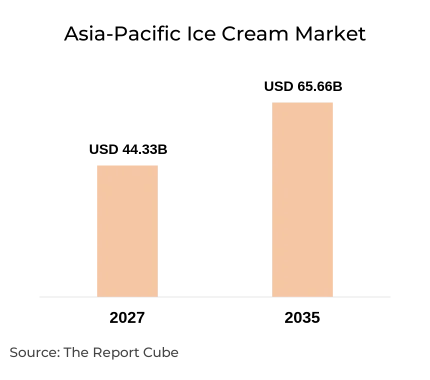
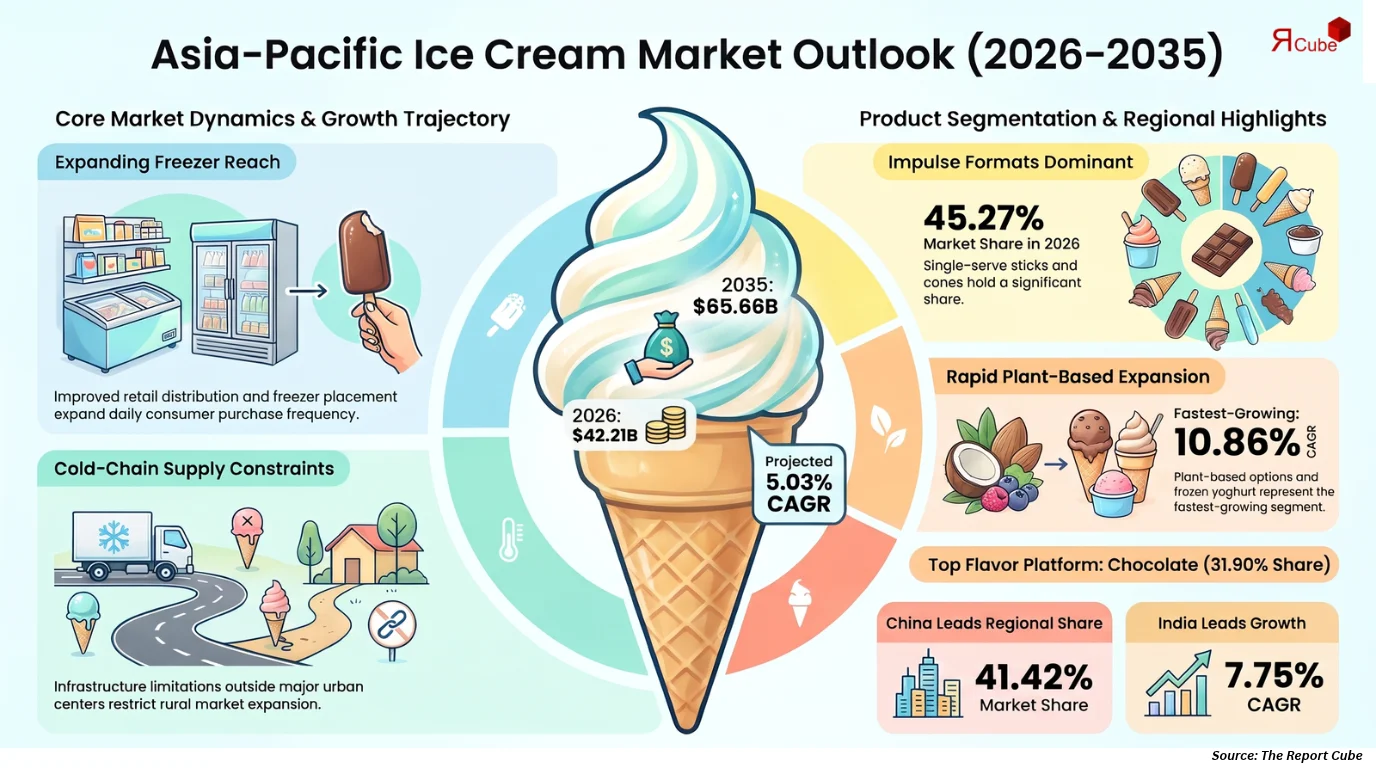
- Asia-Pacific ice cream market size is estimated at USD 42.208 billion in 2026, reflecting a provisional base-year value in nominal USD terms.
- The market is forecast to reach USD 65.658 billion by 2035, supported by continued expansion of packaged and frozen-snack consumption occasions.
- The market is projected to grow at a CAGR of 5.03% during 2027–2035, calculated over eight annual intervals.
- By type, Impulse Ice Cream is estimated to lead with 45.27% value share in 2026, while Frozen Yoghurt and Plant-Based Options is forecast to grow fastest at a 10.86% CAGR during 2027–2035.
- China leads the regional allocation with a 41.42% share in 2026, supported by scale in urban retail distribution and higher frequency frozen-snack purchasing occasions.
- Rising access to frozen snacks across populous Asian markets is the primary demand driver, as freezer reach and retail density expand consumption frequency and assortment availability.
- October 2026 performance disclosures from The Magnum Ice Cream Company reported organic sales growth of 9.6%, indicating continued innovation-led momentum in branded formats and occasions.
Market Outlook
Demand in Asia-Pacific is concentrated in high-population countries where modern retail density, freezer access, and convenience formats enable frequent consumption. Impulse purchases through convenience stores and grocery chains remain structurally important, while take-home packs support family consumption and promotional bundles. Artisanal outlets and foodservice contribute to premium occasions in larger cities, but packaged products dominate scalable distribution. China anchors regional value demand, while India and parts of Southeast Asia represent incremental distribution-led headroom as availability improves.
Supply is led by a mix of large domestic dairy groups and multinational brand owners competing through product format breadth, cold-chain execution, and route-to-market coverage. Manufacturers differentiate using texture, inclusions, and localized flavor profiles, while also managing high-volume mainstream sticks and cups that match price sensitivity. Modern grocery retailers play a central role in shelf placement and promotional mechanics, and specialized parlours protect premium margins in dense urban districts. Competitive advantage is closely linked to freezer footprint access and consistent replenishment capability.
Customer requirements are shifting toward clearer product positioning, stronger food-safety assurance, and more visible nutrition and ingredient communication, particularly for premium and family formats. Regulators and industry standards across major markets influence labeling, category naming, and compositional definitions, affecting how brands position dairy versus non-dairy offerings. At the same time, digital ordering and last-mile delivery impose tighter requirements on temperature control, packaging insulation, and service-level reliability to protect product integrity during transit.
Government Regulations
Regulatory requirements in Asia-Pacific are not uniform, but leading markets apply specific food-safety and labeling frameworks that shape formulation, naming, and claims. In China, national food safety standards for frozen beverages cover ice cream and related frozen confections, establishing baseline compliance expectations for manufacturers and importers. In India, the Food Safety and Standards Authority of India sets product definitions and labeling requirements that distinguish ice cream from frozen dessert products, including mandatory label declarations for relevant subtypes.
These rules directly influence ingredient selection, process control, and documentation, which can increase compliance effort for brands operating across multiple jurisdictions. Labeling and category definitions affect front-of-pack communication and may constrain how dairy-equivalent claims are presented for non-dairy alternatives. In Japan, ministerial ordinances and related labeling guidance define compositional categories for ice cream types and influence how milk-related terms may be displayed, affecting both premium positioning and consumer transparency. Multi-country operators typically respond by adapting recipes, pack claims, and QC procedures by destination market rather than relying on a single regional specification.
Future regulatory direction is expected to continue emphasizing traceability, accurate labeling, and risk-based inspection for processed foods, including frozen categories. As online ordering expands, authorities are also likely to maintain scrutiny on cold-chain integrity and labeling accuracy for delivery-based retail. Commercially, this raises the value of standardized quality systems and strong distributor compliance, while increasing the complexity and cost of rapid cross-border expansion for emerging brands without established regulatory capability.
Asia-Pacific Ice Cream Market Dynamics
Market performance is shaped by distribution reach, cold-chain reliability, and the ability of brands to translate product innovation into repeat purchase at scale. The most material dynamics relate to access expansion in populous markets, operational constraints in secondary territories, and shifting preferences toward localized premium propositions and plant-forward alternatives. These factors collectively influence category availability, mix, pricing, and the pace at which demand broadens beyond major cities.
| Factor | Type | Specific Impact on Market | Impact Magnitude |
|---|---|---|---|
| Rising access to frozen snacks across populous Asian markets | Driver | Expands purchase frequency and assortment availability as freezer reach and retail density improve, supporting higher value sales across impulse and take-home formats. | High |
| Cold-chain gaps beyond major cities | Challenge | Limits penetration into lower-density territories and increases operating costs and spoilage risk, slowing scalable distribution expansion and constraining smaller brands. | High |
| Localized premium innovation alongside affordable mainstream formats | Trend | Shifts product development toward culturally familiar flavors, mini portions, and premium novelties while maintaining mass-market formats, influencing mix and margin structure. | Medium–High |
| Secondary city and Southeast Asian distribution expansion | Opportunity | Creates addressable-market growth through targeted route-to-market buildout, starting with low-ticket formats and scaling into higher-value packs as freezer density improves. | Medium–High |
Market Drivers
Expanding freezer reach and retail density increasing consumption occasions for frozen snacks
Access expansion is the primary demand mechanism because ice cream consumption depends on reliable freezing capacity at retail and in transit. In large, densely populated markets, incremental freezer placement and improved distribution execution translate into more purchase occasions, particularly for impulse sticks, cones, and single-serve cups. As availability improves, retailers can carry broader assortments, and brands can introduce differentiated SKUs without sacrificing in-stock reliability, supporting both volume growth and a gradual premium mix.
Modelled allocations indicate that China remains the largest regional demand center with a 41.42% share in 2026, demonstrating how scale and retail infrastructure concentrate regional value. The overall market is estimated at USD 42.208 billion in 2026 and is forecast to reach USD 65.658 billion by 2035, implying that expansion is not solely price-led but also linked to broader access and mix development. The type structure also reflects access-driven consumption, with impulse estimated at 45.27% share in 2026.
Commercially, access-led demand favors operators that can finance freezer programs, manage replenishment, and tailor pack sizes to channel economics. Impulse formats benefit first from improved coverage because they match convenience-led missions and require less household freezer capacity. Over time, stronger distribution can also support take-home and premium packs, provided temperature stability and inventory discipline improve. The most defensible growth strategies therefore combine route execution with localized innovation, rather than relying on premiumization alone in access-constrained territories.
Need Specific Data, Let’s Customize the Report for You
Request CustomizationMarket Challenges
Cold-chain limitations constraining scale-up outside major urban centers
Cold-chain gaps remain the defining constraint because product integrity and consumer trust depend on consistent frozen storage, handling, and delivery. Beyond tier-one cities, reliability issues in power supply, freezer servicing, and refrigerated transport can restrict the number of viable outlets and reduce the practical range of premium and multi-serve products. The constraint is most acute in hot and humid climates where temperature excursions accelerate melt risk, shrink, and quality complaints.
The distribution-channel mix highlights the operational exposure: online and e-commerce platforms are forecast to grow at a 13.04% CAGR during 2027–2035, but delivery expansion increases the importance of last-mile temperature control and insulated packaging. Geographic allocations also imply uneven readiness, with India modelled as the fastest-growing geography at a 7.75% CAGR during 2027–2035, a profile consistent with high potential but meaningful infrastructure variability across states and city tiers. These patterns reinforce that expansion depends on logistics capability, not only consumer demand.
The near-term implication is margin pressure for brands that attempt rapid coverage growth without sufficient cold-chain controls, because losses and service failures can offset gross sales gains. Larger producers with established networks can dilute fixed logistics costs across higher throughput, while smaller brands face financing constraints and must prioritize corridor-based expansion. Mitigation typically includes tighter distributor qualification, telemetry-enabled freezer monitoring where feasible, and SKU rationalization toward formats that tolerate distribution variability without undermining brand positioning.
Recent Market Trends
Brands balancing mass-market affordability with localized premium and culturally relevant product innovation
Manufacturers are increasingly combining affordable mainstream products with localized premium innovation to protect volume while improving mix. This shift reflects the need to win frequent, low-ticket purchases in convenience-led channels while still creating differentiated reasons to pay more in urban grocery and specialty outlets. The trend is visible in the use of culturally familiar flavors, texture-led novelties, and smaller premium portions that reduce price barriers without abandoning premium positioning.
Recent company disclosures support the strategic focus on innovation and format expansion in branded portfolios. In October 2026, The Magnum Ice Cream Company reported organic sales growth of 9.6%, with volume growth of 7.3% and price growth of 2.2%, indicating that innovation and execution can still deliver demand gains in mature and emerging markets. The model also projects higher growth for non-dairy and plant-forward propositions, with non-dairy category value forecast to expand at an 11.96% CAGR during 2027–2035.
This trend raises the value of agile product development and localized sourcing that can support limited-run flavors and faster renovation cycles without disrupting base assortment stability. It also increases competitive intensity in premium shelves where brand differentiation depends on sensory performance, ingredient signaling, and consistent cold-chain handling. Over the forecast period, operators that combine disciplined core-volume formats with selective premium launches are more likely to protect margins while scaling into new channels such as delivery and specialty retail.
Future Market Opportunities
Secondary-city rollout and Southeast Asian route-to-market buildout expanding the addressable market
The strongest opportunity is distribution expansion into secondary cities and Southeast Asian corridors where freezer penetration and modern trade footprints are still developing. Addressable-market growth comes from adding reliable outlets and repeat purchase occasions rather than assuming uniform nationwide access. Brands can typically enter with low-ticket sticks and cones that match impulse behavior and constrained household freezer space, then expand into branded tubs, bricks, and premium multipacks once replenishment reliability and consumer familiarity are established.
Forecast allocations provide directional support for where incremental value may emerge. ASEAN and Rest of Asia-Pacific is modelled to rise to a 19.00% share by 2035, while India is projected to expand to a 13.00% share by 2035, reflecting the scenario assumption of broader access and faster penetration. Channel forecasts show online and e-commerce platforms increasing to a 9.00% share by 2035, reinforcing that route-to-market design must increasingly integrate delivery-ready packs and last-mile temperature protection.
Capturing this opportunity requires disciplined execution capabilities, including distributor selection, freezer asset management, and SKU architecture matched to local price points and climate exposure. Domestic dairy groups may benefit from milk sourcing and established retail relationships, while international operators can contribute product development systems and global brand equities, subject to local adaptation. Commercial uncertainty remains tied to cold-chain investment economics and the pace of modern retail expansion, which can vary meaningfully across city tiers and countries.
Asia-Pacific Ice Cream Market Segmentation Analysis
By Type
- Impulse Ice Cream
- Take-Home Ice Cream
- Artisanal and Unpackaged Ice Cream
- Frozen Yoghurt and Plant-Based Options
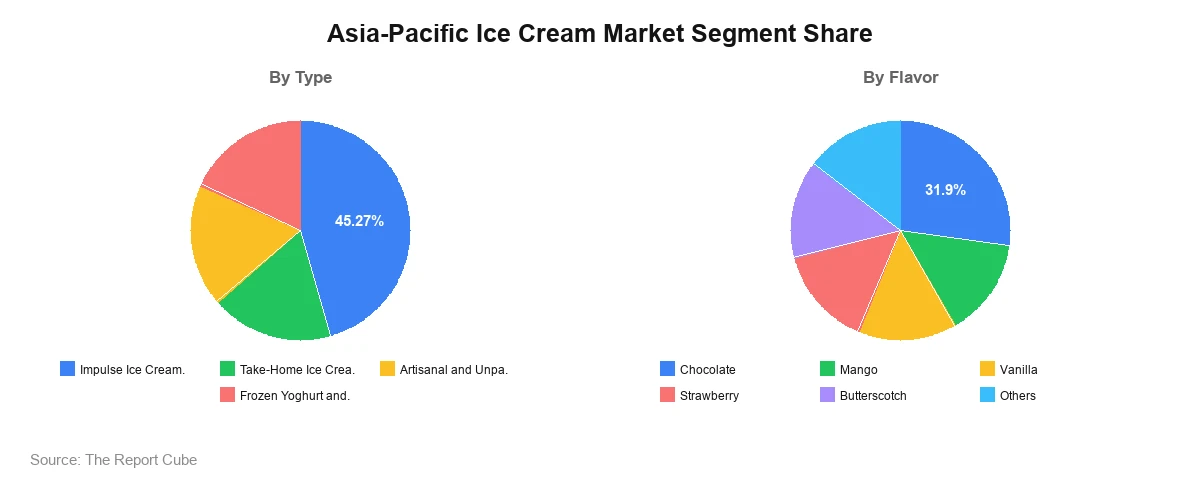
Impulse Ice Cream is estimated to account for 45.27% of Asia-Pacific market value in 2026, reflecting the importance of convenience-led occasions and widespread single-serve merchandising in grocery and small-store formats. The segment benefits from high purchase frequency, low unit price points that suit broad affordability bands, and strong suitability for freezer placement in high-traffic retail locations. Its scale also supports operational efficiency for leading manufacturers through standardized production and distribution of sticks and cones, even as regional preferences drive flavor rotation and limited-run novelty formats.
Frozen Yoghurt and Plant-Based Options is forecast to record the fastest value growth, with a modelled CAGR of 10.86% during 2027–2035. Growth is supported by incremental demand for variety, perceived wellness alignment, and dietary alternatives, as well as brand efforts to improve taste and texture parity with dairy. As the segment scales, manufacturers will need stronger ingredient supply control, clear labeling and claims governance, and delivery-ready packaging, because these products often target urban modern trade and digital ordering occasions where service expectations are high.
By Flavor
- Chocolate
- Mango
- Vanilla
- Strawberry
- Butterscotch
- Others
Chocolate is estimated as the leading flavor with a 31.9% share in 2026, reflecting broad appeal and compatibility with inclusions and premium line extensions. Large-scale producers use chocolate as a core platform for mainstream sticks, cups, and cones, while premium tiers differentiate through cocoa intensity, coated formats, and layered textures. This base demand profile supports consistent production planning and promotional activity across modern grocery outlets, even as localized flavors expand the assortment around the core segment.
Mango is projected as the fastest-growing named flavor with a 6.64% CAGR during 2027–2035, consistent with increasing localization of fruit-forward profiles across South Asia and Southeast Asia. Commercial upside is linked to innovation in fruit inclusions, sorbet-style textures, and hybrid dairy and fruit concepts that can bridge premium and mass segments. Brand success will depend on maintaining flavor consistency and supply reliability for fruit inputs while delivering stable frozen quality through varied climates and distribution conditions.
Asia-Pacific Ice Cream Market Regional Analysis
Regional performance varies materially across Asia-Pacific because consumption intensity, modern trade penetration, and cold-chain readiness differ by country and city tier. China anchors value demand through scale, while Japan and Australia and New Zealand exhibit mature retail structures. India and parts of ASEAN represent higher-growth potential where distribution buildout and affordability expansion can translate into new purchase occasions. These differences shape optimal pack architecture, channel priorities, and the speed of premium and non-dairy adoption.
| Region | Estimated Market Share | Key Growth Factors | Industry Trends |
|---|---|---|---|
| China | 41.42% | Large urban consumer base and extensive modern retail freezer reach supporting high-frequency impulse and take-home purchases | Growing mix of localized premium novelties alongside high-volume mainstream formats |
| India | - | Expanding distribution footprint and rising accessibility in fast-growing cities, supporting incremental penetration beyond metro markets | Faster adoption of localized flavors and delivery-led purchasing in major urban clusters |
| Japan | - | Mature retail and strict category and labeling practices supporting stable mainstream demand and premium segmentation | Premium texture and ingredient differentiation in branded products and convenience-led single-serve formats |
| South Korea | - | Strong convenience-store culture and high acceptance of packaged novelties supporting impulse turnover | Frequent product rotation and innovation cycles in branded sticks and cups |
| Australia and New Zealand | - | High modern grocery penetration and stable cold-chain execution enabling multi-serve take-home formats | Sustained demand for premium dairy and growing shelf presence of plant-forward alternatives |
| ASEAN and Rest of Asia-Pacific | - | Distribution expansion across fast-growing cities and retail modernization supporting new outlets and occasions | Rising relevance of small packs and selective e-commerce growth where last-mile cold-chain is reliable |
China is the leading geography with an estimated 41.42% share in 2026, reflecting scale effects in modern retail infrastructure and higher frequency purchase occasions supported by freezer availability. The country also provides the largest platform for innovation to scale quickly across grocery and convenience channels, which supports both mainstream volume and selective premium mix. Commercially, China’s scale makes it a priority market for brand owners seeking to amortize product development and packaging investments, although competitive intensity and retailer bargaining power can pressure margins.
India is modelled at a 10.30% share in 2026 but is forecast to be the fastest-growing geography with a 7.75% CAGR during 2027–2035, indicating distribution-led headroom. Growth is likely to be uneven across states and city tiers, so corridor-based expansion and disciplined freezer economics are critical. Brands that win repeat purchase through affordable sticks and cones are better positioned to broaden into take-home packs as cold-chain reliability improves.
Competitive Landscape
Company Profiles
Inner Mongolia Yili Industrial Group Yili is a major Chinese dairy group with a wide consumer portfolio and established national distribution capabilities. In ice cream, its competitive relevance is tied to the ability to scale mainstream dairy formats through modern grocery and convenience channels while maintaining consistent cold-chain execution. The company’s strength is typically expressed through broad SKU coverage, price-tier architecture from value to premium, and the operational capacity to support promotions and seasonal demand swings. Its positioning benefits from domestic sourcing and route control, which are important in a category where freezer placement and replenishment reliability determine on-shelf availability.
China Mengniu Dairy Mengniu is a large Chinese dairy participant with branded reach and a broad retail presence that supports packaged ice cream distribution. Its market role is anchored in mainstream dairy offerings across impulse and take-home formats, where scale helps optimize production planning, packaging procurement, and refrigerated distribution. Commercial performance is influenced by retailer negotiations in modern trade and the company’s capacity to refresh flavor and format assortments without disrupting core volume lines. As competition increases in premium novelties and localized innovation, the company’s route-to-market execution remains a central differentiator.
Recent Developments and Updates
- October 2026 - The Magnum Ice Cream Company: Q3 2026 trading update reported organic sales growth of 9.6%, comprising volume growth of 7.3% and price growth of 2.2%, highlighting continued brand momentum and innovation-led performance.
- December 2025 - Unilever and The Magnum Ice Cream Company: Unilever completed the demerger of its Ice Cream business into The Magnum Ice Cream Company, establishing a standalone ice cream group intended to operate with separate listings and investor disclosures.
- July 2026 - The Magnum Ice Cream Company: Half-year 2026 results reported revenue of EUR 4.7 billion and organic sales growth of 4.7%, balanced between volume and pricing, supporting ongoing portfolio renovation across major brands.
Asia-Pacific Ice Cream Market Future Outlook
During 2027–2035, the market is expected to expand as freezer reach improves and modern trade and delivery channels increase category availability in more cities. Mix is likely to shift gradually toward higher-growth segments such as non-dairy and plant-forward options and toward formats suited to on-demand delivery, while mainstream dairy impulse products remain the largest value pool. Growth realization depends on disciplined cold-chain investment, route densification, and price architecture that sustains affordability in emerging urban clusters.
Competitive strategy is expected to emphasize distribution execution, SKU rationalization by channel, and faster localized innovation cycles that protect margin without sacrificing base volume. Companies with strong retail partnerships and freezer asset management can scale corridor-based expansion more efficiently, while smaller brands may pursue focused city clusters and premium niches. Key risks include uneven infrastructure readiness, increased logistics costs, and stricter compliance expectations for labeling and food-safety management as cross-border trade and delivery penetration increase.
Asia-Pacific Ice Cream Market Report Coverage
| Parameter | Details |
|---|---|
| Market Name | Asia-Pacific Ice Cream Market |
| Base-Year Market Size | USD 42.208 billion in 2026 |
| Forecast Market Size | USD 65.658 billion in 2035 |
| Market CAGR | 5.03% during 2027–2035 |
| Historical Period | 2021–2025 |
| Base Year | 2026 |
| Forecast Period | 2027–2035 |
| Geographic Coverage | China; India; Japan; South Korea; Australia and New Zealand; ASEAN and Rest of Asia-Pacific |
| Market Segmentation | Type; Flavor; Product; Category; Distribution Channel |
| Subsegment Coverage | Type: Impulse Ice Cream, Take-Home Ice Cream, Artisanal and Unpackaged Ice Cream, Frozen Yoghurt and Plant-Based Options. Flavor: Chocolate, Mango, Vanilla, Strawberry, Butterscotch, Others. Product: Cup, Stick, Cone, Brick, Tub, Others. Category: Dairy, Non-Dairy including plant-based. Distribution: Modern Grocery Retailers, Traditional Small Grocers, Specialized Ice Cream Parlours, Online and e-commerce platforms. |
| Key Companies Covered | Inner Mongolia Yili Industrial Group; China Mengniu Dairy; GCMMF Amul; The Magnum Ice Cream Company; Lotte Wellfood; Meiji Holdings; Froneri International; Morinaga Milk Industry; Binggrae; Aice Group; Bulla Dairy Foods; Ezaki Glico |
| Research Coverage | Market size and forecast, market outlook, government regulations, market dynamics, drivers, challenges, trend, opportunity, segmentation analysis, regional analysis, competitive landscape, recent developments, future outlook, and FAQs |
| Customisation Options | Not specified |
Why Choose This Asia-Pacific Ice Cream Market Report?
- Assess Asia-Pacific market expansion drivers and constraints with clear cause-and-effect analysis tied to distribution access and cold-chain execution.
- Identify which segments lead current value and which are forecast to grow fastest across type, category, format, flavor, and distribution channel views.
- Understand how regional differences across China, India, Japan, South Korea, Australia and New Zealand, and ASEAN influence route-to-market strategy.
- Evaluate competitive positioning of major regional and multinational participants based on defensible operating capabilities and channel relevance.
- Benchmark regulatory considerations that influence labeling, category definitions, and quality management practices across major Asia-Pacific markets.
- Examine how premium localization, non-dairy adoption, and e-commerce growth may reshape product and channel mix through 2035.
Table of Contents
- Introduction
- Objective of the Study
- Product Definition
- Market Segmentation
- Study Variables
- Research Methodology
- Secondary Data Points
- Companies Interviewed
- Primary Data Points
- Breakdown of Primary Interviews
- Secondary Data Points
- Executive Summary
- Market Dynamics
- Drivers
- Challenges
- Opportunity Assessment
- Recent Trends and Developments
- Policy and Regulatory Landscape
- Asia-Pacific Ice Cream Market Overview and Forecast Analysis (2022-2035)
- Market Size, By Value, By Growth Rate (CAGR/USD Billions)
- Demand – Supply Trends
- Market Share, By Type
- Impulse Ice Cream
- Take-Home Ice Cream
- Artisanal/Unpackaged Ice Cream
- Frozen Yoghurt and Plant-Based Options
- Market Share, By Flavor
- Chocolate
- Mango
- Vanilla
- Strawberry
- Butterscotch
- Others
- Market Share, By Product
- Cup
- Stick
- Cone
- Brick
- Tub
- Others
- Market Share, By Category
- Dairy
- Non-Dairy (Including Plant-Based)
- Market Share, By Distribution Channel
- Modern Grocery Retailers
- Traditional Small Grocers
- Specialized Ice Cream Parlours
- Online/E-commerce Platforms
- Market Share, By Region
- East Asia
- South Asia
- Southeast Asia
- Oceania
- Rest of Asia-Pacific
- Market Share, By Competitors
- Competition Characteristics
- Revenue Shares
- Impulse Ice Cream Asia-Pacific Ice Cream Market Overview, 2022-2035F
- By Value (USD Million)
- By Flavor – Market Size & Forecast 2022-2035, USD Million
- Chocolate
- Mango
- Vanilla
- Strawberry
- Butterscotch
- Others
- Take-Home Ice Cream Asia-Pacific Ice Cream Market Overview, 2022-2035F
- By Value (USD Million)
- By Flavor – Market Size & Forecast 2022-2035, USD Million
- Chocolate
- Mango
- Vanilla
- Strawberry
- Butterscotch
- Others
- Artisanal/Unpackaged Ice Cream Asia-Pacific Ice Cream Market Overview, 2022-2035F
- By Value (USD Million)
- By Flavor – Market Size & Forecast 2022-2035, USD Million
- Chocolate
- Mango
- Vanilla
- Strawberry
- Butterscotch
- Others
- Frozen Yoghurt and Plant-Based Options Asia-Pacific Ice Cream Market Overview, 2022-2035F
- By Value (USD Million)
- By Flavor – Market Size & Forecast 2022-2035, USD Million
- Chocolate
- Mango
- Vanilla
- Strawberry
- Butterscotch
- Others
- Competitive Outlook (Company Profile – Partial List)
- Inner Mongolia Yili Industrial Group
- Company Overview
- Business Segments
- Strategic Alliances/Partnerships
- Recent Developments
- China Mengniu Dairy
- Company Overview
- Business Segments
- Strategic Alliances/Partnerships
- Recent Developments
- GCMMF (Amul)
- Company Overview
- Business Segments
- Strategic Alliances/Partnerships
- Recent Developments
- The Magnum Ice Cream Company
- Company Overview
- Business Segments
- Strategic Alliances/Partnerships
- Recent Developments
- Lotte Wellfood
- Company Overview
- Business Segments
- Strategic Alliances/Partnerships
- Recent Developments
- Meiji Holdings
- Company Overview
- Business Segments
- Strategic Alliances/Partnerships
- Recent Developments
- Froneri International
- Company Overview
- Business Segments
- Strategic Alliances/Partnerships
- Recent Developments
- Morinaga Milk Industry
- Company Overview
- Business Segments
- Strategic Alliances/Partnerships
- Recent Developments
- Binggrae
- Company Overview
- Business Segments
- Strategic Alliances/Partnerships
- Recent Developments
- Aice Group
- Company Overview
- Business Segments
- Strategic Alliances/Partnerships
- Recent Developments
- Bulla Dairy Foods
- Company Overview
- Business Segments
- Strategic Alliances/Partnerships
- Recent Developments
- Ezaki Glico
- Company Overview
- Business Segments
- Strategic Alliances/Partnerships
- Recent Developments
- Others
- Inner Mongolia Yili Industrial Group
- Contact Us & Disclaimer
Top Key Players & Market Share Outlook
- Inner Mongolia Yili Industrial Group
- China Mengniu Dairy
- GCMMF (Amul)
- The Magnum Ice Cream Company
- Lotte Wellfood
- Meiji Holdings
- Froneri International
- Morinaga Milk Industry
- Binggrae
- Aice Group
- Bulla Dairy Foods
- Ezaki Glico
Frequently Asked Questions