


Build Your Custom Market Intelligence Report
Customize Your ReportKey Highlights
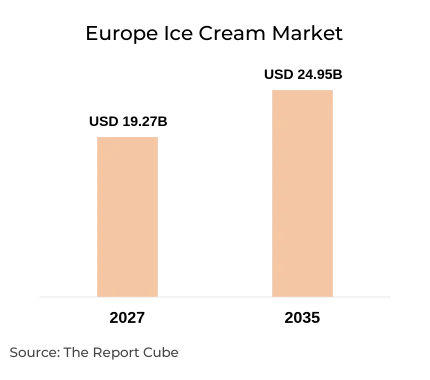
- Europe ice cream market is valued at 18.662 USD billion in 2026, based on a provisional base-year estimate in the supplied dataset.
- The market is forecast to reach 24.956 USD billion by 2035, reflecting an analyst forecast trajectory rather than an audited retail census.
- The market is projected to expand at a CAGR of 3.28% during 2027–2035, calculated over eight annual intervals.
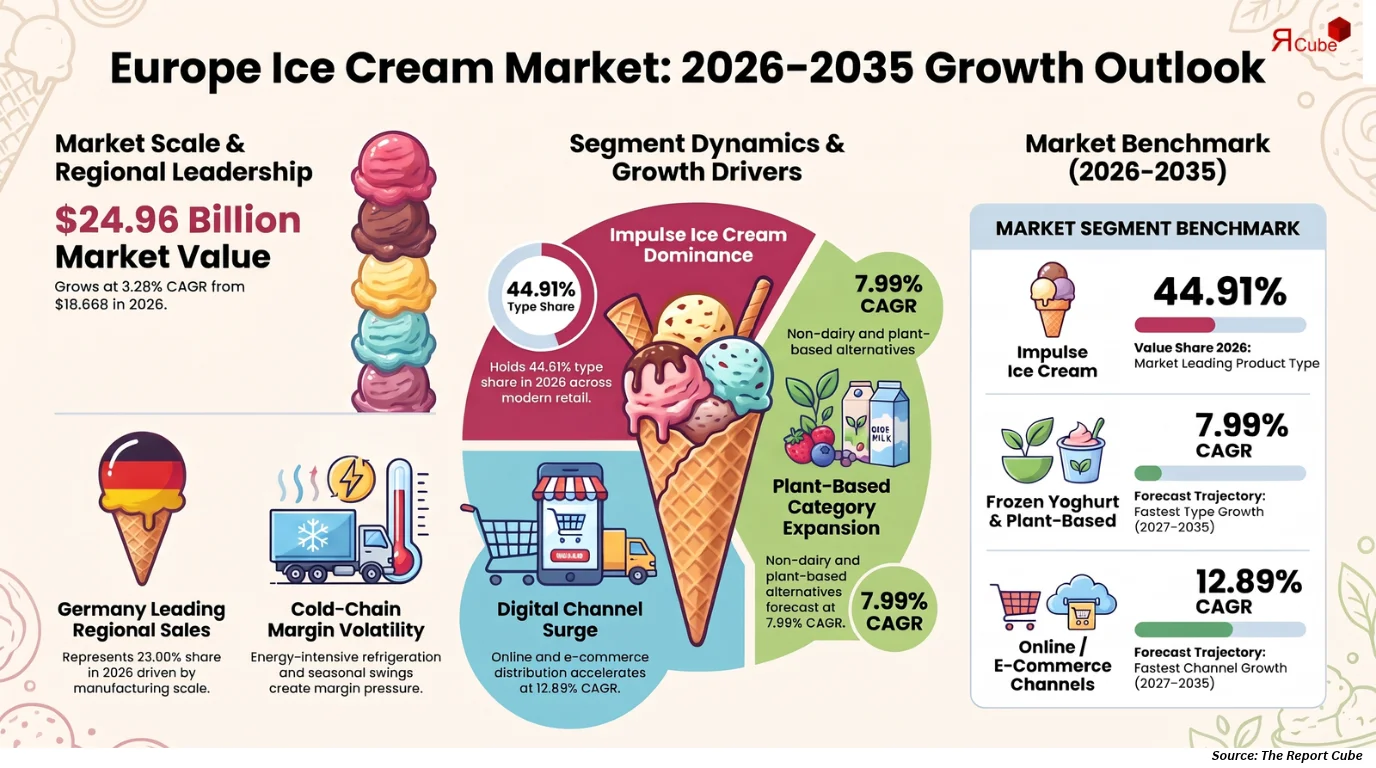
- By type, impulse ice cream is estimated to lead with a 44.91% share in 2026, while frozen yoghurt and plant-based options are forecast to grow fastest at 7.99% CAGR during 2027–2035.
- Germany leads the modelled 2026 geography split with a 23.90% share, supported by scale in packaged retail and manufacturing depth across the broader EU supply base.
- A broad manufacturing base and established consumer habits support repeat purchases, enabling frequent portfolio renovation and reliable seasonal demand capture.
- In October 2026, The Magnum Ice Cream Company reported Q3 2026 organic sales growth of 9.6%, indicating continued emphasis on volume execution and pricing discipline in a competitive category.
Market Outlook
Demand is anchored in packaged retail purchasing, seasonal impulse consumption, and established take-home multipack routines across large grocery chains. Modern grocery retailers represent the main route-to-market by value in the supplied model, while specialist parlours and artisanal outlets remain relevant in tourist and city-centre locations. Consumption patterns vary materially by climate, household shopping cadence, and the balance between branded packaged formats and local artisanal traditions, which creates uneven country-level performance despite a shared regional category identity.
Supply is characterised by a mature manufacturing footprint that supports scale production, extensive freezer distribution, and high-frequency new product introductions. Branded manufacturers compete with private label through portfolio breadth, promotional execution, and the ability to hold product quality through the cold chain. Large players typically win shelf presence through category management capabilities and reliable service levels, while smaller producers tend to focus on differentiated recipes, local provenance, and selective geographic coverage where frozen logistics costs can be contained.
Customer requirements are shifting toward clearer ingredient narratives, dietary variety, and sustainability-aligned packaging and sourcing claims. This is increasing formulation and compliance complexity, particularly for non-dairy and reduced-sugar lines that must still meet sensory expectations such as texture stability and melt performance. In parallel, energy efficiency and operational resilience are becoming more important procurement considerations for retailers and foodservice operators, because freezer operating costs and temperature integrity directly affect shrink, product safety, and margin outcomes.
Government Regulations
Ice cream sold across Europe is governed by a combination of EU-level food law and country-level enforcement, with labelling and food-safety controls shaping product formulation and on-pack claims. Key compliance expectations typically include ingredient and allergen labelling, hygiene and hazard-control procedures, and traceability across manufacturing and distribution, with additional scrutiny for nutrition and marketing claims when products target children or position reduced-sugar or plant-based benefits.
These requirements influence commercial execution by raising the importance of validated supplier specifications, robust cold-chain monitoring, and disciplined quality management to prevent temperature abuse and microbiological risk. For manufacturers, compliance tends to increase documentation, testing, and change-control costs, especially when portfolios expand into non-dairy, allergen-free, or functional-positioned products. Retailers and foodservice buyers often reinforce these requirements through private standards and audit programmes that affect listing decisions and the pace of product renovation.
Regulatory direction is expected to remain focused on transparency and consumer protection, with continued attention to claim substantiation, nutrition information, and packaging sustainability. Companies are likely to prioritise reformulation capability and packaging redesign to align with evolving expectations, while maintaining sensory performance and shelf stability. The main commercial implication is that innovation pipelines increasingly require earlier regulatory review and stronger data support for on-pack statements to protect brand equity and avoid costly recalls or relabelling.
Europe Ice Cream Market Dynamics
Market performance reflects a mature category with stable baseline demand, where incremental value growth is shaped by product mix, channel execution, and cold-chain economics. The most influential dynamics combine industrial capacity that supports consistent availability, operating constraints linked to energy-intensive refrigeration, portfolio premiumisation and dietary expansion, and targeted opportunities in specialty propositions that can justify higher price points when distribution quality is protected.
| Factor | Type | Specific Impact on Market | Impact Magnitude |
|---|---|---|---|
| Broad manufacturing base and established consumer habits sustaining repeat purchases | Driver | Supports consistent supply and frequent innovation cycles, maintaining baseline volume and enabling value uplift through premium formats | High |
| Seasonal demand combined with energy-intensive cold-chain operations | Challenge | Raises operating costs and utilisation risk, increasing margin pressure and constraining aggressive expansion of freezer-dependent distribution | High |
| Premiumisation and dietary variety accelerating plant-based and specialty portfolio expansion | Trend | Shifts product mix toward higher-value and differentiated SKUs, increasing R&D, sourcing, and quality-control requirements | Medium–High |
| Premium artisanal and dietary-specialty products expanding in urban and tourist catchments | Opportunity | Creates headroom for premium pricing and niche brand growth when operators can scale selective distribution and maintain frozen quality | Medium–High |
Market Drivers
Broad manufacturing base and established consumer habits sustaining repeat purchases
Repeat purchasing in Europe is supported by entrenched consumption habits and a supply base designed to serve both impulse and take-home occasions. Large grocery retailers and freezer-equipped convenience points provide wide access to single-serve sticks, cones, and multipacks, while brand owners use frequent seasonal launches to stimulate incremental purchases. This industrial and channel infrastructure reduces availability risk and makes it easier for manufacturers to rotate limited editions and premium lines without rebuilding distribution from first principles.
Official production evidence illustrates the scale of upstream capability supporting the category. Eurostat reported EU ice cream production of 3.44 billion litres in 2025, up about 1.9% versus 2024, with Germany producing 608 million litres. While production volume cannot be treated as retail market value, it signals sustained manufacturing throughput and operational capacity that can support both domestic supply and cross-border flows, particularly for packaged formats distributed through modern retail.
Commercially, this driver favours operators that can convert stable baseline demand into value growth through portfolio architecture, disciplined promotion, and differentiated textures and inclusions. Impulse products benefit from high-visibility placement and seasonal footfall, while take-home lines benefit from household shopping routines and multipack economics. Over the forecast period, the most resilient growth is expected from companies that combine innovation velocity with cold-chain execution, avoiding availability gaps during peak summer periods when category elasticity improves.
Need Specific Data, Let’s Customize the Report for You
Request CustomizationMarket Challenges
Seasonal demand combined with energy-intensive cold-chain operations increasing margin pressure
The category faces a structural constraint from demand seasonality paired with year-round refrigeration requirements across factories, warehouses, retail freezers, and transport. Volume concentration in warmer months can leave capacity underutilised in colder periods, while electricity and fuel costs remain continuous. Labour costs and retailer promotion calendars add further variability, creating a cost base that is difficult to flex in line with temperature-driven demand cycles across different European climates.
The cost exposure is reinforced by the operational reality that frozen distribution requires continuous temperature control and high service levels to limit shrink and product damage. Industry disclosures and public commentary consistently emphasise volume and pricing discipline in response to cost conditions, and company performance updates highlight the need to protect margins even when sales grow. The category’s reliance on refrigerated assets makes it more sensitive to energy-market volatility than many ambient packaged food segments.
This constraint can slow market development by narrowing the viable economics of national freezer-network expansion for smaller brands and limiting the profitability of low-priced SKUs during high-cost periods. Manufacturers typically respond through capacity planning, route optimisation, freezer efficiency upgrades, and tighter SKU rationalisation to prioritise lines with better contribution margins. As a mitigation pathway, selective geographic rollout and partnerships with established distributors can lower fixed costs while maintaining on-shelf service levels.
Recent Market Trends
Premiumisation and dietary variety accelerating plant-based and specialty portfolio expansion
Portfolio strategies are increasingly shifting from standard flavours toward premium textures, differentiated inclusions, and broader dietary coverage, including vegan and plant-based options. This marks a move away from relying primarily on mainstream dairy-led ranges, as manufacturers seek higher-value occasions and respond to shoppers who expect choice across indulgent, better-for-you, and lifestyle-positioned products. The change is also visible in portion-sized innovation designed to support controlled indulgence without sacrificing sensory appeal.
The supplied segmentation outlook indicates faster growth in specialty subcategories, with frozen yoghurt and plant-based options forecast to expand at a 7.99% CAGR during 2027–2035 and the non-dairy category forecast at an 8.38% CAGR during 2027–2035. Company activity also points to sustained focus on brand-led innovation and execution: The Magnum Ice Cream Company reported Q3 2026 organic sales growth of 9.6%, supported by 7.3% volume growth and 2.2% price growth, consistent with active portfolio and pricing management.
The commercial implication is a gradual rebalancing of value toward differentiated and higher-margin SKUs, which increases the importance of formulation expertise, supplier qualification, and quality assurance for novel ingredients. Premium and dietary-led products can command higher price points, but they also raise the bar for stability, mouthfeel, and melt performance in frozen distribution. Over time, manufacturers that scale premiumisation while sustaining service levels in modern retail are likely to strengthen listing resilience and reduce dependence on deep discounting.
Future Market Opportunities
Premium artisanal and dietary-specialty products expanding in urban and tourist catchments
A clear opportunity exists in premium artisanal propositions and dietary-specialty lines that can capture incremental spend in dense urban areas and tourist-driven locations. Consumers in these catchments often accept higher prices for differentiated flavours, local provenance cues, and curated experiences, while retail buyers can support premium shelves with portion-controlled and reduced-sugar options. This opportunity is commercially attractive because it focuses on value per unit rather than only expanding volume, improving the potential return on freezer space.
Modelled growth signals support this direction, particularly where channel formats reduce friction for trial and repeat purchase. Online and e-commerce platforms are forecast to grow at a 12.89% CAGR during 2027–2035, indicating improving digital access and fulfilment models for frozen products in selected markets. In parallel, non-dairy lines are forecast to expand at an 8.38% CAGR during 2027–2035, suggesting sustained innovation headroom for premium plant-based and allergen-aware products when sensory performance is competitive.
To convert this opportunity into durable revenue, companies need disciplined distribution choices and cold-chain capability that protects texture and product integrity in all seasons. Smaller brands typically benefit from selective city-first coverage, partnerships with specialist frozen distributors, and targeted placement in premium retailers and high-footfall venues rather than immediate national rollouts. The primary uncertainty is execution risk in last-mile temperature control and unit economics, which can erode margins if delivery density and freezer utilisation do not reach operational thresholds.
Europe Ice Cream Market Segmentation Analysis
By Type
- Impulse Ice Cream
- Take-Home Ice Cream
- Artisanal/Unpackaged Ice Cream
- Frozen Yoghurt and Plant-Based Options
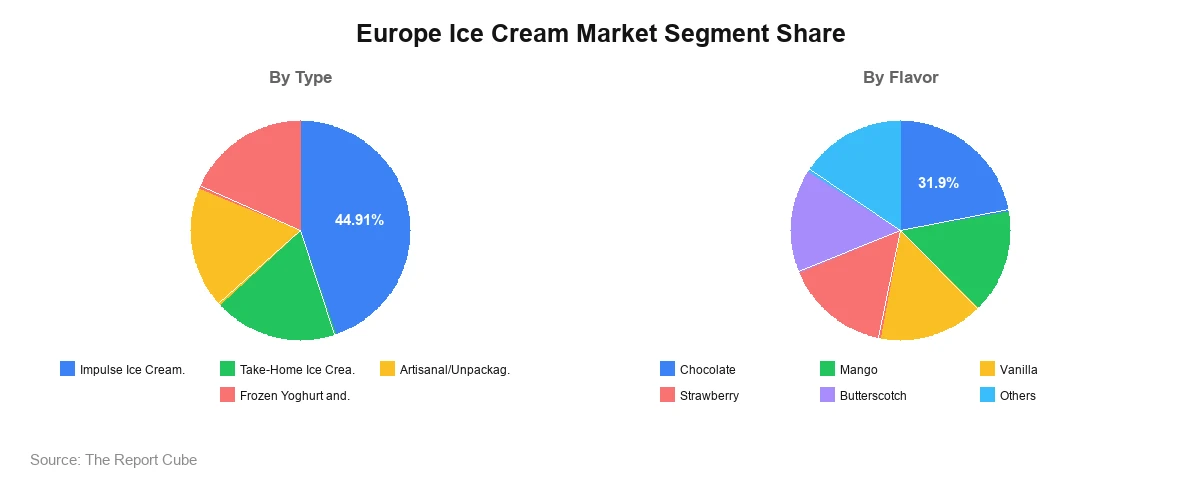
Impulse ice cream is estimated to hold the largest value share at 44.91% in 2026, reflecting the scale of single-serve consumption occasions across modern retail, convenience, and seasonal footfall locations. This format benefits from high-visibility freezer placement and established brand equities that support repeat purchase, particularly for stick and cone variants positioned around indulgence and limited editions. The segment’s projected share decline in the model through 2035 indicates gradual diversification rather than structural collapse, with performance increasingly tied to innovation cadence and retailer execution during peak months.
Frozen yoghurt and plant-based options are forecast to record the fastest growth with a 7.99% CAGR during 2027–2035, reflecting portfolio broadening into vegan, dairy-free, and lifestyle-positioned propositions. Growth is commercially linked to improving sensory performance, broader distribution, and premium pricing architecture that supports margins even at smaller volumes. The fastest-growth outlook does not imply dominance by 2035, but it suggests rising strategic value for manufacturers that can manage ingredient sourcing, cross-contamination controls, and clear labelling while keeping texture and melt characteristics competitive.
By Flavor
- Chocolate
- Mango
- Vanilla
- Strawberry
- Butterscotch
- Others
Chocolate is estimated to lead flavour demand with a 31.9% share in 2026, reflecting broad mainstream acceptance and its compatibility with premium inclusions such as nuts, brownie pieces, and coated formats. Its leadership is commercially important because it supports high-volume production runs and stable retailer ranging, which can improve manufacturing efficiency and reduce waste. The segment also provides an innovation platform for limited editions that extend shelf visibility without forcing consumers into unfamiliar base profiles.
Mango is forecast as the fastest-growing named flavour with a 7.36% CAGR, indicating expanding interest in fruit-led, refreshing profiles that translate well into portion-controlled and plant-based formulations. For manufacturers, faster flavour growth tends to pull R&D toward stabilisers, acidity management, and consistent sourcing to keep sensory performance predictable across batches. Commercially, mango’s growth supports seasonal promotions and cross-selling through multi-flavour packs, but requires disciplined forecasting to avoid short shelf-life risks in slower months.
Europe Ice Cream Market Regional Analysis
The geographic scope covers Germany, the United Kingdom, France, Italy, Turkey, and the Rest of Europe grouping. Market conditions differ by retail structure, seasonal weather sensitivity, the balance between packaged and artisanal consumption, and the maturity of freezer distribution networks. Shares presented here reflect modelled allocations within the supplied dataset and are not claimed as official country retail turnover statistics.
| Region | Estimated Market Share | Key Growth Factors | Industry Trends |
|---|---|---|---|
| Germany | 23.90% | Large packaged retail base supporting high-volume impulse and take-home purchasing, underpinned by strong manufacturing throughput capacity | Continued premiumisation and branded competition alongside private label, with emphasis on innovation cadence and retail execution |
| United Kingdom | - | Grocery-led demand with strong branded and private-label competition and high promotional intensity in modern retail | Portfolio renovation and premium formats, with increasing relevance of plant-based and portion-controlled propositions |
| France | - | Mix of modern retail and strong artisanal culture supporting seasonal demand and tourist-linked consumption | Premium flavours and experiential formats, with sustained role for specialist outlets in urban and leisure locations |
| Italy | - | High relevance of artisanal and unpackaged consumption alongside packaged retail, supporting premium positioning | Growing role of premium textures and cones, with continued importance of local tastes and seasonal footfall |
| Turkey | - | Rising modern retail penetration and urbanisation effects supporting wider packaged access | Faster modelled growth than larger Western markets, with expanding interest in premium and specialty lines |
| Rest of Europe | - | Diverse country mix where growth is shaped by retail maturity, climate variability, and distribution economics | Gradual shift toward specialty products and improving digital access, constrained by cold-chain cost discipline |
Germany leads the modelled regional split with a 23.90% share in 2026, reflecting the scale of packaged retail demand and the broader industrial base supporting consistent supply. Eurostat’s production statistics place Germany as the EU’s largest ice cream producer by volume in 2025, which supports the logic of strong upstream capability even though production volume is not a retail-value measure. Commercially, Germany’s leadership makes it a priority market for innovation launches, retail negotiations, and freezer execution strategies that protect availability during peak months.
The United Kingdom accounts for an estimated 19.90% share in 2026, supported by high modern-retail penetration and intense branded competition that places emphasis on promotions and pack architecture. The market’s performance is closely tied to household purchasing routines and retailer category management practices, which can amplify premium launches when execution is strong. Manufacturers that balance innovation with margin discipline are better positioned to sustain growth in this mature, promotion-led environment.
Competitive Landscape
Company Profiles
The Magnum Ice Cream Company operates a portfolio of global and local ice cream brands and competes primarily through brand strength, innovation cadence, and scaled frozen distribution execution. Public disclosures following its separation from Unilever indicate a standalone operating structure designed around the distinct economics of ice cream, including seasonality and capital intensity. In October 2026, the company reported Q3 2026 organic sales growth of 9.6%, supported by 7.3% volume growth and 2.2% price growth, signalling continued emphasis on both demand capture and pricing discipline in a competitive category.
Froneri International is a major packaged ice cream manufacturer with broad participation in European retail and foodservice channels, competing through manufacturing scale, brand partnerships, and distribution reach. Its competitive relevance is strongest in markets where grocery-led consumption and multipack economics shape category outcomes, and where retailer requirements favour high service levels and consistent product availability. The company’s strategy typically benefits from operational execution across frozen logistics and the ability to support a wide range of product formats, enabling it to compete across both mainstream and premium price tiers.
Recent Developments and Updates
- October 2026 - The Magnum Ice Cream Company: Q3 2026 trading update reported organic sales growth of 9.6%, supported by volume growth of 7.3% and price growth of 2.2%, highlighting continued emphasis on execution and pricing discipline during the peak season period.
- July 2026 - The Magnum Ice Cream Company: H1 2026 results reported revenue of EUR 4.7 billion and organic growth of 4.7%, signalling continued scale performance as a standalone ice cream group with a focus on portfolio and operational delivery.
- August 2026 - Eurostat: Reported EU ice cream production of 3.44 billion litres in 2025, up about 1.9% versus 2024, with Germany producing 608 million litres, illustrating sustained manufacturing throughput supporting category supply.
- November 2025 - The Magnum Ice Cream Company: Public filings and demerger communications described the separation process that created a standalone ice cream group, clarifying governance and reporting structure for an ice-cream-specific operating model with distinct seasonality and cold-chain economics.
Europe Ice Cream Market Future Outlook
During 2027–2035, the market is expected to expand steadily, supported by premiumisation, innovation-led mix improvement, and rising relevance of specialty lines such as non-dairy and plant-based options. Growth is likely to be uneven by country due to climate variability, retailer structure, and the balance between packaged and artisanal consumption occasions. Channel dynamics are expected to shift as online ordering improves access for premium bundles and dietary-specialty products, while modern grocery remains the anchor for scale distribution and seasonal promotion execution.
Strategically, competitive advantage is expected to concentrate in operators that can protect margins through freezer efficiency, disciplined SKU management, and high service levels during peak demand months. Investment priorities are likely to include formulation capability for plant-based and reduced-sugar products, packaging and insulation improvements for e-commerce, and selective expansion models that avoid overbuilding fixed cold-chain assets. Key risks include energy-cost volatility and promotion intensity in modern retail, which can compress profitability even when nominal market value rises.
Europe Ice Cream Market Report Coverage
| Parameter | Details |
|---|---|
| Market Name | Europe Ice Cream Market |
| Base-Year Market Size | 18.662 USD billion in 2026 |
| Forecast Market Size | 24.956 USD billion in 2035 |
| Market CAGR | 3.28% during 2027–2035 |
| Historical Period | 2021–2025 |
| Base Year | 2026 |
| Forecast Period | 2027–2035 |
| Geographic Coverage | Germany; United Kingdom; France; Italy; Turkey; Rest of Europe |
| Market Segmentation | Type; Flavor; Product; Category; Distribution Channel |
| Subsegment Coverage | Type: Impulse Ice Cream; Take-Home Ice Cream; Artisanal or Unpackaged Ice Cream; Frozen Yoghurt and Plant-Based Options. Flavor: Chocolate; Mango; Vanilla; Strawberry; Butterscotch; Others. Product: Cup; Stick; Cone; Brick; Tub; Others. Category: Dairy; Non-Dairy Including Plant-Based. Distribution: Modern Grocery Retailers; Traditional Small Grocers; Specialized Ice Cream Parlours; Online or E-commerce Platforms. |
| Key Companies Covered | The Magnum Ice Cream Company; Froneri International; General Mills; Ferrero Group; Mars, Incorporated; Arla Foods; DMK Group; Sammontana; Valsoia; Jude's Ice Cream; Mackie's of Scotland; Grupo Alacant |
| Research Coverage | Market sizing and forecast; market outlook; government regulations context; market dynamics; segmentation analysis; regional analysis; competitive landscape and company profiles; recent developments; future outlook |
| Customisation Options | Not confirmed in the supplied scope |
Why Choose This Europe Ice Cream Market Report?
- Assess the Europe ice cream market size trajectory through 2035 using a consistent nominal USD value series and stated CAGR periods.
- Identify which product types and channels are expected to drive mix-led growth, including plant-based options and online purchasing routes.
- Understand how seasonal demand and cold-chain economics influence profitability, capacity planning, and feasible distribution strategies.
- Evaluate country-level market positioning across Germany, the United Kingdom, France, Italy, Turkey, and the Rest of Europe grouping.
- Benchmark competitive participation using evidence-led company positioning, recent verified updates, and defensible capability descriptions.
- Examine how premiumisation and dietary variety are reshaping product development priorities and retail assortment strategies.
Table of Contents
- Introduction
- Objective of the Study
- Product Definition
- Market Segmentation
- Study Variables
- Research Methodology
- Secondary Data Points
- Companies Interviewed
- Primary Data Points
- Breakdown of Primary Interviews
- Secondary Data Points
- Executive Summary
- Market Dynamics
- Drivers
- Challenges
- Opportunity Assessment
- Recent Trends and Developments
- Policy and Regulatory Landscape
- Europe Ice Cream Market Overview and Forecast Analysis (2022-2035)
- Market Size, By Value, By Growth Rate (CAGR/USD Billions)
- Demand – Supply Trends
- Market Share, By Type
- Impulse Ice Cream
- Take-Home Ice Cream
- Artisanal/Unpackaged Ice Cream
- Frozen Yoghurt and Plant-Based Options
- Market Share, By Flavor
- Chocolate
- Mango
- Vanilla
- Strawberry
- Butterscotch
- Others
- Market Share, By Product
- Cup
- Stick
- Cone
- Brick
- Tub
- Others
- Market Share, By Category
- Dairy
- Non-Dairy (Including Plant-Based)
- Market Share, By Distribution Channel
- Modern Grocery Retailers
- Traditional Small Grocers
- Specialized Ice Cream Parlours
- Online/E-commerce Platforms
- Market Share, By Region
- Western Europe
- Eastern Europe
- Northern Europe
- Southern Europe
- Market Share, By Competitors
- Competition Characteristics
- Revenue Shares
- Impulse Ice Cream Europe Ice Cream Market Overview, 2022-2035F
- By Value (USD Million)
- By Flavor – Market Size & Forecast 2022-2035, USD Million
- Chocolate
- Mango
- Vanilla
- Strawberry
- Butterscotch
- Others
- Take-Home Ice Cream Europe Ice Cream Market Overview, 2022-2035F
- By Value (USD Million)
- By Flavor – Market Size & Forecast 2022-2035, USD Million
- Chocolate
- Mango
- Vanilla
- Strawberry
- Butterscotch
- Others
- Artisanal/Unpackaged Ice Cream Europe Ice Cream Market Overview, 2022-2035F
- By Value (USD Million)
- By Flavor – Market Size & Forecast 2022-2035, USD Million
- Chocolate
- Mango
- Vanilla
- Strawberry
- Butterscotch
- Others
- Frozen Yoghurt and Plant-Based Options Europe Ice Cream Market Overview, 2022-2035F
- By Value (USD Million)
- By Flavor – Market Size & Forecast 2022-2035, USD Million
- Chocolate
- Mango
- Vanilla
- Strawberry
- Butterscotch
- Others
- Competitive Outlook (Company Profile – Partial List)
- The Magnum Ice Cream Company
- Company Overview
- Business Segments
- Strategic Alliances/Partnerships
- Recent Developments
- Froneri International
- Company Overview
- Business Segments
- Strategic Alliances/Partnerships
- Recent Developments
- General Mills
- Company Overview
- Business Segments
- Strategic Alliances/Partnerships
- Recent Developments
- Ferrero Group
- Company Overview
- Business Segments
- Strategic Alliances/Partnerships
- Recent Developments
- Mars Incorporated
- Company Overview
- Business Segments
- Strategic Alliances/Partnerships
- Recent Developments
- Arla Foods
- Company Overview
- Business Segments
- Strategic Alliances/Partnerships
- Recent Developments
- DMK Group
- Company Overview
- Business Segments
- Strategic Alliances/Partnerships
- Recent Developments
- Sammontana
- Company Overview
- Business Segments
- Strategic Alliances/Partnerships
- Recent Developments
- Valsoia
- Company Overview
- Business Segments
- Strategic Alliances/Partnerships
- Recent Developments
- Jude's Ice Cream
- Company Overview
- Business Segments
- Strategic Alliances/Partnerships
- Recent Developments
- Mackie's of Scotland
- Company Overview
- Business Segments
- Strategic Alliances/Partnerships
- Recent Developments
- Grupo Alacant
- Company Overview
- Business Segments
- Strategic Alliances/Partnerships
- Recent Developments
- Others
- The Magnum Ice Cream Company
- Contact Us & Disclaimer
Top Key Players & Market Share Outlook
- The Magnum Ice Cream Company
- Froneri International
- General Mills
- Ferrero Group
- Mars, Incorporated
- Arla Foods
- DMK Group
- Sammontana
- Valsoia
- Jude's Ice Cream
- Mackie's of Scotland
- Grupo Alacant
Frequently Asked Questions