



Build Your Custom Market Intelligence Report
Customize Your ReportAsia Pacific In-Cabin Monitoring Systems Market Key Highlights
By System Type:
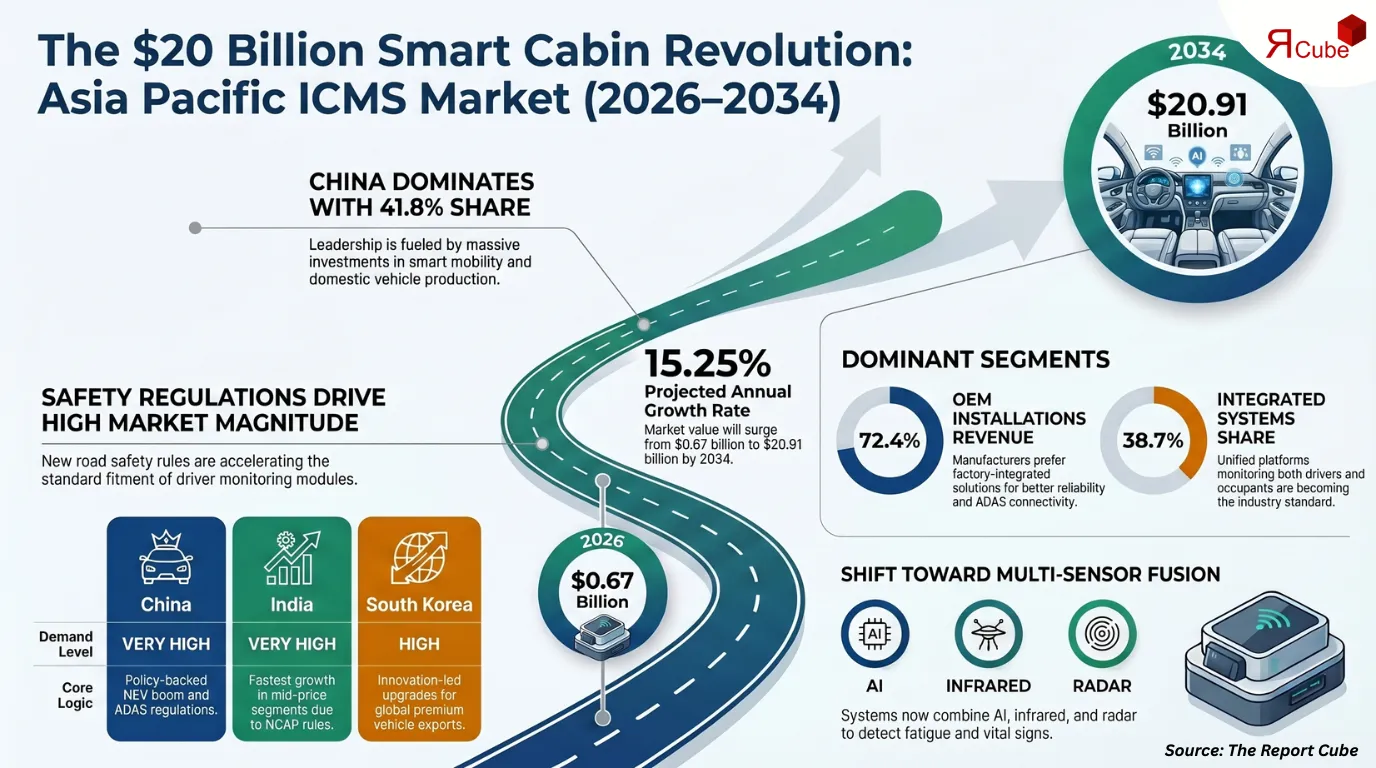
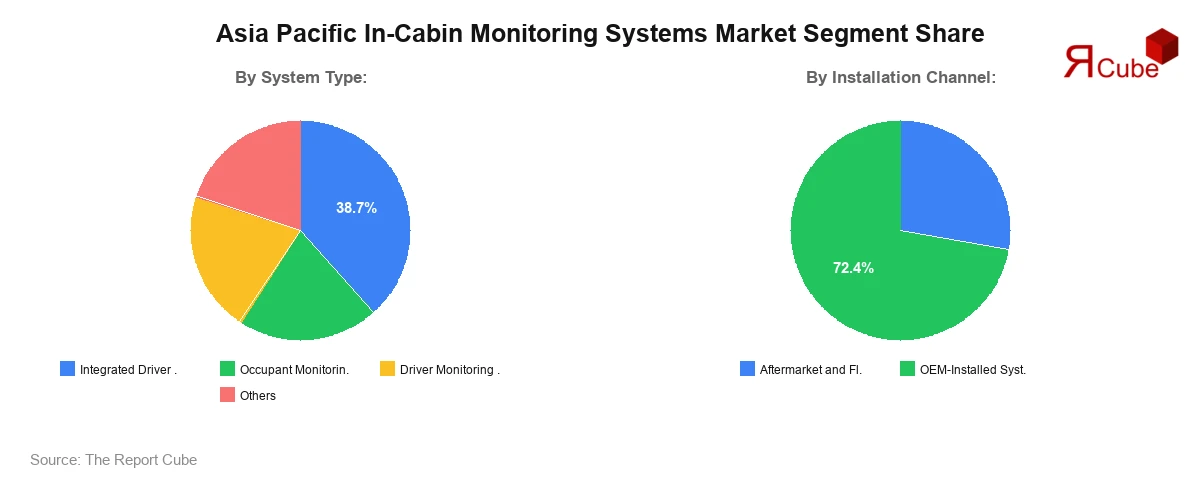
Integrated Driver and Occupant Monitoring Systems segment leads the market with nearly 38.7% share.
By Installation Channel:
OEM-Installed Systems segment dominates the market with approximately 72.4% of revenue.
Regional Outlook:
China dominates the Asia Pacific In-Cabin Monitoring Systems market with around 41.8% share.
Asia Pacific In-Cabin Monitoring Systems Market Insights & Analysis
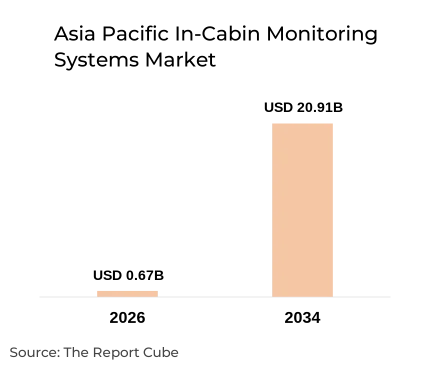
The Asia Pacific In-Cabin Monitoring Systems Market is anticipated to register a CAGR of around 15.25% during the forecast period 2026-2034. The market size is valued at USD 0.67 billion in 2026 and is projected to reach USD 20.91 billion by 2034. Growth is being supported by the rapid evolution of vehicle safety architectures across Asia Pacific, where automakers are increasingly embedding driver and occupant monitoring capabilities into next-generation vehicle platforms. Regulatory attention toward road safety, combined with rising adoption of advanced driver assistance systems, is encouraging manufacturers to deploy camera-based monitoring, infrared sensing modules, and biometric recognition technologies. Vehicle producers in China, Japan, South Korea, and India are accelerating investments in intelligent cockpit systems that integrate driver awareness monitoring, occupant detection, and personalized in-vehicle experiences within a single software-defined ecosystem.
Industry momentum is also being shaped by growing consumer expectations for safer and more connected mobility solutions. Automakers are partnering with technology providers to develop multi-sensor cabin intelligence systems capable of detecting distraction, fatigue, seat occupancy, child presence, and vital signs in real time. China continues to lead regional deployment due to strong domestic vehicle production and substantial investments in smart mobility innovation. At the same time, Japanese and South Korean manufacturers are advancing sensor fusion technologies to support higher levels of vehicle automation. These developments are strengthening the long-term outlook for the Asia Pacific In-Cabin Monitoring Systems Market while creating new opportunities across passenger vehicles and commercial transportation fleets.
Asia Pacific In‑Cabin Monitoring Systems Market Impact Analysis
| Factor | Type | Specific Impact on Market | Magnitude | Business Implication |
|---|---|---|---|---|
| Surge in Advanced Safety Adoption | Market | Automakers add monitoring to enhance occupant and driver safety systems | High | Creates strong pull for integrated camera and sensor based cabin platforms |
| Regulatory Focus on Driver Attention | Regulatory | Safety rules encourage driver monitoring to reduce distraction and drowsiness risks | High | Accelerates OEM adoption of compliant in‑cabin monitoring modules as standard fitment |
| Growth of Asia Pacific Vehicle Production | Market | Expanding regional vehicle output lifts addressable base for cabin systems | High | Supports volume scaling and localized supply partnerships with major carmakers |
| Integration with Digital Cockpit Platforms | Technological | In‑cabin sensing combines with displays and connectivity in advanced cockpits | Medium | Favors suppliers offering software defined, cockpit ready monitoring architectures |
| Rapid Innovation in AI and Sensor Fusion | Technological | AI driven analytics improve accuracy of behavior and presence detection in cabins | Medium | Raises differentiation potential for firms investing in algorithms and data models |
| Cost Sensitivity in Emerging Markets | Consumer | Price conscious buyers may resist paying premiums for optional cabin features | Medium | Requires tiered feature packages and scalable hardware to protect adoption |
| Competitive Entry of Global Tier‑One Suppliers | Competitive | Strong incumbents expand offerings, intensifying technology and price competition | High | Demands clear OEM relationships and differentiated, platform based solution roadmaps |
Asia Pacific In-Cabin Monitoring Systems Market Dynamics
Key Driver: Strengthening Vehicle Safety Requirements Across Asia Pacific
Vehicle safety has become a strategic priority for automotive manufacturers and transportation authorities across Asia Pacific. Rising urbanization, growing vehicle ownership, and increasing traffic density have intensified concerns regarding driver distraction and fatigue-related incidents. As a result, automakers are integrating in-cabin monitoring technologies to improve situational awareness and support safer driving behavior. Driver monitoring systems equipped with eye-tracking, facial recognition, and attention-detection capabilities are gaining traction as manufacturers seek to enhance occupant protection and reduce accident risks.
The transition toward intelligent and semi-autonomous vehicles has further elevated the importance of cabin monitoring functions. Safety systems are increasingly required to verify driver readiness, monitor passenger conditions, and support emergency intervention when necessary. This trend is particularly evident in China, Japan, and South Korea, where advanced safety technologies are becoming standard features in premium and upper-mid vehicle segments. Continued expansion of these capabilities is expected to remain a major growth catalyst for In-Cabin Monitoring in Asia Pacific throughout the forecast period.
Industry Trends: Integration of Smart Cabin and Multi-Sensor Monitoring Technologies
Automotive manufacturers across Asia Pacific are moving toward fully integrated smart-cabin environments that combine safety, convenience, and personalization features within a unified digital platform. Modern monitoring systems increasingly utilize cameras, infrared sensors, radar modules, and AI-enabled processing units to deliver comprehensive visibility into driver and occupant behavior. This convergence allows vehicle systems to provide more accurate monitoring while reducing hardware redundancy and improving overall operational efficiency.
Multi-sensor fusion monitoring is emerging as a preferred technology approach because it improves detection performance across varying lighting conditions and seating positions. Vehicle manufacturers are also expanding the use of biometric authentication and cabin personalization features that automatically adjust vehicle settings based on occupant identification. As software-defined vehicles gain market share across Asia Pacific, demand for scalable monitoring platforms capable of supporting future over-the-air upgrades and advanced safety applications is expected to increase significantly.
Book your FREE 30-minute expert consultation today
Contact UsMajor Challenge: Cost Pressures and System Validation Requirements
Developing and integrating advanced in-cabin monitoring systems requires substantial investment in sensing hardware, software development, validation testing, and cybersecurity protection. While premium vehicle manufacturers can absorb these costs more effectively, adoption within entry-level vehicle segments remains constrained by pricing considerations. The challenge becomes particularly relevant in cost-sensitive automotive markets where balancing affordability and advanced safety functionality remains a key priority.
Achieving reliable performance across diverse driving environments presents another obstacle for market participants. Monitoring systems must maintain high detection accuracy under changing lighting conditions, varying driver characteristics, and different seating configurations. Regulatory requirements related to biometric data handling and privacy protection also introduce additional compliance obligations for manufacturers. Addressing these technical and operational challenges will remain essential for broader deployment of In-Cabin Monitoring Systems across Asia Pacific.
Opportunity: Expansion of Connected, Electric, and Autonomous Mobility
Growing investment in connected and electric vehicle ecosystems is creating substantial opportunities for the Asia Pacific In-Cabin Monitoring Systems Market. Vehicle manufacturers are increasingly viewing cabin intelligence as a core differentiator that enhances both safety and user experience. Advanced monitoring solutions enable continuous assessment of driver readiness, occupant well-being, and cabin conditions, making them highly valuable in connected mobility environments.
The progression toward higher levels of vehicle automation is expected to generate additional demand for sophisticated monitoring capabilities. Autonomous and semi-autonomous vehicles require continuous observation of driver engagement during transitions between manual and automated driving modes. Simultaneously, biometric identification, personalized infotainment settings, and health-monitoring functions are expanding the role of cabin monitoring beyond traditional safety applications. These developments position the technology as a critical component of future mobility platforms throughout Asia Pacific.
Asia Pacific In-Cabin Monitoring Systems Market Segment-wise Analysis
By System Type:
- Integrated Driver and Occupant Monitoring Systems
- Occupant Monitoring Systems
- Driver Monitoring Systems
- Others
Integrated Driver and Occupant Monitoring Systems accounted for the largest share of the Asia Pacific In-Cabin Monitoring Systems Market, capturing approximately 38.7% of total revenue in 2026. Automakers increasingly prefer integrated platforms because they deliver comprehensive cabin visibility through a single architecture capable of monitoring both driver behavior and passenger activity. These systems support multiple functions, including distraction detection, fatigue monitoring, occupant classification, child presence detection, and seatbelt compliance verification.
Their ability to reduce hardware complexity while improving operational efficiency has accelerated deployment across passenger vehicles. Growing demand for software-defined vehicle platforms and intelligent cockpit environments is expected to further strengthen the segment's position during the forecast period, particularly among leading automotive manufacturers in China, Japan, and South Korea.
By Installation Channel:
- Aftermarket and Fleet Retrofit Systems
- OEM-Installed Systems
OEM-Installed Systems represent the leading installation channel with nearly 72.4% market share. Vehicle manufacturers increasingly prefer factory-installed monitoring solutions due to improved system integration, reliability, and compliance with vehicle safety requirements. OEM installations enable seamless connectivity between monitoring sensors, ADAS platforms, and vehicle control systems, resulting in enhanced functionality and user experience.
The growing popularity of connected vehicles and software-defined architectures has further strengthened demand for integrated factory-installed solutions. Additionally, leading automotive brands are incorporating driver monitoring and occupant sensing technologies as standard or optional features across multiple vehicle categories. This trend is expected to continue as governments and consumers place greater emphasis on vehicle safety and intelligent mobility technologies.
Regional Projection of Asia Pacific In-Cabin Monitoring Systems Industry
- Japan
- Malaysia
- India
- South Korea
- Thailand
- China
- Philippines
- Indonesia
- Vietnam
- Rest of Asia-Pacific
China represented the largest market for in-cabin monitoring systems in Asia Pacific, accounting for approximately 41.8% of regional revenue in 2026. The country's leadership is supported by its position as the world's largest automotive manufacturing hub and its strong focus on intelligent vehicle development. Domestic automakers are rapidly incorporating driver monitoring, occupant sensing, and AI-powered cockpit technologies into both electric and conventional vehicle platforms. Strong investment in software-defined vehicles and smart mobility infrastructure continues to accelerate technology deployment throughout the automotive sector.
Demand is also being reinforced by China's expanding electric vehicle ecosystem and growing consumer preference for advanced safety features. Local technology providers and automotive suppliers are actively developing innovative sensing solutions tailored to regional market requirements. Continued advancements in AI computing, imaging technologies, and connected vehicle platforms are expected to support sustained market expansion, allowing China to maintain its leading position within the Asia Pacific In-Cabin Monitoring Systems Market through 2034.
Need insights for a specific region within this market?
Request Regional DataAsia Pacific In-Cabin Monitoring Systems - Country View
The Asia Pacific in-cabin monitoring market differs by auto volumes, safety rules, and tech maturity.
| Country | Demand Level | Key Auto / Tech Hubs | System Focus | Core Demand Logic | Growth Nature |
|---|---|---|---|---|---|
| Japan | High | Tokyo, Nagoya, Osaka | DMS with AI cameras | OEM safety focus and exports | Stable, tech upgrade led |
| Malaysia | Medium | Klang Valley, Penang | Basic DMS, tier-2 units | CKD plants and tax support | Gradual, cost driven |
| India | Very High | Pune, Chennai, Gurugram | DMS and occupant sensing | NCAP rules and mass volume | Fastest mid-price growth |
| South Korea | High | Seoul, Ulsan, Incheon | Premium AI monitoring | Global OEM export demand | Innovation led upgrades |
| Thailand | Medium | Bangkok, Rayong | Fleet and pickup DMS | Export hub and fleets | Fleet retrofit driven |
| China | Very High | Shanghai, Shenzhen, Wuhan | Full cabin AI suites | NEV boom and ADAS rules | Strongest, policy backed |
| Philippines | Low | Metro Manila, Calabarzon | Aftermarket DMS kits | Ride-hail and bus safety | Niche, policy linked |
| Indonesia | Medium | Jakarta, Bekasi, Karawang | Basic driver cameras | MPV volume and fleets | Volume-led, value focus |
| Vietnam | Medium | Hanoi, Hai Phong, Ho Chi Minh | OEM-fitted DMS sets | Emerging OEMs and CKD | Early, OEM centered |
| Rest of Asia-Pacific | Low to Medium | Singapore, Australia, others | Premium and fleet DMS | Luxury and safety niches | Selective, high value |
Government Initiatives & Policies
- China Intelligent Connected Vehicle Development Program (2025): China continues expanding intelligent connected vehicle deployment through national smart transportation initiatives that encourage AI-enabled cockpit systems, driver monitoring technologies, and autonomous vehicle innovation.
- India Automotive Industry Vision and Road Safety Programs (2026): India is promoting advanced vehicle safety technologies through road safety initiatives and automotive modernization programs supporting intelligent driver assistance and occupant protection systems.
Asia Pacific In-Cabin Monitoring Systems Industry Recent Developments
- 2025: FORVIA SE presented AirVision at Auto Shanghai 2025 as part of its smart-cabin portfolio. The solution utilizes a Driver Monitoring System camera to detect driver gaze and enable gaze-and-select interaction with a 3D virtual display, supporting lower-distraction cockpit experiences for Asia Pacific vehicle manufacturers.
- 2025: Robert Bosch GmbH secured its first customer order in China for a high-performance vehicle computer designed to support AI cockpit development. Production was scheduled to begin in 2025, strengthening localized smart-cabin computing capabilities and software-defined mobility integration across Chinese automotive programs.
Why Choose This Report?
- Provides a comprehensive overview of the overall market analysis, encompassing key trends, consumer behavior analysis, and risk assessment to support strategic decision-making.
- Provides accurate, up-to-date insights into market size, segmentation, and emerging opportunities, helping to minimize risk & capitalizing on growth.
- Gives deep understanding of target audience preferences, investment habits, and communication channels for enhanced product development & marketing effectiveness.
- Delivers competitive analysis & benchmarking, uncovering the strengths & weaknesses of market competitors to guide strategies.
- Consolidate comprehensive market intelligence, reducing reasoning & streamlining research efforts.
- Facilitates customized market segmentation & risk mitigation strategies, fine-tuned to the business objectives.
- Aids in identifying both market challenges & untapped opportunities within the industry to drive long-term business growth.
- Provides valuable information based on actual customer data & search trends.
Table of Contents
- Introduction
- Objective of the Study
- Product and Category Definition
- Market Segmentation
- Study Variables
- Research Methodology
- Secondary Data Points
- Breakdown of Secondary Sources
- Primary Data Points
- Breakdown of Primary Interviews
- Secondary Data Points
- Executive Summary
- Market Dynamics
- Emerging Opportunities
- Adoption Trends
- Demand Drivers
- Disruption Analysis (Challenges)
- Industry Analysis and Strategic Insights
- Supply and Value Chain Analysis
- Pricing Analysis
- Go-To-Market Strategy
- BCG Matrix
- Recent Trends and Developments
- Import and Export Analysis
- Regulatory and Policy Landscape
- Country-wise Policies
- Government Initiatives
- Asia Pacific In-Cabin Monitoring Systems Market Overview and Forecast Analysis (2021-2034)
- Market Size, By Value, By Growth Rate (CAGR/USD Billion)
- Market Share, By System Type
- Integrated Driver and Occupant Monitoring Systems
- Occupant Monitoring Systems
- Driver Monitoring Systems
- Others
- Market Share, By Component
- Software and AI Algorithms
- Processing ECUs and AI Compute Units
- Infrared and Time-of-Flight Sensing Modules
- Cameras and Imaging Modules
- Radar Sensors
- Others
- Market Share, By Sensing Technology
- Multi-Sensor Fusion Monitoring
- Biometric and Vital-Sign Sensing
- Time-of-Flight and 3D Depth Sensing
- Radar-Based Monitoring
- Camera-Based Monitoring
- Others
- Market Share, By Application
- Biometric Identification and Cabin Personalization
- Vital Signs Monitoring
- Child Presence Detection
- Seatbelt Usage and Posture Monitoring
- Occupant Presence and Classification
- Driver Distraction and Attention Monitoring
- Driver Drowsiness and Fatigue Detection
- Others
- Market Share, By Vehicle Type
- Buses and Coaches
- Heavy Commercial Vehicles
- Light Commercial Vehicles
- Passenger Cars
- Others
- Market Share, By Installation Channel
- Aftermarket and Fleet Retrofit Systems
- OEM-Installed Systems
- Market Share, By Country
- Japan
- Malaysia
- India
- South Korea
- Thailand
- China
- Philippines
- Indonesia
- Vietnam
- Rest of Asia-Pacific
- Market Share, By Company
- Revenue Shares and Analysis
- Competitive Landscape
- Japan In-Cabin Monitoring Systems Market Overview and Forecast Analysis (2021-2034)
- Market Size, By Value, By Growth Rate (CAGR/USD Billion/Million)
- Market Share, By System Type
- Market Share, By Component
- Market Share, By Sensing Technology
- Market Share, By Application
- Market Share, By Vehicle Type
- Market Share, By Installation Channel
- China In-Cabin Monitoring Systems Market Overview and Forecast Analysis (2021-2034)
- Market Size, By Value, By Growth Rate (CAGR/USD Billion/Million)
- Market Share, By System Type
- Market Share, By Component
- Market Share, By Sensing Technology
- Market Share, By Application
- Market Share, By Vehicle Type
- Market Share, By Installation Channel
- India In-Cabin Monitoring Systems Market Overview and Forecast Analysis (2021-2034)
- Market Size, By Value, By Growth Rate (CAGR/USD Billion/Million)
- Market Share, By System Type
- Market Share, By Component
- Market Share, By Sensing Technology
- Market Share, By Application
- Market Share, By Vehicle Type
- Market Share, By Installation Channel
- South Korea In-Cabin Monitoring Systems Market Overview and Forecast Analysis (2021-2034)
- Market Size, By Value, By Growth Rate (CAGR/USD Billion/Million)
- Market Share, By System Type
- Market Share, By Component
- Market Share, By Sensing Technology
- Market Share, By Application
- Market Share, By Vehicle Type
- Market Share, By Installation Channel
- Thailand In-Cabin Monitoring Systems Market Overview and Forecast Analysis (2021-2034)
- Market Size, By Value, By Growth Rate (CAGR/USD Billion/Million)
- Market Share, By System Type
- Market Share, By Component
- Market Share, By Sensing Technology
- Market Share, By Application
- Market Share, By Vehicle Type
- Market Share, By Installation Channel
- Malaysia In-Cabin Monitoring Systems Market Overview and Forecast Analysis (2021-2034)
- Market Size, By Value, By Growth Rate (CAGR/USD Billion/Million)
- Market Share, By System Type
- Market Share, By Component
- Market Share, By Sensing Technology
- Market Share, By Application
- Market Share, By Vehicle Type
- Market Share, By Installation Channel
- Philippines In-Cabin Monitoring Systems Market Overview and Forecast Analysis (2021-2034)
- Market Size, By Value, By Growth Rate (CAGR/USD Billion/Million)
- Market Share, By System Type
- Market Share, By Component
- Market Share, By Sensing Technology
- Market Share, By Application
- Market Share, By Vehicle Type
- Market Share, By Installation Channel
- Indonesia In-Cabin Monitoring Systems Market Overview and Forecast Analysis (2021-2034)
- Market Size, By Value, By Growth Rate (CAGR/USD Billion/Million)
- Market Share, By System Type
- Market Share, By Component
- Market Share, By Sensing Technology
- Market Share, By Application
- Market Share, By Vehicle Type
- Market Share, By Installation Channel
- Vietnam In-Cabin Monitoring Systems Market Overview and Forecast Analysis (2021-2034)
- Market Size, By Value, By Growth Rate (CAGR/USD Billion/Million)
- Market Share, By System Type
- Market Share, By Component
- Market Share, By Sensing Technology
- Market Share, By Application
- Market Share, By Vehicle Type
- Market Share, By Installation Channel
- Competitive Analysis, 2026
- Market Share of Key Players
- Competitive Mapping for Each System Type, Component, Sensing Technology, Application, Vehicle Type, and Installation Channel
- Asia Pacific In-Cabin Monitoring Systems Companies Share and Competitive Analysis, 2026
- Japan In-Cabin Monitoring Systems Companies Share and Competitive Analysis, 2026
- China In-Cabin Monitoring Systems Companies Share and Competitive Analysis, 2026
- India In-Cabin Monitoring Systems Companies Share and Competitive Analysis, 2026
- South Korea In-Cabin Monitoring Systems Companies Share and Competitive Analysis, 2026
- Company Profile (Partial List)
- Hyundai Mobis Co. Ltd.
- Company Overview
- Product Portfolio
- Strategic Alliances/Partnerships
- Recent Developments
- Desay SV
- Company Overview
- Product Portfolio
- Strategic Alliances/Partnerships
- Recent Developments
- Sony Semiconductor Solutions Corporation
- Company Overview
- Product Portfolio
- Strategic Alliances/Partnerships
- Recent Developments
- FORVIA SE
- Company Overview
- Product Portfolio
- Strategic Alliances/Partnerships
- Recent Developments
- Minieye Technology Co. Ltd.
- Company Overview
- Product Portfolio
- Strategic Alliances/Partnerships
- Recent Developments
- DENSO Corporation
- Company Overview
- Product Portfolio
- Strategic Alliances/Partnerships
- Recent Developments
- Aptiv PLC
- Company Overview
- Product Portfolio
- Strategic Alliances/Partnerships
- Recent Developments
- Smart Eye Aktiebolag (publ)
- Company Overview
- Product Portfolio
- Strategic Alliances/Partnerships
- Recent Developments
- Robert Bosch GmbH
- Company Overview
- Product Portfolio
- Strategic Alliances/Partnerships
- Recent Developments
- Panasonic Automotive Systems Co. Ltd.
- Company Overview
- Product Portfolio
- Strategic Alliances/Partnerships
- Recent Developments
- Continental AG
- Company Overview
- Product Portfolio
- Strategic Alliances/Partnerships
- Recent Developments
- Valeo SE
- Company Overview
- Product Portfolio
- Strategic Alliances/Partnerships
- Recent Developments
- Others (Partial List)
- Hyundai Mobis Co. Ltd.
- Contact Us and Disclaimer
Top Key Players & Market Share Outlook
- Hyundai Mobis Co. Ltd.
- Desay SV
- Sony Semiconductor Solutions Corporation
- FORVIA SE
- Minieye Technology Co. Ltd.
- DENSO Corporation
- Aptiv PLC
- Smart Eye Aktiebolag (publ)
- Robert Bosch GmbH
- Panasonic Automotive Systems Co. Ltd.
- Continental AG
- Valeo SE
Frequently Asked Questions






