



Build Your Custom Market Intelligence Report
Customize Your ReportIndia In-vitro Fertilization Market Statistics and Insights
Market Insight
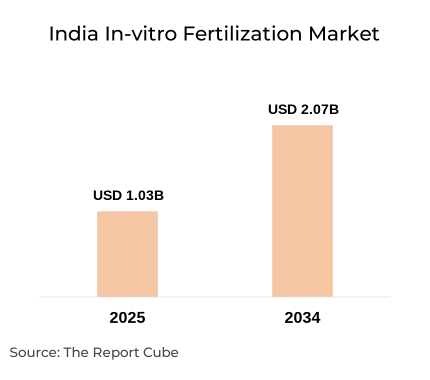
- The India In-vitro Fertilization Market was valued at USD 1.03 billion in 2025.
- The market is projected to reach approximately USD 2.07 billion by 2034.
- The market is expected to grow at a CAGR of 8.09% during 2026-2034.
By Product
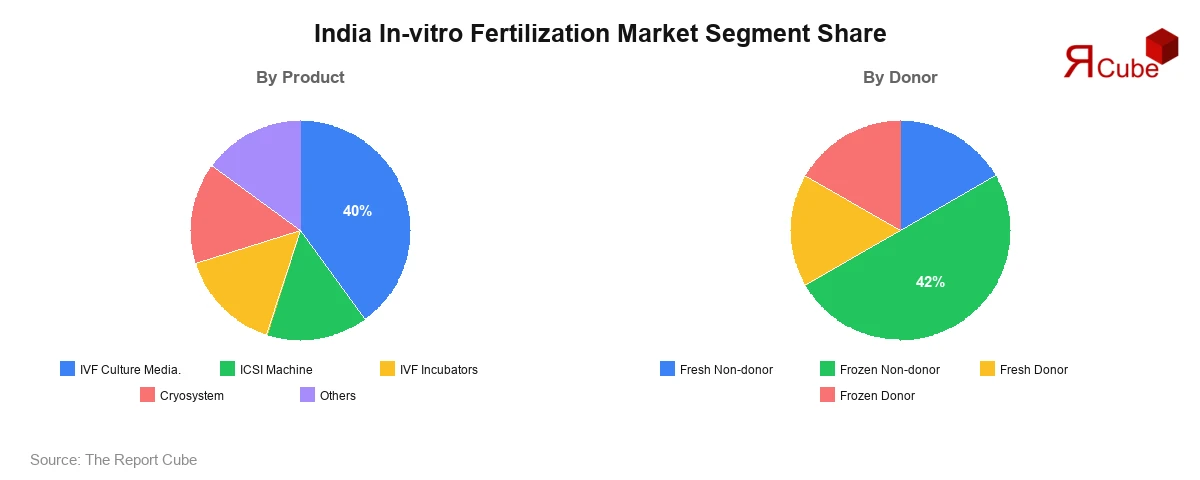
- IVF Culture Media segment dominates with approximately 40% market share.
Competitive Landscape
- More than 10 companies are actively engaged in producing India In-vitro Fertilization Market.
- Top 5 companies acquired around 68% of the market share.
- CK Birla Healthcare, Nova IVF, Indira IVF, Apollo Fertility, Max Healthcare, and others.
By Donor
- Frozen Non-donor segment holds approximately 42% of the market share.
India In-vitro Fertilization Market Insights & Analysis
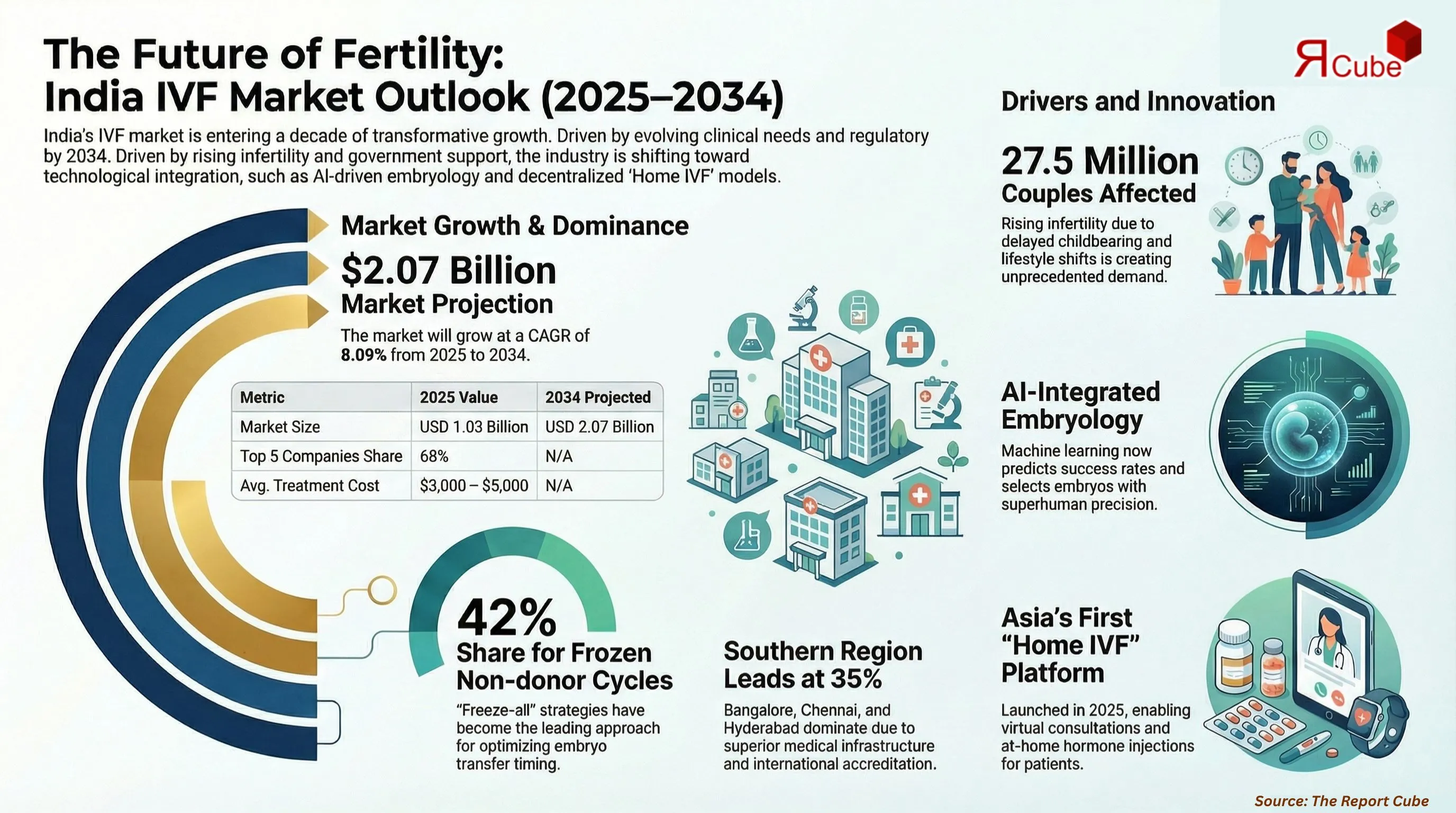
The India In-vitro Fertilization Market is anticipated to register an 8.09% CAGR during 2026-2034. The market size was valued at USD 1.03 billion in 2025 and is projected to reach USD 2.07 billion by 2034. The government's Production Linked Incentive Scheme promotes domestic pharmaceutical production, lowering reliance on imports for IVF drugs and medical devices. The ART Regulation Act of 2021 and the Surrogacy Regulation Act of 2021 have laid down stringent regulations to ensure ethical practice and safety in assisted reproduction.
Pradhan Mantri Bhartiya Jan Aushadhi Kendras intend to provide access to fertility treatments, with the count of PMBJK centres standing at 10,500 by March 2025, offering a wide array of affordable fertility-associated drugs and machinery. Seeds of Innocence launched Asia's first Home IVF platform in July 2025, enabling patients to begin IVF treatment through virtual consultations and at-home hormone injections, marking a significant advancement in India's fertility care accessibility.
India In-vitro Fertilization Market Dynamics
Key Market Driver: Rising Infertility Rates Across Demographics
Changing lifestyles, delayed childbearing, obesity, and pollution are major causes of infertility, creating unprecedented demand for assisted reproductive technologies across India. The prevalence of polycystic ovarian syndrome, endometriosis, and male factor infertility has surged among couples in their reproductive prime, with approximately 27.5 million couples affected by infertility. Urban populations face particularly acute challenges due to sedentary work patterns, processed food consumption, and environmental toxin exposure.
Delayed marriage and career-focused lifestyles have pushed the average age of first pregnancy upward, correlating directly with diminished ovarian reserve and reduced natural conception rates. This demographic shift has normalized IVF as a mainstream medical solution rather than a last resort, with younger couples increasingly seeking preemptive fertility assessments and preservation services.
Major Industry Challenge: Limited Rural Healthcare Infrastructure Accessibility
Despite metropolitan expansion, rural and semi-urban populations face persistent barriers in accessing specialized fertility care due to inadequate laboratory infrastructure and skilled embryologist shortages. The capital-intensive nature of establishing state-of-the-art IVF laboratories requires investments in cryosystems, incubators, and culture media preparation facilities that remain economically unfeasible in smaller towns.
Geographic concentration of fertility centers in tier-one cities forces rural couples to undertake expensive multi-day travel for consultations, egg retrievals, and embryo transfers, creating financial and logistical burdens. Cultural sensitivities around infertility disclosure in conservative communities further complicate treatment adherence, with many couples abandoning cycles mid-treatment. The technical expertise required for embryology and andrology procedures cannot be rapidly scaled through training programs alone, creating persistent quality disparities between established urban centers and emerging regional clinics.
Emerging Trend Shaping Outlook: Artificial Intelligence Integration in Embryology
AI-driven tools help analyze large datasets to identify the best embryos, predict success rates, and personalize treatment protocols, fundamentally transforming clinical decision-making in reproductive medicine. Machine learning algorithms now evaluate embryo morphology with superhuman precision, detecting subtle cellular characteristics that predict implantation potential beyond what experienced embryologists can visually assess.
Predictive analytics models synthesize patient age, hormone profiles, genetic markers, and previous cycle outcomes to generate individualized success probability forecasts, enabling informed treatment pathway selection. Time-lapse imaging systems integrated with AI assess embryo development continuously without manual observation, reducing handling stress while capturing developmental anomalies invisible in static assessments. These technologies democratize access to cutting-edge embryo selection capabilities previously available only at premium centers, standardizing success rates across the geographic hierarchy of Indian fertility clinics.
Need Specific Data, Let’s Customize the Report for You
Request CustomizationIndia In-vitro Fertilization Market Segment-wise Analysis
The India In-vitro Fertilization Market demonstrates sophisticated segmentation patterns driven by technological advancement and patient preference evolution. Product differentiation spans specialized equipment categories while donor classification reflects diverse patient medical requirements and treatment protocols. Understanding these segment dynamics enables stakeholders to identify high-growth opportunities and optimize resource allocation strategies across India's rapidly expanding fertility infrastructure.
By Product
- IVF Culture Media
- ICSI Machine
- IVF Incubators
- Cryosystem
- Others
IVF Culture Media dominates with approximately 40% market share, reflecting the consumable nature of these products and their critical role in every treatment cycle. The rise in research and development activities to improve culture media and availability of funding drives continuous innovation in formulation optimization. Culture media serves as the biochemical environment sustaining embryonic development from fertilization through blastocyst stage, with even minor compositional variations significantly impacting implantation rates.
Sequential media systems that mimic the changing nutritional requirements of developing embryos have become standard practice, requiring clinics to maintain diverse inventory. The ICSI Machine segment captures substantial revenue due to its superior success rates over traditional IVF procedures, especially useful for cases of severe male infertility. IVF Incubators represent significant capital investments with advanced models incorporating time-lapse imaging, pH monitoring, and multi-chamber designs that reduce temperature fluctuations. Cryosystem technologies have evolved with vitrification techniques improving frozen embryo survival rates beyond 95%, encouraging single embryo transfer strategies that rely on banking surplus embryos for future cycles.
By Donor
- Fresh Non-donor
- Frozen Non-donor
- Fresh Donor
- Frozen Donor
The Frozen Non-donor segment leads with approximately 42% market share, reflecting the widespread adoption of freeze-all strategies that decouple ovarian stimulation from embryo transfer timing. This approach allows endometrial optimization cycles separate from egg retrieval, improving implantation rates while reducing ovarian hyperstimulation syndrome risks.
Fresh Non-donor cycles remain prevalent for patients with diminished ovarian reserve who cannot afford to lose embryos during the freezing process, despite improvements in cryopreservation methods, especially vitrification, enhancing the survival rate of frozen embryos. The Fresh Donor segment serves patients with premature ovarian failure or genetic concerns, though logistical complexity in synchronizing donor and recipient cycles limits adoption. Frozen Donor protocols offer scheduling flexibility and genetic screening opportunities, with established egg banks emerging in metropolitan markets to reduce wait times. The regulatory framework governing donor anonymity and compensation influences segment dynamics, with the Surrogacy Regulation Act of 2021 establishing clear ethical boundaries for donor gamete utilization.
Regional Projection of India In-vitro Fertilization Market
The India In-vitro Fertilization Market exhibits concentrated geographic distribution with gradual tier-two and tier-three city penetration. Major regions include:
- Northern Region
- Southern Region
- Western Region
- Eastern Region
The Southern Region dominates with approximately 35% market share, driven by established medical infrastructure in Bangalore, Chennai, and Hyderabad. Fertility clinic networks are increasingly targeting tier-two and tier-three markets through new centers and outreach initiatives, with Nova IVF Fertility inaugurating its 100th center in Jammu in 2025.
Karnataka, Tamil Nadu, and Telangana host concentrations of specialty fertility hospitals with international accreditation, attracting medical tourism from neighboring states and overseas patients. IVF in India costs around USD 3,000 to USD 5,000 compared to the United States or Europe, which costs around USD 15,000 to USD 20,000, positioning the region competitively for international patients. Western region growth is propelled by Maharashtra and Gujarat's urban populations with high disposable incomes and fertility awareness. Northern states benefit from Delhi NCR's medical hub status but face rural-urban disparities in access. Eastern and Central regions represent untapped opportunities with improving healthcare infrastructure gradually enabling local treatment availability.
India In-vitro Fertilization Market: Recent Development (2025)
- Seeds of Innocence launched Asia's first Home IVF platform enabling virtual consultations and at-home hormone injections in July 2025.
- Nova IVF Fertility inaugurated its 100th center in Jammu in 2025, strengthening access to fertility care in tier-two cities.
- Cloudnine achieved annual revenue of ₹1,510 Crore as of March 2025, demonstrating robust financial performance in maternity and fertility segments.
- Birla Fertility and IVF launched its first fertility center in Jalandhar in 2025, marking its 51st clinic nationwide.
India In-vitro Fertilization Market Future Outlook (2034)
The India In-vitro Fertilization Market is anticipated to witness transformative expansion through 2034, reaching USD 2.07 billion with sustained 8.09% CAGR momentum. AI transformation of the market improves accuracy and efficiency in diagnosis, embryo selection, and treatment planning through personalized protocols. Genetic screening integration will become standard practice with preimplantation genetic testing for aneuploidy reducing miscarriage rates and improving live birth outcomes per embryo transfer. Automation of embryology laboratory workflows will address skilled personnel shortages while standardizing quality across geographic markets.
Digital decision-support tools enhancing patient awareness, transparency, and early engagement are emerging as significant trends. Telemedicine platforms will extend specialist consultations to remote populations, reducing geographic barriers to expert guidance. Government initiatives expanding insurance coverage for fertility treatments will democratize access beyond urban affluent populations. The convergence of declining natural fertility rates, technological sophistication, and improved social acceptance positions India as a global leader in affordable, high-quality assisted reproductive services.
Why Choose This Report?
- Provides a comprehensive overview of the overall market analysis, encompassing key trends, consumer behavior analysis, and risk assessment to support strategic decision-making.
- Provides accurate, up-to-date insights into market size, segmentation, and emerging opportunities, helping to minimize risk and capitalizing on growth.
- Gives deep understanding of target audience preferences, investment habits, and communication channels for enhanced product development and marketing effectiveness.
- Delivers competitive analysis and benchmarking, uncovering the strengths and weaknesses of market competitors to guide strategies.
- Consolidate comprehensive market intelligence, reducing reasoning and streamlining research efforts.
- Facilitates customized market segmentation and risk mitigation strategies, fine-tuned to the business objectives.
- Aids in identifying both market challenges and untapped opportunities within the industry to drive long-term business growth.
- Provides valuable information based on actual customer data and search trends.
Table of Contents
- Introduction
- Objective of the study
- Product Definition
- Market Segmentation
- Study Variables
- Research Methodology
- Secondary Data Points
- Companies Interviewed
- Primary Data Points
- Breakdown of Primary Interviews
- Secondary Data Points
- Executive Summary
- Market Dynamics
- Drivers
- Challenges
- Opportunity Assessment
- Recent Trends and Developments
- Policy and Regulatory Landscape
- India In-vitro Fertilization Market Overview (2021-2034)
- Market Size, By Value (in USD Billions)
- Market Share, By Technique
- ICSI IVF
- Non-ICSI/ Traditional IVF
- Market Share, By Product
- IVF Culture Media
- ICSI Machine
- IVF Incubators
- Cryosystem
- Others
- Market Share, By Donor
- Fresh Non-donor
- Frozen Non-donor
- Fresh Donor
- Frozen Donor
- Market Share, By Infertility
- Male
- Female
- Market Share, By Embryo
- Fresh Embryo
- Frozen-thawed Embryo
- Market Share, By End Users
- Fertility Clinics
- Hospitals
- Others
- Market Share, By Region
- Northern Region
- Southern Region
- Western Region
- Eastern Region
- Market Share, By Competitors
- Competition Characteristics
- Revenue Shares
- India ICSI IVF In-vitro Fertilization Market Overview, 2021-2034F
- By Value (USD Million)
- By Product- Market Size & Forecast 2021-2034, USD Million
- By Donor- Market Size & Forecast 2021-2034, USD Million
- By Infertility- Market Size & Forecast 2021-2034, USD Million
- By Embryo- Market Size & Forecast 2021-2034, USD Million
- By End Users- Market Size & Forecast 2021-2034, USD Million
- India Non-ICSI/ Traditional IVF In-vitro Fertilization Market Overview, 2021-2034F
- By Value (USD Million)
- By Product- Market Size & Forecast 2021-2034, USD Million
- By Donor- Market Size & Forecast 2021-2034, USD Million
- By Infertility- Market Size & Forecast 2021-2034, USD Million
- By Embryo- Market Size & Forecast 2021-2034, USD Million
- By End Users- Market Size & Forecast 2021-2034, USD Million
- Competitive Outlook (Company Profile - Partial List)
- CK Birla Healthcare Pvt. Ltd.
- Company Overview
- Business Segments
- Strategic Alliances/Partnerships
- Recent Developments
- Nova IVF
- Company Overview
- Business Segments
- Strategic Alliances/Partnerships
- Recent Developments
- Indira IVF Hospital Private Limited.
- Company Overview
- Business Segments
- Strategic Alliances/Partnerships
- Recent Developments
- Apollo Fertility (Apollo Specialty Hospitals Pvt. Ltd.)
- Company Overview
- Business Segments
- Strategic Alliances/Partnerships
- Recent Developments
- Max Healthcare
- Company Overview
- Business Segments
- Strategic Alliances/Partnerships
- Recent Developments
- Manipal Health Enterprises Pvt. Ltd.
- Company Overview
- Business Segments
- Strategic Alliances/Partnerships
- Recent Developments
- Bloom Fertility Centre
- Company Overview
- Business Segments
- Strategic Alliances/Partnerships
- Recent Developments
- BACC Healthcare Private Limited
- Company Overview
- Business Segments
- Strategic Alliances/Partnerships
- Recent Developments
- Cloudnine Hospitals
- Company Overview
- Business Segments
- Strategic Alliances/Partnerships
- Recent Developments
- Others
- CK Birla Healthcare Pvt. Ltd.
- Contact Us & Disclaimer
Top Key Players & Market Share Outlook
- CK Birla Healthcare Pvt. Ltd.
- Nova IVF
- Indira IVF Hospital Private Limited.
- Apollo Fertility (Apollo Specialty Hospitals Pvt. Ltd.)
- Max Healthcare
- Manipal Health Enterprises Pvt. Ltd.
- Bloom Fertility Centre
- BACC Healthcare Private Limited
- Cloudnine Hospitals
- Others
Frequently Asked Questions






