




Build Your Custom Market Intelligence Report
Customize Your ReportSaudi Arabia Industrial & Warehousing Market Statistics and Insights
Market Insight
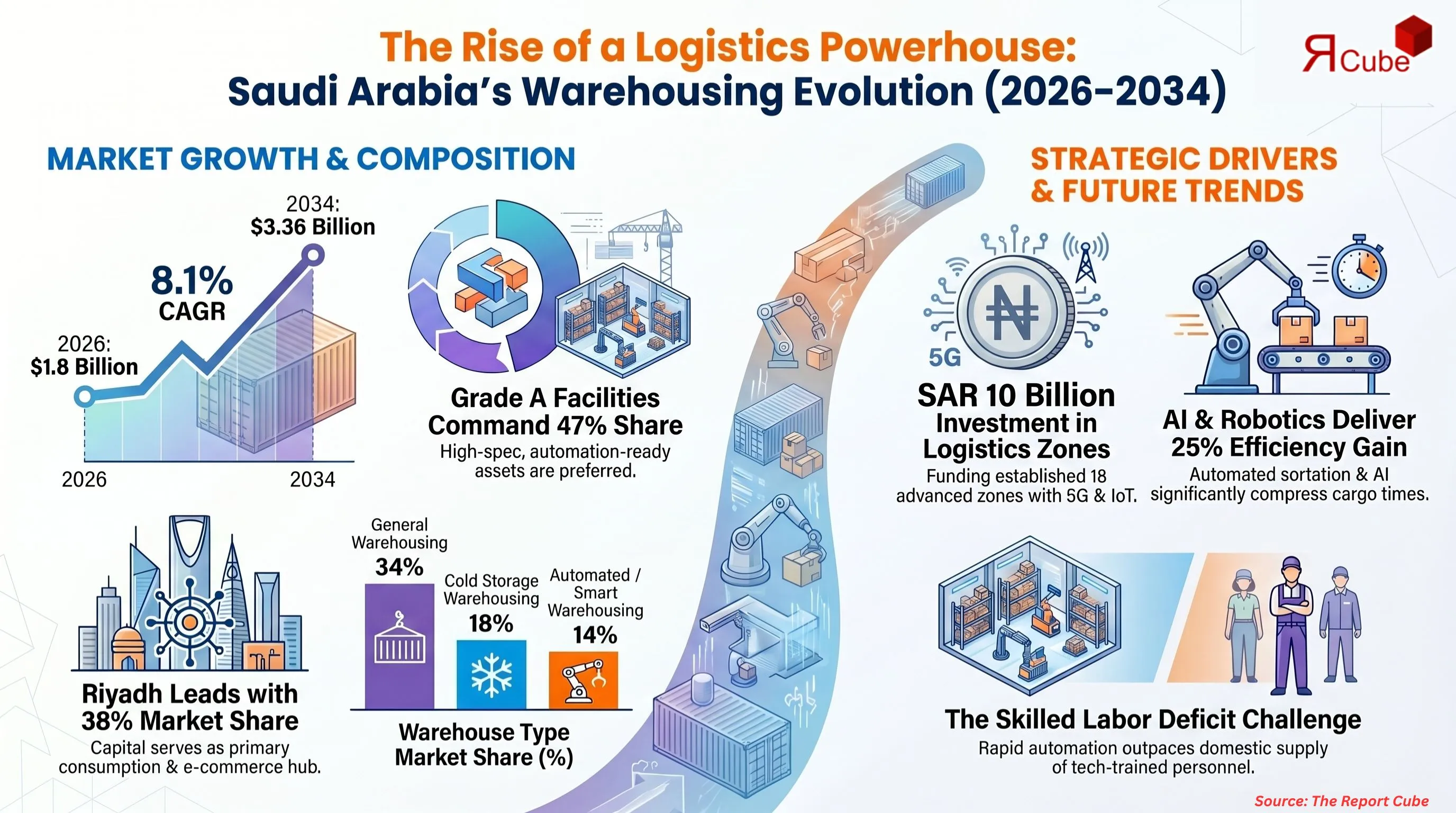
- The Saudi Arabia Industrial & Warehousing Market was valued at USD 1.8 billion in 2026.
- The market is projected to reach USD 3.36 billion by 2034.
- The market is anticipated to register a CAGR of 8.1% during 2026-2034.
By Warehouse Type
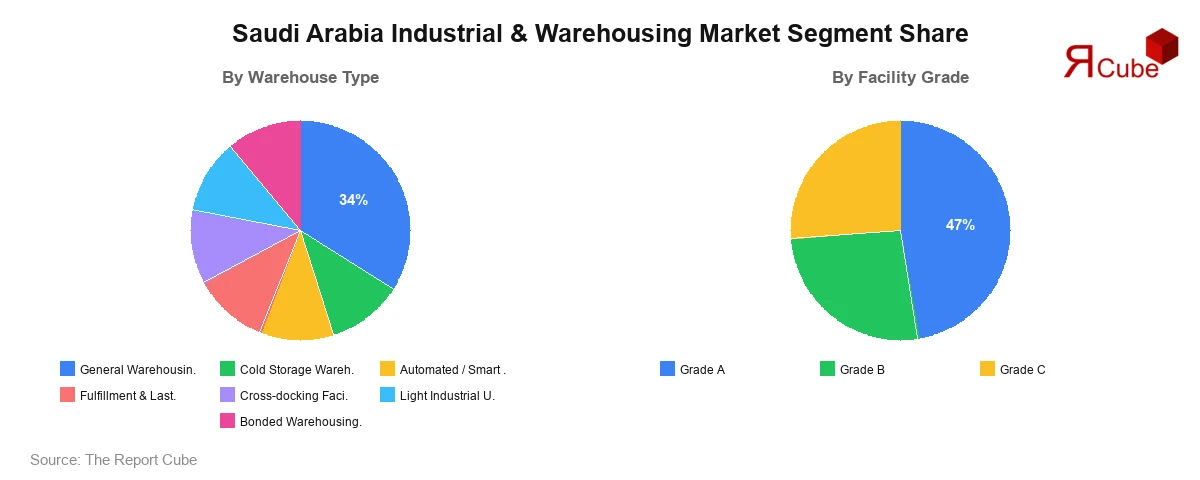
- General Warehousing holds the leading share at approximately 34% of the market.
Key Players
- More than 10 companies are actively engaged in producing Saudi Arabia Industrial & Warehousing Market solutions.
- Top 5 companies acquired around 52% of the market share.
- SABIC, LSC Logistics, Agility Logistics, Almajdouie Logistics, SAL Saudi Logistics Services, and others.
By Facility Grade
- Grade A facilities dominate, commanding approximately 47% of the total market.
Saudi Arabia Industrial & Warehousing Market Insights & Analysis
The Saudi Arabia Industrial & Warehousing Market is anticipated to register a 8.1% CAGR during 2026-2034. The market size was valued at USD 1.8 billion in 2026 and is projected to reach USD 3.36 billion by 2034. The market's trajectory is underpinned by the Kingdom's Vision 2030 economic transformation agenda, which targets logistics as a strategic pillar of non-oil GDP growth. The National Industrial Development and Logistics Program (NIDLP) has channeled over SAR 10 billion (approximately USD 2.67 billion) toward the development of 18 advanced logistics zones embedded with 5G infrastructure, IoT-enabled cargo tracking, and streamlined customs clearance.
These purpose-built zones have reduced cargo processing times to under four hours from legacy benchmarks exceeding 12 hours. In December 2025, Mawani, the Saudi Ports Authority, signed SAR 229 million in agreements for new logistics centers at Dammam and Yanbu ports, including a 40,000 sqm food-grade storage hub, signaling continued public investment. In November 2025, DHL Supply Chain committed USD 150 million to develop a new facility in the Kingdom, affirming confidence from global operators. These combined public and private investment flows are rapidly elevating the quality and capacity of industrial warehousing infrastructure across the Saudi market.
Saudi Arabia Industrial & Warehousing Market Dynamics
|
Market Dynamic |
Short Impact Analysis |
Impact Level |
|---|---|---|
|
Vision 2030 Logistics Zone Investment |
Government investment in logistics zones is increasing demand for Grade A warehouses, improving cargo movement speed, and attracting global 3PL and logistics companies. This is boosting warehouse leasing and infrastructure expansion across key cities. |
High |
|
Saudi Landbridge Rail Project |
The rail connectivity project is reducing transit time between ports and industrial hubs, supporting faster distribution and encouraging development of intermodal warehouse facilities. |
High |
|
Skilled Labor Deficit in Automation-Ready Facilities |
Shortage of trained workers for automated warehouses is slowing operational efficiency and increasing training costs for operators adopting robotics and smart warehouse systems. |
Medium |
|
Saudization Hiring Regulations |
Workforce localization requirements may delay recruitment of foreign technical experts, creating temporary operational bottlenecks in advanced warehousing facilities. |
Medium |
|
Cold Chain & Fulfillment Infrastructure Convergence |
Rising demand for food, pharma, and e-commerce delivery is accelerating investment in temperature-controlled warehouses and micro-fulfillment centers, creating premium warehouse opportunities. |
High |
Key Market Driver Vision 2030 Logistics Zone Investment
Saudi Arabia's targeted logistics zone development program represents the most structural demand catalyst in the industrial warehousing market. The Industrial Development Fund has committed SAR 10 billion to 18 purpose-built logistics zones situated adjacent to the Kingdom's major industrial corridors in Riyadh, Dammam, and Jeddah. These zones offer operators discounted utility tariffs, 100% foreign ownership rights, and customs-light processing that compress cargo clearance timelines to roughly four hours, one-third of legacy facility benchmarks.
The Saudi Landbridge rail project, linking the Red Sea coast to the Arabian Gulf, is further compressing transit times and incentivizing investment in intermodal warehouse hubs. With first-phase zone openings already operational before 2026, the pipeline of Grade A industrial warehouse supply is accelerating, directly elevating lease absorption rates, raising average facility specifications, and attracting multinational 3PL operators to establish regional headquarters within the Kingdom.
Need Specific Data, Let’s Customize the Report for You
Request CustomizationMajor Industry Challenge Skilled Labor Deficit in Automation-Ready Facilities
Despite rapid infrastructure development, the Saudi Arabia Industrial & Warehousing Market faces a pronounced shortage of skilled workers capable of managing increasingly technology-driven warehouse environments. As operators deploy automated storage and retrieval systems (ASRS), robotics-based sortation lines, and IoT-integrated warehouse management software, the demand for technicians, systems operators, and data-driven logistics planners is growing faster than domestic training pipelines can supply.
Workforce nationalization mandates under the Saudization (Nitaqat) program impose hiring quotas that, while strategically sound, can slow recruitment of specialized foreign technicians during critical facility ramp-up periods. This mismatch raises onboarding timelines, increases training expenditure, and temporarily constrains throughput efficiency at newly commissioned automated facilities. Without accelerated vocational training partnerships between logistics operators, the Saudi Technical and Vocational Training Corporation (TVTC), and global automation suppliers, this skills gap risks delaying full productivity realization across Grade A and automated facility categories through the mid-forecast period.
Emerging Trend Shaping Outlook Cold Chain and Fulfillment Infrastructure Convergence
A defining structural shift in the Saudi Arabia Industrial & Warehousing Market is the convergence of cold chain logistics with urban fulfillment infrastructure. Driven by Saudi Arabia's food security imperatives, pharmaceutical traceability regulations, and surge in perishable e-commerce, cold storage warehousing is now among the fastest-growing facility subcategories. The December 2025 Mawani agreement to develop a 40,000 sqm food storage hub at Yanbu typifies this accelerating investment.
Concurrently, last-mile fulfillment centers are being co-located with temperature-controlled zones to serve high-density cities including Riyadh, Jeddah, and Dammam within two-hour delivery windows. Platforms including Noon, Amazon.sa, and regional grocery delivery operators are driving demand for micro-fulfillment nodes embedded within industrial parks. This convergence is redefining facility design parameters, pushing developers toward multi-temperature zoned buildings with automation-ready layouts, and establishing cold-capable fulfillment as the premium segment within the broader Saudi warehousing landscape.
Saudi Arabia Industrial & Warehousing Market Segment-wise Analysis
The Saudi Arabia Industrial & Warehousing Market exhibits significant segmentation diversity, reflecting the breadth of industrial activity and supply chain complexity across the Kingdom. Facility type and grade both play a decisive role in shaping where capital flows, which operators dominate, and how quickly individual segments are likely to scale toward the 2034 forecast horizon.
By Warehouse Type
- General Warehousing
- Cold Storage Warehousing
- Automated / Smart Warehousing
- Fulfillment & Last-mile Centers
- Cross-docking Facilities
- Light Industrial Units
- Bonded Warehousing
General Warehousing currently accounts for the largest revenue share at approximately 34% of the total market, driven by the dominance of ambient storage requirements across domestic manufacturing, retail, and FMCG supply chains. Most Saudi manufacturers and modern trade retailers continue to rely on general-purpose facilities for inventory consolidation and distribution. Cold Storage Warehousing, representing around 18% of market revenues, is registering the fastest growth rate among all warehouse types as food security policies under Vision 2030 tighten traceability standards and pharmaceutical import volumes rise.
Automated and Smart Warehousing holds approximately 14% market share, a figure expected to rise substantially as labor cost optimization and throughput density requirements drive operator investment in ASRS, robotic picking, and AI-driven WMS platforms. Fulfillment and Last-mile Centers account for roughly 12%, experiencing strong acceleration tied to e-commerce growth, while Bonded Warehousing, at approximately 10% share, is benefiting from Saudi Arabia's ambition to become a global re-export hub, with bonded facilities near Dammam and Jeddah ports attracting importers seeking customs-deferred storage. Cross-docking Facilities and Light Industrial Units collectively represent the remaining 12% of the market, with Light Industrial Units gaining prominence as the Kingdom's manufacturing localization push under Vision 2030 expands production activity across MODON industrial cities.
By Facility Grade
- Grade A
- Grade B
- Grade C
Grade A facilities dominate the Saudi Arabia Industrial & Warehousing Market, commanding approximately 47% of total market revenues. These high-specification assets, typically featuring clear heights exceeding 10 meters, dock-leveler access, fire suppression systems, CCTV surveillance, and automation-readiness, are the preferred choice of multinational 3PLs, large e-commerce operators, and pharmaceutical distributors requiring compliance-grade environments. The surge in government-backed logistics zone development is directly expanding Grade A supply, particularly in Riyadh, Dammam, and Jeddah.
Grade B facilities account for around 33% of market share, serving a broad middle tier of domestic manufacturers, SME logistics operators, and regional distributors that require functional but cost-sensitive storage without premium specifications. Grade C legacy facilities, representing approximately 20% of the market, are gradually losing share as occupancy migrates toward upgraded assets, though these facilities remain relevant in secondary cities and for bulk commodity storage where specification requirements are less stringent. The sustained shift toward Grade A assets is a key structural trend expected to compress Grade C share further through 2034, as Vision 2030 logistics zone incentives make premium facility development more economically viable.
Regional Projection of Saudi Arabia Industrial & Warehousing Market
The Saudi Arabia Industrial & Warehousing Market demonstrates concentrated geographic demand across the Kingdom's three principal economic corridors.
- Riyadh
- Jeddah
- Eastern Province (Dammam)
- Emerging Logistics Zones
The Central Region, anchored by Riyadh, leads the market with approximately 38% share, driven by the Capital's status as the Kingdom's primary consumption hub, its proximity to King Khalid International Airport and the Special Integrated Logistics Zone (SILZ), and robust fulfillment center demand from e-commerce operators. The Eastern Province holds a significant secondary share at approximately 29%, benefiting from port adjacency at King Abdulaziz Port in Dammam and deep integration with petrochemical and energy supply chains. The Western Region commands around 22% share, underpinned by Jeddah Islamic Port's Red Sea connectivity and religious tourism cargo flows. Secondary regions including Northern corridors and Southern cities are gradually gaining share aligned with Vision 2030's balanced regional development objectives.
Saudi Arabia Industrial & Warehousing Market: Recent Development (2025)
- Aramex activated automated robotic sortation at Jeddah Islamic Port, processing 96,000 parcels daily in January 2025.
- DHL Supply Chain committed USD 150 million to develop a new Grade A warehouse facility in Saudi Arabia in November 2025.
- Mawani signed SAR 229 million agreements for logistics centers at Dammam and Yanbu ports in December 2025.
- SAL Logistics showcased AI robotics and IoT at Saudi Warehousing Expo 2026, delivering verified 25% efficiency gains.
Saudi Arabia Industrial & Warehousing Market Future Outlook (2034)
The Saudi Arabia Industrial & Warehousing Market is positioned for sustained expansion, projected to grow at an 8.1% CAGR to reach USD 3.36 billion by 2034. Growth will be shaped by the full operationalization of Vision 2030 logistics zones, the deepening integration of AI-driven warehouse management systems, and the maturation of cold chain infrastructure serving food security and pharmaceutical distribution mandates. Automated and smart warehousing will emerge as the highest-growth facility category as labor productivity imperatives and throughput density demands accelerate robotics adoption.
The Saudi Landbridge project will unlock new intermodal industrial hub opportunities in central and northern corridors, redistributing warehouse investment beyond the three primary city clusters. Long-term, the Kingdom's positioning as a tri-continental re-export hub connecting Asia, Europe, and Africa will sustain structural demand for bonded and Grade A general warehousing well beyond the forecast horizon.
Why Choose This Report?
- Provides a comprehensive overview of the overall market analysis, encompassing key trends, consumer behavior analysis, and risk assessment to support strategic decision-making.
- Provides accurate, up-to-date insights into market size, segmentation, and emerging opportunities, helping to minimize risk & capitalizing on growth.
- Gives deep understanding of target audience preferences, investment habits, and communication channels for enhanced product development & marketing effectiveness.
- Delivers competitive analysis & benchmarking, uncovering the strengths & weaknesses of market competitors to guide strategies.
- Consolidate comprehensive market intelligence, reducing reasoning & streamlining research efforts.
- Facilitates customized market segmentation & risk mitigation strategies, fine-tuned to the business objectives.
- Aids in identifying both market challenges & untapped opportunities within the industry to drive long-term business growth.
- Provides valuable information based on actual customer data & search trends.
Table of Contents
- Introduction
- Objective of the study
- Product Definition
- Market Segmentation
- Research Methodology
- Secondary Data Points
- Companies Interviewed
- Primary Data Points
- Breakdown of Primary Interviews
- Secondary Data Points
- Executive Summary
- Market Dynamics
- Drivers
- Challenges
- Opportunity Assessment
- Recent Trends and Developments
- Policy and Regulatory Landscape
- Vision 2030 Initiatives
- National Industrial Development & Logistics Program (NIDLP)
- National Transport and Logistics Strategy (NTLS)
- Foreign Investment & Industrial Licensing Policies
- Land Allocation & Industrial Zone Regulations
- Market Analysis
- Supply (GLA, m² – Existing vs Pipeline Stock)
- Demand (Absorption, Leasing Activity)
- Rental Benchmarks (SAR/m²/year)
- Occupancy & Vacancy Rates
- Lease Terms & Covenant Strength
- Construction Cost & Land Pricing
- Distance to Ports, Highways & Logistics Corridors
- Mapping of Industrial Zones, Logistics Parks & Free Zones
- Identification of Key Logistics Corridors
- Submarket Segmentation (City-level & Cluster-level)
- Proximity Analysis (Ports, Airports, Highways)
- Market Supply Analysis
- Existing Warehouse Stock by Grade (A/B/C) – GLA (m²)
- Pipeline Supply & Upcoming Developments
- Classification by Facility Type
- General Storage
- Cold Chain
- Light Industrial
- Last-mile Fulfilment
- Cross-dock Facilities
- Performance Indicators
- Occupancy Levels & Vacancy Rates by Grade & Zone
- Rental Benchmarks (SAR/m²/year
- Land Lease Rates
- Built-to-Suit Lease Rates
- Typical Lease Structures & Tenure
- Tenant / Occupier Profile Analysis
- 3PL Operators
- E-commerce Players
- FMCG & Retail
- Pharma & Healthcare
- Government & Strategic Entities
- Saudi Arabia Industrial & Warehousing Market Overview and Forecast Analysis (2021-2034)
- Market Size, By Value, By growth rate (CAGR/USD Billions)
- Market Share, By Warehouse Type
- General Warehousing
- Cold Storage Warehousing
- Automated / Smart Warehousing
- Fulfillment & Last-mile Centers
- Cross-docking Facilities
- Light Industrial Units
- Bonded Warehousing
- Market Share, By Facility Grade
- Grade A
- Grade B
- Grade C
- Market Share, By Ownership Model
- Owned
- Leased
- Build-to-Suit
- Speculative Development
- Market Share, By Temperature Type
- Ambient
- Temperature-Controlled
- Market Share, By End-use Industry
- 3PL & Logistics Operators
- E-commerce & Retail
- FMCG & Food & Beverage
- Pharmaceuticals & Healthcare
- Manufacturing & Industrial
- Government & Strategic Logistics
- Oil & Gas / Chemicals
- Others
- Market Share, By Region
- Riyadh
- Jeddah
- Eastern Province (Dammam)
- Emerging Logistics Zones
- Market Share, By Competitors
- Competition Characteristics
- Revenue Shares
- Saudi Arabia General Warehousing Industrial & Warehousing Market Overview, 2021-2034F
- By Value (USD Million/Billion)
- By Facility Grade- Market Size & Forecast 2021-2034, USD Million/Billion
- By Ownership Model- Market Size & Forecast 2021-2034, USD Million/Billion
- By Temperature Type- Market Size & Forecast 2021-2034, USD Million/Billion
- By End-use Industry- Market Size & Forecast 2021-2034, USD Million/Billion
- Saudi Arabia Cold Storage Warehousing Industrial & Warehousing Market Overview, 2021-2034F
- By Value (USD Million/Billion)
- By Facility Grade- Market Size & Forecast 2021-2034, USD Million/Billion
- By Ownership Model- Market Size & Forecast 2021-2034, USD Million/Billion
- By Temperature Type- Market Size & Forecast 2021-2034, USD Million/Billion
- By End-use Industry- Market Size & Forecast 2021-2034, USD Million/Billion
- Saudi Arabia Automated / Smart Warehousing Industrial & Warehousing Market Overview, 2021-2034F
- By Value (USD Million/Billion)
- By Facility Grade- Market Size & Forecast 2021-2034, USD Million/Billion
- By Ownership Model- Market Size & Forecast 2021-2034, USD Million/Billion
- By Temperature Type- Market Size & Forecast 2021-2034, USD Million/Billion
- By End-use Industry- Market Size & Forecast 2021-2034, USD Million/Billion
- Saudi Arabia Fulfillment & Last-mile Centers Industrial & Warehousing Market Overview, 2021-2034F
- By Value (USD Million/Billion)
- By Facility Grade- Market Size & Forecast 2021-2034, USD Million/Billion
- By Ownership Model- Market Size & Forecast 2021-2034, USD Million/Billion
- By Temperature Type- Market Size & Forecast 2021-2034, USD Million/Billion
- By End-use Industry- Market Size & Forecast 2021-2034, USD Million/Billion
- Saudi Arabia Cross-docking Facilities Industrial & Warehousing Market Overview, 2021-2034F
- By Value (USD Million/Billion)
- By Facility Grade- Market Size & Forecast 2021-2034, USD Million/Billion
- By Ownership Model- Market Size & Forecast 2021-2034, USD Million/Billion
- By Temperature Type- Market Size & Forecast 2021-2034, USD Million/Billion
- By End-use Industry- Market Size & Forecast 2021-2034, USD Million/Billion
- Saudi Arabia Light Industrial Units Industrial & Warehousing Market Overview, 2021-2034F
- By Value (USD Million/Billion)
- By Facility Grade- Market Size & Forecast 2021-2034, USD Million/Billion
- By Ownership Model- Market Size & Forecast 2021-2034, USD Million/Billion
- By Temperature Type- Market Size & Forecast 2021-2034, USD Million/Billion
- By End-use Industry- Market Size & Forecast 2021-2034, USD Million/Billion
- Saudi Arabia Bonded Warehousing Industrial & Warehousing Market Overview, 2021-2034F
- By Value (USD Million/Billion)
- By Facility Grade- Market Size & Forecast 2021-2034, USD Million/Billion
- By Ownership Model- Market Size & Forecast 2021-2034, USD Million/Billion
- By Temperature Type- Market Size & Forecast 2021-2034, USD Million/Billion
- By End-use Industry- Market Size & Forecast 2021-2034, USD Million/Billion
- Competitive Outlook (Company Profile - Partial List)
- SABIC (Saudi Basic Industries Corporation)
- Company Overview
- Business Segments
- Strategic Alliances/Partnerships
- Recent Developments
- LSC Logistics (LSC Warehousing and Logistics Company)
- Company Overview
- Business Segments
- Strategic Alliances/Partnerships
- Recent Developments
- Agility Logistics (Agility Logistics Parks)
- Company Overview
- Business Segments
- Strategic Alliances/Partnerships
- Recent Developments
- Almajdouie Logistics
- Company Overview
- Business Segments
- Strategic Alliances/Partnerships
- Recent Developments
- SAL Saudi Logistics Services
- Company Overview
- Business Segments
- Strategic Alliances/Partnerships
- Recent Developments
- Bahri (National Shipping Company of Saudi Arabia)
- Company Overview
- Business Segments
- Strategic Alliances/Partnerships
- Recent Developments
- Aramex
- Company Overview
- Business Segments
- Strategic Alliances/Partnerships
- Recent Developments
- Others
- SABIC (Saudi Basic Industries Corporation)
- Contact Us & Disclaimer
Top Key Players & Market Share Outlook
- SABIC
- LSC Logistics
- Agility Logistics
- Almajdouie Logistics
- SAL Saudi Logistics Services
- Bahri (National Shipping Company of Saudi Arabia)
- Aramex
- Others
Frequently Asked Questions






