



Build Your Custom Market Intelligence Report
Customize Your ReportVietnam Infrastructure Market Key Takeaways
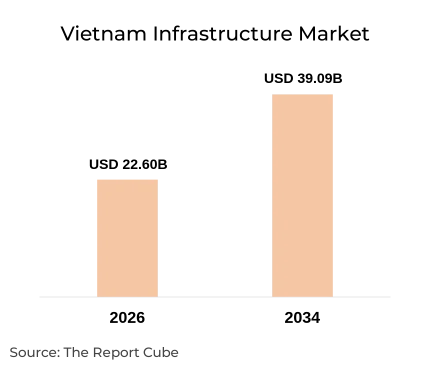
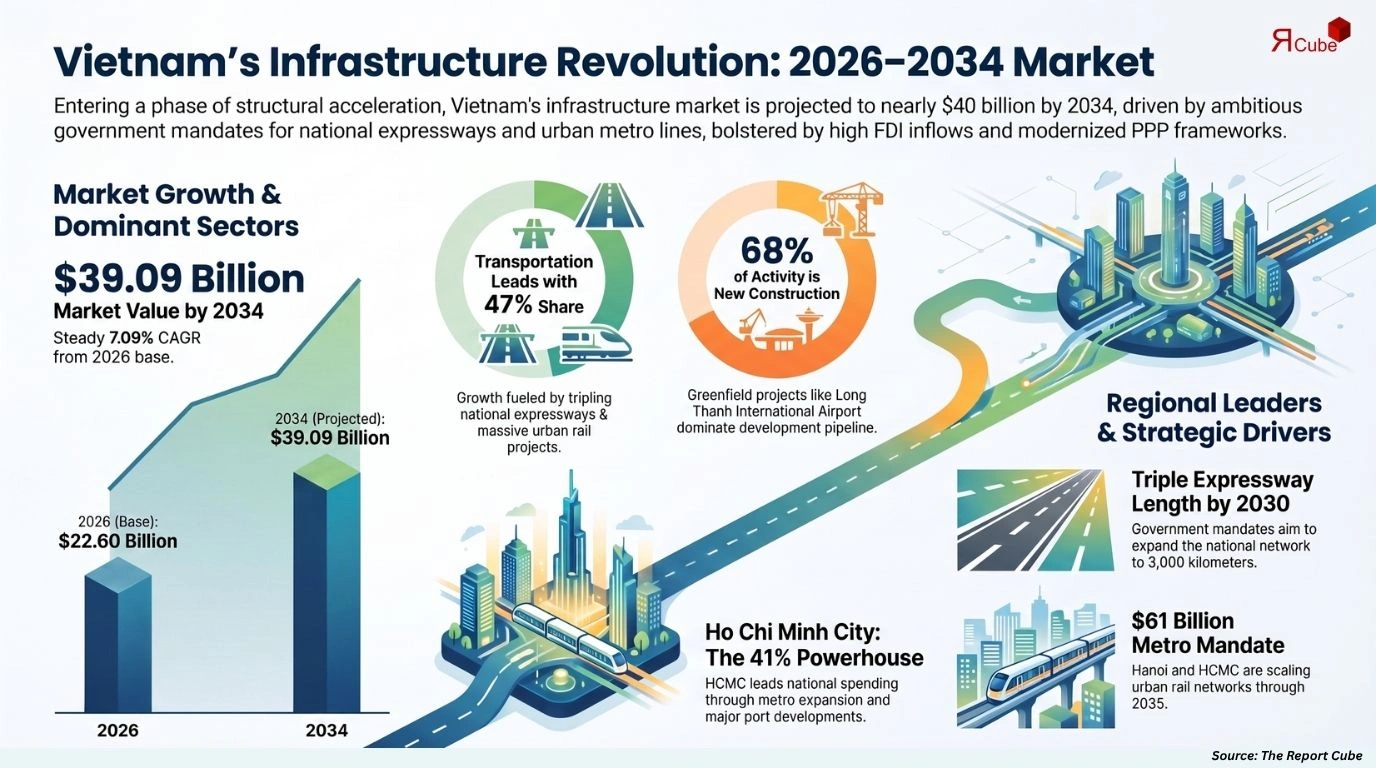
- Vietnam Infrastructure Market is valued at USD 22.60 billion in 2026, reflecting accelerating public investment momentum.
- Market is projected to reach USD 39.09 billion by 2034, expanding at a 7.09% CAGR.
- Transportation infrastructure dominates as the leading segment driven by expressway and metro network expansion.
- New construction commands the largest share across Vietnam's active infrastructure development pipeline.
- Ho Chi Minh City holds regional leadership due to large-scale transport, aviation, and urban connectivity projects.
- Da Nang is emerging as the fastest-growing city driven by tourism, logistics, and industrial zone development.
- Hoa Binh Construction Group, Coteccons, and Construction Corporation No.1 are key players shaping market activity.
- Public-private partnership frameworks and rising FDI inflows continue accelerating infrastructure capacity expansion nationwide.
Vietnam Infrastructure Market Insights & Analysis
The Vietnam Infrastructure Market is anticipated to register a 7.09% CAGR during 2026–2034. The market size was valued at USD 22.60 billion in 2026 and is projected to reach USD 39.09 billion by 2034. The market is benefiting from accelerated government disbursement targets, a rapidly expanding national expressway network, and ambitious urban rail programs across Hanoi and Ho Chi Minh City. In 2025, Vietnam committed to completing over 1,188 kilometers of new expressways while simultaneously advancing Phase 1 of Long Thanh International Airport - signaling the country's decisive infrastructure-led growth strategy and Vietnam construction sector development into the next decade.
Foreign direct investment continues reshaping the demand landscape. Vietnam's government mobilized more than USD 25 billion in combined public and private infrastructure investment in 2025, with Ho Chi Minh City alone targeting USD 25.2 billion in societal investment for urban transport, aviation, and port projects. Legislative reforms - including new PPP approval mechanisms and streamlined disbursement rules - have lowered entry barriers for private developers and diversified funding across transportation, energy, and social sectors. These structural tailwinds are expected to sustain compound market growth well beyond 2026, with Vietnam's expanding road and rail infrastructure network serving as a primary investment driver through the forecast period.
Vietnam Infrastructure Market Dynamics
Vietnam's infrastructure market is entering a structural acceleration phase driven by urbanization, industrial relocation, and government-mandated spending targets. With more than 80% of 2025 public investment earmarked for transportation and energy capacity expansion, and the government targeting double-digit GDP growth through 2030, the spending pipeline remains robust. Rising FDI inflows, metro line activations, and legislative streamlining are collectively reinforcing long-term infrastructure demand across all segments.
|
Factor |
Type |
Specific Impact on Market |
Magnitude |
|---|---|---|---|
|
Accelerated government disbursement targets |
Driver |
Boosts transportation and energy project commencement rates |
Very High |
|
Rising FDI and industrial relocation |
Opportunity |
Increases demand for manufacturing and logistics infrastructure |
High |
|
PPP framework modernization |
Driver |
Expands private capital participation in large-scale projects |
High |
|
Urbanization in Hanoi and Ho Chi Minh City |
Driver |
Sustains residential, metro, and utilities construction spending |
High |
|
Green construction adoption |
Trend |
Shifts procurement toward BIM, prefabrication, and ESG-compliant delivery |
Moderate |
Key Market Driver: Government Expressway and Metro Expansion
Vietnam's government has set binding targets to triple national expressway length by 2030, with 1,188 kilometers of new expressway completed in 2025 alone as part of a broader 3,000-kilometer national network goal. Simultaneously, Hanoi's resolution to build 10 urban rail lines totaling 400 kilometers by 2035 - requiring approximately USD 21 billion in investment - and Ho Chi Minh City's plan for seven lines spanning 355 kilometers at USD 40 billion collectively represent a generational infrastructure mandate. These programs directly sustain demand for civil contractors, materials suppliers, systems integrators, and Vietnam's growing urban rail and metro market, keeping project pipelines active across both cities through the full forecast period.
Major Industry Challenge: Land Clearance Delays and Contractor Fragmentation
Despite record-level disbursement commitments, Vietnam's infrastructure market faces persistent execution risk from delayed land acquisition, fragmented contractor capacity, and materials bottlenecks including sand shortages. Ring Road 3 in Ho Chi Minh City - with preliminary investment exceeding VND 75,378 billion - encountered multi-phase land clearance challenges that required inter-provincial coordination and repeated timeline adjustments. Public investment disbursement rates consistently lag allocation targets, creating project cost inflation and schedule overruns that disproportionately affect smaller contractors with limited financial buffers. Addressing these structural constraints remains critical to sustaining Vietnam's ambitious infrastructure throughput.
Emerging Trend Shaping Outlook: Green Construction and BIM Technology Adoption
Vietnam's leading contractors - including Coteccons and its subsidiary Unicons - are actively embedding Building Information Modeling (BIM), prefabrication, and ESG compliance frameworks into large-scale project delivery. Coteccons was recognized as a Top 10 Contractor in Vietnam at the 2025 Hubexo Asia Awards, with green-certified projects including the Pandora Factory and Sun Urban City demonstrating measurable gains in cost efficiency, schedule adherence, and environmental compliance. As public project owners and international lenders raise documentation and sustainability standards, ESG-aligned delivery capabilities are becoming a genuine competitive differentiator across Vietnam's manufacturing and industrial infrastructure segment.
Need Specific Data, Let’s Customize the Report for You
Request CustomizationVietnam Infrastructure Market Segment-wise Analysis
Vietnam's infrastructure market serves a diverse mix of public, private, and foreign-backed project categories. Spending spans transportation networks, energy and utility systems, social institutions, extraction assets, and manufacturing facilities, each attracting distinct funding structures and contractor profiles.
By Infrastructure Type
- Social Infrastructure
- Transportation Infrastructure
- Extraction Infrastructure
- Manufacturing Infrastructure
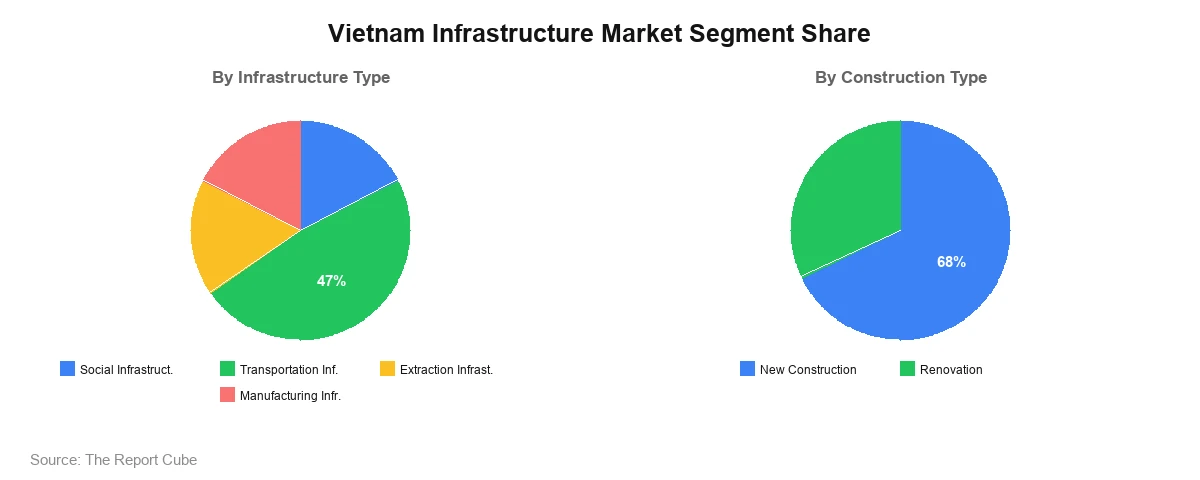
Transportation Infrastructure dominates the By Infrastructure Type segment with an estimated 47% revenue share, driven by Vietnam's binding national expressway targets, active metro line programs in Hanoi and Ho Chi Minh City, and major aviation investments including Long Thanh International Airport and Tan Son Nhat Terminal 3. The government's stated goal of doubling airport passenger capacity and increasing seaport capacity by 50% by 2030 continues channeling large volumes of public and PPP capital into transportation assets, sustaining contractor order books and materials demand across civil engineering, MEP systems, and systems integration disciplines.
Social Infrastructure represents the second-largest segment with an estimated 26% share, encompassing schools, hospitals, water treatment systems, and urban utilities. Vietnam's expanding urban population - particularly in Hanoi and Ho Chi Minh City - is driving sustained investment in public health facilities, educational campuses, and water security projects. Coteccons' 2025 bid win for Vietnam National University's development project, valued at nearly VND 500 billion and financed by a World Bank loan, illustrates growing multilateral funding participation in this segment. Manufacturing Infrastructure is the fastest-growing type, propelled by FDI-driven factory construction for electronics, footwear, and food processing, with Coteccons and Unicons actively building facilities for Suntory PepsiCo, Pandora, and Apache Shoe Factory across multiple provinces.
By Construction Type
- New Construction
- Renovation
New Construction commands the dominant position within the By Construction Type segment, accounting for an estimated 68% market share, consistent with the pace of Vietnam's greenfield infrastructure expansion. The active pipeline of expressways, metro corridors, airports, hospitals, and industrial parks collectively supports sustained demand for new construction activity. Public investment in new transport arteries - including the USD 67 billion North-South high-speed railway approved in principle and the USD 8 billion Lao Cai–Hanoi–Hai Phong railway - represents multi-year contract opportunities for major contractors and materials suppliers operating across the country.
Renovation construction holds the remaining 32% share and is accelerating in pace as Vietnam's earlier-generation infrastructure stock - including legacy roads, aging port facilities, and dated hospital complexes - requires systematic upgrading. The government's fast-track resolution mechanism for urban metro development and Vietnam's social infrastructure renovation pipeline are both supporting rising renovation contract values, particularly for road widening, terminal retrofits, and utilities modernization. Private sector developers are also increasingly converting legacy commercial and industrial buildings in Ho Chi Minh City and Hanoi into mixed-use facilities, further broadening renovation demand beyond the public sector.
Regional Projection of Vietnam Infrastructure Market
Vietnam's infrastructure market exhibits distinct regional variation shaped by economic concentration, government project mandates, and industrial activity levels. Ho Chi Minh City and Hanoi together account for the majority of annual infrastructure spending, while Da Nang and secondary provinces are gaining ground through targeted regional development programs and rising private investment flows.
|
Region |
Estimated Market Share |
Key Growth Factors |
Consumer Trends |
|---|---|---|---|
|
Ho Chi Minh City |
41% |
Metro expansion, Long Thanh Airport, Ring Road 3, port development |
High demand for transport and social infrastructure projects |
|
Hanoi |
30% |
Ring Road 4, metro network scale-up, capital urbanization programs |
Rising investment in urban rail, utilities, and education infrastructure |
|
Da Nang |
14% |
Logistics hub growth, industrial zone expansion, tourism infrastructure |
Increasing private and FDI-backed manufacturing and hospitality construction |
|
Rest of Vietnam |
15% |
Provincial expressways, energy projects, coastal road completion |
Growing demand for extraction, energy, and secondary transport infrastructure |
- Ho Chi Minh City: The city holds approximately 41% of national infrastructure spending, driven by Ring Road 3, Tan Son Nhat Terminal 3, and multi-line metro development requiring USD 40 billion through 2035, anchoring Vietnam's largest construction market by value.
- Hanoi: Hanoi accounts for roughly 30% market share, supported by Ring Road 4 - with a preliminary investment of VND 85,813 billion - and a 10-line urban metro program targeting 400 kilometers of track and USD 21 billion in investment by 2035.
- Da Nang: Da Nang represents approximately 14% market share and is advancing as the fastest-growing regional market, benefiting from industrial zone development, logistics corridor investment, and rising hospitality and tourism infrastructure demand from both domestic and foreign developers.
- Rest of Vietnam: Secondary provinces collectively account for approximately 15% of market value, with growth supported by national coastal road completion, provincial expressway connections, and extraction-related infrastructure across energy and mining sectors in northern and central regions.
Vietnam Infrastructure Market: Recent Development (2025)
- Hoa Binh Construction Group secured a major contract for a mega urban area project in Ho Chi Minh City.
- Coteccons won the Vietnam National University infrastructure package financed by the World Bank.
- Vietnam's government approved the USD 67 billion North-South high-speed railway national project.
- Coteccons and Unicons earned Top 10 Contractor honors at the Hubexo Asia Awards for 2025.
Vietnam Infrastructure Market Future Outlook (2034)
The Vietnam Infrastructure Market is projected to expand at a 7.09% CAGR, reaching approximately USD 39.09 billion by 2034. Growth will be sustained by the country's binding national targets to double highway capacity, expand airport throughput, and increase seaport volume by 50% before 2030. Urban metro programs across Hanoi and Ho Chi Minh City - requiring a combined USD 61 billion through 2035 - represent the single largest infrastructure investment commitment in Vietnam's history, creating a decade-long pipeline for civil contractors, systems integrators, and materials suppliers. End-of-life infrastructure rehabilitation and modernization will also gain traction as earlier-generation assets require systematic upgrading throughout the forecast period.
Future market expansion will be supported by rising PPP participation, legislative streamlining, and increasing multilateral financing from institutions including the World Bank and Asian Development Bank. BIM adoption, prefabricated construction, and green-certified project delivery will become baseline procurement requirements as public owners and international lenders raise environmental and governance standards. Manufacturing infrastructure will record the fastest compound growth, driven by continued FDI inflows from electronics, automotive, and food processing sectors relocating regional production to Vietnam. Contractors with integrated ESG capabilities, digital project management tools, and strong balance sheets are best positioned to capture Vietnam's next phase of infrastructure-led economic growth.
Vietnam Infrastructure Market Report Coverage
|
Report Attribute |
Details |
|---|---|
|
Market Name |
Vietnam Infrastructure Market |
|
Market Size (2026) |
USD 22.60 Billion |
|
Market Size (2034) |
USD 39.09 Billion |
|
Forecast Period |
2026–2034 |
|
CAGR |
7.09% |
|
Base Year |
2026 |
|
Historical Years |
2021–2025 |
|
Forecast Years |
2026–2034 |
|
Segments Covered |
By Infrastructure Type, By Construction Type, By Investment Source |
|
Regions Covered |
Ho Chi Minh City, Hanoi, Da Nang, Rest of Vietnam |
|
Key Companies |
Hoa Binh Construction Group, Coteccons Construction Joint Stock Company, Construction Corporation No.1 Joint Stock Company, Others |
|
Report Format |
PDF, Excel, PPT |
|
Customization |
Available as per client requirements |
Why Choose This Report?
- Comprehensive analysis covering all major Vietnam infrastructure segments and regional markets.
- Accurate 2026 market sizing with a reliable forecast through 2034.
- Detailed segmentation across infrastructure type and construction type categories.
- Regional insights supported by active government project pipelines and FDI data.
- Competitive profiling of Vietnam's leading construction contractors and recent developments.
- Strategic analysis of PPP framework evolution and private capital participation trends.
- Data-driven coverage of BIM, green construction, and ESG-driven procurement shifts.
- Forward-looking outlook aligned with Vietnam's 2030 national infrastructure expansion targets.
Table of Contents
- Introduction
- Objective of the Study
- Product Definition
- Market Segmentation
- Study Variables
- Research Methodology
- Secondary Data Points
- Companies Interviewed
- Primary Data Points
- Breakdown of Primary Interviews
- Secondary Data Points
- Executive Summary
- Market Dynamics
- Drivers
- Challenges
- Opportunity Assessment
- Recent Trends and Developments
- Policy and Regulatory Landscape
- Vietnam Infrastructure Market Overview and Forecast Analysis (2021-2034)
- Market Size, By Value, By Growth Rate (CAGR/USD Billions)
- Demand – Supply Trends
- Market Share, By Infrastructure Type
- Social Infrastructure
- Transportation Infrastructure
- Extraction Infrastructure
- Manufacturing Infrastructure
- Market Share, By Construction Type
- New Construction
- Renovation
- Market Share, By Investment Source
- Public
- Private
- Market Share, By Region
- Ho Chi Minh City
- Hanoi
- Da Nang
- Rest of Vietnam
- Market Share, By Competitors
- Competition Characteristics
- Revenue Shares
- Social Infrastructure Vietnam Infrastructure Market Overview, 2021-2034F
- By Value (USD Million)
- By Construction Type – Market Size & Forecast 2021-2034, USD Million
- New Construction
- Renovation
- Transportation Infrastructure Vietnam Infrastructure Market Overview, 2021-2034F
- By Value (USD Million)
- By Construction Type – Market Size & Forecast 2021-2034, USD Million
- New Construction
- Renovation
- Extraction Infrastructure Vietnam Infrastructure Market Overview, 2021-2034F
- By Value (USD Million)
- By Construction Type – Market Size & Forecast 2021-2034, USD Million
- New Construction
- Renovation
- Manufacturing Infrastructure Vietnam Infrastructure Market Overview, 2021-2034F
- By Value (USD Million)
- By Construction Type – Market Size & Forecast 2021-2034, USD Million
- New Construction
- Renovation
- Competitive Outlook (Company Profile - Partial List)
- Hoa Binh Construction Group
- Company Overview
- Business Segments
- Strategic Alliances/Partnerships
- Recent Developments
- Coteccons Construction Joint Stock Company
- Company Overview
- Business Segments
- Strategic Alliances/Partnerships
- Recent Developments
- Construction Corporation No.1 Joint Stock Company
- Company Overview
- Business Segments
- Strategic Alliances/Partnerships
- Recent Developments
- Others
- Hoa Binh Construction Group
- Contact Us & Disclaimer
Top Key Players & Market Share Outlook
- Hoa Binh Construction Group
- Coteccons Construction Joint Stock Company
- Construction Corporation No.1 Joint Stock Company
- Others
Frequently Asked Questions






