



Build Your Custom Market Intelligence Report
Customize Your ReportJapan ISO Tank Container Market Statistics and Insights
Market Insights
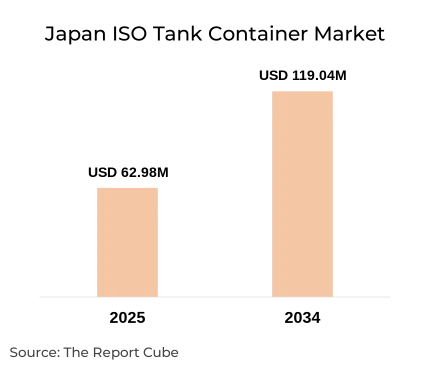
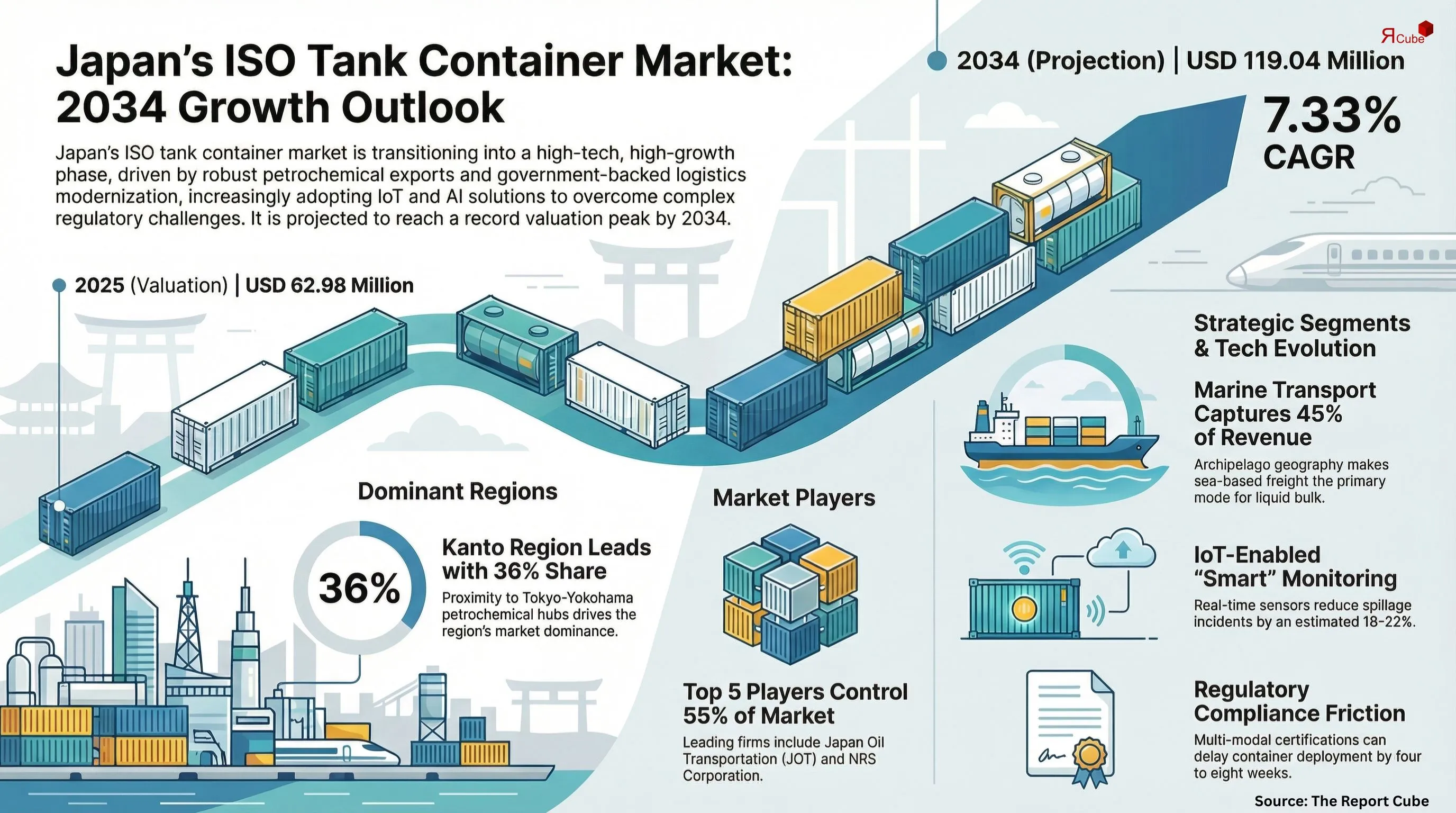
- Japan ISO Tank Container Market was valued at USD 62.98 million in 2025.
- Japan ISO Tank Container Market is projected to reach USD 119.04 million by 2034.
- The market is anticipated to register a robust CAGR of 7.33% through 2034.
By Transport Mode
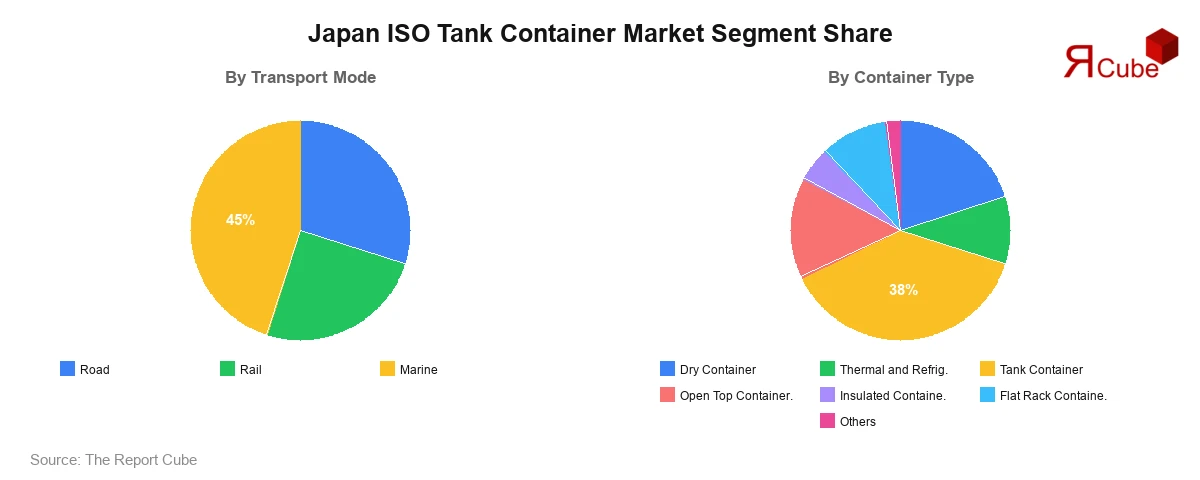
- Marine segment leads with approximately 45% share in 2025.
Competitive Landscape
- More than 10 companies are actively engaged in producing Japan ISO Tank Container Market solutions.
- Top 5 companies acquired around 55% of the market share.
- Japan Oil Transportation (JOT), NRS Corporation, Nippon Marine Logistics, Ltd., Sinotrans Japan Co., Ltd., Manock Industry Co., Ltd., and others.
By Container Type
- Tank Container segment dominates with approximately 38% share in 2025.
Japan ISO Tank Container Market Insights & Analysis
The Japan ISO Tank Container Market is anticipated to register a 7.33% CAGR during 2026–2034. The market size was valued at USD 62.98 million in 2025 and is projected to reach USD 119.04 million by 2034. Japan's robust petrochemical export infrastructure underpins this expansion, with the country operating nearly 23 crude oil refineries that generate consistent demand for multi-compartment ISO tank containers capable of transporting petroleum products of multiple grades simultaneously.
The Japanese government's Strategic Energy Plan, updated in 2024, allocated over JPY 150 billion toward logistics modernization initiatives, including container terminal automation and digital supply chain monitoring at major ports such as Yokohama and Kobe. Furthermore, the post-Fukushima energy realignment has markedly increased LNG imports, generating supplementary demand for cryogenic ISO tank containers. The country's chemical industry, which exports approximately USD 38 billion in specialty chemicals annually, continues to drive sustained adoption of stainless-steel ISO tank containers with a service lifespan of up to 30 years.
Japan ISO Tank Container Market Dynamics
Key Market Driver Petrochemical Export Infrastructure Fueling Demand
Japan's position as one of Asia-Pacific's most prolific petrochemical exporters is a primary force behind sustained ISO tank container adoption. The country's 23 active crude oil refineries produce a diverse array of petroleum derivatives, including naphtha, benzene, and industrial lubricants, that require specialized multi-compartment tank containers for simultaneous multi-grade transport.
In fiscal year 2024, Japan exported approximately USD 38 billion in chemical products, with a significant portion transported via ISO-certified tank containers through marine corridors linking Yokohama, Nagoya, and Osaka ports. As intermodal logistics networks expand to connect inland manufacturing hubs with coastal terminals, demand for road- and rail-compatible ISO tank containers is rising accordingly, reinforcing Japan's containerized liquid bulk transport ecosystem.
Major Industry Challenge Regulatory Compliance Burdens Across Transport Corridors
Japan's ISO tank container market faces growing operational complexity stemming from multi-modal regulatory compliance requirements. Containers crossing road, rail, and marine corridors must simultaneously adhere to Japan's Fire Services Act, the Carriage of Dangerous Goods by Rail Ordinance, and International Maritime Dangerous Goods (IMDG) Code standards, creating a layered certification burden for logistics operators. Periodic inspection mandates, typically every 2.5 years for pressure vessels under Japanese Industrial Safety and Health Law, generate additional downtime and operational expenditures for fleet operators.
Smaller logistics companies handling niche chemical shipments report challenges in maintaining compliance documentation across multiple regulatory bodies, often delaying container deployment by four to eight weeks. These structural friction points constrain fleet utilization rates and impede timely capacity expansion, particularly for operators entering high-value pharmaceutical and specialty chemical transport segments.
Emerging Trend Shaping Outlook IoT-Enabled Smart Container Monitoring Gaining Traction
Real-time digital monitoring of ISO tank containers through embedded IoT sensors, GPS telemetry, and cloud-based fleet management platforms is reshaping operational standards across Japan's liquid bulk logistics sector. Leading operators are deploying sensor arrays capable of tracking internal temperature, pressure, fill-level, and geo-location simultaneously, enabling predictive maintenance scheduling and reducing spillage incidents by an estimated 18–22%.
Mobile applications allowing consignees to access live shipment status data have also accelerated adoption, particularly among pharmaceutical and food-grade liquid shippers who require strict temperature chain verification. Japan's Ministry of Land, Infrastructure, Transport and Tourism (MLIT) has endorsed digital freight management as part of its 2030 Logistics Vision roadmap, offering subsidies to logistics companies investing in container digitalization infrastructure, further catalyzing the integration of smart monitoring technologies into the ISO tank container supply chain.
Need Specific Data, Let’s Customize the Report for You
Request CustomizationJapan ISO Tank Container Market Segment-wise Analysis
Japan's ISO tank container market exhibits a well-diversified segmentation structure driven by the country's expansive industrial base, sophisticated intermodal transport networks, and stringent cargo safety standards. The dual segmentation framework, by transport mode and container type, reflects the operational complexity inherent to transporting petrochemicals, food-grade liquids, and specialty gases across road, rail, and marine corridors serving Japan's densely connected logistics ecosystem.
By Transport Mode
- Road
- Rail
- Marine
The Marine segment commands the leading position within Japan's ISO tank container market by transport mode, accounting for approximately 45% of total revenue share in 2025. Japan's geographic configuration as an archipelago nation inherently privileges sea-based freight, with major ports including Yokohama, Kobe, Nagoya, and Tokyo Bay processing millions of TEUs of liquid bulk cargo annually. Marine transport enables high-volume, long-haul movement of petrochemicals, LNG, and industrial chemicals between domestic production sites and international trade partners across Asia, Europe, and the Americas.
The Road segment holds the second-largest share at approximately 33%, serving as the critical last-mile and domestic distribution backbone connecting port terminals with inland manufacturing facilities, chemical parks, and distribution centers. Rail transport, while representing approximately 22% of the segment, is gaining strategic importance as Japan's freight rail operators invest in specialized flat-rack and tank wagon infrastructure to reduce highway congestion and lower per-unit carbon emissions across domestic supply chains.
By Container Type
- Dry Container
- Thermal and Refrigerated Container
- Tank Container
- Open Top Container
- Insulated Container
- Flat Rack Container
- Others
The Tank Container sub-segment dominates the container type classification, contributing approximately 38% of market revenues in 2025, driven directly by Japan's petrochemical, LNG, and chemical manufacturing industries that require pressure-rated, stainless-steel enclosures for safe and compliant liquid bulk transportation. The multi-compartment design, allowing up to six product grades per unit, enhances payload efficiency and reduces per-unit shipping costs, reinforcing adoption among large-volume operators.
The Thermal and Refrigerated Container segment captures an estimated 22% share, benefiting from rising demand in the pharmaceutical cold-chain logistics sector and temperature-sensitive food ingredient transport, particularly for dairy concentrates and specialty food additives exported through Japanese ports. The Dry Container and Insulated Container sub-segments collectively represent approximately 28% of the market, serving diversified industrial and agricultural commodity shipping needs. Open Top, Flat Rack, and other specialized containers account for the remaining 12%, catering to oversized and irregularly shaped industrial cargo.
Regional Projection of Japan ISO Tank Container Market
- Kanto Region
- Chubu Region
- Kinki Region
- Kyushu Region
- Tohoku and Hokkaido Region
The Kanto Region leads the Japan ISO tank container market with approximately 36% of total market revenue in 2025, driven by the concentration of petrochemical complexes, chemical manufacturers, and major international shipping terminals within the Tokyo–Yokohama corridor. Yokohama Port, one of Japan's busiest container hubs, serves as the primary gateway for ISO tank container exports and imports of specialty chemicals, petroleum derivatives, and industrial gases. The Chubu and Kinki regions collectively contribute nearly 40% of national market revenues, supported by the Nagoya industrial belt's automotive chemical suppliers and Osaka–Kobe's pharmaceutical and food-grade liquid logistics infrastructure.
Japan ISO Tank Container Market: Recent Development (2025)
- Japan Oil Transportation (JOT) expanded its ISO tank fleet by 15%, reporting revenue margins of 12.4% in Q1 2025.
- NRS Corporation launched a new IoT-enabled container monitoring platform in partnership with a leading Japanese tech firm.
- Nippon Marine Logistics reported a 9.8% revenue growth in liquid bulk operations, driven by LNG transport contracts in 2025.
- Sinotrans Japan expanded its road and rail intermodal services, targeting pharmaceutical cold-chain logistics growth in 2025.
Japan ISO Tank Container Market Future Outlook (2034)
The Japan ISO Tank Container Market is projected to reach USD 119.04 million by 2034, registering a 7.33% CAGR through the forecast period. Growth will be anchored by sustained petrochemical export demand, continued LNG infrastructure investment, and the rapid digitalization of container fleet management. The integration of AI-driven predictive maintenance systems and autonomous port logistics technologies is expected to improve fleet utilization rates by 20–25% by the end of the decade.
Government-backed logistics modernization programs under Japan's 2030 Freight Vision will further accelerate investments in smart ISO tank containers featuring embedded telematics. The pharmaceutical and specialty chemical sectors are poised to emerge as high-growth end-users, expanding beyond traditional petroleum-focused demand and broadening the market's long-term revenue base through 2034.
Why Choose This Report?
- Provides a comprehensive overview of the overall market analysis, encompassing key trends, consumer behavior analysis, and risk assessment to support strategic decision-making.
- Provides accurate, up-to-date insights into market size, segmentation, and emerging opportunities, helping to minimize risk & capitalizing on growth.
- Gives deep understanding of target audience preferences, investment habits, and communication channels for enhanced product development & marketing effectiveness.
- Delivers competitive analysis & benchmarking, uncovering the strengths & weaknesses of market competitors to guide strategies.
- Consolidate comprehensive market intelligence, reducing reasoning & streamlining research efforts.
- Facilitates customized market segmentation & risk mitigation strategies, fine-tuned to the business objectives.
- Aids in identifying both market challenges & untapped opportunities within the industry to drive long-term business growth.
- Provides valuable information based on actual customer data & search trends.
Table of Contents
- Introduction
- Objective of the study
- Product Definition
- Market Segmentation
- Study Variables
- Research Methodology
- Secondary Data Points
- Companies Interviewed
- Primary Data Points
- Breakdown of Primary Interviews
- Secondary Data Points
- Executive Summary
- Market Dynamics
- Drivers
- Challenges
- Opportunity Assessment
- Recent Trends and Developments
- Policy and Regulatory Landscape
- Japan ISO Tank Container Market Overview (2021-2034)
- Market Size, By Value (in USD Millions)
- Market Share, By Transport Modes
- Road
- Rail
- Marine
- Market Share, By Contcainer Types
- Dry Container
- Thermal and Refrigerated Container
- Tank Container
- Open Top Container
- Insulated Container
- Flat Rack Container
- Others
- Market Share, By Application
- Chemicals
- Petrochemicals
- Food and Beverage
- Pharmaceuticals
- Industrial Gas
- Others
- Market Share, By Region
- Kanto Region
- Chubu Region
- Kinki Region
- Kyushu Region
- Tohoku and Hokkaido Region
- Market Share, By Competitors
- Competition Characteristics
- Revenue Shares
- Japan Road ISO Tank Container Market Overview, 2021-2034F
- By Value (USD Million)
- By Contcainer Types- Market Size & Forecast 2021-2034, USD Million
- By Application- Market Size & Forecast 2021-2034, USD Million
- Japan Rail ISO Tank Container Market Overview, 2021-2034F
- By Value (USD Million)
- By Contcainer Types- Market Size & Forecast 2021-2034, USD Million
- By Application- Market Size & Forecast 2021-2034, USD Million
- Japan Marine ISO Tank Container Market Overview, 2021-2034F
- By Value (USD Million)
- By Contcainer Types- Market Size & Forecast 2021-2034, USD Million
- By Application- Market Size & Forecast 2021-2034, USD Million
- Competitive Outlook (Company Profile - Partial List)
- Japan Oil Transportation (JOT)
- Company Overview
- Business Segments
- Strategic Alliances/Partnerships
- Recent Developments
- NRS Corporation
- Company Overview
- Business Segments
- Strategic Alliances/Partnerships
- Recent Developments
- Nippon Marine Logistics, Ltd.
- Company Overview
- Business Segments
- Strategic Alliances/Partnerships
- Recent Developments
- Sinotrans Japan Co., Ltd.
- Company Overview
- Business Segments
- Strategic Alliances/Partnerships
- Recent Developments
- Manock Industry Co., Ltd.
- Company Overview
- Business Segments
- Strategic Alliances/Partnerships
- Recent Developments
- Others
- Japan Oil Transportation (JOT)
- Contact Us & Disclaimer
Top Key Players & Market Share Outlook
- Japan Oil Transportation (JOT)
- NRS Corporation
- Nippon Marine Logistics, Ltd.
- Sinotrans Japan Co., Ltd.
- Manock Industry Co., Ltd.
- Others
Frequently Asked Questions






