




Build Your Custom Market Intelligence Report
Customize Your ReportUnited States Leak Detection and Repair Market Key Highlights
By Technology:
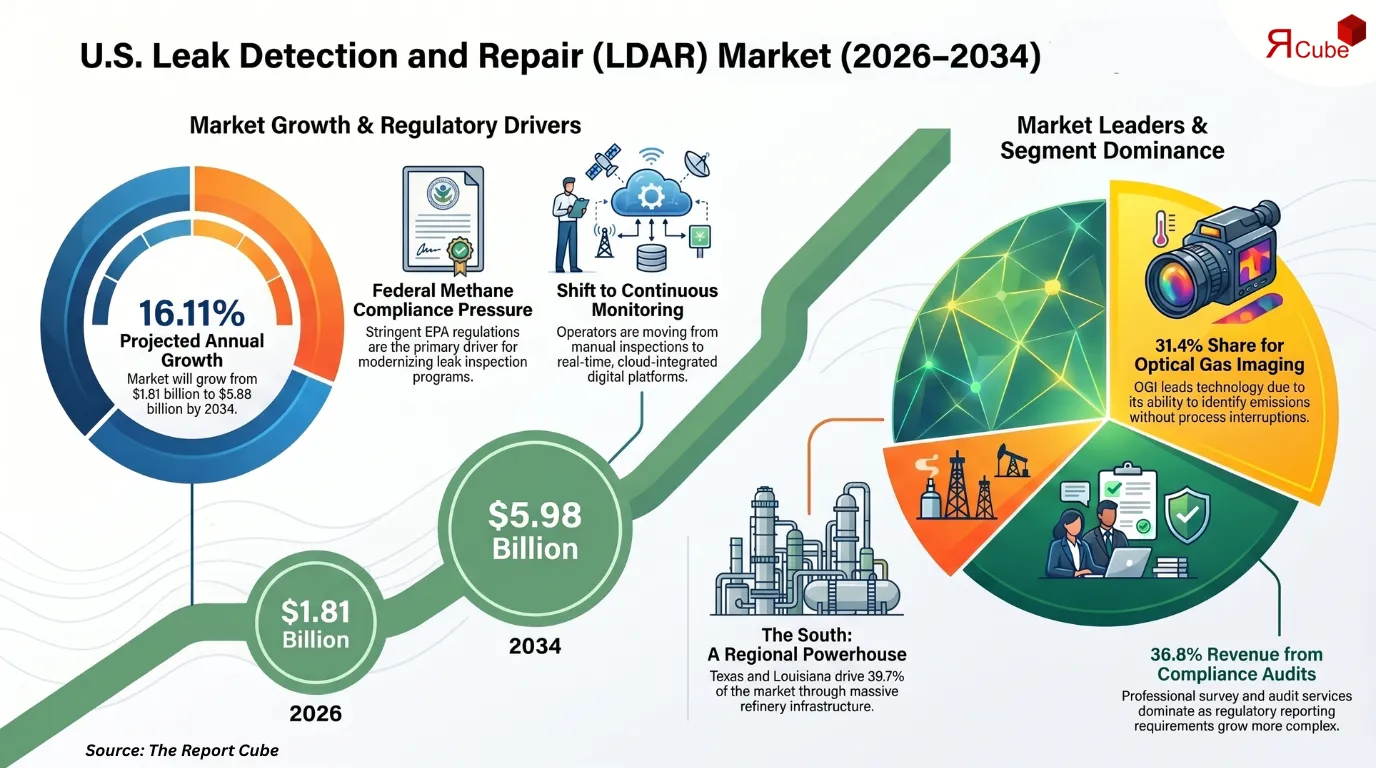
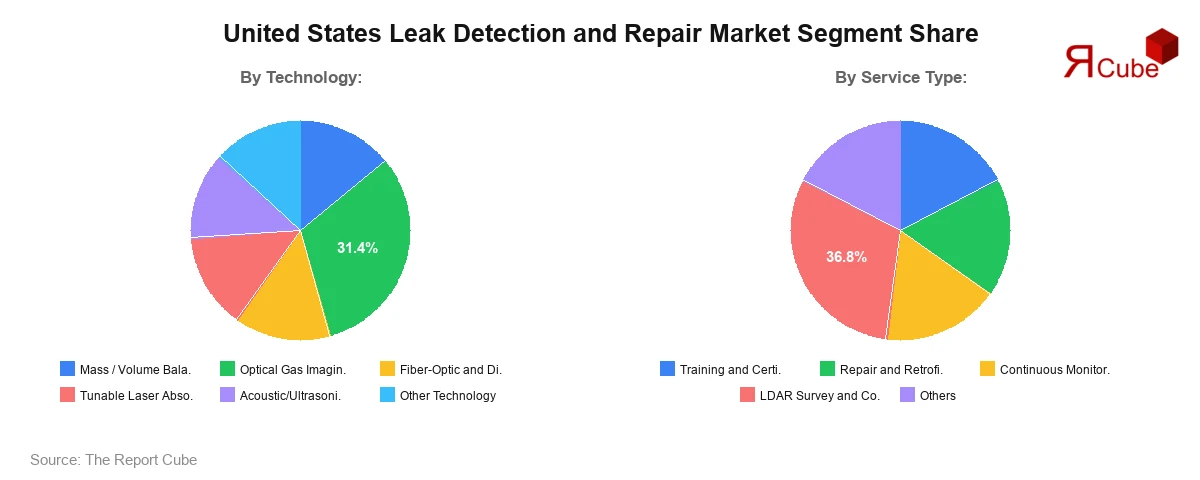
Optical Gas Imaging (OGI) segment leads the market with nearly 31.4% share.
By Service Type:
LDAR Survey and Compliance Audits segment dominates the market with around 36.8% revenue.
Regional Outlook:
South region dominates the United States Leak Detection and Repair Market with approximately 39.7% share.
United States Leak Detection and Repair Market Insights & Analysis
The United States Leak Detection and Repair Market is expected to grow at a CAGR of 16.11% during 2026-2034. The market is valued at USD 1.81 billion in 2026 and is forecast to reach USD 5.98 billion by 2034. Rising federal pressure to reduce methane emissions from oil & gas infrastructure continues to reshape the operational priorities of energy producers, pipeline operators, LNG terminals, and petrochemical facilities across the country. Industrial companies are steadily increasing investments in advanced monitoring systems capable of delivering real-time emissions visibility, faster leak identification, and automated compliance reporting.
Across the Leak Detection and Repair Market in US, facility operators are transitioning from periodic manual inspection programs toward continuous emissions monitoring systems integrated with cloud analytics and remote diagnostics. Technologies such as Optical Gas Imaging (OGI), fiber-optic sensing, acoustic monitoring, and LiDAR-based methane detection are becoming critical for improving asset integrity and reducing environmental risk. Large-scale energy infrastructure projects across Texas, Louisiana, and Pennsylvania are also driving higher adoption of digital LDAR platforms. In parallel, stricter ESG disclosure requirements and investor scrutiny surrounding methane intensity are encouraging companies to strengthen leak prevention capabilities while improving operational efficiency and regulatory transparency.
United States Leak Detection and Repair Market Impact Analysis
| Factor | Type | Specific Impact on Market | Magnitude | Business Implication |
|---|---|---|---|---|
| Stringent EPA LDAR regulations | Regulatory | Methane and VOC rules mandate frequent leak surveys at sites | High | Drives recurring demand for LDAR services and compliant systems |
| Expansion of U.S. oil and gas assets | Market | New pipelines and facilities increase monitored components | High | Creates larger installed base needing continuous leak monitoring |
| Focus on water conservation in utilities | Environmental | Utilities invest in services to cut non‑revenue water losses | High | Supports growth of water leak detection and repair contracts |
| Aging pipeline and distribution infrastructure | Environmental | Old networks raise leak incidence and service outages risk | High | Boosts inspection, condition assessment, and repair spending |
| Adoption of IoT and AI based monitoring | Technological | Smart sensors and analytics enable continuous leak detection | Medium | Shifts value toward integrated digital LDAR platforms |
| Economic case for emission and loss reduction | Market | Leak control lowers product loss and avoids penalty costs | Medium | Supports premium pricing for high performance LDAR offerings |
| Post‑COVID infrastructure and resilience spending | Market | Upgrades to water and energy systems include leak programs | Medium | Opens funding backed projects for service and technology vendors |
United States Leak Detection and Repair Market Dynamics
Key Driver: Increasing Federal Methane Compliance Requirements Across Energy Infrastructure
One of the strongest growth drivers for the United States Leak Detection and Repair Market is the expansion of methane emissions regulations targeting upstream, midstream, and downstream energy facilities. Regulatory agencies including the U.S. Environmental Protection Agency are enforcing stricter leak inspection schedules, emissions quantification standards, and repair timelines for oil & gas operators. These evolving requirements are pushing industrial companies to modernize existing inspection programs through advanced monitoring technologies capable of reducing compliance risk and minimizing fugitive emissions. Continuous monitoring systems are gaining strong acceptance because they help operators identify leaks earlier and reduce product losses across large pipeline networks and processing facilities.
Large refinery operators and natural gas transmission companies are also investing heavily in digital compliance infrastructure to support long-term operational sustainability goals. The increasing integration of remote sensing systems, automated alarm capabilities, and AI-assisted emissions analytics is improving detection accuracy while reducing inspection labor requirements. As methane reduction becomes a central focus within industrial environmental management, demand for advanced LDAR technologies is expected to accelerate steadily across the Leak Detection and Repair Market in US.
Industry Trends: Rapid Adoption of Autonomous Monitoring and Remote Sensing Technologies
The market is experiencing a major shift toward autonomous leak detection systems designed to support continuous industrial monitoring across geographically dispersed assets. Energy companies are increasingly deploying drone-assisted inspections, LiDAR methane imaging, fiber-optic sensing systems, and wireless ultrasonic detectors to improve operational visibility in remote infrastructure environments. These technologies help operators reduce manual inspection frequency while maintaining regulatory compliance standards across pipelines, storage terminals, LNG facilities, and petrochemical complexes.
Another important trend shaping the US Leak Detection and Repair Market is the growing integration of digital emissions management software with field monitoring hardware. Companies are prioritizing centralized platforms capable of combining leak detection, emissions quantification, predictive maintenance, and regulatory reporting into a unified operational workflow. This transition toward digitally connected industrial monitoring ecosystems is strengthening operational efficiency while improving long-term infrastructure reliability. Technology providers are also expanding software-based analytics capabilities that allow industrial users to prioritize repair activities based on leak severity and operational impact.
Major Challenge: High System Deployment Costs and Complex Legacy Infrastructure Integration
Although advanced monitoring technologies are becoming increasingly important, high deployment costs continue to create adoption barriers for some industrial operators. Large-scale implementation of continuous monitoring systems, fiber-optic sensing infrastructure, and AI-driven emissions analytics platforms often requires significant capital expenditure. Older industrial facilities and aging pipeline systems may require additional retrofitting investments before advanced leak detection solutions can be integrated effectively. This challenge is particularly evident among smaller operators with limited infrastructure modernization budgets.
Integration complexity also remains a concern across the Leak Detection and Repair Market in US. Many industrial operators manage multiple generations of operational technology systems that lack interoperability with modern digital monitoring platforms. Data synchronization challenges, cybersecurity concerns, and workforce training requirements can delay full-scale implementation timelines. In some cases, operators also face operational downtime risks during infrastructure upgrades. These technical and financial challenges may temporarily slow adoption rates in certain industrial segments, particularly within mature refining and pipeline networks.
Opportunity: Expansion of Continuous Monitoring-as-a-Service Across Industrial Operations
Continuous Monitoring-as-a-Service (CMaaS) is emerging as a strong growth opportunity within the United States Leak Detection and Repair Market as industrial operators seek flexible compliance solutions with lower upfront investment requirements. Service-based monitoring models allow companies to access advanced emissions detection technologies through subscription-based agreements that include hardware deployment, remote diagnostics, emissions analytics, and compliance reporting support. This operating model is becoming increasingly attractive among midstream gas operators, utility providers, and chemical manufacturers managing large-scale infrastructure assets.
The commercial potential for CMaaS solutions is also expanding due to growing acceptance of autonomous methane monitoring technologies under federal compliance programs. Service providers are introducing scalable platforms that combine remote sensing systems with predictive maintenance analytics and cloud-based operational dashboards. This integrated approach helps industrial operators reduce inspection costs while improving leak response efficiency and regulatory documentation accuracy. As industrial facilities continue prioritizing operational sustainability and emissions transparency, service-based monitoring models are expected to create substantial long-term opportunities across the Leak Detection and Repair Market in US.
United States Leak Detection and Repair Market Segment-wise Analysis
By Technology:
- Mass / Volume Balance
- Optical Gas Imaging (OGI)
- Fiber-Optic and Distributed Sensing
- Tunable Laser Absorption Spectroscopy (TDLAS)
- Acoustic/Ultrasonic Sensors
- Other Technology
Optical Gas Imaging (OGI) technology holds the leading position in the United States Leak Detection and Repair Market with nearly 31.4% share due to its established role in methane inspection programs across oil & gas production facilities and petrochemical plants. OGI systems enable operators to identify hydrocarbon emissions quickly without interrupting industrial processes, making them highly effective for routine compliance inspections. Strong regulatory acceptance under federal emissions programs has further strengthened deployment across upstream drilling sites, compressor stations, LNG infrastructure, and refining facilities.
Industrial operators are increasingly upgrading conventional OGI systems with AI-assisted imaging software, remote connectivity features, and automated emissions analytics to improve operational efficiency. Demand is particularly strong across the Gulf Coast energy corridor where operators manage extensive hydrocarbon transportation and processing infrastructure. The growing transition toward autonomous optical monitoring platforms capable of continuous surveillance is expected to support additional growth opportunities for this technology segment throughout the forecast period.
By Service Type:
- Training and Certification
- Repair and Retrofit
- Continuous Monitoring-as-a-Service (CMaaS)
- LDAR Survey and Compliance Audits
- Others
LDAR Survey and Compliance Audits segment accounts for approximately 36.8% of the US Leak Detection and Repair Market revenue due to rising inspection requirements across regulated industrial sectors. Energy producers, pipeline operators, refining companies, and chemical manufacturers continue to increase spending on professional leak inspection services to comply with methane reduction mandates and emissions reporting standards. Service providers offering integrated audit management, emissions verification, and repair validation capabilities are witnessing stronger contract activity across major industrial regions.
Growing regulatory complexity is also encouraging industrial operators to partner with specialized compliance service providers capable of handling large-scale inspection programs efficiently. Advanced digital reporting platforms and remote monitoring technologies are helping service providers improve inspection turnaround times while reducing operational disruptions for industrial clients. As emissions reporting requirements continue expanding across federal and state jurisdictions, demand for professional LDAR compliance services is expected to remain strong throughout the forecast period.
Regional Projection of United States Leak Detection and Repair Industry
- West
- East
- South
- Midwest
- Others
The South region dominates the United States Leak Detection and Repair Market with an estimated 39.7% share supported by its concentration of upstream drilling operations, interstate pipeline infrastructure, refining capacity, and LNG export terminals. Texas and Louisiana continue to account for a significant portion of industrial methane monitoring investments due to their extensive oil & gas production activity and expanding natural gas processing infrastructure. Federal emissions regulations and investor-driven sustainability targets are encouraging operators throughout the region to deploy advanced continuous monitoring technologies.
Large-scale LNG expansion projects along the Gulf Coast are also increasing demand for high-accuracy leak detection systems capable of supporting real-time operational monitoring and emissions management. Utility modernization programs and pipeline safety initiatives across Southern states are further contributing to adoption of digital LDAR platforms integrated with predictive analytics and remote sensing capabilities. Strong industrial infrastructure investment and expanding energy export activity are expected to maintain the South region’s leadership position in the Leak Detection and Repair Market in US over the coming years.
Need insights for a specific region within this market?
Request Regional DataUnited States Leak Detection and Repair Market Regional Analysis
The United States leak detection and repair market varies significantly across regions due to diverse industrial infrastructure, regulatory frameworks, and pipeline density.
| Region | Demand Level | Key Areas | System Dominance | Core Demand Logic | Growth Nature |
|---|---|---|---|---|---|
| West | Very High | California, Colorado, Wyoming | Optical Gas Imaging (OGI) | Oil & gas basins & aging water infrastructure | Environmental compliance |
| East | High | Pennsylvania, Ohio, West Virginia | Handheld gas detectors | Marcellus & Utica shale pipeline networks | Pipeline safety mandates |
| South | Extremely High | Texas, Louisiana, Gulf Coast | VOC analyzers & VRF systems | Massive refinery & chemical plant infrastructure | Fastest-growing segment |
| Midwest | Medium | Michigan, Ohio, Illinois, Oklahoma | Automated leak detection | Manufacturing hubs & aging water systems | Infrastructure upgrade |
| Others (Rocky Mountains) | Medium | New Mexico, Utah, Montana | UAV-based detectors | Remote oil & gas operations in rugged terrain | Technology-driven growth |
Government Initiatives & Policies
- EPA Methane Emissions Reduction Program (2025): The U.S. Environmental Protection Agency strengthened methane reduction requirements for oil and gas operators through expanded leak monitoring and emissions reporting standards supporting advanced LDAR technology deployment.
- PHMSA Pipeline Leak Detection Modernization Rule (2026): The Pipeline and Hazardous Materials Safety Administration introduced updated leak detection performance standards for natural gas transmission operators to improve infrastructure safety and emissions accountability.
United States Leak Detection and Repair Industry Recent Developments
- 2025: MSA Safety Incorporated acquired M&C TechGroup in a transaction valued at approximately USD 200 million to strengthen its industrial gas analysis and process safety detection capabilities. The acquisition expands MSA’s ability to deliver integrated gas monitoring, sampling, and emissions management solutions across industrial and energy markets.
- 2025: SLB received U.S. EPA approval for its Methane LiDAR Camera as an Alternative Test Method under OOOO regulations, allowing operators to use autonomous LiDAR monitoring systems as standalone LDAR compliance tools across oil & gas infrastructure environments.
Why Choose This Report?
- Provides a comprehensive overview of the overall market analysis, encompassing key trends, consumer behavior analysis, and risk assessment to support strategic decision-making.
- Provides accurate, up-to-date insights into market size, segmentation, and emerging opportunities, helping to minimize risk & capitalizing on growth.
- Gives deep understanding of target audience preferences, investment habits, and communication channels for enhanced product development & marketing effectiveness.
- Delivers competitive analysis & benchmarking, uncovering the strengths & weaknesses of market competitors to guide strategies.
- Consolidate comprehensive market intelligence, reducing reasoning & streamlining research efforts.
- Facilitates customized market segmentation & risk mitigation strategies, fine-tuned to the business objectives.
- Aids in identifying both market challenges & untapped opportunities within the industry to drive long-term business growth.
- Provides valuable information based on actual customer data & search trends.
Table of Contents
- Introduction
- Objective of the Study
- Product and Category Definition
- Market Segmentation
- Study Variables
- Research Methodology
- Secondary Data Points
- Breakdown of Secondary Sources
- Primary Data Points
- Breakdown of Primary Interviews
- Secondary Data Points
- Executive Summary
- Market Dynamics
- Emerging Opportunities
- Adoption Trends
- Demand Drivers
- Disruption Analysis (Challenges)
- Industry Analysis & Strategic Insights
- Supply/Value Chain Analysis
- Pricing Analysis
- Go-To-Market (GTM) Strategy
- BCG Matrix
- Recent Trends and Developments
- Import and Export Analysis
- Regulatory and Policy Landscape
- Region-wise policies
- Government Initiatives
- United States (US) Leak Detection and Repair Market Overview and Forecast Analysis (2021-2034)
- Market Size, By Value, By Growth Rate (CAGR/USD Billion)
- Market Share, By Technology
- Mass / Volume Balance
- Optical Gas Imaging (OGI)
- Fiber-Optic and Distributed Sensing
- Tunable Laser Absorption Spectroscopy (TDLAS)
- Acoustic/Ultrasonic Sensors
- Other Technology
- Market Share, By Component
- Services
- Hardware
- Others
- Market Share, By Service Type
- Training and Certification
- Repair and Retrofit
- Continuous Monitoring-as-a-Service (CMaaS)
- LDAR Survey and Compliance Audits
- Others
- Market Share, By End-use Industry
- Power Generation
- Residential and Commercial Buildings
- Oil and Gas
- Water and Waste-water Utilities
- Chemicals and Petrochemicals
- Others
- Market Share, By Region
- West
- East
- South
- Midwest
- Others
- Market Share, By Company
- Revenue Shares & Analysis
- Competitive Landscape
- West United States Leak Detection and Repair Market Overview and Forecast Analysis (2021-2034)
- Market Size, By Value, By Growth Rate (CAGR/USD Billion/Million)
- Market Share, By Technology
- Market Share, By Component
- Market Share, By Service Type
- Market Share, By End-use Industry
- East United States Leak Detection and Repair Market Overview and Forecast Analysis (2021-2034)
- Market Size, By Value, By Growth Rate (CAGR/USD Billion/Million)
- Market Share, By Technology
- Market Share, By Component
- Market Share, By Service Type
- Market Share, By End-use Industry
- South United States Leak Detection and Repair Market Overview and Forecast Analysis (2021-2034)
- Market Size, By Value, By Growth Rate (CAGR/USD Billion/Million)
- Market Share, By Technology
- Market Share, By Component
- Market Share, By Service Type
- Market Share, By End-use Industry
- Midwest United States Leak Detection and Repair Market Overview and Forecast Analysis (2021-2034)
- Market Size, By Value, By Growth Rate (CAGR/USD Billion/Million)
- Market Share, By Technology
- Market Share, By Component
- Market Share, By Service Type
- Market Share, By End-use Industry
- Competitive Analysis, 2026
- Market Share of Key Players
- Competitive Mapping for Each Segment and Companies Operating Regionally
- West United States Leak Detection and Repair Companies Share & Competitive Analysis, 2026
- East United States Leak Detection and Repair Companies Share & Competitive Analysis, 2026
- South United States Leak Detection and Repair Companies Share & Competitive Analysis, 2026
- Midwest United States Leak Detection and Repair Companies Share & Competitive Analysis, 2026
- Company Profile (Partial List)
- Viper Innovations Ltd.
- Company Overview
- Product Portfolio
- Strategic Alliances/Partnerships
- Recent Developments
- ABB Ltd.
- Company Overview
- Product Portfolio
- Strategic Alliances/Partnerships
- Recent Developments
- Honeywell International Inc.
- Company Overview
- Product Portfolio
- Strategic Alliances/Partnerships
- Recent Developments
- Schneider Electric SE
- Company Overview
- Product Portfolio
- Strategic Alliances/Partnerships
- Recent Developments
- Thermo Fisher Scientific Inc.
- Company Overview
- Product Portfolio
- Strategic Alliances/Partnerships
- Recent Developments
- Atmos International
- Company Overview
- Product Portfolio
- Strategic Alliances/Partnerships
- Recent Developments
- Siemens AG
- Company Overview
- Product Portfolio
- Strategic Alliances/Partnerships
- Recent Developments
- Krohne Group
- Company Overview
- Product Portfolio
- Strategic Alliances/Partnerships
- Recent Developments
- Synodon Inc.
- Company Overview
- Product Portfolio
- Strategic Alliances/Partnerships
- Recent Developments
- Emerson Electric Co.
- Company Overview
- Product Portfolio
- Strategic Alliances/Partnerships
- Recent Developments
- Baker Hughes, a GE Company
- Company Overview
- Product Portfolio
- Strategic Alliances/Partnerships
- Recent Developments
- FLIR Systems Inc.
- Company Overview
- Product Portfolio
- Strategic Alliances/Partnerships
- Recent Developments
- Yokogawa Electric Corp.
- Company Overview
- Product Portfolio
- Strategic Alliances/Partnerships
- Recent Developments
- Clampon AS
- Company Overview
- Product Portfolio
- Strategic Alliances/Partnerships
- Recent Developments
- John Wood Group PLC
- Company Overview
- Product Portfolio
- Strategic Alliances/Partnerships
- Recent Developments
- Zeus Intelligence
- Company Overview
- Product Portfolio
- Strategic Alliances/Partnerships
- Recent Developments
- PSI AG
- Company Overview
- Product Portfolio
- Strategic Alliances/Partnerships
- Recent Developments
- Sensit Technologies LLC
- Company Overview
- Product Portfolio
- Strategic Alliances/Partnerships
- Recent Developments
- TUV SUD AG
- Company Overview
- Product Portfolio
- Strategic Alliances/Partnerships
- Recent Developments
- Pergam Technical Services Inc.
- Company Overview
- Product Portfolio
- Strategic Alliances/Partnerships
- Recent Developments
- Others (Partial List)
- Viper Innovations Ltd.
- Contact Us and Disclaimer
Top Key Players & Market Share Outlook
- Viper Innovations Ltd.
- ABB Ltd.
- Honeywell International Inc.
- Schneider Electric SE
- Thermo Fisher Scientific Inc.
- Atmos International
- Siemens AG
- Krohne Group
- Synodon Inc.
- Emerson Electric Co.
- Baker Hughes, a GE Company
- FLIR Systems Inc.
- Yokogawa Electric Corp.
- Clampon AS
- John Wood Group PLC
- Zeus Intelligence
- PSI AG
- Sensit Technologies LLC
- TUV SUD AG
- Pergam Technical Services Inc.
- Others
Frequently Asked Questions






