



Build Your Custom Market Intelligence Report
Customize Your ReportJapan Lithium Hydroxide Market Insights & Analysis
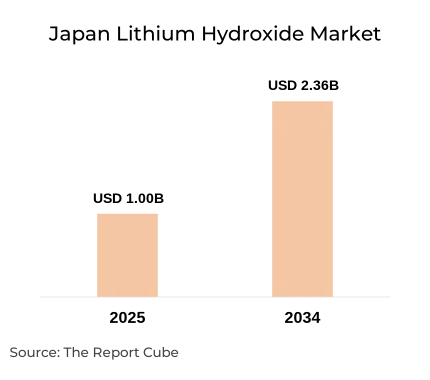
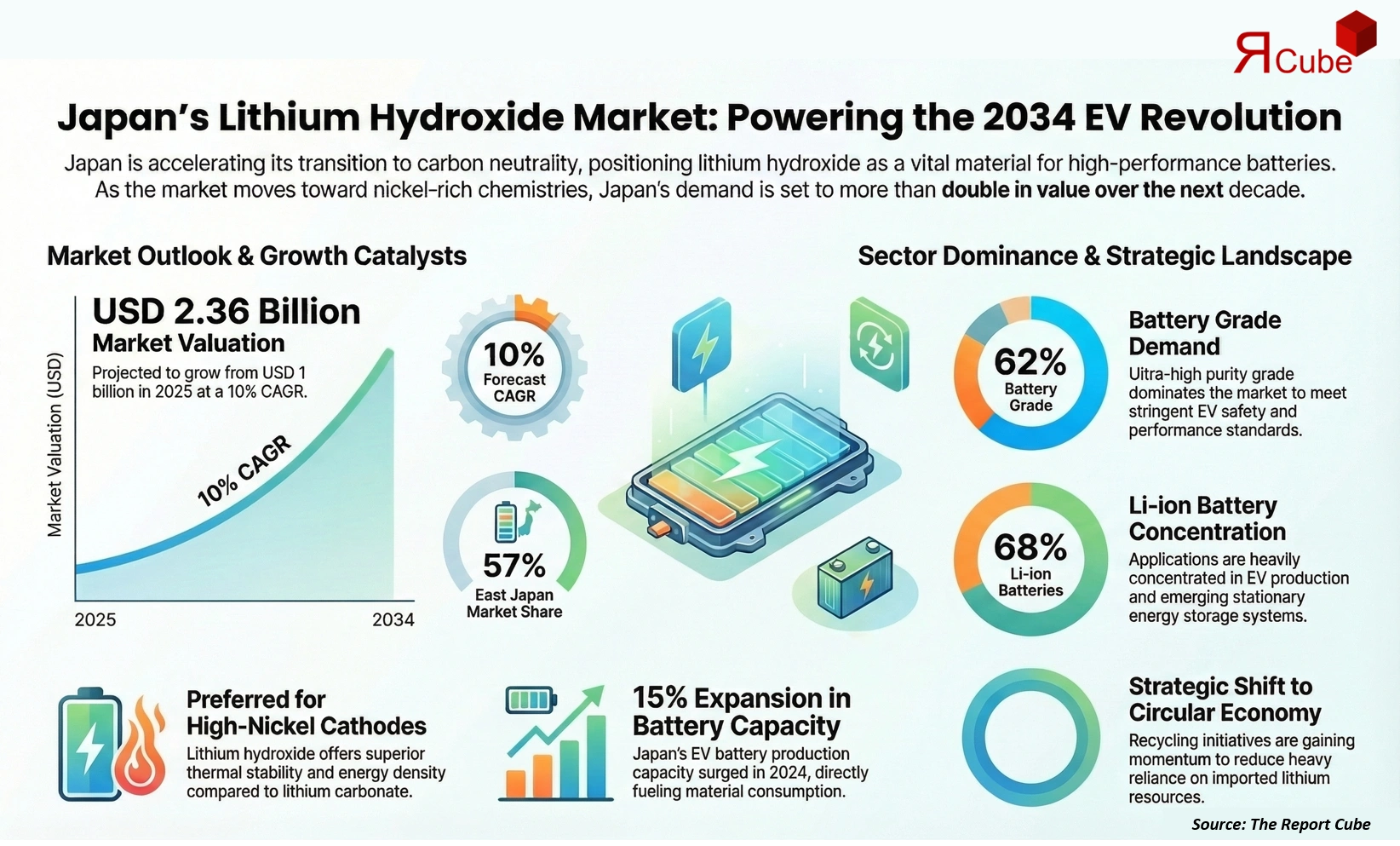
The Japan Lithium Hydroxide Market is anticipated to register a CAGR of 10% during the forecast period. The market size was valued at USD 1 billion and is projected to reach USD 2.36 billion by 2034. This strong expansion reflects Japan’s accelerating transition toward electric mobility, energy storage systems, and advanced battery manufacturing, where lithium hydroxide has emerged as a critical raw material.
Japan’s position as a global leader in lithium-ion battery technology continues to shape demand patterns within the lithium hydroxide market. Compared to lithium carbonate, lithium hydroxide is increasingly preferred for high-nickel cathode chemistries due to its superior thermal stability and energy density performance. As Japanese automotive OEMs and battery manufacturers scale production of next-generation electric vehicles, demand for high-purity lithium hydroxide is rising steadily. This shift is closely tied to long-term electrification strategies and commitments to carbon neutrality.
Furthermore, supply chain diversification has become a strategic priority for Japanese buyers amid global lithium market volatility. Long-term offtake agreements, overseas mining investments, and recycling initiatives are being actively pursued to secure stable lithium hydroxide supply. These interconnected developments are strengthening market fundamentals, positioning the Japan Lithium Hydroxide Market for sustained growth through the forecast period.
Japan Lithium Hydroxide Market Recent Developments
- 2025: Japanese battery manufacturers expanded long-term lithium hydroxide supply agreements to secure EV production capacity.
- 2025: Global lithium producers increased shipments of battery-grade lithium hydroxide to Japan amid rising cathode demand.
Government Initiatives & Policies
- Green Growth Strategy: Promotes battery supply chain resilience and EV adoption across Japan.
- Strategic Energy Plan: Supports energy storage deployment and decarbonization targets.
Japan Lithium Hydroxide Market Dynamics
Key Driver: Rising Demand for High-Energy Density Lithium-Ion Batteries
The primary driver of the Japan Lithium Hydroxide Market is the rapid increase in demand for high-energy density lithium-ion batteries. Japanese automakers and battery manufacturers are transitioning toward nickel-rich cathode chemistries to improve driving range and charging efficiency in electric vehicles. Lithium hydroxide is a preferred input for these cathodes, offering better electrochemical performance compared to alternative lithium compounds. In 2024, Japan’s EV battery production capacity expanded by over 15%, directly supporting lithium hydroxide consumption. Additionally, growth in stationary energy storage systems for grid stabilization and renewable integration further reinforces demand. These interconnected trends ensure lithium hydroxide remains a strategic material within Japan’s advanced energy ecosystem.
Book your FREE 30-minute expert consultation today
Contact UsIndustry Trends: Shift Toward Battery-Grade and Sustainable Sourcing
A key industry trend is the growing emphasis on battery-grade lithium hydroxide and sustainable sourcing practices. Battery manufacturers increasingly require ultra-high purity lithium hydroxide to meet stringent performance and safety standards. As a result, suppliers are investing in advanced refining technologies and quality control systems. At the same time, Japanese companies are actively pursuing sustainability by supporting recycling initiatives and low-carbon lithium production methods. Recycling of end-of-life batteries is gaining momentum, with recovered lithium expected to supplement primary supply over time. This trend aligns with Japan’s broader environmental goals while reducing exposure to global supply disruptions.
Major Challenge: Dependence on Imported Lithium Resources
Japan’s heavy reliance on imported lithium resources poses a significant challenge for the lithium hydroxide market. The country lacks domestic lithium reserves, making it vulnerable to geopolitical risks, supply chain disruptions, and price volatility in global markets. Fluctuations in lithium prices can directly impact production costs for battery manufacturers, affecting profitability and long-term planning. Additionally, competition from other major lithium-consuming regions intensifies supply pressure. While strategic partnerships and overseas investments mitigate some risk, import dependence remains a structural challenge that could constrain market stability during periods of global supply tightness.
Opportunity: Expansion of Energy Storage and Recycling Ecosystems
The expansion of energy storage systems and battery recycling presents a compelling opportunity for the Japan Lithium Hydroxide Market. Large-scale deployment of renewable energy requires reliable storage solutions, increasing demand for lithium-based batteries beyond the automotive sector. Concurrently, recycling technologies are advancing, enabling recovery of lithium hydroxide from spent batteries at higher yields. Government support and private investment are accelerating commercialization of recycling facilities, which could supply a meaningful share of future lithium demand. This circular economy approach not only enhances supply security but also supports long-term cost optimization and sustainability goals.
Japan Lithium Hydroxide Market Segment-wise Analysis
By Grade:
- Battery Grade
- Technical Grade
- Industrial Grade
Battery Grade lithium hydroxide dominates the market, accounting for nearly 62% of total demand. This leadership is driven by Japan’s strong battery manufacturing base and increasing adoption of high-performance cathode materials. Battery-grade lithium hydroxide is essential for ensuring safety, longevity, and energy density in lithium-ion batteries. Technical and Industrial Grades together account for the remaining share, serving applications such as lubricating greases and specialty chemicals. However, their growth remains moderate compared to battery-grade demand, reflecting the market’s strong alignment with electrification trends.
By Application:
- Li-ion Batteries
- Lubricating Grease
- Glass & Ceramics
- Energy Storage
- Other Uses
Li-ion Batteries represent the leading application segment, contributing approximately 68% of the Japan Lithium Hydroxide Market. This dominance stems from robust EV production and continuous innovation in battery technology. Energy Storage applications are emerging rapidly, supported by renewable energy integration and grid modernization initiatives. Lubricating Grease and Glass & Ceramics maintain steady but smaller shares, benefiting from industrial demand. Overall, application trends underscore the market’s heavy dependence on battery-related growth drivers.
Regional Projection of Japan Lithium Hydroxide Industry
- East Japan
- West Japan
East Japan leads the Japan Lithium Hydroxide Market with an estimated 57% market share, supported by a high concentration of battery manufacturers, automotive OEMs, and advanced materials companies. The region benefits from strong industrial infrastructure, R&D capabilities, and port connectivity for raw material imports. West Japan follows, driven by growing energy storage projects and chemical processing facilities. While East Japan is expected to maintain leadership throughout the forecast period, West Japan is projected to grow steadily as new investments in battery-related manufacturing expand regional demand.
Need insights for a specific region within this market?
Request Regional DataWhy Choose This Report?
- Provides a comprehensive overview of the overall market analysis, encompassing key trends, consumer behavior analysis, and risk assessment to support strategic decision-making.
- Provides accurate, up-to-date insights into market size, segmentation, and emerging opportunities, helping to minimize risk & capitalizing on growth.
- Gives deep understanding of target audience preferences, investment habits, and communication channels for enhanced product development & marketing effectiveness.
- Delivers competitive analysis & benchmarking, uncovering the strengths & weaknesses of market competitors to guide strategies.
- Consolidate comprehensive market intelligence, reducing reasoning & streamlining research efforts.
- Facilitates customized market segmentation & risk mitigation strategies, fine-tuned to the business objectives.
- Aids in identifying both market challenges & untapped opportunities within the industry to drive long-term business growth.
- Provides valuable information based on actual customer data & search trends.
Table of Contents
- Introduction
- Objective of the Study
- Product and Category Definition
- Market Segmentation
- Study Variables
- Research Methodology
- Secondary Data Points
- Breakdown of Secondary Sources
- Primary Data Points
- Breakdown of Primary Interviews
- Secondary Data Points
- Executive Summary
- Market Dynamics
- Drivers
- Challenges
- Opportunity Assessment
- Recent Trends and Developments
- Regulatory and Policy Landscape
- Japan Lithium Hydroxide Market Overview (2020-2034)
- Market Size, By Value (USD Billion)
- Market Share, By Grade
- Battery Grade
- Technical Grade
- Industrial Grade
- Market Share, By Application
- Li-ion Batteries
- Lubricating Grease
- Glass & Ceramics
- Energy Storage
- Other Uses
- Market Share, By End User
- Automotive OEMs
- Battery Makers
- Chemical Firms
- Electronics OEMs
- Other Industries
- Market Share, By Distribution
- Direct Sales
- Distributors
- Trading Houses
- Market Share, By Region
- East
- West
- Market Share, By Company
- Revenue Shares
- Competitive Landscape
- East Japan Lithium Hydroxide Market
- Market Size, By Value (USD Billion)
- Market Share, By Grade
- Market Share, By Application
- Market Share, By End User
- Market Share, By Distribution
- Market Share, By Prefecture Cluster
- West Japan Lithium Hydroxide Market
- Market Size, By Value (USD Billion)
- Market Share, By Grade
- Market Share, By Application
- Market Share, By End User
- Market Share, By Distribution
- Market Share, By Prefecture Cluster
- Competitive Outlook and Company Profiles
- Albemarle Corporation
- Company Overview
- Product Portfolio
- Strategic Alliances/Partnerships
- Recent Developments
- Ganfeng Lithium
- Company Overview
- Product Portfolio
- Strategic Alliances/Partnerships
- Recent Developments
- Tianqi Lithium
- Company Overview
- Product Portfolio
- Strategic Alliances/Partnerships
- Recent Developments
- SQM
- Company Overview
- Product Portfolio
- Strategic Alliances/Partnerships
- Recent Developments
- Livent Corporation
- Company Overview
- Product Portfolio
- Strategic Alliances/Partnerships
- Recent Developments
- Arcadium Lithium
- Company Overview
- Product Portfolio
- Strategic Alliances/Partnerships
- Recent Developments
- Mineral Resources
- Company Overview
- Product Portfolio
- Strategic Alliances/Partnerships
- Recent Developments
- Pilbara Minerals
- Company Overview
- Product Portfolio
- Strategic Alliances/Partnerships
- Recent Developments
- Yahua Group
- Company Overview
- Product Portfolio
- Strategic Alliances/Partnerships
- Recent Developments
- Sichuan Energy
- Company Overview
- Product Portfolio
- Strategic Alliances/Partnerships
- Recent Developments
- Others
- Albemarle Corporation
- Contact Us and Disclaimer
Top Key Players & Market Share Outlook
- Albemarle Corporation
- Ganfeng Lithium
- Tianqi Lithium
- SQM
- Livent Corporation
- Arcadium Lithium
- Mineral Resources
- Pilbara Minerals
- Yahua Group
- Sichuan Energy
- Others
Frequently Asked Questions






