



Build Your Custom Market Intelligence Report
Customize Your ReportAsia Pacific LNG Bunkering Market Insights & Analysis
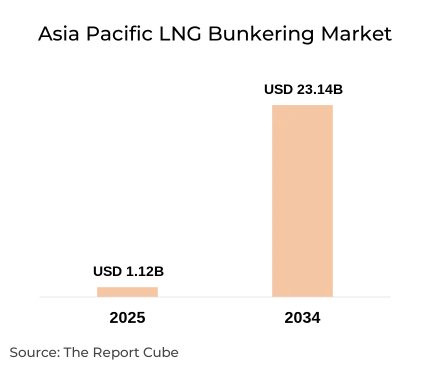
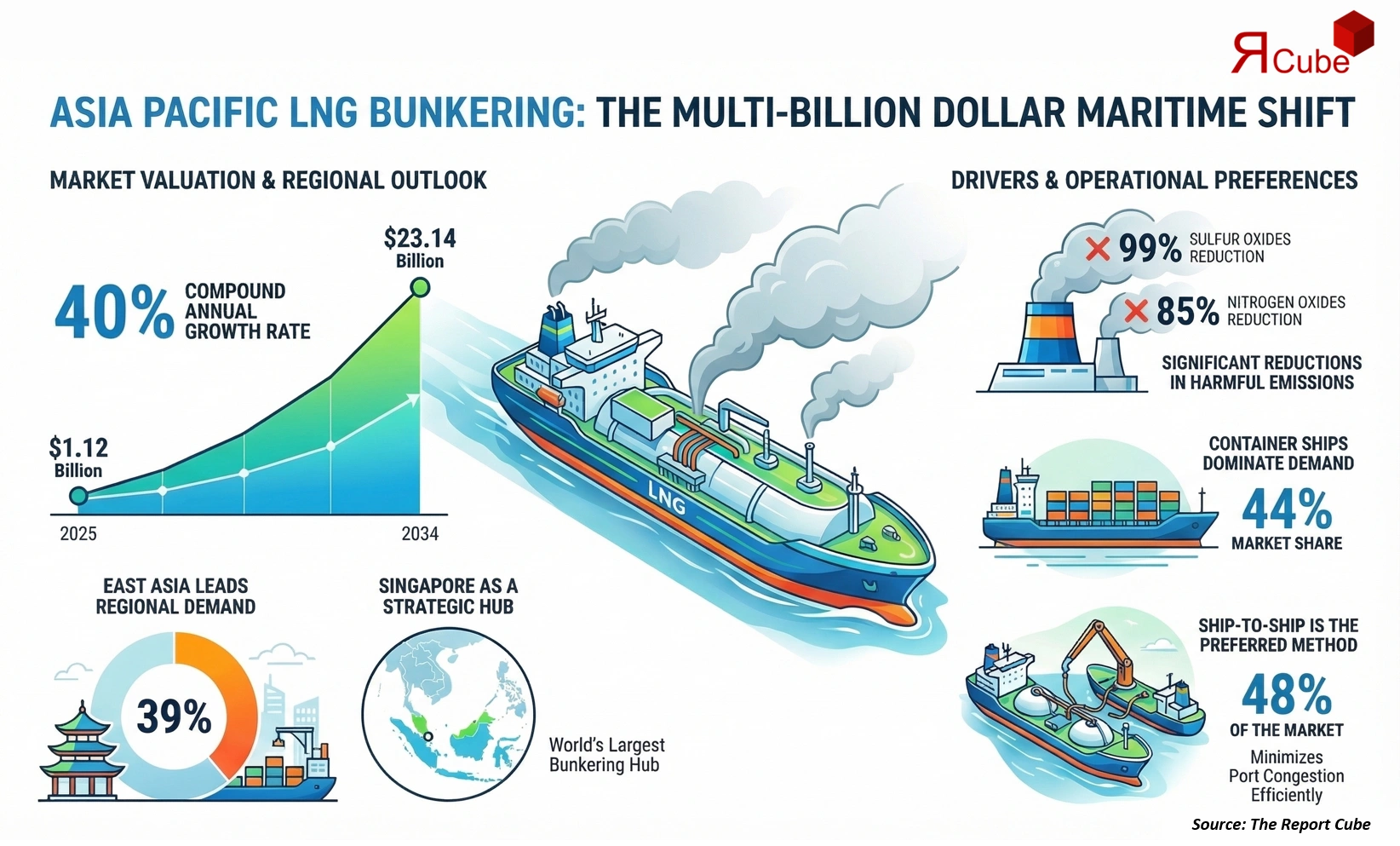
The Asia Pacific LNG Bunkering Market is anticipated to register a CAGR of 40% during the forecast period. The market size was valued at USD 1.12 billion and is projected to reach USD 23.14 billion by the end of the forecast timeline. This exceptional growth trajectory is closely linked to the region’s rapid transition toward cleaner marine fuels, tightening international emission regulations, and expanding LNG-powered vessel fleets across major Asian ports.
Asia Pacific has emerged as the global epicenter for LNG bunkering adoption due to its dominance in global seaborne trade, high concentration of container traffic, and proactive decarbonization strategies within the maritime sector. Ports across East Asia and Southeast Asia are accelerating investments in LNG bunkering infrastructure to support IMO 2020 sulfur cap compliance and long-term greenhouse gas reduction targets. Countries such as China, South Korea, Singapore, and Japan are actively positioning LNG as a transitional fuel to bridge conventional marine fuels and future zero-carbon alternatives.
Furthermore, the region’s strong shipbuilding ecosystem is reinforcing market momentum, with a growing number of LNG-fueled container ships, tankers, and bulk carriers entering service. Strategic collaborations between energy suppliers, port authorities, and shipping lines are enabling scalable bunkering solutions. As LNG bunkering economics improve through infrastructure maturity and operational efficiency, the Asia Pacific LNG Bunkering Market is expected to remain the fastest-growing regional market globally.
Asia Pacific LNG Bunkering Market Recent Developments
- 2025: Shell expanded LNG bunkering operations across key Asian ports to support rising LNG-fueled vessel deployments.
- 2025: TotalEnergies strengthened LNG bunkering partnerships in Southeast Asia to enhance regional supply coverage.
Government Initiatives & Policies
- IMO Green Shipping Corridors Initiative: Supports LNG and low-emission fuels adoption along major Asia-Pacific trade routes.
- Singapore Maritime Green Initiative: Incentivizes LNG bunkering and cleaner marine fuel infrastructure investments.
Asia Pacific LNG Bunkering Market Dynamics
Key Driver: Stringent Emission Regulations Accelerating LNG Adoption
The primary driver of the Asia Pacific LNG Bunkering Market is the enforcement of stringent emission regulations across international and regional maritime operations. The IMO 2020 sulfur cap and forthcoming carbon intensity requirements have compelled shipowners to seek compliant and economically viable fuel alternatives. LNG offers up to 99% sulfur oxide reduction, nearly 85% nitrogen oxide reduction, and approximately 20% lower carbon dioxide emissions compared to conventional marine fuels. These environmental advantages, combined with stable long-term fuel pricing, make LNG an attractive solution for fleet operators. As Asia Pacific handles more than 60% of global container throughput, regulatory-driven LNG adoption has a multiplier effect across the region, directly boosting bunkering demand.
Book your FREE 30-minute expert consultation today
Contact UsIndustry Trends: Rapid Expansion of LNG Bunkering Infrastructure
A defining trend in the market is the rapid expansion of LNG bunkering infrastructure across major ports. Ship-to-ship bunkering is increasingly favored for its scalability and operational efficiency, particularly at high-traffic hubs such as Singapore, Shanghai, and Busan. Port authorities are investing heavily in LNG storage, transfer vessels, and safety systems to support growing volumes. Additionally, cross-border harmonization of LNG bunkering standards is improving operational confidence among shipping companies. This infrastructure-led growth is creating a robust ecosystem that supports higher LNG penetration across multiple vessel categories, reinforcing long-term market sustainability.
Major Challenge: High Initial Infrastructure and Vessel Conversion Costs
Despite strong growth prospects, high capital requirements pose a major challenge to market expansion. Developing LNG bunkering terminals, cryogenic storage facilities, and specialized bunkering vessels requires substantial upfront investment. Similarly, LNG-powered vessels or retrofitting existing fleets involve higher initial costs compared to conventional fuel systems. These financial barriers can deter smaller shipping companies and emerging ports from rapid adoption. Additionally, uneven infrastructure availability across Asia Pacific creates operational constraints for vessels operating on multi-port routes, potentially slowing adoption in less-developed maritime economies.
Opportunity: Growth of LNG-Fueled Container and Cargo Fleets
The accelerating deployment of LNG-fueled container ships and cargo vessels presents a significant opportunity for the Asia Pacific LNG Bunkering Market. Major shipping lines are placing large orders for LNG-powered vessels to future-proof fleets against tightening emission norms. Container ships alone account for a substantial share of new LNG vessel orders, driven by predictable routes and high fuel consumption profiles. As these vessels enter service, consistent LNG bunkering demand will be generated across Asia Pacific ports. This fleet transition creates long-term fuel supply contracts, enhances volume stability, and strengthens the commercial viability of LNG bunkering investments.
Asia Pacific LNG Bunkering Market Segment-wise Analysis
By Bunkering Method:
- Ship-to-Ship
- Port-to-Ship
- Truck-to-Ship
- Portable Tanks
Ship-to-Ship bunkering dominates the market, accounting for approximately 48% of total market share. This method is preferred due to its ability to handle large fuel volumes efficiently and minimize port congestion. Port-to-Ship bunkering follows, particularly in well-established terminals with fixed infrastructure. Truck-to-Ship and Portable Tanks serve niche and smaller-scale operations, especially during early-stage adoption. The dominance of Ship-to-Ship bunkering reflects the market’s shift toward high-capacity, operationally flexible fueling solutions that align with rising LNG vessel traffic.
By Vessel Type:
- Container Ships
- Tankers
- Bulk Cargo Vessels
- Ferries and OSVs
- Other Vessel Types
Container Ships lead this segment with an estimated 44% market share, driven by large-scale LNG-powered fleet orders and consistent refueling requirements. Tankers and Bulk Cargo Vessels collectively account for a significant portion, supported by long-haul trade routes and fuel efficiency priorities. Ferries and OSVs are emerging as fast-growing segments due to stricter emission rules in coastal and short-sea shipping. The diversified vessel mix underscores the broad applicability of LNG across maritime operations in Asia Pacific.
Regional Projection of Asia Pacific LNG Bunkering Industry
- East Asia
- Southeast Asia
- South Asia
- Oceania
- Rest of Asia Pacific
East Asia leads the Asia Pacific LNG Bunkering Market, contributing nearly 39% of total demand. The region benefits from high maritime trade volumes, advanced port infrastructure, and strong government backing for cleaner marine fuels. Southeast Asia follows closely, anchored by Singapore’s role as the world’s largest bunkering hub. South Asia and Oceania are witnessing gradual adoption as infrastructure investments increase. East Asia’s leadership is expected to persist throughout the forecast period due to sustained vessel traffic and aggressive decarbonization initiatives.
Need insights for a specific region within this market?
Request Regional DataWhy Choose This Report?
- Provides a comprehensive overview of the overall market analysis, encompassing key trends, consumer behavior analysis, and risk assessment to support strategic decision-making.
- Provides accurate, up-to-date insights into market size, segmentation, and emerging opportunities, helping to minimize risk & capitalizing on growth.
- Gives deep understanding of target audience preferences, investment habits, and communication channels for enhanced product development & marketing effectiveness.
- Delivers competitive analysis & benchmarking, uncovering the strengths & weaknesses of market competitors to guide strategies.
- Consolidate comprehensive market intelligence, reducing reasoning & streamlining research efforts.
- Facilitates customized market segmentation & risk mitigation strategies, fine-tuned to the business objectives.
- Aids in identifying both market challenges & untapped opportunities within the industry to drive long-term business growth.
- Provides valuable information based on actual customer data & search trends.
Table of Contents
- Introduction
- Objective of the Study
- Product and Category Definition
- Market Segmentation
- Study Variables
- Research Methodology
- Secondary Data Points
- Breakdown of Secondary Sources
- Primary Data Points
- Breakdown of Primary Interviews
- Secondary Data Points
- Executive Summary
- Market Dynamics
- Drivers
- Challenges
- Opportunity Assessment
- Recent Trends and Developments
- Regulatory and Policy Landscape
- Asia Pacific LNG Bunkering Market Overview (2020-2034)
- Market Size, By Value (USD Billion)
- Market Share, By Bunkering Method
- Ship-to-Ship
- Port-to-Ship
- Truck-to-Ship
- Portable Tanks
- Market Share, By Vessel Type
- Container Ships
- Tankers
- Bulk Cargo Vessels
- Ferries and OSVs
- Other Vessel Types
- Market Share, By End User
- Oil and Gas
- Shipping Lines
- Port Operators
- Defense and Coastguard
- Market Share, By Distribution Channel
- Direct Sales
- Bunkering Stations
- Market Share, By Region
- East Asia
- Southeast Asia
- South Asia
- Oceania
- Rest of Asia Pacific
- Market Share, By Company
- Revenue Shares
- Competition Characteristics
- Revenue Shares & Analysis
- East Asia LNG Bunkering Market
- Market Size, By Value (USD Billion)
- Market Share, By Bunkering Method
- Market Share, By Vessel Type
- Market Share, By End User
- Market Share, By Distribution Channel
- Market Share, By Country
- China
- Japan
- South Korea
- Southeast Asia LNG Bunkering Market
- Market Size, By Value (USD Billion)
- Market Share, By Bunkering Method
- Market Share, By Vessel Type
- Market Share, By End User
- Market Share, By Distribution Channel
- Market Share, By Country
- Singapore
- Malaysia
- Indonesia
- Vietnam
- Philippines
- Thailand
- South Asia LNG Bunkering Market
- Market Size, By Value (USD Billion)
- Market Share, By Bunkering Method
- Market Share, By Vessel Type
- Market Share, By End User
- Market Share, By Distribution Channel
- Market Share, By Country
- India
- Sri Lanka
- Bangladesh
- Rest of South Asia
- Oceania LNG Bunkering Market
- Market Size, By Value (USD Billion)
- Market Share, By Bunkering Method
- Market Share, By Vessel Type
- Market Share, By End User
- Market Share, By Distribution Channel
- Market Share, By Country
- Australia
- New Zealand
- Rest of Oceania
- Rest of Asia Pacific LNG Bunkering Market
- Market Size, By Value (USD Billion)
- Market Share, By Bunkering Method
- Market Share, By Vessel Type
- Market Share, By End User
- Market Share, By Distribution Channel
- Market Share, By Country
- Competitive Outlook and Company Profiles
- Shell plc
- Company Overview
- Service Portfolio
- Strategic Alliances/Partnerships
- Recent Developments
- TotalEnergies SE
- Company Overview
- Service Portfolio
- Strategic Alliances/Partnerships
- Recent Developments
- ENGIE SA
- Company Overview
- Service Portfolio
- Strategic Alliances/Partnerships
- Recent Developments
- Gasum Oy
- Company Overview
- Service Portfolio
- Strategic Alliances/Partnerships
- Recent Developments
- Korea Gas Corporation (KOGAS)
- Company Overview
- Service Portfolio
- Strategic Alliances/Partnerships
- Recent Developments
- ENN Energy Holdings
- Company Overview
- Service Portfolio
- Strategic Alliances/Partnerships
- Recent Developments
- Eagle LNG Partners
- Company Overview
- Service Portfolio
- Strategic Alliances/Partnerships
- Recent Developments
- Harvey Gulf International
- Company Overview
- Service Portfolio
- Strategic Alliances/Partnerships
- Recent Developments
- EVOL LNG
- Company Overview
- Service Portfolio
- Strategic Alliances/Partnerships
- Recent Developments
- PRIMA LNG
- Company Overview
- Service Portfolio
- Strategic Alliances/Partnerships
- Recent Developments
- Others
- Shell plc
- Contact Us and Disclaimer
Top Key Players & Market Share Outlook
- Shell plc
- TotalEnergies SE
- ENGIE SA
- Gasum Oy
- Korea Gas Corporation (KOGAS)
- ENN Energy Holdings
- Eagle LNG Partners
- Harvey Gulf International
- EVOL LNG
- PRIMA LNG
- Others
Frequently Asked Questions