



Build Your Custom Market Intelligence Report
Customize Your ReportUnited States Mattress Market Key Takeaways
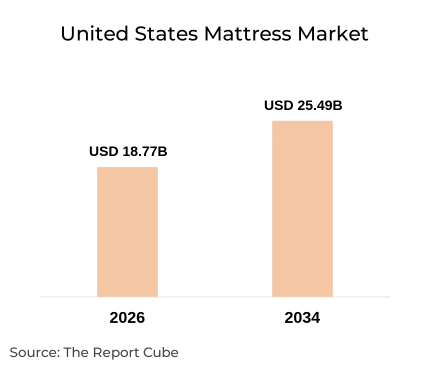
- Market valued at USD 18.77 billion in 2026, driven by housing recovery and sleep wellness trends.
- Industry projected to reach USD 25.49 billion by 2034, expanding at a steady 3.90% CAGR.
- Innerspring and coil mattresses retain the dominant product segment share in the United States.
- Queen-size mattresses lead all size categories, accounting for approximately 44% of unit sales.
- The West region emerges as the fastest-growing regional segment supported by tech-forward consumers.
- Leading players include Tempur Sealy, Serta Simmons, Sleep Number, Purple Innovation, and Saatva.
- Direct-to-consumer and bed-in-a-box channels are fundamentally reshaping mattress retail distribution.
- Smart mattress technology and sustainable materials define the most significant emerging market trends.
United States Mattress Market Insights & Analysis
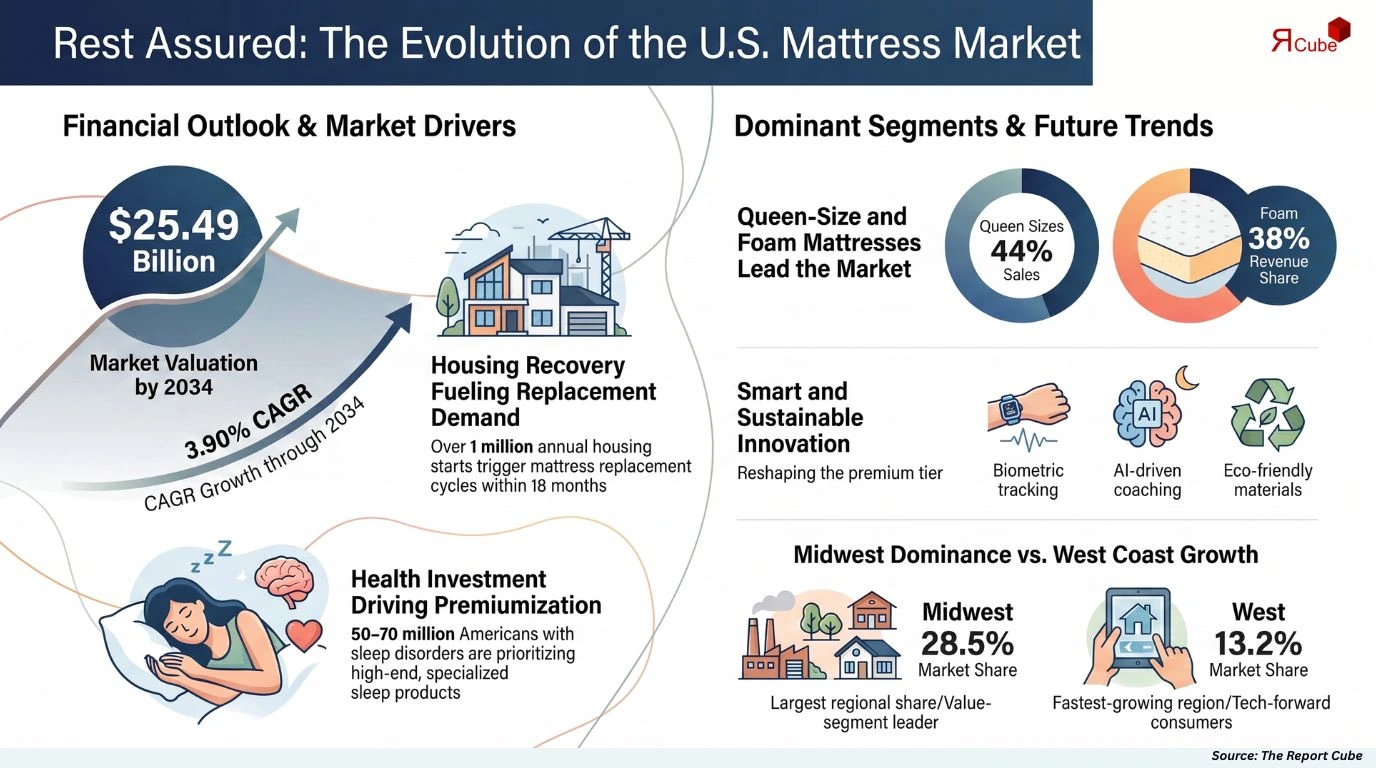
The United States Mattress Market is anticipated to register a 3.90% CAGR during 2026–2034. The market size was valued at USD 18.77 billion in 2026 and is projected to reach USD 25.49 billion by 2034. Growth is anchored in accelerating residential construction, with single-family housing starts projected at approximately 1.01 million units in 2025, each triggering mattress replacement cycles within 18 months of occupancy. Heightened consumer investment in sleep health, supported by research from the American Academy of Sleep Medicine indicating that 50–70 million Americans suffer from sleep disorders, continues to expand the addressable market for premium and specialty sleep products.
The United States Mattress Market is further shaped by e-commerce disruption and direct-to-consumer brand expansion. Major players including Casper, Purple, and Saatva have accelerated omnichannel footprints, combining digital-first purchasing with physical showrooms to reduce return rates and elevate consumer confidence. Institutional investment in sleep technology startups exceeded USD 1.2 billion between 2022 and 2025, signaling long-term confidence in innovation-led growth. Hybrid and foam construction segments are gaining disproportionate revenue share as consumers shift away from traditional innerspring models toward solutions offering advanced pressure relief, motion isolation, and biometric-integrated sleep tracking capabilities.
United States Mattress Market Dynamics
Demand across the United States Mattress Market continues to expand as housing completions rise, consumer wellness spending increases, and e-commerce channels fundamentally transform retail distribution. Replacement cycle momentum, supported by the International Sleep Products Association's recommendation to evaluate mattresses every five to seven years, generates consistent baseline volume. Simultaneously, premiumization trends are driving average unit selling prices upward, with the USD 1,000-plus price tier gaining meaningful market penetration as American households treat sleep infrastructure as a health investment.
|
Factor |
Type |
Specific Impact on Market |
Magnitude |
|---|---|---|---|
|
Housing market recovery |
Driver |
Generates replacement and first-purchase mattress demand cycles |
Very High |
|
Sleep health awareness |
Driver |
Accelerates premium foam and hybrid mattress adoption nationally |
High |
|
Direct-to-consumer growth |
Opportunity |
Expands online channels and compresses retail distribution overhead |
High |
|
Extended replacement cycles |
Challenge |
Reduces annual unit volume as consumers delay mattress purchases |
High |
|
Smart mattress technology |
Trend |
Differentiates premium segment through biometric and AI integration |
Very High |
Key Market Driver: Housing Recovery Fueling Replacement Demand
The sustained recovery of the United States residential housing market directly supports mattress purchasing activity. New homeowners statistically replace mattresses within 18 months of occupancy, creating a reliable and predictable demand pipeline. Single-family construction starts continue trending above one million units annually, while remodeling expenditures are increasing at approximately 5% per year, further stimulating premium mattress upgrades. Equity appreciation is also correlated with higher willingness to invest in improved sleep solutions, particularly hybrid and smart adjustable mattress technology, which command significantly higher average selling prices than standard coil units.
Major Industry Challenge: Elongating Consumer Replacement Cycles
The United States Mattress Market faces a structural headwind in the form of lengthening replacement cycles. Although the International Sleep Products Association recommends replacement every five to seven years, actual consumer behavior skews toward eight to ten years or beyond, compressing annual unit demand. Post-pandemic economic caution, combined with rising household debt obligations, has reinforced delayed purchasing decisions across middle-income demographics. Manufacturers are responding by intensifying focus on upsell strategies, extended trial periods, and value-added services such as white-glove delivery and removal of old mattresses to create compelling reasons for mid-cycle replacement.
Emerging Trend Shaping Outlook: Smart and Sustainable Mattress Innovation
Technology integration is reshaping the United States Mattress Market's premium tier. Sleep Number's ComfortMode platform and Tempur Sealy's TEMPUR-ActiveBreeze series each reflect intensifying investment in climate control, firmness adjustability, and biometric sleep tracking. The organic and natural latex segment is simultaneously expanding as sustainability-conscious consumers increasingly prioritize GOTS-certified and CertiPUR-US-compliant products. Brands offering carbon-neutral manufacturing credentials and recyclable sleep surfaces are capturing a growing premium-tier cohort, particularly among millennial and Gen Z households that treat environmental impact as a central purchase criterion.
Need Specific Data, Let’s Customize the Report for You
Request CustomizationUnited States Mattress Market Segment-wise Analysis
The United States Mattress Market spans a rich product and size landscape, with consumer preferences fragmented across construction types, comfort technologies, and sleeping configurations. Each segment reflects distinct value propositions shaped by demographic trends, housing dynamics, and the ongoing premiumization of American sleep culture.
By Product Type
- Innerspring / Coil
- Foam (including memory foam)
- Latex
- Hybrid
- Other Mattress Types
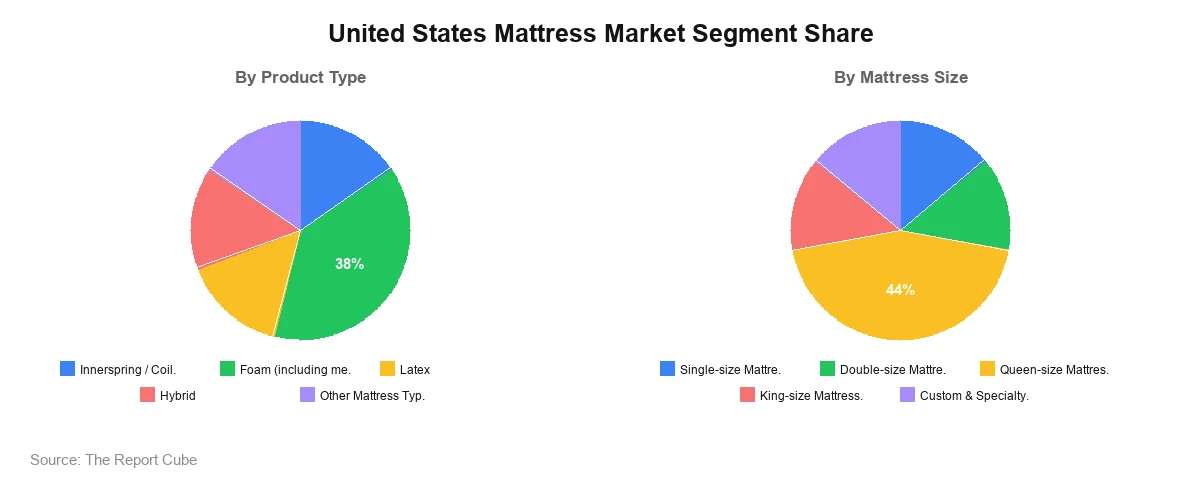
Foam mattresses, including memory foam variants, lead product type revenue contribution with an estimated 38% share of the United States Mattress Market in 2025. The segment's dominance reflects decades of investment by leading manufacturers in gel-infusion and phase-change material technologies that resolved legacy heat retention concerns. Memory foam's ability to deliver body-contouring pressure relief at accessible price points, particularly within the USD 500–1,200 range, has made it the default recommendation for sleepers managing back pain, joint disorders, and sleep apnea. Approximately 70 million Americans living with chronic sleep conditions represent a structurally loyal consumer base for foam-based solutions offering orthopedic certifications.
Innerspring and coil mattresses retain meaningful market presence at an estimated 28–32% revenue share, anchored by price accessibility and widespread brand recognition in mass-market retail channels. However, growth is being redirected toward the hybrid segment, which combines coil support infrastructure with foam comfort layers to deliver balanced firmness and superior motion isolation. The hybrid mattress segment is expanding at a CAGR of approximately 9.5% through the forecast period, outpacing every other product type. Latex mattresses, while occupying a smaller share at approximately 6–8%, are growing rapidly within the premium organic consumer cohort, supported by allergy-conscious purchasing decisions and GOTS-certified manufacturing credentials.
By Mattress Size
- Single-size Mattress
- Double-size Mattress
- Queen-size Mattress
- King-size Mattress
- Custom & Specialty Sizes
Queen-size mattresses dominate the United States Mattress Market by volume, commanding approximately 44% of total unit sales in 2025 according to data from the International Sleep Products Association. The segment's leadership reflects its optimal balance of space efficiency and two-person comfort, making it the default selection for master bedrooms, guest rooms, and apartment configurations. New residential housing developments and apartment complexes across the United States are systematically designed around queen-bed footprints, reinforcing demand predictability. At a 3.74% CAGR through the forecast period, the queen-size segment is also among the most resilient size categories, driven by household formation trends and replacement cycle activation among millennial homebuyers.
King-size mattresses represent the premium-growth opportunity within the size segment, expanding at approximately 9.4% CAGR as rising premium housing adoption and dual-income household income growth shift aspirational purchasing upward. Custom and specialty sizes represent a niche but high-margin category appealing to boutique hospitality operators and consumers with unique bedroom configurations. Single and double-size segments maintain stable volume supported by college housing, dormitory procurement, and budget-sensitive residential markets characterized by high tenant mobility and frequent replacement cycles, ensuring a consistent volume floor across the forecast period.
Regional Projection of United States Mattress Market
The United States Mattress Market demonstrates significant regional variation driven by differences in housing market activity, consumer income levels, urbanization density, and cultural attitudes toward sleep wellness. Each region presents a distinct demand profile shaped by local construction trends, demographic composition, and e-commerce penetration rates.
|
Region |
Estimated Market Share |
Key Growth Factors |
Consumer Trends |
|---|---|---|---|
|
Northeast |
22.4% |
Dense urban housing, premium consumer base |
High adoption of DTC and luxury brands |
|
Midwest |
28.5% |
Strong housing completions, value-segment leadership |
Preference for established retail and coil types |
|
Southeast |
23.1% |
Rapid population growth, new construction activity |
Rising demand for hybrid and cooling mattresses |
|
Southwest |
12.8% |
Urban expansion, millennial household formation |
Increasing smart mattress adoption |
|
West |
13.2% |
Tech-forward consumers, sustainability orientation |
Fastest growth in eco-friendly and smart mattresses |
- Northeast: The Northeast holds an estimated 22.4% market share, anchored by a high-income urban consumer base in metropolitan areas including New York, Boston, and Philadelphia that consistently favors premium and luxury mattress brands.
- Midwest: The Midwest commands the largest regional share at approximately 28.5%, driven by robust housing completions in suburban markets and consistent volume from traditional retail distribution networks serving value-conscious consumer segments.
- Southeast: The Southeast, accounting for approximately 23.1% of revenue, is benefiting from one of the strongest population migration trends in the nation, fueling new residential construction and driving substantial first-purchase mattress demand across Florida, Texas, Georgia, and the Carolinas.
- Southwest: The Southwest, representing approximately 12.8% of market revenue, is driven by rapid urban expansion in Phoenix, Las Vegas, and Austin, where millennial household formation and dual-income demographics are accelerating premiumization toward smart and hybrid mattress categories.
- West: The West, estimated at 13.2% market share and emerging as the fastest-growing region, is defined by a tech-forward consumer culture in California, Washington, and Colorado that prioritizes sustainable materials, biometric sleep tracking, and organic-certified sleep products.
United States Mattress Market: Recent Development (2025)
- Tempur Sealy completed its USD 5 billion Mattress Firm acquisition, forming Somnigroup International Inc. in February 2025.
- Purple Innovation expanded its Mattress Firm presence to 12,000 display slots via a Somnigroup supply agreement in 2025.
- Sleep Number launched the ComfortMode smart mattress below USD 1,600, its largest product reset in nearly a decade.
- Saatva expanded its physical Viewing Room network across multiple U.S. cities to enhance omnichannel retail presence.
United States Mattress Market Future Outlook (2034)
The United States Mattress Market is projected to expand at a 3.90% CAGR, reaching approximately USD 25.49 billion by 2034. Long-term growth will be supported by sustained residential construction, the continued normalization of premium sleep investment among American consumers, and accelerating adoption of smart mattress technologies incorporating biometric monitoring, AI-driven sleep coaching, and adaptive firmness systems. The luxury and premium mattress segment is projected to grow at a disproportionately higher CAGR as income bifurcation shifts a larger share of category spending toward the USD 1,500-plus price tier across urban and suburban markets.
Future market expansion will be driven by advancing materials science, including next-generation phase-change cooling layers, graphene-infused foam composites, and fully biodegradable spring and upholstery systems. Direct-to-consumer brands will continue gaining structural advantages through superior data analytics, personalized recommendation engines, and subscription-based mattress services offering periodic replacement and recycling programs. Environmental regulation, particularly California's stringent product emission and recyclability standards, will accelerate the industry's transition toward sustainable manufacturing, creating durable competitive differentiation for brands that achieve compliance ahead of the regulatory curve and build credibility with the growing sustainability-oriented consumer cohort.
United States Mattress Market Report Coverage
|
Report Attribute |
Details |
|---|---|
|
Market Name |
United States Mattress Market |
|
Market Size (2026) |
USD 18.77 Billion |
|
Market Size (2034) |
USD 25.49 Billion |
|
Forecast Period |
2026–2034 |
|
CAGR |
3.90% |
|
Base Year |
2026 |
|
Historical Years |
2021–2025 |
|
Forecast Years |
2026–2034 |
|
Segments Covered |
By Product Type, By Mattress Size, By End User, By Distribution Channel |
|
Regions Covered |
Northeast, Midwest, Southeast, Southwest, West |
|
Key Companies |
Tempur Sealy International Inc., Serta Simmons Bedding LLC, Sleep Number Corporation, Purple Innovation Inc., Casper Sleep Inc., Resident (Nectar, DreamCloud), Saatva Inc., Helix Sleep LLC, Brooklyn Bedding LLC, Others |
|
Report Format |
PDF, Excel, PPT |
|
Customization |
Available as per client requirements |
Why Choose This Report?
- Comprehensive analysis of all major product types and mattress size configurations across the United States.
- Accurate market sizing with verified 3.90% CAGR and a reliable forecast through 2034.
- Detailed segmentation revealing dominant and fastest-growing revenue opportunity areas.
- Regional insights spanning all five U.S. geographic zones with individual market share estimates.
- Competitive profiling of ten leading national and direct-to-consumer mattress brands.
- Analysis of smart mattress technology adoption, sustainable materials trends, and DTC disruption.
- 2025-grounded recent developments including Somnigroup formation and Sleep Number product resets.
- Data-driven strategic insights supporting investment, market entry, and product development decisions.
Table of Contents
- Introduction
- Objective of the Study
- Product Definition
- Market Segmentation
- Study Variables
- Research Methodology
- Secondary Data Points
- Companies Interviewed
- Primary Data Points
- Breakdown of Primary Interviews
- Secondary Data Points
- Executive Summary
- Market Dynamics
- Drivers
- Challenges
- Opportunity Assessment
- Recent Trends and Developments
- Policy and Regulatory Landscape
- United States Mattress Market Overview and Forecast Analysis (2021-2034)
- Market Size, By Value, By Growth Rate (CAGR/USD Billions)
- Demand – Supply Trends
- Market Share, By Product Type
- Innerspring / Coil
- Foam (including memory foam)
- Latex
- Hybrid
- Other Mattress Types
- Market Share, By Mattress Size
- Single-size Mattress
- Double-size Mattress
- Queen-size Mattress
- King-size Mattress
- Custom & Specialty Sizes
- Market Share, By End User
- Residential
- Commercial
- Market Share, By Distribution Channel
- B2C/Retail
- B2B/Project
- Market Share, By Region
- Northeast
- Midwest
- Southeast
- Southwest
- West
- Market Share, By Competitors
- Competition Characteristics
- Revenue Shares
- Innerspring / Coil United States Mattress Market Overview, 2021-2034F
- By Value (USD Million)
- By Mattress Size – Market Size & Forecast 2021-2034, USD Million
- Single-size Mattress
- Double-size Mattress
- Queen-size Mattress
- King-size Mattress
- Custom & Specialty Sizes
- Foam (including memory foam) United States Mattress Market Overview, 2021-2034F
- By Value (USD Million)
- By Mattress Size – Market Size & Forecast 2021-2034, USD Million
- Single-size Mattress
- Double-size Mattress
- Queen-size Mattress
- King-size Mattress
- Custom & Specialty Sizes
- Latex United States Mattress Market Overview, 2021-2034F
- By Value (USD Million)
- By Mattress Size – Market Size & Forecast 2021-2034, USD Million
- Single-size Mattress
- Double-size Mattress
- Queen-size Mattress
- King-size Mattress
- Custom & Specialty Sizes
- Hybrid United States Mattress Market Overview, 2021-2034F
- By Value (USD Million)
- By Mattress Size – Market Size & Forecast 2021-2034, USD Million
- Single-size Mattress
- Double-size Mattress
- Queen-size Mattress
- King-size Mattress
- Custom & Specialty Sizes
- Other Mattress Types United States Mattress Market Overview, 2021-2034F
- By Value (USD Million)
- By Mattress Size – Market Size & Forecast 2021-2034, USD Million
- Single-size Mattress
- Double-size Mattress
- Queen-size Mattress
- King-size Mattress
- Custom & Specialty Sizes
- Competitive Outlook (Company Profile – Partial List)
- Tempur Sealy International Inc.
- Company Overview
- Business Segments
- Strategic Alliances/Partnerships
- Recent Developments
- Serta Simmons Bedding LLC
- Company Overview
- Business Segments
- Strategic Alliances/Partnerships
- Recent Developments
- Sleep Number Corporation
- Company Overview
- Business Segments
- Strategic Alliances/Partnerships
- Recent Developments
- Purple Innovation Inc.
- Company Overview
- Business Segments
- Strategic Alliances/Partnerships
- Recent Developments
- Casper Sleep Inc.
- Company Overview
- Business Segments
- Strategic Alliances/Partnerships
- Recent Developments
- Resident (Home of Nectar
- Company Overview
- Business Segments
- Strategic Alliances/Partnerships
- Recent Developments
- DreamCloud)
- Company Overview
- Business Segments
- Strategic Alliances/Partnerships
- Recent Developments
- Saatva Inc.
- Company Overview
- Business Segments
- Strategic Alliances/Partnerships
- Recent Developments
- Helix Sleep LLC
- Company Overview
- Business Segments
- Strategic Alliances/Partnerships
- Recent Developments
- Brooklyn Bedding LLC
- Company Overview
- Business Segments
- Strategic Alliances/Partnerships
- Recent Developments
- Others
- Tempur Sealy International Inc.
- Contact Us & Disclaimer
Top Key Players & Market Share Outlook
- Tempur Sealy International Inc.
- Serta Simmons Bedding LLC
- Sleep Number Corporation
- Purple Innovation Inc.
- Casper Sleep Inc.
- Resident (Home of Nectar, DreamCloud)
- Saatva Inc.
- Helix Sleep LLC
- Brooklyn Bedding LLC
- Others
Frequently Asked Questions






