



Build Your Custom Market Intelligence Report
Customize Your ReportChina Membrane Bioreactor Market Key Highlights
By System Configuration:
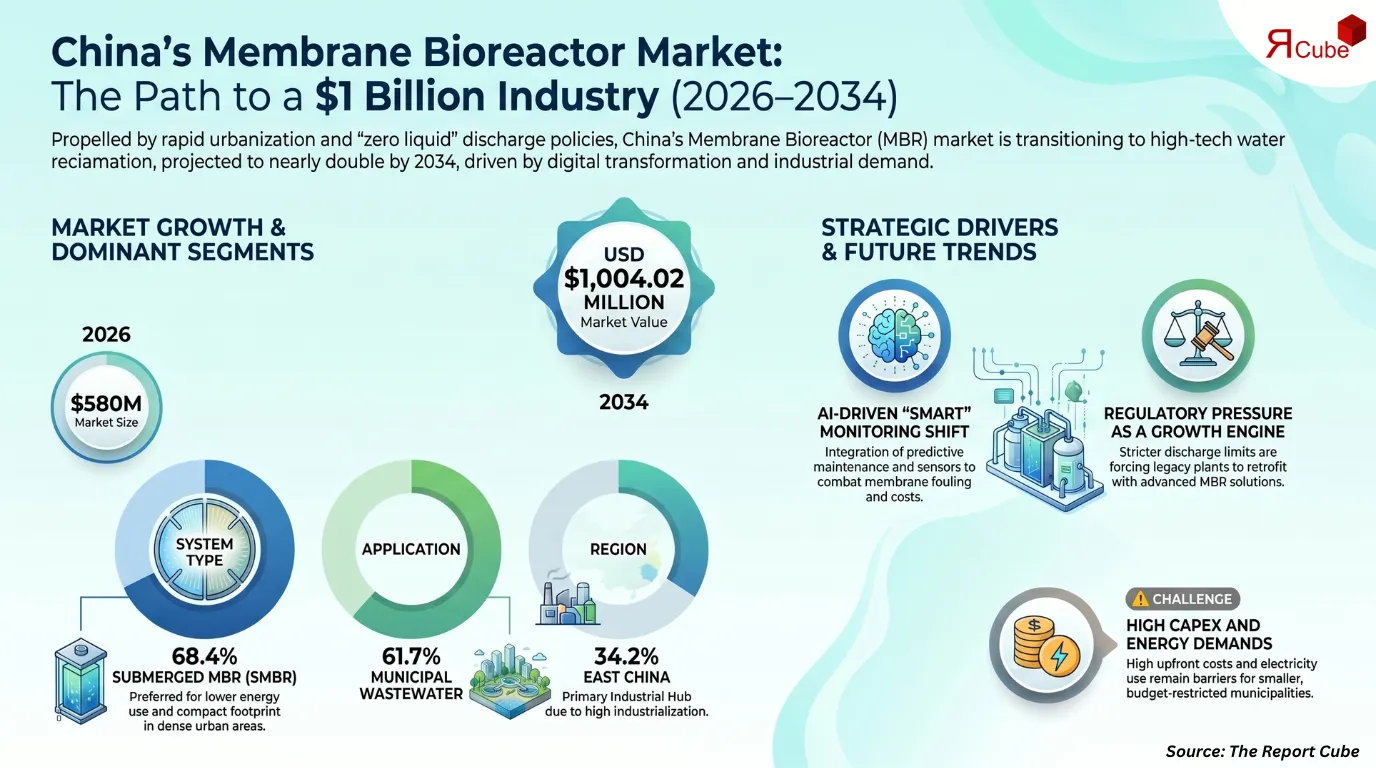
Submerged MBR Systems (SMBR) segment leads the market with nearly 68.4% share.
By Application:
Municipal Wastewater Treatment segment dominates the market with approximately 61.7% of revenue.
Regional Outlook:
East China region dominates the China Membrane Bioreactor Market with nearly 34.2% share.
China Membrane Bioreactor Market Insights & Analysis
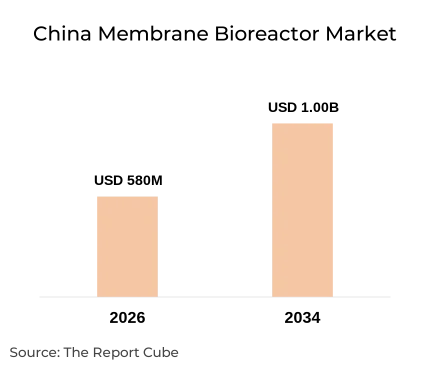
The China Membrane Bioreactor Market is anticipated to register a CAGR of around 7.1% during the forecast period 2026-2034. The market size is valued at USD 580 million in 2026 and is projected to reach USD 1004.02 million by 2034. Rising pressure from industrial wastewater and increasing volumes of municipal sewage are driving strong demand for advanced membrane bioreactor (MBR) systems across China. These systems are becoming more widely adopted because they produce higher-quality effluent, take up less land, and better support water reuse goals in densely populated urban areas.
Growth in the sector is also being fueled by continued investment in smarter wastewater infrastructure, digital monitoring tools, and more energy-efficient treatment technologies. China’s wastewater treatment industry surpassed RMB 450 billion in 2025, and ongoing government targets for reclaimed water use and low-carbon treatment are pushing rapid upgrades across the sector.At the same time, advanced membrane filtration technologies, including hollow fiber membranes, ultrafiltration-based MBR systems, and hybrid configurations, are being deployed more broadly in industrial parks, chemical and pharmaceutical facilities, and municipal plants. New AI-driven monitoring systems and predictive maintenance tools are also helping operators improve efficiency and reduce long-term operating costs in large-scale treatment operations
China Membrane Bioreactor Market Impact Analysis
| Factor | Type | Specific Impact on Market | Magnitude | Business Implication |
|---|---|---|---|---|
| Stringent Wastewater Discharge Policies | Regulatory | Tighter pollutant limits accelerate migration to advanced MBR solutions | High | Favors compliant vendors and drives retrofits of legacy treatment assets |
| Rapid Urbanization and Water Scarcity | Market | Growing cities and limited freshwater raise demand for reuse centric treatment | High | Supports deployment of compact MBR plants in high density urban locations |
| Industrial Expansion and Zero Liquid Goals | Market | Process industries adopt MBRs to meet stricter onsite effluent obligations | High | Creates recurring projects in chemicals, pharma, food and textile units |
| Government Investment in Water Infrastructure | Environmental | Public programs for reuse, security and sanitation uplift MBR adoption | High | Enables large municipal tenders and long term concession opportunities |
| Advances in Membrane Technology | Technological | Improved durability and lower fouling enhance reliability and lifecycle value | Medium | Helps suppliers justify premium pricing with reduced operating expenditure |
| High Capital and Operating Complexity | Market | Upfront cost and skill intensive operation slow adoption in smaller plants | Medium | Drives demand for financing models, service contracts and operator training |
| Growing Presence of Domestic Competitors | Competitive | Local manufacturers intensify price pressure and local service expectations | Medium | Requires differentiation through performance guarantees and digital monitoring |
China Membrane Bioreactor Market Dynamics
Key Driver: Expanding Water Reuse Programs and Stricter Wastewater Discharge Regulations
China’s increasing focus on water security and sustainable water management is significantly boosting demand for membrane bioreactor (MBR) systems. Rapid urbanization, industrial growth, and mounting freshwater scarcity have led regulators to enforce stricter wastewater discharge standards across both municipal and industrial sectors. MBR technology, with its strong contaminant removal efficiency and ability to produce high-quality reclaimed water, is emerging as a preferred solution for modern treatment infrastructure.
Government-led water recycling initiatives are also creating sustained growth opportunities for MBR equipment manufacturers and technology providers. China has set ambitious reclaimed water utilization targets, particularly in water-stressed cities, and continues to invest heavily in upgrading sewage treatment capacity. Industries such as chemicals, pharmaceuticals, food processing, and textiles are increasingly adopting MBR systems to comply with environmental regulations while reducing reliance on freshwater resources.
Industry Trends: Integration of Artificial Intelligence and Smart Membrane Monitoring Systems
Digital transformation is becoming a defining trend in China’s membrane bioreactor market. Wastewater treatment operators are increasingly deploying AI-enabled monitoring platforms, predictive analytics, and sensor-based optimization tools to enhance process efficiency. These technologies help detect membrane fouling, optimize aeration performance, and reduce overall operating costs.
Advances in membrane materials and intelligent system design are further improving plant reliability and performance. Research institutions and technology providers are focusing on innovations such as self-cleaning membranes, AI-assisted process control, and automated maintenance systems. This shift toward smart wastewater infrastructure aligns with China’s broader industrial digitalization strategy and is expected to strengthen long-term competitiveness across both municipal and industrial treatment facilities.
Book your FREE 30-minute expert consultation today
Contact UsMajor Challenge: High Capital Costs and Energy Consumption Concerns
Despite their operational advantages, membrane bioreactor systems face challenges related to high upfront investment costs. Expenses associated with membrane modules, automation systems, advanced controls, and specialized maintenance can make MBR adoption more expensive than conventional wastewater treatment solutions, particularly for smaller municipalities and cost-sensitive industries.
Energy consumption is another key concern. Aeration processes, membrane cleaning cycles, and continuous filtration operations contribute to relatively high electricity demand in large-scale installations. As a result, operators are increasingly seeking energy-efficient designs and low-carbon treatment technologies to improve project viability. While ongoing technological improvements are helping reduce lifecycle costs, financial constraints may still limit adoption in smaller or budget-restricted projects.
Opportunity: Growing Industrial Wastewater Treatment Investments Across Manufacturing Sectors
Industrial wastewater treatment represents a major growth opportunity for China’s membrane bioreactor market. Manufacturing sectors are producing increasingly complex effluent streams that require advanced treatment systems capable of handling high pollutant loads and variable operating conditions. MBR technology offers stable performance while enabling water reuse within industrial processes.
Rising investments in petrochemicals, pharmaceuticals, power generation, electronics manufacturing, and food processing are expected to drive further demand for advanced membrane systems. In addition, industrial parks are increasingly adopting centralized wastewater treatment facilities equipped with MBR technology to comply with tightening environmental standards. The combination of regulatory pressure, sustainability goals, and water reuse initiatives is expected to support strong market expansion over the forecast period.
China Membrane Bioreactor Market Segment-wise Analysis
By System Configuration:
- Side-stream / External MBR Systems
- Submerged MBR Systems (SMBR)
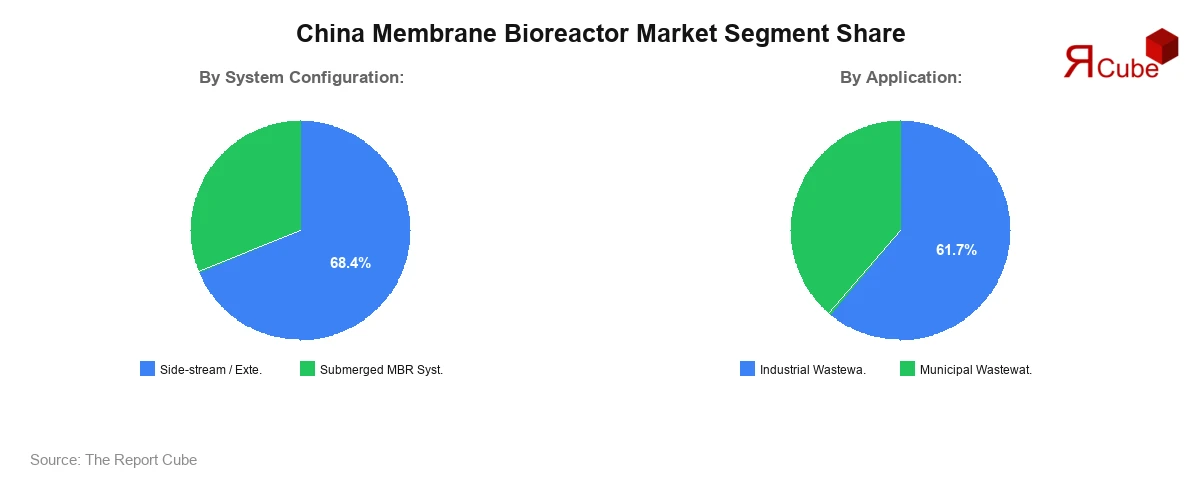
Submerged MBR systems (SMBR) dominate the China membrane bioreactor market, accounting for approximately 68.4% of total revenue in 2026. This leading position is largely driven by their lower energy consumption, reduced operating costs, and higher overall treatment efficiency compared to side-stream MBR configurations. Municipal wastewater treatment plants are the primary adopters of SMBR technology, as these systems offer a compact footprint and are well-suited for large-scale treatment requirements in densely populated urban areas. Increasing investments in wastewater infrastructure across regions such as East China and South Central China are further accelerating demand for submerged systems.
Ongoing improvements in membrane durability, fouling resistance, and system stability are also strengthening adoption across both municipal and industrial applications. As a result, SMBR systems continue to be the preferred configuration for expanding wastewater treatment capacity and supporting long-term water reuse initiatives in China
By Application:
- Industrial Wastewater Treatment
- Municipal Wastewater Treatment
Municipal wastewater treatment continues to be the leading application segment in the China membrane bioreactor market, accounting for around 61.7% of total market share. This dominance is supported by rapid urban expansion, population growth, and the resulting increase in municipal sewage generation, which has placed significant pressure on existing wastewater infrastructure.
To address these challenges, local governments are increasingly upgrading treatment facilities with advanced membrane technologies. Membrane bioreactor (MBR) systems are being widely adopted due to their ability to produce high-quality effluent that is suitable for water reuse applications. As a result, they are playing a key role in supporting China’s broader water recycling and resource recovery initiatives.
Reclaimed water programs are further accelerating adoption across major urban clusters, including Shanghai, Beijing, Jiangsu, Zhejiang, and Guangdong. In addition, municipal operators are increasingly integrating ultrafiltration-based membrane systems to meet stricter discharge standards, enhance treatment performance, and improve overall operational efficiency
Regional Projection of China Membrane Bioreactor Industry
- North China
- Northeast China
- East China
- South Central China
- Southwest China
- Northwest China
East China holds the leading position in the China membrane bioreactor market, accounting for an estimated 34.2% revenue share. This dominance is supported by a high level of industrialization, well-developed municipal infrastructure, and sustained investment in wastewater treatment upgrades across the region. Key provinces such as Jiangsu, Zhejiang, Fujian, and Shandong host numerous large-scale wastewater treatment projects where membrane bioreactor technologies are increasingly deployed. The region’s strong industrial base—spanning pharmaceuticals, petrochemicals, electronics, and textiles—continues to generate substantial demand for advanced industrial wastewater treatment solutions.
In addition, the presence of leading technology suppliers, engineering firms, and research institutions reinforces East China’s competitive advantage in the sector. Growing implementation of water reuse initiatives and smart wastewater management systems is expected to further consolidate the region’s leadership position over the forecast period.
Need insights for a specific region within this market?
Request Regional DataChina Membrane Bioreactor Market Regional Analysis
The China membrane bioreactor market varies significantly across regions due to diverse industrial density, water scarcity levels, and urbanization patterns.
| Region | Demand Level | Key Areas | System Dominance | Core Demand Logic | Growth Nature |
|---|---|---|---|---|---|
| North China | Very High | Beijing, Tianjin, Hebei | Submerged MBR | Municipal wastewater treatment & reuse | Water scarcity-driven |
| Northeast China | Medium | Liaoning, Jilin, Heilongjiang | A/O process & MBR hybrids | Cold climate sewage treatment challenges | Steady municipal growth |
| East China | Extremely High | Shanghai, Jiangsu, Zhejiang | External & Submerged MBR | High-strength industrial wastewater treatment | Fastest industrial segment |
| South Central China | High | Guangdong, Hubei, Hunan | Hollow fiber MBR | Dense urban population & industrial zones | Rapid urbanization-driven |
| Southwest China | Medium to High | Sichuan, Chongqing, Yunnan | Submerged MBR systems | Expanding urban wastewater infrastructure | Infrastructure expansion |
| Northwest China | High | Shaanxi, Gansu, Xinjiang | Water reuse MBR systems | Extreme water scarcity & reuse priority | Water reuse-driven growth |
Government Initiatives & Policies
- Wastewater Reuse & Resource Utilization Program: China established targets for water-scarce cities to achieve more than 25% recycled water utilization and develop 100 green low-carbon sewage treatment plants by 2025, supporting advanced membrane treatment deployment.
- 2025 Guidelines on Preferential Policies for Water Conservation Industry: The Ministry of Water Resources introduced updated policy guidelines in 2026 supporting investment incentives, water-saving technologies, and wastewater treatment modernization projects across industrial and municipal sectors.
China Membrane Bioreactor Industry Recent Developments
- 2026: Chinese Research Institutions developed an AI-assisted dual-atom catalyst technology capable of converting nitrate-rich wastewater into ammonia-based fertilizer with nearly three times greater efficiency than conventional processes, supporting circular wastewater treatment and resource recovery applications.
- 2026: CITIC Envirotech and Tsinghua University introduced an intelligent membrane fouling monitoring platform utilizing advanced sensors, machine learning algorithms, and predictive analytics to improve membrane lifespan, operational stability, and treatment efficiency across large-scale wastewater treatment facilities.
Why Choose This Report?
- Provides a comprehensive overview of the overall market analysis, encompassing key trends, consumer behavior analysis, and risk assessment to support strategic decision-making.
- Provides accurate, up-to-date insights into market size, segmentation, and emerging opportunities, helping to minimize risk & capitalizing on growth.
- Gives deep understanding of target audience preferences, investment habits, and communication channels for enhanced product development & marketing effectiveness.
- Delivers competitive analysis & benchmarking, uncovering the strengths & weaknesses of market competitors to guide strategies.
- Consolidate comprehensive market intelligence, reducing reasoning & streamlining research efforts.
- Facilitates customized market segmentation & risk mitigation strategies, fine-tuned to the business objectives.
- Aids in identifying both market challenges & untapped opportunities within the industry to drive long-term business growth.
- Provides valuable information based on actual customer data & search trends.
Table of Contents
- Introduction
- Objective of the Study
- Product and Category Definition
- Market Segmentation
- Study Variables
- Research Methodology
- Secondary Data Points
- Breakdown of Secondary Sources
- Primary Data Points
- Breakdown of Primary Interviews
- Secondary Data Points
- Executive Summary
- Market Dynamics
- Emerging Opportunities
- Adoption Trends
- Demand Drivers
- Disruption Analysis (Challenges)
- Industry Analysis & Strategic Insights
- Supply/Value Chain Analysis
- Pricing Analysis
- Go-To-Market (GTM) Strategy
- BCG Matrix
- Recent Trends and Developments
- Import and Export Analysis
- Regulatory and Policy Landscape
- Region-wise policies
- Government Initiatives
- China Membrane Bioreactor Market Overview and Forecast Analysis (2021-2034)
- Market Size, By Value, By Growth Rate (CAGR/USD Million)
- Market Share, By System Configuration
- Side-stream / External MBR Systems
- Submerged MBR Systems (SMBR)
- Market Share, By Flow Rate Capacity
- Less than 50,000 GPD
- 50,000 - 250,000 GPD
- 250,000 - 1,000,000 GPD
- Over 1,000,000 GPD
- Market Share, By Membrane Type
- Flat Sheet Membranes
- Multi-tubular Membranes
- Hollow Fiber Membranes
- Market Share, By Application
- Industrial Wastewater Treatment
- Municipal Wastewater Treatment
- Market Share, By End-Use Industry
- Food & Beverage
- Power & Energy
- Municipalities
- Pulp & Paper
- Textile Industry
- Oil & Gas
- Pharmaceuticals
- Chemical & Petrochemical
- Market Share, By Technology Integration
- Ultrafiltration (UF) based MBR
- Hybrid systems (advanced combinations with NF/RO in reuse plants)
- Microfiltration (MF) based MBR
- Market Share, By Module Configuration
- Plate & frame modules
- Spiral wound systems
- Tubular modules
- Hollow fiber modules (dominant)
- Ceramic-based systems (premium industrial use)
- Market Share, By Region
- North
- Northeast
- East
- South Central
- Southwest
- Northwest
- Market Share, By Company
- Revenue Shares & Analysis
- Competitive Landscape
- North China Membrane Bioreactor Market Overview and Forecast Analysis (2021-2034)
- Market Size, By Value, By Growth Rate (CAGR/USD Million)
- Market Share, By System Configuration
- Market Share, By Flow Rate Capacity
- Market Share, By Membrane Type
- Market Share, By Application
- Market Share, By End-Use Industry
- Market Share, By Technology Integration
- Market Share, By Module Configuration
- Northeast China Membrane Bioreactor Market Overview and Forecast Analysis (2021-2034)
- Market Size, By Value, By Growth Rate (CAGR/USD Million)
- Market Share, By System Configuration
- Market Share, By Flow Rate Capacity
- Market Share, By Membrane Type
- Market Share, By Application
- Market Share, By End-Use Industry
- Market Share, By Technology Integration
- Market Share, By Module Configuration
- East China Membrane Bioreactor Market Overview and Forecast Analysis (2021-2034)
- Market Size, By Value, By Growth Rate (CAGR/USD Million)
- Market Share, By System Configuration
- Market Share, By Flow Rate Capacity
- Market Share, By Membrane Type
- Market Share, By Application
- Market Share, By End-Use Industry
- Market Share, By Technology Integration
- Market Share, By Module Configuration
- South Central China Membrane Bioreactor Market Overview and Forecast Analysis (2021-2034)
- Market Size, By Value, By Growth Rate (CAGR/USD Million)
- Market Share, By System Configuration
- Market Share, By Flow Rate Capacity
- Market Share, By Membrane Type
- Market Share, By Application
- Market Share, By End-Use Industry
- Market Share, By Technology Integration
- Market Share, By Module Configuration
- Southwest China Membrane Bioreactor Market Overview and Forecast Analysis (2021-2034)
- Market Size, By Value, By Growth Rate (CAGR/USD Million)
- Market Share, By System Configuration
- Market Share, By Flow Rate Capacity
- Market Share, By Membrane Type
- Market Share, By Application
- Market Share, By End-Use Industry
- Market Share, By Technology Integration
- Market Share, By Module Configuration
- Northwest China Membrane Bioreactor Market Overview and Forecast Analysis (2021-2034)
- Market Size, By Value, By Growth Rate (CAGR/USD Million)
- Market Share, By System Configuration
- Market Share, By Flow Rate Capacity
- Market Share, By Membrane Type
- Market Share, By Application
- Market Share, By End-Use Industry
- Market Share, By Technology Integration
- Market Share, By Module Configuration
- Competitive Analysis, 2026
- Market Share of Key Players
- Competitive Mapping for Each Segment and Companies Operating Regionally
- North China Membrane Bioreactor Companies Share & Competitive Analysis, 2026
- Northeast China Membrane Bioreactor Companies Share & Competitive Analysis, 2026
- East China Membrane Bioreactor Companies Share & Competitive Analysis, 2026
- South Central China Membrane Bioreactor Companies Share & Competitive Analysis, 2026
- Southwest China Membrane Bioreactor Companies Share & Competitive Analysis, 2026
- Northwest China Membrane Bioreactor Companies Share & Competitive Analysis, 2026
- Company Profile (Partial List)
- Kemira Oyj
- Company Overview
- Product Portfolio
- Strategic Alliances/Partnerships
- Recent Developments
- Veolia Environnement SA
- Company Overview
- Product Portfolio
- Strategic Alliances/Partnerships
- Recent Developments
- Mitsubishi Electric Corp.
- Company Overview
- Product Portfolio
- Strategic Alliances/Partnerships
- Recent Developments
- Calgon Carbon
- Company Overview
- Product Portfolio
- Strategic Alliances/Partnerships
- Recent Developments
- Aquatech BM
- Company Overview
- Product Portfolio
- Strategic Alliances/Partnerships
- Recent Developments
- Danaher Corp.
- Company Overview
- Product Portfolio
- Strategic Alliances/Partnerships
- Recent Developments
- Kubota Corp.
- Company Overview
- Product Portfolio
- Strategic Alliances/Partnerships
- Recent Developments
- SUEZ Environnement
- Company Overview
- Product Portfolio
- Strategic Alliances/Partnerships
- Recent Developments
- Buckman
- Company Overview
- Product Portfolio
- Strategic Alliances/Partnerships
- Recent Developments
- Portland General Electric Co.
- Company Overview
- Product Portfolio
- Strategic Alliances/Partnerships
- Recent Developments
- CITIC Envirotech
- Company Overview
- Product Portfolio
- Strategic Alliances/Partnerships
- Recent Developments
- Toray Industries Inc.
- Company Overview
- Product Portfolio
- Strategic Alliances/Partnerships
- Recent Developments
- Aquatech International Corp.
- Company Overview
- Product Portfolio
- Strategic Alliances/Partnerships
- Recent Developments
- Others (Partial List)
- Kemira Oyj
- Contact Us and Disclaimer
Top Key Players & Market Share Outlook
- Kemira Oyj
- Veolia Environnement SA
- Mitsubishi Electric Corp.
- Calgon Carbon
- Aquatech BM
- Danaher Corp.
- Kubota Corp.
- SUEZ Environnement
- Buckman
- Portland General Electric Co.
- CITIC Envirotech
- Toray Industries Inc.
- Aquatech International Corp.
Frequently Asked Questions






