



Build Your Custom Market Intelligence Report
Customize Your ReportIndia Microfluidics Market Statistics and Insights
Market Insight
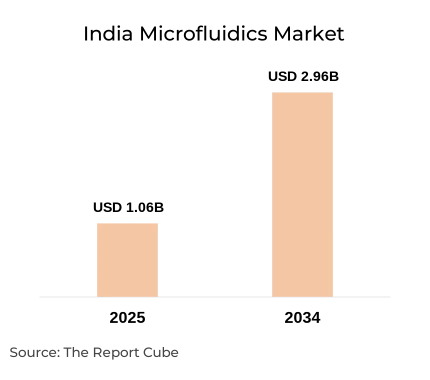
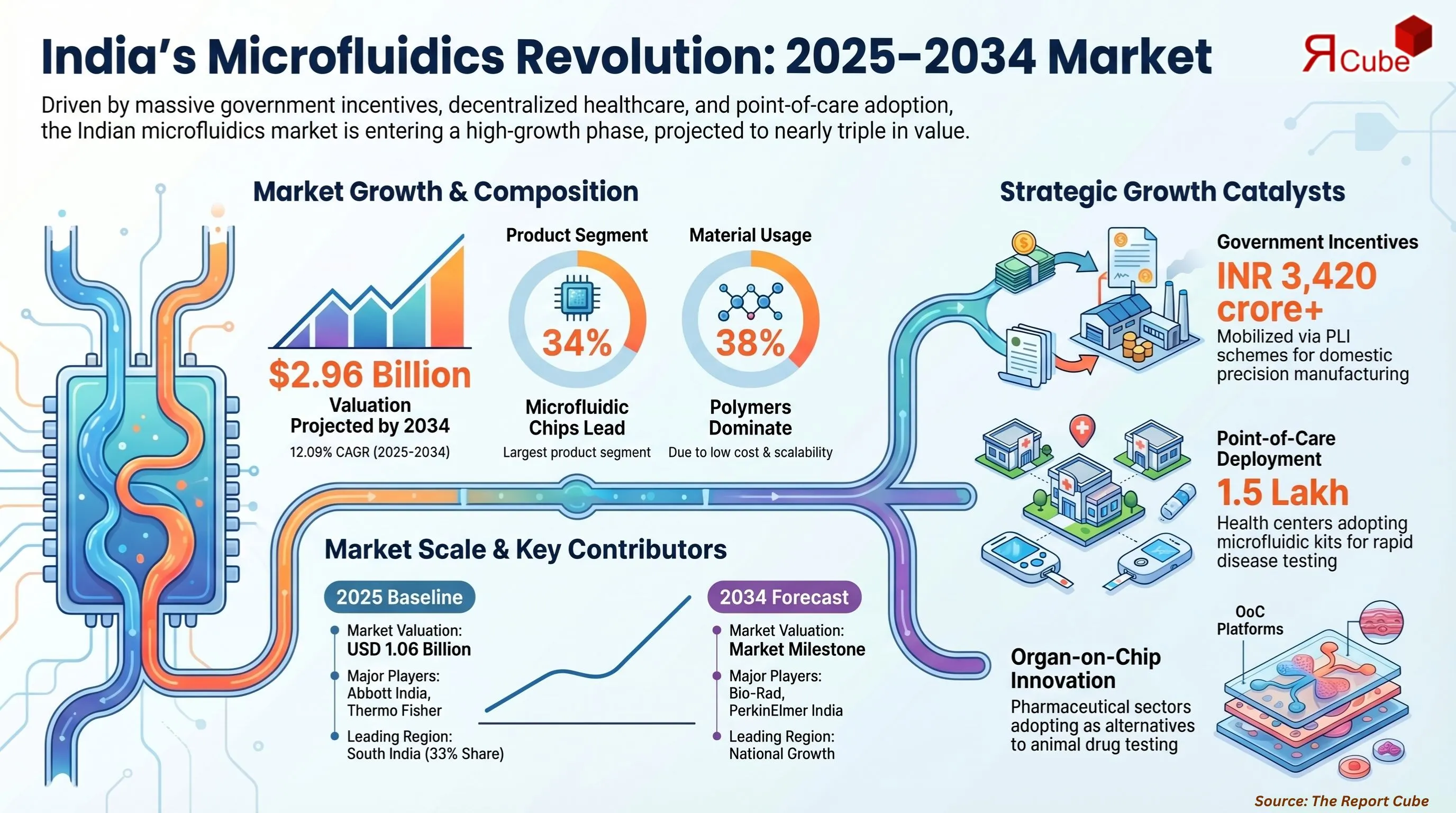
- India Microfluidics Market size was valued at USD 1.06 billion in 2025.
- India Microfluidics Market is projected to reach USD 2.96 billion by 2034.
- India Microfluidics Market is anticipated to register a 12.09% CAGR during 2026–2034.
By Product Type
- Microfluidic Chips held the leading share, capturing approximately 34% of the market.
Competitive Landscape
- More than 10 companies are actively engaged in producing India Microfluidics Market products.
- Top 5 companies acquired around 42% of the market share.
- AQC Chem. Lab Pvt Ltd., Bio-Rad Laboratories India Pvt Ltd, Abbott India Ltd, PerkinElmer India Pvt Ltd, Thermo Fisher Scientific India Pvt. Ltd., and others
By Material
- Polymer-based materials dominated the market, commanding approximately 38% of total revenue.
India Microfluidics Market Insights & Analysis
The India Microfluidics Market is anticipated to register a 12.09% CAGR during 2026–2034. The market size was valued at USD 1.06 billion in 2025 and is projected to reach USD 2.96 billion by 2034. India's microfluidics sector is gaining strong traction on the back of robust government-backed healthcare modernization programs and the growing demand for point-of-care diagnostics across Tier II and Tier III cities. The Indian government's Ayushman Bharat Digital Mission and PLI (Production-Linked Incentive) scheme for medical devices have collectively mobilized over INR 3,420 crore in incentives to stimulate domestic manufacturing of precision diagnostic tools, including microfluidic systems.
Private sector investment has also surged, with domestic biotech incubators and venture capital funds channeling significant funding into lab-on-chip start-ups. The convergence of pharmaceutical R&D expansion, IVD (in vitro diagnostics) adoption, and increased biosensor integration into wearable and implantable devices is positioning India as a high-priority growth market for global and domestic microfluidics stakeholders through the forecast horizon.
India Microfluidics Market Dynamics
Key Market Driver: Point-of-Care Diagnostics Fueling Rapid Adoption
The accelerating deployment of point-of-care (POC) diagnostic platforms across India's primary healthcare infrastructure is the most decisive growth driver for the microfluidics market. Over 1.5 lakh Health and Wellness Centres operationalized under Ayushman Bharat are increasingly deploying rapid diagnostic kits powered by microfluidic chips for conditions including tuberculosis, malaria, dengue, and diabetes.
These systems reduce turnaround time to under 15 minutes, enabling frontline healthcare workers to make treatment decisions without laboratory referral. The National Health Mission's push to decentralize diagnostics at the sub-district level has directly stimulated procurement of portable microfluidic-enabled devices, cementing POC diagnostics as the primary commercial catalyst across the 2026–2034 forecast period.
Major Industry Challenge: Regulatory Complexity Slowing Product Commercialization
India's regulatory environment for medical devices, governed by the Medical Devices Rules, 2017 and CDSCO oversight, presents a significant structural challenge for microfluidics manufacturers seeking market entry. Microfluidic systems that combine diagnostics, drug delivery, and biosensing functions often fall into ambiguous classification categories, leading to protracted approval timelines ranging from 18 to 36 months.
For domestic start-ups and SMEs operating with limited capital runway, the compliance burden of clinical validation, quality management systems (ISO 13485 certification), and import substitution compliance creates an uneven competitive landscape. This regulatory friction slows the speed of product iteration and commercialization, particularly for novel lab-on-chip formats that do not align neatly with existing device classification schedules under Schedule D1 and D2.
Emerging Trend Shaping Outlook: Organ-on-Chip Platforms Transforming Drug Discovery
India's pharmaceutical and biotechnology sector is increasingly exploring organ-on-chip (OoC) microfluidic platforms as viable alternatives to conventional animal models in early-stage drug discovery. Institutions including IIT Bombay, NCBS Bangalore, and InStem are actively developing multi-organ microphysiological systems that replicate human tissue microenvironments for oncology and metabolic disease research.
Globally, the organ-on-chip market is projected to exceed USD 500 million by 2027, and India is positioning itself as a cost-competitive research hub within this segment. As global pharmaceutical companies escalate their R&D partnerships with Indian CROs and academic laboratories, demand for sophisticated microfluidic platforms capable of mimicking vascular, hepatic, and pulmonary systems will emerge as a defining growth vector through 2034.
Need Specific Data, Let’s Customize the Report for You
Request CustomizationIndia Microfluidics Market Segment-wise Analysis
India's microfluidics market is characterized by a diverse product and material ecosystem that reflects the country's dual priorities of diagnostic accessibility and advanced research capability. Across both key segmentation axes, product type and material, distinct sub-segments are exhibiting differentiated growth trajectories, shaped by regulatory approvals, end-user adoption, and manufacturing maturity.
By Product Type
- Microfluidic Chips
- Microfluidic Sensors
- Microfluidic Pumps
- Microneedles
- Others
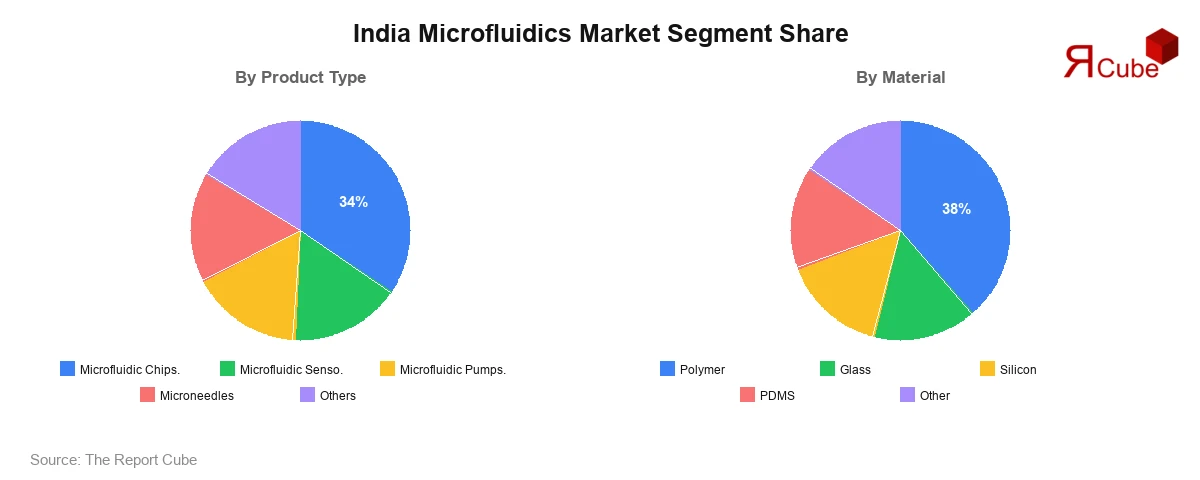
Microfluidic chips represent the largest and most commercially mature sub-segment, accounting for approximately 34% of the India Microfluidics Market revenue in 2025. Their dominance is underpinned by widespread integration into IVD assay platforms, genomic analysis kits, and POC diagnostic cartridges deployed across hospital networks and primary care centers. Microfluidic sensors hold the second-largest share at approximately 26%, driven by demand in environmental monitoring, blood glucose management, and wearable health tracking.
Microfluidic pumps contribute around 18% of revenue, largely serving pharmaceutical fluid handling and drug delivery research applications. Microneedles are an emerging sub-segment with high growth potential, particularly in transdermal drug delivery and vaccine administration, currently contributing approximately 13% of market share. The "Others" category, encompassing valves, mixers, and connectors, accounts for the remaining 9%, serving specialized OEM and research applications.
By Material
- Polymer
- Glass
- Silicon
- PDMS
- Other
Polymer-based microfluidic devices lead the material segment with approximately 38% market share, owing to their low cost, scalability in injection molding, and biocompatibility, making them ideal for single-use diagnostic cartridges and wearable biosensor housings. PDMS (polydimethylsiloxane) holds around 24% share and remains the preferred material in academic and early-stage R&D environments due to its optical transparency and ease of microfabrication, although its limited scalability for mass production moderates commercial penetration.
Silicon accounts for approximately 19% of the segment, primarily used in high-precision MEMS-based microfluidic systems for semiconductor-integrated diagnostics. Glass contributes approximately 12%, valued for its chemical resistance and optical clarity in high-end laboratory and pharmaceutical applications. Other materials, including paper-based and hybrid composites, make up the remaining 7%.
Regional Projection of India Microfluidics Market
India's microfluidics market exhibits meaningful regional variation across its major healthcare and industrial clusters.
- North India
- South India
- West India
- East India
South India commands the leading regional position, accounting for approximately 33% of the national market share. States including Karnataka, Tamil Nadu, and Telangana host a dense concentration of biotech parks, diagnostic device manufacturers, and top-tier research institutions, most notably in Bengaluru and Hyderabad, which drive both production and consumption of microfluidic systems. North India follows, propelled by Delhi-NCR's robust hospital infrastructure and pharmaceutical R&D corridor. West India, particularly Maharashtra, is experiencing accelerated growth through Mumbai's emerging medtech start-up ecosystem. East and Central India currently represent smaller but progressively developing markets as healthcare infrastructure investment intensifies under national schemes.
India Microfluidics Market: Recent Development (2025)
- Thermo Fisher Scientific India expanded its microfluidic diagnostics portfolio, reporting 14% revenue growth in Q1 2025.
- Abbott India launched a next-generation lab-on-chip system targeting infectious disease POC segments in 2025.
- Bio-Rad Laboratories India secured a government supply contract valued at INR 280 crore for microfluidic IVD systems.
- PerkinElmer India reported an 11% operating margin improvement after automating its microfluidic sensor assembly line.
India Microfluidics Market Future Outlook (2034)
By 2034, the India Microfluidics Market is projected to reach USD 2.96 billion, advancing at a 12.09% CAGR over the forecast period. Growth will be powered by the continued expansion of decentralized diagnostics, integration of AI-driven analytics into microfluidic data interpretation, and the commercialization of organ-on-chip systems for pharmaceutical discovery. The maturation of domestic manufacturing capabilities under the PLI scheme will reduce import dependency and enable competitive pricing for polymer and PDMS-based devices. Long-term market expansion will also be shaped by next-generation microneedle adoption in vaccine delivery, smart biosensor proliferation in chronic disease management, and India's emergence as a global contract research and manufacturing hub for precision microfluidic technologies.
Why Choose This Report?
- Provides a comprehensive overview of the overall market analysis, encompassing key trends, consumer behavior analysis, and risk assessment to support strategic decision-making.
- Provides accurate, up-to-date insights into market size, segmentation, and emerging opportunities, helping to minimize risk & capitalizing on growth.
- Gives deep understanding of target audience preferences, investment habits, and communication channels for enhanced product development & marketing effectiveness.
- Delivers competitive analysis & benchmarking, uncovering the strengths & weaknesses of market competitors to guide strategies.
- Consolidate comprehensive market intelligence, reducing reasoning & streamlining research efforts.
- Facilitates customized market segmentation & risk mitigation strategies, fine-tuned to the business objectives.
- Aids in identifying both market challenges & untapped opportunities within the industry to drive long-term business growth.
- Provides valuable information based on actual customer data & search trends.
Table of Contents
- Introduction
- Objective of the study
- Product Definition
- Market Segmentation
- Study Variables
- Research Methodology
- Secondary Data Points
- Companies Interviewed
- Primary Data Points
- Break Down of Primary Interviews
- Secondary Data Points
- Executive Summary
- Market Dynamics
- Drivers
- Challenges
- Opportunity Assessment
- Recent Trends and Developments
- Policy and Regulatory Landscape
- India Microfluidics Market Overview (2021-2034)
- Market Size, By Value (in USD Billions)
- Market Share, By Product Type
- Microfluidic Chips
- Microfluidic Sensors
- Microfluidic Pumps
- Microneedles
- Others
- Market Share, By Material
- Polymer
- Glass
- Silicon
- PDMS
- Other
- Market Share, By Application
- In Vitro diagnostics
- Pharmaceutical Research
- Drug Delivery
- Market Share, By End User
- Hospitals & Diagnostic Centres
- Academic & Research Institutes
- Pharmaceutical & Biotechnology Companies
- Market Share, By Region
- North India
- South India
- West India
- East India
- Market Share, By Competitors
- Competition Characteristics
- Revenue Shares
- India Microfluidic Chips Microfluidics Market Overview, 2021-2034F
- By Value (USD Million)
- By Material- Market Size & Forecast 2019-2030, USD Million
- By Application- Market Size & Forecast 2019-2030, USD Million
- By End User- Market Size & Forecast 2019-2030, USD Million
- India Microfluidic Sensors Microfluidics Market Overview, 2021-2034F
- By Value (USD Million)
- By Material- Market Size & Forecast 2019-2030, USD Million
- By Application- Market Size & Forecast 2019-2030, USD Million
- By End User- Market Size & Forecast 2019-2030, USD Million
- India Microfluidic Pumps Microfluidics Market Overview, 2021-2034F
- By Value (USD Million)
- By Material- Market Size & Forecast 2019-2030, USD Million
- By Application- Market Size & Forecast 2019-2030, USD Million
- By End User- Market Size & Forecast 2019-2030, USD Million
- India Microneedles Microfluidics Market Overview, 2021-2034F
- By Value (USD Million)
- By Material- Market Size & Forecast 2019-2030, USD Million
- By Application- Market Size & Forecast 2019-2030, USD Million
- By End User- Market Size & Forecast 2019-2030, USD Million
- India Others Microfluidics Market Overview, 2021-2034F
- By Value (USD Million)
- By Material- Market Size & Forecast 2019-2030, USD Million
- By Application- Market Size & Forecast 2019-2030, USD Million
- By End User- Market Size & Forecast 2019-2030, USD Million
- Competitive Outlook (Company Profile - Partial List)
- AQC Chem. Lab Pvt Ltd.
- Company Overview
- Business Segments
- Strategic Alliances/Partnerships
- Recent Developments
- Bio-Rad Laboratories India Pvt Ltd
- Company Overview
- Business Segments
- Strategic Alliances/Partnerships
- Recent Developments
- Abbott India Ltd
- Company Overview
- Business Segments
- Strategic Alliances/Partnerships
- Recent Developments
- PerkinElmer India Pvt Ltd
- Company Overview
- Business Segments
- Strategic Alliances/Partnerships
- Recent Developments
- Thermo Fisher Scientific India Pvt. Ltd.
- Company Overview
- Business Segments
- Strategic Alliances/Partnerships
- Recent Developments
- Others
- AQC Chem. Lab Pvt Ltd.
- Contact Us & Disclaimer
Top Key Players & Market Share Outlook
- AQC Chem. Lab Pvt Ltd.
- Bio-Rad Laboratories India Pvt Ltd
- Abbott India Ltd
- PerkinElmer India Pvt Ltd
- Thermo Fisher Scientific India Pvt. Ltd.
- Others
Frequently Asked Questions






