



Build Your Custom Market Intelligence Report
Customize Your ReportIndia Mobility Aid Medical Devices Market Statistics and Insights
Market Insight
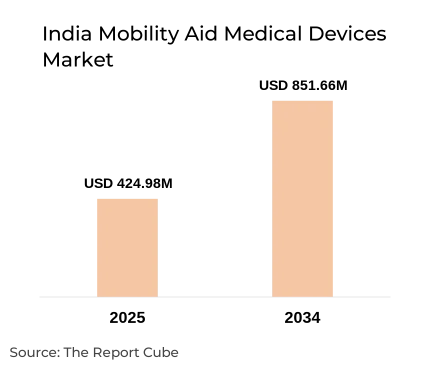
- India Mobility Aid Medical Devices Market was valued at USD 424.98 million in 2025.
- India Mobility Aid Medical Devices Market is projected to reach USD 851.66 million by 2034.
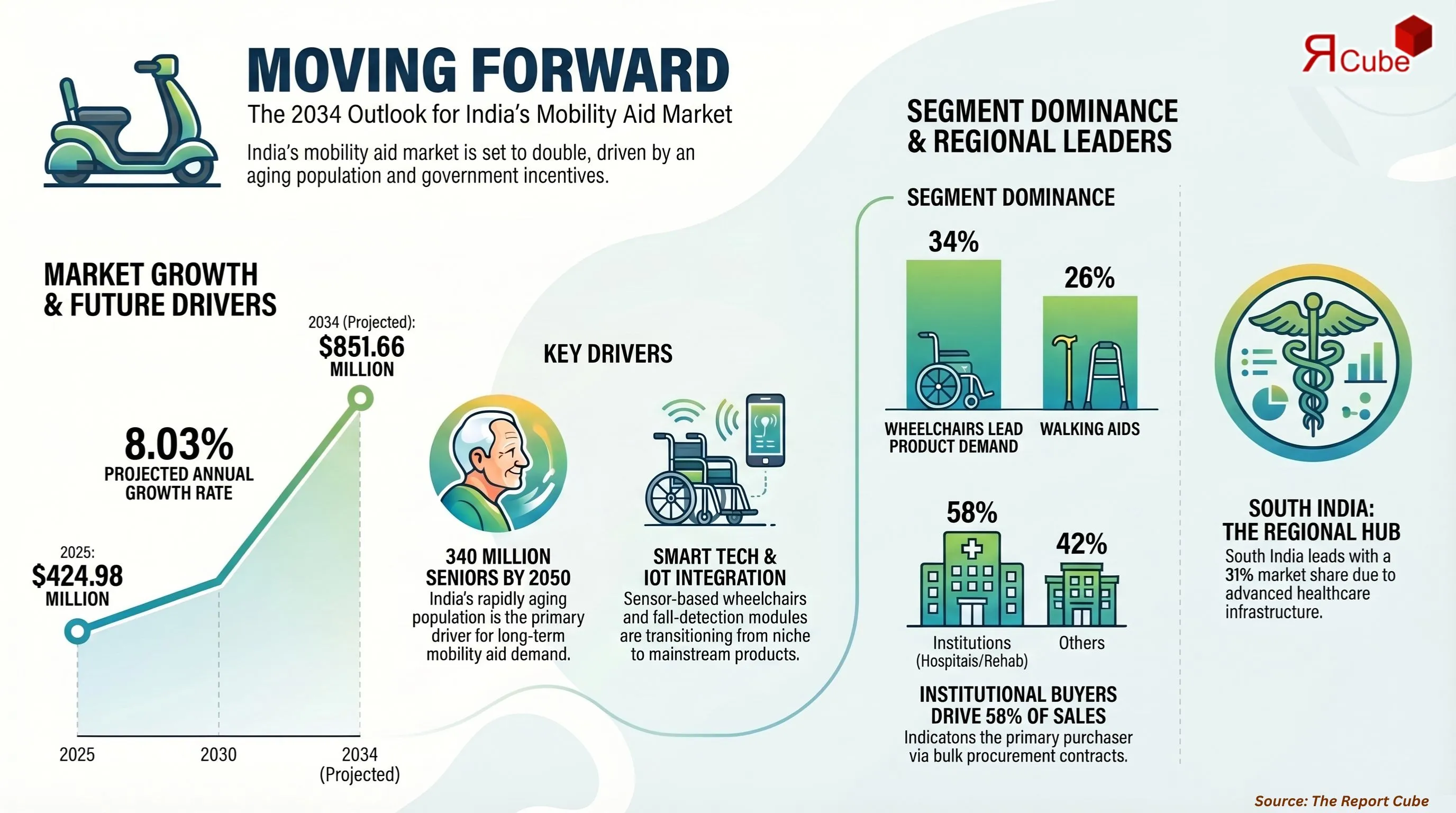
- The market is anticipated to register a CAGR of 8.03% during the forecast period.
By Product
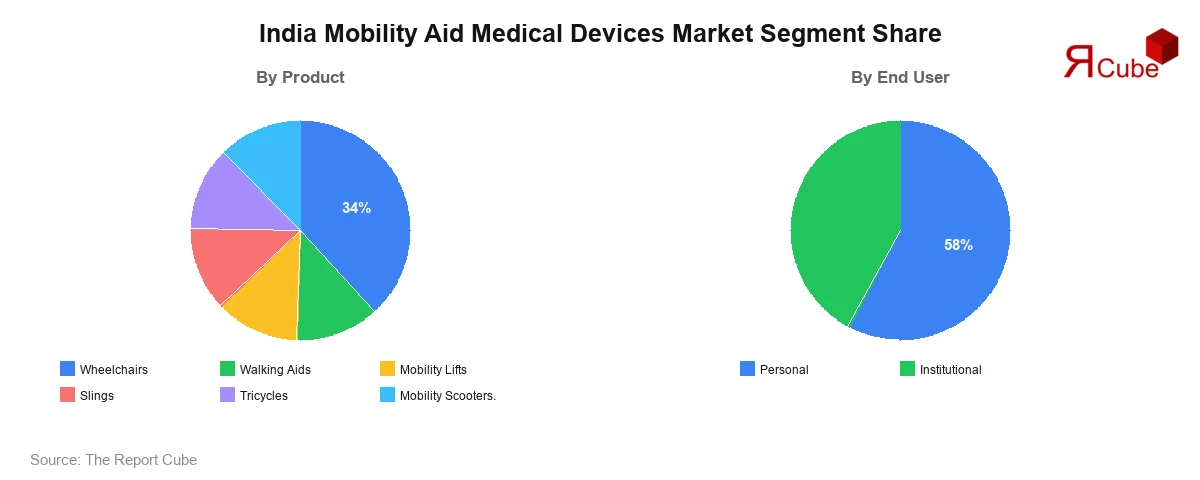
- Wheelchairs dominate the by Product segment with approximately 34% market share.
Key Players
- More than 10 companies are actively engaged in producing India Mobility Aid Medical Devices.
- Top 5 companies acquired around 48% of the market share.
- Stryker India Private Limited, ForzaMedi India Private Limited, Arjohuntleigh Healthcare India Private Limited, Hill-Rom India Private Limited, Karma Healthcare Limited, and others.
By End User
- Institutional end users lead the by End User segment with nearly 58% market share.
India Mobility Aid Medical Devices Market Insights & Analysis
The India Mobility Aid Medical Devices Market is anticipated to register a 8.03% CAGR during 2026–2034. The market size was valued at USD 424.98 million in 2025 and is projected to reach USD 851.66 million by 2034. India's rapidly aging population, projected to exceed 340 million individuals aged 60 and above by 2050, is fundamentally reshaping demand for assistive and mobility aid devices. The country's growing burden of musculoskeletal disorders, stroke-related disabilities, and road accident injuries is compelling healthcare providers and patients alike to invest in mobility solutions.
Government programs such as the Assistance to Disabled Persons (ADIP) scheme continue to subsidize mobility device procurement for economically weaker sections, injecting targeted capital into the market. In 2024, the Ministry of Social Justice & Empowerment allocated over INR 280 crore under ADIP, reinforcing institutional procurement across rehabilitation centers and government hospitals. Private sector participation has also intensified, with several domestic manufacturers upgrading facilities to meet Bureau of Indian Standards (BIS) compliance mandates introduced in 2023–24, further elevating product quality and end-user confidence.
India Mobility Aid Medical Devices Market Dynamics
Key Market Driver: Rising Geriatric Population Accelerating Device Demand
India's demographic transition is one of the most consequential drivers of the mobility aid medical devices market. According to the United Nations Population Fund (UNFPA), India's elderly population is growing at nearly 4% annually, the fastest among major economies. This cohort exhibits disproportionately high incidences of osteoporosis, hip fractures, and Parkinson's disease, all of which require sustained use of mobility aids such as walkers, wheelchairs, and mobility scooters.
With India's National Health Mission progressively expanding geriatric care infrastructure across tier-2 and tier-3 cities, demand for cost-effective, durable mobility aids is intensifying at both institutional and personal levels, creating a sustained revenue pipeline for manufacturers and distributors through the forecast period.
Major Industry Challenge: Fragmented Distribution Infrastructure Limiting Market Penetration
Despite robust central government initiatives, India's mobility aid market remains constrained by uneven distribution infrastructure, particularly across rural and semi-urban geographies where over 60% of the disabled population resides. Inconsistent cold-chain logistics for specialized devices, lack of trained rehabilitation technicians, and inadequate last-mile delivery networks impede equitable access.
Additionally, the dominance of informal, unregistered suppliers in tier-3 markets dilutes brand equity and creates quality inconsistency that undermines patient trust. Import dependency for high-precision components such as power-assisted wheelchair motors and pneumatic lift mechanisms compounds supply-chain fragility, exposing manufacturers to currency fluctuation risks and port-related delays that distort product availability timelines.
Emerging Trend Shaping Outlook: Smart Mobility Aids Integrating Sensor-Based Technologies
A notable trend reshaping the India Mobility Aid Medical Devices Market is the integration of IoT-enabled sensors, gyroscopic stabilizers, and lightweight carbon-fiber composites into next-generation wheelchairs and walking aids. Domestic start-ups and multinational subsidiaries alike are prototyping self-balancing wheelchairs with fall-detection alerts and GPS tracking modules designed for Indian terrain conditions.
The Government of India's PLI (Production Linked Incentive) scheme for medical devices, with INR 3,420 crore allocated through 2028, is catalyzing domestic manufacturing of smart assistive technologies. As smartphone penetration deepens and telehealth platforms expand, connected mobility aids are expected to transition from niche premium offerings to mainstream mid-market products by 2030.
Need Specific Data, Let’s Customize the Report for You
Request CustomizationIndia Mobility Aid Medical Devices Market Segment-wise Analysis
India's mobility aid medical devices market presents a diversified segmentation landscape shaped by clinical necessity, patient demographics, and institutional procurement priorities. Both the product portfolio and end-user base reflect the breadth of India's disability-care ecosystem, from government-operated rehabilitation hospitals to individual home-care settings.
By Product
- Wheelchairs
- Walking Aids
- Mobility Lifts
- Slings
- Tricycles
- Mobility Scooters
The by Product segment underscores the wide clinical scope of mobility rehabilitation in India. Wheelchairs command the largest share at approximately 34%, driven by high volumes of spinal cord injury patients, stroke survivors, and elderly individuals who require full lower-limb support. Manual wheelchairs dominate due to their affordability and suitability for Indian home environments, while motorized variants are gaining traction in institutional settings.
Walking aids, including crutches, rollators, and quad canes, account for roughly 26% of product revenue, supported by post-operative orthopedic recovery protocols in hospitals nationwide. Mobility lifts and slings collectively represent around 18% of the segment, with uptake concentrated in multi-specialty hospitals and long-term care facilities. Tricycles, particularly hand-propelled variants procured under the ADIP scheme, maintain steady institutional demand in rural districts. Mobility scooters, though currently at lower penetration (~5%), are expected to record the fastest sub-segment CAGR as urban infrastructure and disposable incomes improve through 2034.
By End User
- Personal
- Institutional
The By End User segment distinguishes between individuals purchasing mobility aids for personal home use and organizations procuring devices for patient care. Institutional end users, comprising government hospitals, private multispecialty hospitals, rehabilitation centers, nursing homes, and long-term care facilities, hold the dominant share at approximately 58%. Bulk procurement contracts, insurance reimbursement frameworks, and government subsidy programs enable institutions to invest in a broader and higher-value device portfolio.
Hospitals affiliated with the Ayushman Bharat scheme increasingly incorporate mobility aids into their discharge and post-acute care pathways, sustaining institutional demand. The personal segment, contributing approximately 42% of revenue, is expanding rapidly as middle-class families seek home-based rehabilitation solutions for elderly relatives. Rising awareness of fall prevention and the proliferation of e-commerce platforms offering doorstep delivery of mobility devices are key catalysts propelling personal-use adoption through the forecast period.
Regional Projection of India Mobility Aid Medical Devices Market
India's mobility aid medical devices market exhibits notable regional variation driven by healthcare infrastructure, elderly population concentration, and government scheme implementation efficiency.
- North India
- South India
- West India
- East India
South India leads the regional landscape with an estimated market share of approximately 31%, underpinned by its advanced private healthcare ecosystem, high density of multispecialty hospitals, and above-average geriatric population in states such as Kerala, which records the nation's highest elderly dependency ratio. Tamil Nadu's robust public health procurement system and Karnataka's growing medical tourism industry further amplify regional demand. North India follows with significant market activity in Uttar Pradesh and Delhi NCR, supported by government hospital infrastructure and ADIP scheme rollouts.
India Mobility Aid Medical Devices Market: Recent Development (2025)
- Stryker India expanded its rehabilitation portfolio, reporting a 14% revenue margin improvement in Q1 2025.
- Karma Healthcare Limited launched three new lightweight wheelchair models targeting India's mid-income segment nationwide.
- Otto Bock HealthCare India partnered with a major hospital chain to supply smart mobility lifts across 45 facilities.
- ForzaMedi India reported a gross margin of 19.3%, driven by strong institutional sling and walker sales in 2025.
India Mobility Aid Medical Devices Market Future Outlook (2034)
The India Mobility Aid Medical Devices Market is poised for sustained expansion, projected to reach USD 851.66 million by 2034, registering an 8.03% CAGR over the forecast period. Growth opportunities are expected to concentrate in smart assistive technology adoption, driven by increasing integration of sensor-based mobility solutions and AI-powered rehabilitation monitoring systems.
The PLI scheme's ongoing support for domestic medical device manufacturing will strengthen supply-chain resilience and reduce import dependency. As India's geriatric cohort swells and tier-2 healthcare infrastructure matures, both institutional and personal-use demand will diversify across all product categories. Long-term expansion will also be shaped by evolving insurance reimbursement policies, regulatory quality standardization, and cross-sector collaborations between device manufacturers, telehealth platforms, and government disability welfare programs.
Why Choose This Report?
- Provides a comprehensive overview of the overall market analysis, encompassing key trends, consumer behavior analysis, and risk assessment to support strategic decision-making.
- Provides accurate, up-to-date insights into market size, segmentation, and emerging opportunities, helping to minimize risk & capitalizing on growth.
- Gives deep understanding of target audience preferences, investment habits, and communication channels for enhanced product development & marketing effectiveness.
- Delivers competitive analysis & benchmarking, uncovering the strengths & weaknesses of market competitors to guide strategies.
- Consolidate comprehensive market intelligence, reducing reasoning & streamlining research efforts.
- Facilitates customized market segmentation & risk mitigation strategies, fine-tuned to the business objectives.
- Aids in identifying both market challenges & untapped opportunities within the industry to drive long-term business growth.
- Provides valuable information based on actual customer data & search trends.
Table of Contents
- Introduction
- Objective of the study
- Product Definition
- Market Segmentation
- Study Variables
- Research Methodology
- Secondary Data Points
- Companies Interviewed
- Primary Data Points
- Breakdown of Primary Interviews
- Secondary Data Points
- Executive Summary
- Market Dynamics
- Drivers
- Challenges
- Opportunity Assessment
- Recent Trends and Developments
- Policy and Regulatory Landscape
- India Mobility Aid Medical Devices Market Overview (2021-2034)
- Market Size, By Value (in USD Millions)
- Market Share, By Product
- Wheelchairs
- Walking Aids
- Mobility Lifts
- Slings
- Tricycles
- Mobility Scooters
- Market Share, By End User
- Personal
- Institutional
- Market Share, By Region
- North India
- South India
- West India
- East India
- Market Share, By Competitors
- Competition Characteristics
- Revenue Shares
- India Wheelchairs Mobility Aid Medical Devices Market Overview, 2021-2034F
- By Value (USD Million)
- By End User- Market Size & Forecast 2021-2034, USD Million
- India Walking Aids Mobility Aid Medical Devices Market Overview, 2021-2034F
- By Value (USD Million)
- By End User- Market Size & Forecast 2021-2034, USD Million
- India Mobility Lifts Mobility Aid Medical Devices Market Overview, 2021-2034F
- By Value (USD Million)
- By End User- Market Size & Forecast 2021-2034, USD Million
- India Slings Mobility Aid Medical Devices Market Overview, 2021-2034F
- By Value (USD Million)
- By End User- Market Size & Forecast 2021-2034, USD Million
- India Tricycles Mobility Aid Medical Devices Market Overview, 2021-2034F
- By Value (USD Million)
- By End User- Market Size & Forecast 2021-2034, USD Million
- India Mobility Scooters Mobility Aid Medical Devices Market Overview, 2021-2034F
- By Value (USD Million)
- By End User- Market Size & Forecast 2021-2034, USD Million
- Competitive Outlook (Company Profile - Partial List)
- Stryker India PrivateLimited
- Company Overview
- Business Segments
- Strategic Alliances/Partnerships
- Recent Developments
- ForzaMedi India Private Limited
- Company Overview
- Business Segments
- Strategic Alliances/Partnerships
- Recent Developments
- Arjohuntleigh Healthcare India Private Limited
- Company Overview
- Business Segments
- Strategic Alliances/Partnerships
- Recent Developments
- Hill-Rom India Private, Limited
- Company Overview
- Business Segments
- Strategic Alliances/Partnerships
- Recent Developments
- Karma Healthcare Limited
- Company Overview
- Business Segments
- Strategic Alliances/Partnerships
- Recent Developments
- Paramount Bed India Private Limited
- Company Overview
- Business Segments
- Strategic Alliances/Partnerships
- Recent Developments
- Otto Bock HealthCare India Private Limited
- Company Overview
- Business Segments
- Strategic Alliances/Partnerships
- Recent Developments
- Ostrich Mobility Instruments Private Limited
- Company Overview
- Business Segments
- Strategic Alliances/Partnerships
- Recent Developments
- Others
- Stryker India PrivateLimited
- Contact Us & Disclaimer
Top Key Players & Market Share Outlook
- Stryker India PrivateLimited
- ForzaMedi India Private Limited
- Arjohuntleigh Healthcare India Private Limited
- Hill-Rom India Private, Limited
- Karma Healthcare Limited
- Paramount Bed India Private Limited
- Otto Bock HealthCare India Private Limited
- Ostrich Mobility Instruments Private Limited
- Others
Frequently Asked Questions






