



Build Your Custom Market Intelligence Report
Customize Your ReportKey Takeaways
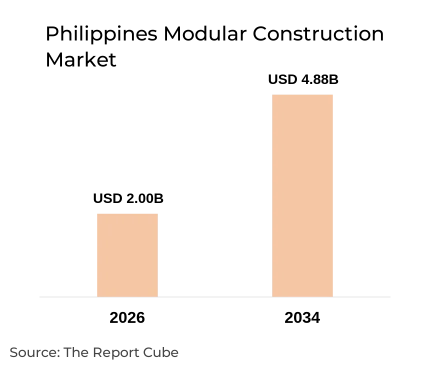
- Philippines Modular Construction Market was valued at USD 2.00 billion in 2026, reflecting accelerating infrastructure investment activity.
- Market is projected to reach USD 4.88 billion by 2034, expanding at a robust 11.80% CAGR through the forecast period.
- A comprehensive Philippines Modular Construction Market Analysis reveals structural shifts toward factory-built, time-efficient building delivery across multiple sectors.
- Permanent modular construction leads the by-type segment driven by residential and commercial project adoption.
- Residential application dominates end-user demand, supported by national housing gap reduction programs.
- Commercial and infrastructure applications represent the fastest-growing segments across metropolitan and provincial project pipelines.
- Smarthouse Corporation, CUBO Modular, and DATEM Inc. are among the leading modular construction providers in the Philippines.
- Sustainability requirements and disaster-resilient design mandates are accelerating adoption of modular building systems nationwide.
Market Overview
The Philippines Modular Construction Market is anticipated to register an 11.80% CAGR during 2026–2034. The market was valued at USD 2.00 billion in 2026 and is projected to reach USD 4.88 billion by 2034. A widening housing deficit exceeding 6.5 million units, government-backed infrastructure acceleration under the Build Better More program, and rising demand for rapid-deployment commercial structures are collectively sustaining Philippines Modular Construction Market Analysis as a strategic investment priority. International and domestic suppliers including Smarthouse Corporation, CUBO Modular, and Zhongjian Prefab Container House have strengthened their project delivery capabilities across Metro Manila and key regional hubs.
Growing urbanization across Northern and Central Luzon is generating consistent demand for modular residential communities and temporary worker accommodation. The Philippines' vulnerability to natural disasters has elevated demand for structurally resilient, factory-built modular systems capable of rapid post-disaster deployment. Increasing adoption of green building standards and EDGE certification frameworks is encouraging modular manufacturers to develop thermally efficient, eco-certified building systems. DATEM Inc. and Hive-Modular have intensified engagement with government housing agencies, property developers, and infrastructure contractors seeking factory-produced modular components aligned with Philippine building code compliance requirements.
Market Size & Forecast
|
Metric |
Details |
|---|---|
|
Market Size (2026) |
USD 2.00 Billion |
|
Market Size (2034) |
USD 4.88 Billion |
|
CAGR (2026–2034) |
11.80% |
|
Base Year |
2026 |
|
Historical Years |
2021–2025 |
|
Forecast Years |
2026–2034 |
This Philippines Modular Construction Market Size study values the industry at USD 2.00 billion in 2026, with projections reaching USD 4.88 billion by 2034 at an 11.80% CAGR. Growth outpaces the broader Southeast Asia construction sector average, driven by a 6.5-million-unit housing deficit, aggressive Build Better More infrastructure investments, and expanding contractor adoption of off-site fabrication methods for accelerated project delivery across urban and provincial markets.
Market Dynamics
The Philippines modular construction sector is expanding at an accelerating pace as urban population pressures intensify, government housing programs scale, and disaster-resilience requirements reshape building procurement standards. Sustained infrastructure investment under national development programs, combined with growing commercial real estate demand across Metro Manila and regional economic zones, is reinforcing contractor and developer interest in modular delivery methodologies. The Philippines Modular Construction Market Growth trajectory is underpinned by rising urbanization rates, shrinking construction timelines, and an expanding domestic supplier base capable of meeting public and private sector volume requirements.
|
Factor |
Type |
Specific Impact on Market |
Magnitude |
|---|---|---|---|
|
National housing deficit exceeding 6.5 million units |
Driver |
Accelerates government-backed modular residential procurement and social housing deployment |
High |
|
Build Better More infrastructure program investment |
Driver |
Expands modular component demand for bridges, schools, health facilities, and transportation infrastructure |
High |
|
High typhoon exposure and disaster-resilience mandates |
Opportunity |
Drives demand for typhoon-rated, rapid-deployment modular structures across all application categories |
High |
|
Skilled labor shortage in conventional construction |
Challenge |
Increases project cost overruns and delays, indirectly benefiting factory-built modular alternatives |
Medium |
|
Rising raw material and steel input costs |
Restraint |
Compresses modular manufacturer margins and increases end-user procurement budgets for prefabricated structures |
Medium |
- Growth Drivers - National Housing Gap and Infrastructure Expansion: The Philippine government's flagship housing gap reduction programs and expanded infrastructure budgets under Build Better More are generating substantial volume demand for modular residential units and factory-produced infrastructure components. Social housing agencies including the National Housing Authority are actively procuring modular solutions from DATEM Inc. and Smarthouse Corporation to accelerate community resettlement and affordable housing delivery across major urban centers and disaster-affected provinces.
- Market Restraints - Input Cost Pressures and Regulatory Complexity: Steel and galvanized material cost volatility, exacerbated by global supply chain disruptions, is increasing production costs for Philippine modular manufacturers. Compliance with the National Building Code, local government zoning regulations, and emerging green building certification requirements creates procurement complexity for developers, particularly in provincial markets with limited accredited modular supplier networks and inspection infrastructure.
- Market Opportunities - Disaster-Resilient and Climate-Adaptive Modular Systems: The Philippines' position among the world's most typhoon-prone nations creates consistent demand for wind-rated, flood-resistant modular structures suited to rapid post-disaster community rebuilding. CUBO Modular and Hive-Modular are developing typhoon-category-rated modular systems capable of meeting DPWH disaster-resilience specifications, opening substantial procurement pipelines from NDRRMC-affiliated agencies, international humanitarian organizations, and insurance-backed reconstruction programs.
- Industry Challenges - Skilled Workforce and Local Manufacturing Capacity Gaps: Despite modular construction's labor efficiency advantage over conventional methods, a shortage of trained modular assembly technicians and factory engineers limits production throughput scaling among domestic suppliers. Dependence on imported prefabricated components from China - primarily through Zhongjian Prefab Container House - creates supply chain vulnerability and currency risk that domestic manufacturers are only beginning to address through localized production investment programs.
Need Specific Data, Let’s Customize the Report for You
Request CustomizationMarket Trends
- Emerging Trends: Among the most significant Philippines Modular Construction Market Trends is the rapid adoption of integrated permanent modular systems for affordable residential township development. Property developers are partnering with Smarthouse Corporation and CUBO Modular to deliver factory-produced housing communities that reduce on-site construction time by 40–60% compared to conventional methods across Luzon's expanding suburban corridors.
- Technology Trends: Building Information Modeling (BIM) integration, digital twin simulation platforms, and automated factory production lines are entering the Philippines modular construction supply chain. DATEM Inc. and Hive-Modular are deploying BIM-enabled prefabrication workflows to improve design accuracy, reduce material waste, and enable real-time project monitoring across multi-site modular residential and commercial developments through 2034.
- Consumer / Buyer Trends: Government housing agencies, private property developers, and commercial real estate investors are increasingly specifying modular building systems for projects requiring guaranteed delivery timelines, predictable cost structures, and compliance with EDGE or BERDE green building certification frameworks. Buyer demand for climate-adaptive, energy-efficient modular units is growing among both institutional procurement channels and individual residential purchasers in flood-prone and typhoon-exposed communities.
- Regulatory Trends: The Department of Public Works and Highways (DPWH) is advancing standardized specifications for modular construction components used in public infrastructure projects. The National Building Code is being updated to incorporate modular structural standards, and local government units are developing zoning accommodation frameworks for temporary and relocatable modular structures in special economic zones, tourism destinations, and resettlement communities across the Philippines.
Philippines Modular Construction Market Segment Analysis
The Philippines modular construction market serves distinct building categories and structural deployment scenarios, shaped by unique procurement timelines, regulatory requirements, volume specifications, and end-user functional demands across residential, commercial, industrial, and infrastructure application sectors.
By Type
- Permanent Modular Construction
- Relocatable Modular Construction
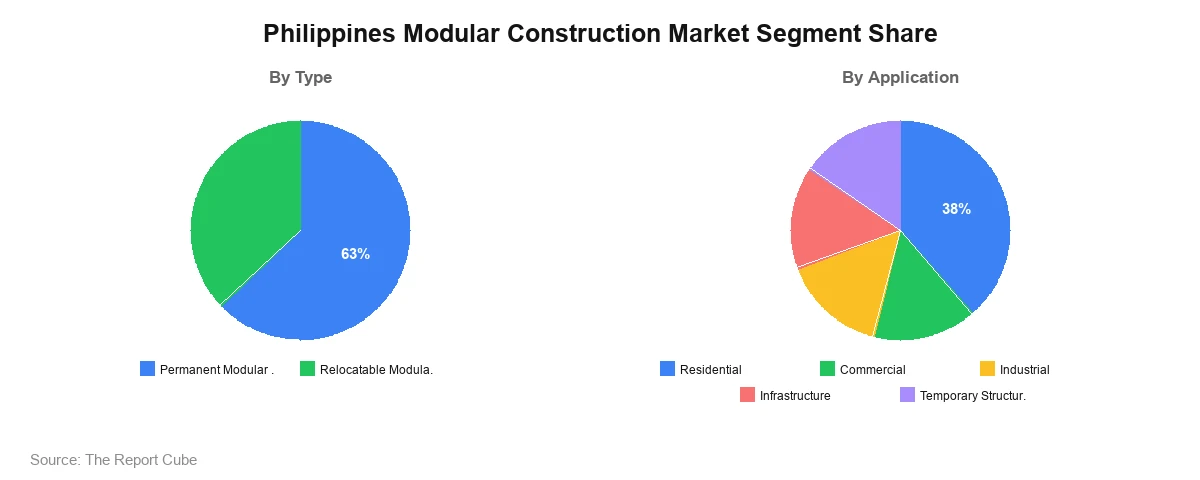
Permanent modular construction leads the By Type segment, commanding an estimated 63% Philippines Modular Construction Market Share in 2026. Smarthouse Corporation, DATEM Inc., and CUBO Modular supply the majority of permanent modular systems consumed across residential township developments, commercial building projects, and government-funded social housing programs. These structures are engineered to meet full National Building Code compliance standards with design lifespans of 25–50 years. Relocatable modular construction, accounting for approximately 37%, serves temporary worker accommodation, construction site offices, emergency shelters, and short-deployment commercial structures. Zhongjian Prefab Container House and Hive-Modular are key suppliers of relocatable modular units targeting project-based industrial and disaster-response procurement channels.
By Application
- Residential
- Commercial
- Industrial
- Infrastructure
- Temporary Structures
Residential application represents the dominant end-use segment at an estimated 38% market share in 2026, driven by government-backed social housing programs and private affordable housing development. Commercial application accounts for approximately 22%, with retail park developments, mixed-use commercial structures, and hotel projects in Metro Manila and Visayas Economic Zone sourcing modular solutions from DATEM Inc. and Smarthouse Corporation. Industrial application commands an estimated 15% share, primarily for factory buildings and logistics hubs in Clark, Batangas, and Laguna economic zones. Infrastructure application - covering modular school buildings, health centers, and transportation facilities - holds approximately 14%, while temporary structures represent the remaining 11%, sourced heavily through Zhongjian Prefab Container House and Hive-Modular for construction site, disaster-response, and event deployment applications.
Regional Analysis
|
Region |
Estimated Market Share |
Key Growth Factors |
Consumer Trends |
|---|---|---|---|
|
Metro Manila |
44% |
Dense commercial real estate pipeline, urban infill redevelopment, government housing programs |
High permanent modular adoption, premium commercial and mixed-use project demand |
|
Northern Luzon |
18% |
Expanding economic zones, tourism infrastructure investment, agricultural-sector worker housing demand |
Relocatable and semi-permanent modular accommodation, tourism resort structures |
|
Central Luzon |
24% |
Clark Economic Zone expansion, industrial park development, residential subdivision growth |
Industrial modular facilities, affordable residential township demand |
|
Southern Luzon |
14% |
Batangas and Laguna industrial zone activity, logistics hub development, provincial residential expansion |
Industrial and logistics modular structures, community residential projects |
- Metro Manila - Accounting for approximately 44% of total market demand, Metro Manila houses the Philippines' highest concentration of commercial real estate developers, social housing procurement agencies, and infrastructure project pipelines. Permanent modular systems from Smarthouse Corporation and DATEM Inc. are serving mixed-use commercial developments, government resettlement communities, and urban infill residential projects across the National Capital Region and adjacent urbanized areas.
- Central Luzon - Representing approximately 24% of market demand, Central Luzon's Clark Economic Zone and expanding industrial parks in Pampanga and Bulacan are generating strong procurement demand for factory-built industrial facilities and affordable residential townships. CUBO Modular and Zhongjian Prefab Container House supply prefabricated structures for industrial ecozone tenants requiring rapid facility deployment within tight occupancy timelines.
- Northern Luzon - Growing tourism infrastructure investment across Ilocos and Cagayan regions, combined with agricultural-sector worker housing demand and expanding mining operation accommodation requirements, is driving modular procurement across Northern Luzon. Relocatable modular units from Hive-Modular and Zhongjian Prefab Container House are seeing increased specification for resort developments and remote-site worker accommodation projects.
- Southern Luzon - Batangas Port expansion, Laguna Technopark industrial growth, and logistics hub development across the Calabarzon corridor are generating modular procurement demand from industrial occupants and residential developers. Southern Luzon's ongoing exposure to volcanic and seismic risk factors is accelerating interest in disaster-resilient modular residential systems from DATEM Inc. and Smarthouse Corporation.
Market Share & Competitive Landscape
The Philippines modular construction market features a mixed competitive landscape of domestic specialists, property-linked builders, and international prefab suppliers competing across permanent housing, relocatable structures, and infrastructure component categories. Key players differentiate through design engineering capability, disaster-resilience certification, supply chain localization, and government procurement accreditation.
|
Company |
Competitive Strength |
Primary Segment Served |
|---|---|---|
|
Smarthouse Corporation |
Domestic engineering capability, residential project scale, government accreditation |
Residential, social housing, commercial |
|
CUBO Modular |
Modular residential design specialization, sustainable material sourcing |
Residential townships, affordable housing |
|
Hive-Modular |
Innovative modular architecture, boutique commercial and tourism projects |
Commercial, hospitality, temporary structures |
|
Zhongjian Prefab Container House |
Volume manufacturing, cost-competitive container-based structures |
Relocatable, industrial, temporary structures |
|
DATEM Inc. |
Full-service construction delivery, government project experience |
Infrastructure, commercial, social housing |
|
Others |
Regional suppliers, emerging domestic manufacturers |
Mixed, regionally distributed |
Key Companies in the Philippines Modular Construction Market
Smarthouse Corporation
Smarthouse Corporation is a Philippines-based modular construction specialist headquartered in Metro Manila, recognized for delivering factory-engineered residential and commercial building systems at scale. In 2025, the company expanded its production facility capacity in Cavite to accommodate growing social housing procurement from the National Housing Authority. Its government accreditation and structural compliance track record position it as a preferred modular contractor for public sector projects across Luzon.
CUBO Modular
CUBO Modular is a Philippines-based sustainable modular housing manufacturer known for its design-forward approach to affordable residential construction. In 2025, the company secured partnerships with private residential developers in Laguna and Batangas to deliver modular township communities targeting middle-income homebuyers. Its integration of eco-certified materials, BIM-designed factory production, and rapid on-site assembly capability makes it a competitive alternative to conventional residential construction across the Philippines' expanding suburban markets.
Recent Developments
|
Year |
Company |
Development |
|---|---|---|
|
2025 |
Smarthouse Corporation |
Expanded Cavite production facility to increase modular residential unit output capacity for NHA social housing procurement programs |
|
2025 |
CUBO Modular |
Secured modular township delivery partnerships with private residential developers in Southern Luzon targeting middle-income housing demand |
|
2025 |
DATEM Inc. |
Awarded government infrastructure contract for modular school building deployment across typhoon-affected Northern Luzon communities |
|
2025 |
Hive-Modular |
Launched new typhoon-rated modular hospitality structure line targeting eco-tourism resort developers across Philippine island destinations |
Future Outlook
The Philippines Modular Construction Market Forecast projects market value reaching USD 4.88 billion by 2034, expanding at an 11.80% CAGR through the forecast period. Sustained government investment in social housing, expanding commercial real estate pipelines in Metro Manila and regional economic zones, and growing industrial facility demand across Clark, Batangas, and Laguna corridors will continue driving modular procurement volumes. Smarthouse Corporation, CUBO Modular, and DATEM Inc. are expected to deepen market penetration through expanded production capacity, government accreditation programs, and modular product lines engineered specifically for Philippine climate and seismic resilience requirements through 2034.
Technological advancement in off-site manufacturing - including BIM-integrated production workflows, automated panel fabrication, and digital quality assurance platforms - will enable domestic modular suppliers to compete on delivery speed, cost predictability, and structural performance standards comparable to conventional construction. Sustainability requirements embedded in DPWH infrastructure procurement specifications and BERDE green building frameworks will make eco-certified modular systems standard across public sector and institutional projects, while disaster-resilience mandates will reinforce government and private sector preference for factory-engineered modular building systems through 2034.
Philippines Modular Construction Market Report Coverage
This Philippines Modular Construction Market Report covers the complete forecast period from 2026 to 2034, providing market sizing, segmentation analysis, competitive profiling, and regional demand insights across all major application categories and construction types.
|
Report Attribute |
Details |
|---|---|
|
Market Name |
Philippines Modular Construction Market |
|
Market Size (2026) |
USD 2.00 Billion |
|
Market Size (2034) |
USD 4.88 Billion |
|
Forecast Period |
2026–2034 |
|
CAGR |
11.80% |
|
Base Year |
2026 |
|
Historical Years |
2021–2025 |
|
Forecast Years |
2026–2034 |
|
Segments Covered |
By Type (Permanent Modular Construction, Relocatable Modular Construction); By Application (Residential, Commercial, Industrial, Infrastructure, Temporary Structures) |
|
Regions Covered |
Metro Manila, Northern Luzon, Central Luzon, Southern Luzon |
|
Key Companies |
Smarthouse Corporation, CUBO Modular, Hive-Modular, Zhongjian Prefab Container House, DATEM Inc., Others |
|
Report Format |
PDF, Excel, PPT |
|
Customization |
Available as per client requirements |
Why Choose This Philippines Modular Construction Market Report?
- Comprehensive coverage of the Philippines' rapidly expanding modular construction sector across all major building types and applications.
- Accurate market sizing from USD 2.00 billion in 2026 through the USD 4.88 billion 2034 forecast.
- Detailed segmentation by construction type (Permanent vs. Relocatable) and end-use application category with share estimates.
- Regional insights covering Metro Manila, Northern Luzon, Central Luzon, and Southern Luzon with demand share analysis.
- Competitive profiling of leading domestic and international modular construction suppliers active in the Philippines.
- Analysis of disaster-resilience, sustainability, and BIM-technology trends reshaping modular procurement decisions.
- Forecast data supporting strategic investment, contractor positioning, and government procurement planning through 2034.
- Research aligned with Philippines national development objectives under the Build Better More infrastructure program and national housing gap reduction targets.
Table of Contents
- Introduction
- Objective of the Study
- Product Definition
- Market Segmentation
- Study Variables
- Research Methodology
- Secondary Data Points
- Companies Interviewed
- Primary Data Points
- Breakdown of Primary Interviews
- Secondary Data Points
- Executive Summary
- Market Dynamics
- Drivers
- Challenges
- Opportunity Assessment
- Recent Trends and Developments
- Policy and Regulatory Landscape
- Philippines Modular Construction Market Overview and Forecast Analysis (2021-2034)
- Market Size, By Value, By Growth Rate (CAGR/USD Billions)
- Demand – Supply Trends
- Market Share, By Type
- Permanent Modular Construction
- Relocatable Modular Construction
- Market Share, By Application
- Residential
- Commercial
- Industrial
- Infrastructure
- Temporary Structures
- Market Share, By Region
- Metro Manila
- Northern Luzon
- Central Luzon
- Southern Luzon
- Market Share, By Competitors
- Competition Characteristics
- Revenue Shares
- Permanent Modular Construction Philippines Modular Construction Market Overview, 2021-2034F
- By Value (USD Million)
- By Application – Market Size & Forecast 2021-2034, USD Million
- Residential
- Commercial
- Industrial
- Infrastructure
- Temporary Structures
- Relocatable Modular Construction Philippines Modular Construction Market Overview, 2021-2034F
- By Value (USD Million)
- By Application – Market Size & Forecast 2021-2034, USD Million
- Residential
- Commercial
- Industrial
- Infrastructure
- Temporary Structures
- Competitive Outlook (Company Profile - Partial List)
- Smarthouse Corporation
- Company Overview
- Business Segments
- Strategic Alliances/Partnerships
- Recent Developments
- CUBO Modular
- Company Overview
- Business Segments
- Strategic Alliances/Partnerships
- Recent Developments
- Hive-Modular
- Company Overview
- Business Segments
- Strategic Alliances/Partnerships
- Recent Developments
- Zhongjian Prefab Container House
- Company Overview
- Business Segments
- Strategic Alliances/Partnerships
- Recent Developments
- DATEM Inc.
- Company Overview
- Business Segments
- Strategic Alliances/Partnerships
- Recent Developments
- Others
- Smarthouse Corporation
- Contact Us & Disclaimer
Top Key Players & Market Share Outlook
- Smarthouse Corporation
- CUBO Modular
- Hive-Modular
- Zhongjian Prefab Container House
- DATEM Inc.
- Others
Frequently Asked Questions






