



Build Your Custom Market Intelligence Report
Customize Your ReportSoutheast Asia Mosquito Repellent Market Key Highlights
By Product Type:
Liquid Vaporizers segment leads the market with nearly 28.7% share.
By Active Ingredient Type:
Chemical-based segment dominates the market with around 62.4% of revenue.
Regional Outlook:
Indonesia dominates the Southeast Asia Mosquito Repellent Market with approximately 31.2% share.
Southeast Asia Mosquito Repellent Market Insights & Analysis
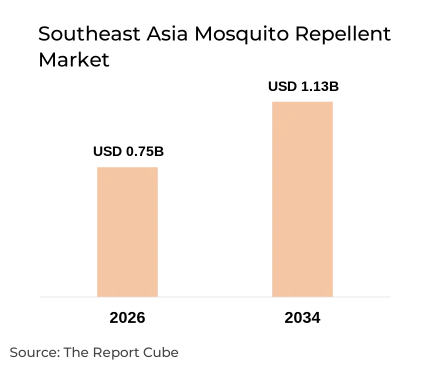
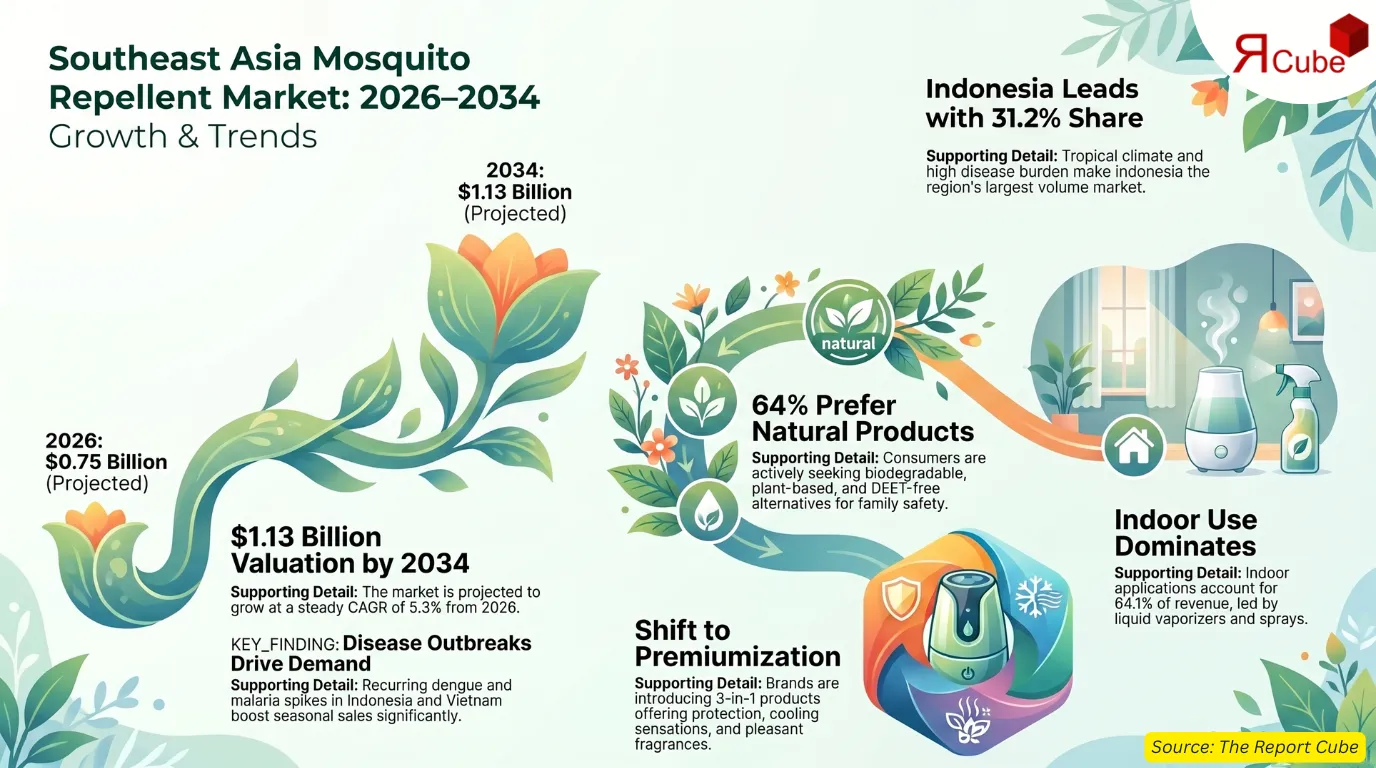
The Southeast Asia Mosquito Repellent Market is anticipated to register a CAGR of around 5.3% during the forecast period 2026-2034. The market size is valued at USD 0.75 billion in 2026 and is projected to reach USD 1.13 billion by 2034. The market continues to expand due to the increasing prevalence of mosquito-borne diseases across tropical Southeast Asian countries, particularly dengue fever outbreaks reported in Indonesia, Thailand, the Philippines, and Vietnam. Public health authorities across the region have intensified mosquito control campaigns, encouraging households to adopt preventive solutions such as liquid vaporizers, topical repellents, aerosol sprays, and wearable products. Continuous urban expansion and dense residential environments are also contributing to higher mosquito exposure, especially during monsoon seasons.
Product innovation remains a defining characteristic of the Southeast Asia mosquito repellent industry. Manufacturers are focusing on dermatologically tested formulations, plant-based ingredients, and multifunctional protection products designed for humid tropical climates. Rising awareness regarding skin sensitivity and indoor air quality has increased consumer preference for low-odor and non-irritating formulations. Regional companies are also introducing cooling sprays, child-safe repellents, and portable wearable formats to strengthen brand differentiation. The growing availability of premium mosquito repellent products through supermarkets, pharmacies, and digital commerce platforms is further supporting long-term market expansion across urban and semi-urban populations.
Southeast Asia Mosquito Repellent Market Impact Analysis
| Factor | Type | Specific Impact on Market | Magnitude | Business Implication |
|---|---|---|---|---|
| Rising Dengue & Malaria Incidence | Demand Driver | High disease rates in Indonesia and Vietnam boost sales | High | Align campaigns with outbreak seasons and health alerts |
| Rapid Urbanization | Structural Driver | Dense cities create breeding grounds and raise demand | High | Target urban households with portable, long-lasting formats |
| Consumer Shift to Natural Products | Consumer | 64% prefer biodegradable and plant-based repellents | High | Develop citronella, neem, and eucalyptus-based product lines |
| WHO & Government Awareness Campaigns | Regulatory Driver | Public health programs educate on vector control measures | High | Partner with health agencies for co-branded messaging |
| Rising Middle-Class Disposable Income | Market Behavior | Higher spending enables premium and innovative purchases | Medium–High | Introduce mid-tier and premium offerings with efficacy claims |
| Climate Change & Extended Monsoons | Environmental | Warmer, wetter conditions expand mosquito breeding seasons | Medium | Maintain year-round inventory and extend marketing cycles |
| Travel & Tourism Growth | Market Constraint | Tourist influx increases demand for portable repellents | Medium | Stock travel-sized packs at airports, hotels, and resorts |
| Regulatory Scrutiny on Chemical Ingredients | Regulatory Driver | DEET and permethrin face stricter labeling and safety checks | Medium | Ensure compliance and highlight safer alternative formulas |
| Technological Innovation in Formulations | Technological | Microencapsulation and spatial repellents improve efficacy | Medium | Invest in R&D for wearable and long-duration technologies |
| E-Commerce & Digital Distribution Expansion | Market Structure | Online channels reach remote areas and enable bulk purchases | Medium | Strengthen digital presence and offer subscription models |
Southeast Asia Mosquito Repellent Market Dynamics
Key Driver: Increasing Public Health Concerns Related to Dengue and Vector-Borne Diseases
Recurring outbreaks of dengue fever and other mosquito-transmitted illnesses continue to create strong demand for mosquito repellent products across Southeast Asia. Countries such as Indonesia and the Philippines regularly experience seasonal spikes in dengue cases, encouraging households to increase spending on preventive healthcare solutions. Government health agencies and local municipalities have expanded awareness campaigns promoting mosquito prevention practices, including indoor repellents, mosquito sprays, and personal protection products. These initiatives are strengthening product adoption across both metropolitan and rural communities.
Changing weather conditions and prolonged rainy seasons have also increased mosquito breeding activity in densely populated urban areas. As a result, consumers are seeking reliable protection solutions suitable for daily household use. Parents are increasingly purchasing child-friendly and skin-safe repellents for family protection, while working professionals and travelers are driving demand for portable wearable formats. This growing emphasis on preventive healthcare continues to reinforce Southeast Asia mosquito repellent market growth and long-term product consumption.
Book your FREE 30-minute expert consultation today
Contact UsIndustry Trends: Strong Shift Toward Natural Ingredients and Premium Formulations
Natural mosquito repellent formulations are gaining significant traction across Southeast Asia as consumers become more conscious about ingredient safety and skin compatibility. Products containing citronella, eucalyptus oil, lavender, and lemongrass extracts are witnessing increasing demand, particularly among urban households in Singapore, Thailand, and Malaysia. Consumers are actively choosing low-chemical and DEET-free alternatives for children and sensitive skin applications, encouraging companies to expand herbal and plant-derived product portfolios.
Premiumization is also emerging as a major industry trend within the Southeast Asia mosquito repellent market. Companies are introducing advanced products featuring cooling effects, fragrance enhancement, moisturizing properties, and long-duration protection to improve user convenience. Wearable repellents and compact outdoor sprays are gaining popularity among travelers and outdoor consumers seeking lightweight protection products. Continuous investment in safer active ingredients and multifunctional personal care solutions is reshaping product development strategies throughout the regional market.
Major Challenge: Affordability Pressure and Fragmented Local Competition
The Southeast Asia mosquito repellent industry continues to face pricing pressure due to the widespread presence of regional and unorganized manufacturers offering low-cost alternatives. In developing economies such as Cambodia and parts of Indonesia, affordability remains a major purchasing factor for households. Traditional mosquito coils and low-priced aerosol products continue to dominate volume sales because they remain accessible for lower-income consumers. This creates competitive challenges for premium international brands attempting to expand their regional market share.
Another challenge affecting market stability is the circulation of low-quality and counterfeit mosquito repellent products within informal retail channels. Products lacking proper ingredient labeling or regulatory compliance can reduce consumer confidence and create safety concerns. Fluctuating raw material costs associated with essential oils, packaging materials, and chemical compounds are also affecting manufacturing margins. These pricing and supply chain pressures continue to influence profitability across the Southeast Asia mosquito repellent market.
Opportunity: Expansion of Premium Household Protection and Digital Retail Channels
Rapid growth in e-commerce infrastructure across Southeast Asia is creating substantial opportunities for mosquito repellent manufacturers to strengthen regional product visibility. Online retail platforms in Indonesia, Thailand, Vietnam, and Malaysia are helping companies introduce premium mosquito repellent sprays, wearable products, and natural formulations to broader consumer groups. Digital retail expansion is particularly supporting niche brands specializing in family-safe and plant-based mosquito protection products.
Rising disposable incomes and increasing urban middle-class populations are further encouraging spending on premium household protection solutions. Consumers are showing growing interest in smart vaporizers, refill-based systems, and multifunctional products that combine mosquito protection with skincare and fragrance benefits. Tourism growth across tropical destinations is also supporting outdoor mosquito repellent demand among travelers and hospitality businesses. These evolving purchasing patterns are expected to generate new business opportunities for regional and international mosquito repellent manufacturers through 2034.
Southeast Asia Mosquito Repellent Market Segment-wise Analysis
By Product Type:
- Wearable Repellents
- Topical Repellents
- Repellent Mats
- Liquid Vaporizers
- Coils
- Aerosol Sprays
- Others
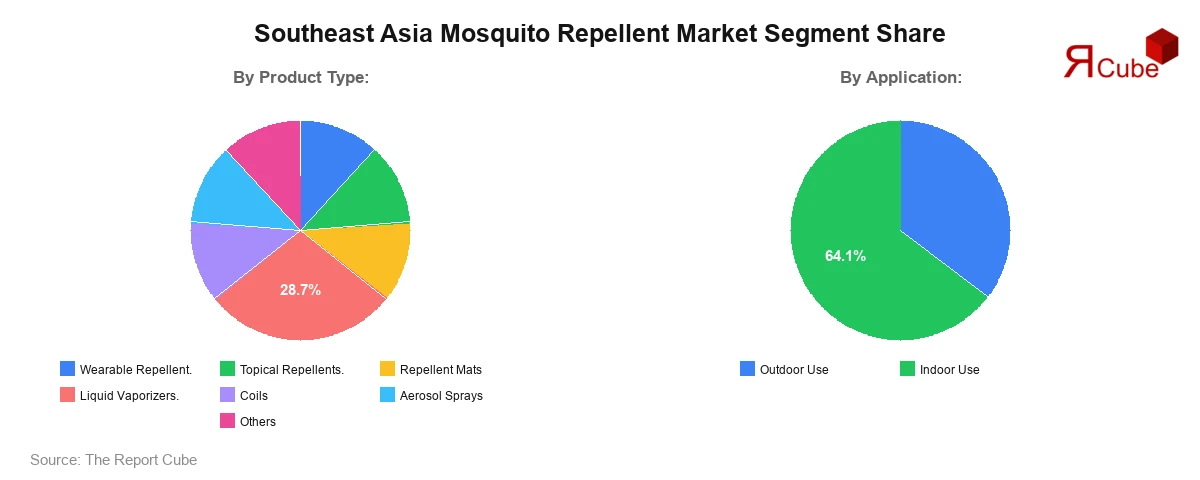
Liquid vaporizers accounted for the largest share of the Southeast Asia mosquito repellent market in 2025 due to their convenience, longer protection duration, and strong household acceptance. The segment represented nearly 28.7% of regional revenue as consumers increasingly preferred smoke-free indoor mosquito control products. Urban households across Thailand, Malaysia, and Indonesia are adopting plug-in vaporizers because they provide consistent overnight protection while minimizing odor and residue concerns commonly associated with traditional coils.
Manufacturers are strengthening this segment through innovations focused on refill efficiency, adjustable intensity settings, and safer formulations suitable for children and elderly consumers. Products integrated with mild fragrances and plant-derived ingredients are also witnessing stronger traction among premium buyers. Increasing electricity access in semi-urban areas and rising consumer awareness regarding indoor mosquito prevention continue to support sustained growth within the liquid vaporizer category across Southeast Asia.
By Application:
- Outdoor Use
- Indoor Use
Indoor use emerged as the dominant application segment within the Southeast Asia mosquito repellent market, accounting for approximately 64.1% of total revenue in 2025. High humidity levels, compact housing structures, and year-round mosquito activity have increased dependence on household mosquito protection products across urban populations. Liquid vaporizers, aerosol sprays, and repellent mats remain widely used during nighttime hours when mosquito exposure risks are highest.
Demand for indoor mosquito protection has also strengthened due to growing awareness regarding family health and preventive hygiene practices. Consumers are increasingly selecting odor-controlled, low-smoke, and child-safe products designed for continuous indoor use. Rising apartment living trends in cities such as Bangkok, Jakarta, and Manila are further supporting demand for compact and efficient mosquito control solutions suitable for smaller residential spaces. This sustained household reliance continues to reinforce the dominance of indoor-use applications across the regional market.
Regional Projection of Southeast Asia Mosquito Repellent Industry
- Thailand
- Singapore
- Philippines
- Malaysia
- Indonesia
- Vietnam
- Cambodia
- Others
Indonesia maintained the leading position in the Southeast Asia mosquito repellent market during 2025, contributing nearly 31.2% of regional revenue. The country’s tropical climate, dense urban population, and recurring dengue outbreaks continue to generate strong demand for household mosquito prevention products. Consumers across Indonesia widely use coils, aerosol sprays, topical repellents, and liquid vaporizers as part of routine household protection practices, particularly during rainy seasons.
Large-scale distribution networks operated by domestic and multinational companies are improving product accessibility across both metropolitan and rural regions. Growth in modern retail chains and online commerce platforms is further expanding the availability of premium mosquito repellent products within Indonesia. Rising public awareness regarding mosquito-borne diseases and increasing household spending on personal healthcare products are expected to support steady market expansion across the country during the forecast period.
Need insights for a specific region within this market?
Request Regional DataSoutheast Asia Mosquito Repellent Industry Countries Analysis
The Southeast Asia mosquito repellent industry varies significantly across countries due to disease burden, climate patterns, and consumer purchasing power.
| Country | Demand Level | Key Disease Drivers | Product Dominance | Core Market Logic | Growth Nature |
|---|---|---|---|---|---|
| Indonesia | Extremely High | Dengue, malaria endemic | Coils & electric vaporizers | Largest market share, high disease burden | Volume-led expansion |
| Thailand | Very High | Among 30 most dengue-endemic | Sprays & lotions | Mature market with brand loyalty | Premium segment growth |
| Vietnam | High | Dengue 184,903 cases in 2025 | Electric repellents & sprays | Rapid urbanization, 6.1% CAGR to 2031 | Fast-growing segment |
| Philippines | High | Dengue fever outbreaks | Imported sprays & lotions | Import-heavy, price-sensitive buyers | Awareness-driven growth |
| Malaysia | Medium-High | Year-round tropical climate | Multi-split & smart devices | Middle-income preference for technology | Innovation-led growth |
| Singapore | Medium | Dengue & Zika awareness | Natural & premium brands | High humidity, quality-focused consumers | Premium segment focus |
| Cambodia | Medium | Malaria in rural zones | Coils & basic sprays | Affordability-driven market | Rural penetration growth |
| Others (Myanmar, Laos) | Low-Medium | Malaria & dengue in forests | Traditional coils | Limited distribution, low awareness | Emerging market stage |
Government Initiatives & Policies
- Thailand Dengue Prevention Campaign 2025: Thailand’s Ministry of Public Health expanded nationwide mosquito vector-control programs and public awareness campaigns promoting household mosquito prevention products and environmental sanitation practices.
- Indonesia National Vector-Borne Disease Control Program 2026: Indonesia strengthened dengue surveillance and mosquito eradication initiatives through regional health departments, encouraging preventive healthcare product adoption across residential communities.
Southeast Asia Mosquito Repellent Industry Recent Developments
- 2025: LANXESS showcased its Saltidin® mosquito repellent technology at in-cosmetics Asia 2025 in Bangkok, Thailand. The company highlighted advanced skin-friendly repellent formulations suitable for creams, gels, and sprays, supporting rising regional demand for premium personal protection products and safer active ingredient technologies.
- 2025: Dragkooler launched a new 3-in-1 mosquito repellent cooling spray in Thailand combining mosquito protection, cooling sensation, and fragrance benefits. The product introduction reflects growing regional demand for multifunctional, natural ingredient-based, and family-oriented mosquito repellent solutions targeting premium urban consumers.
Why Choose This Report?
- Provides a comprehensive overview of the overall market analysis, encompassing key trends, consumer behavior analysis, and risk assessment to support strategic decision-making.
- Provides accurate, up-to-date insights into market size, segmentation, and emerging opportunities, helping to minimize risk & capitalizing on growth.
- Gives deep understanding of target audience preferences, investment habits, and communication channels for enhanced product development & marketing effectiveness.
- Delivers competitive analysis & benchmarking, uncovering the strengths & weaknesses of market competitors to guide strategies.
- Consolidate comprehensive market intelligence, reducing reasoning & streamlining research efforts.
- Facilitates customized market segmentation & risk mitigation strategies, fine-tuned to the business objectives.
- Aids in identifying both market challenges & untapped opportunities within the industry to drive long-term business growth.
- Provides valuable information based on actual customer data & search trends.
Table of Contents
- Introduction
- Objective of the Study
- Product and Category Definition
- Market Segmentation
- Study Variables
- Research Methodology
- Secondary Data Points
- Breakdown of Secondary Sources
- Primary Data Points
- Breakdown of Primary Interviews
- Secondary Data Points
- Executive Summary
- Market Dynamics
- Emerging Opportunities
- Adoption Trends
- Demand Drivers
- Disruption Analysis (Challenges)
- Industry Analysis & Strategic Insights
- Supply/Value Chain Analysis
- Pricing Analysis
- Go-to-Market Strategy
- BCG Matrix
- Recent Trends and Developments
- Import and Export Analysis
- Regulatory and Policy Landscape
- Country-wise Policies
- Government Initiatives
- Southeast Asia Mosquito Repellent Market Overview and Forecast Analysis (2021-2034)
- Market Size, By Value, By Growth Rate (CAGR/USD Billion)
- Market Share, By Product Type
- Wearable Repellents
- Topical Repellents
- Repellent Mats
- Liquid Vaporizers
- Coils
- Aerosol Sprays
- Others
- Market Share, By Active Ingredient Type
- Plant-based
- Chemical-based
- Market Share, By Distribution Channel
- Online Retail
- Offline Retail
- Market Share, By Application
- Outdoor Use
- Indoor Use
- Market Share, By End User
- Children
- Adults
- Market Share, By Country
- Thailand
- Singapore
- Philippines
- Malaysia
- Indonesia
- Vietnam
- Cambodia
- Others
- Market Share, By Company
- Revenue Shares and Analysis
- Competitive Landscape
- Thailand Mosquito Repellent Market Overview and Forecast Analysis (2021-2034)
- Market Size, By Value, By Growth Rate (CAGR/USD Billion/Million)
- Country-level Market Overview
- Key Demand Drivers
- Regulatory Environment
- Key Market Participants
- Singapore Mosquito Repellent Market Overview and Forecast Analysis (2021-2034)
- Market Size, By Value, By Growth Rate (CAGR/USD Billion/Million)
- Country-level Market Overview
- Key Demand Drivers
- Regulatory Environment
- Key Market Participants
- Philippines Mosquito Repellent Market Overview and Forecast Analysis (2021-2034)
- Market Size, By Value, By Growth Rate (CAGR/USD Billion/Million)
- Country-level Market Overview
- Key Demand Drivers
- Regulatory Environment
- Key Market Participants
- Malaysia Mosquito Repellent Market Overview and Forecast Analysis (2021-2034)
- Market Size, By Value, By Growth Rate (CAGR/USD Billion/Million)
- Country-level Market Overview
- Key Demand Drivers
- Regulatory Environment
- Key Market Participants
- Indonesia Mosquito Repellent Market Overview and Forecast Analysis (2021-2034)
- Market Size, By Value, By Growth Rate (CAGR/USD Billion/Million)
- Country-level Market Overview
- Key Demand Drivers
- Regulatory Environment
- Key Market Participants
- Vietnam Mosquito Repellent Market Overview and Forecast Analysis (2021-2034)
- Market Size, By Value, By Growth Rate (CAGR/USD Billion/Million)
- Country-level Market Overview
- Key Demand Drivers
- Regulatory Environment
- Key Market Participants
- Cambodia Mosquito Repellent Market Overview and Forecast Analysis (2021-2034)
- Market Size, By Value, By Growth Rate (CAGR/USD Billion/Million)
- Country-level Market Overview
- Key Demand Drivers
- Regulatory Environment
- Key Market Participants
- Competitive Analysis, 2026
- Market Share of Key Players
- Competitive Mapping by Product Type
- Competitive Mapping by Active Ingredient Type
- Competitive Mapping by Distribution Channel
- Competitive Mapping by Application
- Competitive Mapping by End User
- Competitive Landscape Across Southeast Asia Country
- Company Profiles (Partial List)
- Earth Corporation
- Company Overview
- Product Portfolio
- Strategic Alliances/Partnerships
- Recent Developments
- Dabur India Limited
- Company Overview
- Product Portfolio
- Strategic Alliances/Partnerships
- Recent Developments
- S. C. Johnson & Son, Inc.
- Company Overview
- Product Portfolio
- Strategic Alliances/Partnerships
- Recent Developments
- Godrej Consumer Products Limited
- Company Overview
- Product Portfolio
- Strategic Alliances/Partnerships
- Recent Developments
- Sumitomo Chemical Co., Ltd.
- Company Overview
- Product Portfolio
- Strategic Alliances/Partnerships
- Recent Developments
- Reckitt Benckiser Group plc
- Company Overview
- Product Portfolio
- Strategic Alliances/Partnerships
- Recent Developments
- Spectrum Brands Holdings, Inc.
- Company Overview
- Product Portfolio
- Strategic Alliances/Partnerships
- Recent Developments
- Haw Par Corporation Limited
- Company Overview
- Product Portfolio
- Strategic Alliances/Partnerships
- Recent Developments
- PT. Enesis Group
- Company Overview
- Product Portfolio
- Strategic Alliances/Partnerships
- Recent Developments
- Jyothy Labs Limited
- Company Overview
- Product Portfolio
- Strategic Alliances/Partnerships
- Recent Developments
- Others (Partial List)
- Earth Corporation
- Contact Us and Disclaimer
Top Key Players & Market Share Outlook
- Earth Corporation
- Dabur India Limited
- S. C. Johnson & Son, Inc.
- Godrej Consumer Products Limited
- Sumitomo Chemical Co., Ltd.
- Reckitt Benckiser Group plc
- Spectrum Brands Holdings, Inc.
- Haw Par Corporation Limited
- PT. Enesis Group
- Jyothy Labs Limited
- Others
Frequently Asked Questions






